Quick Answer: Agencies evaluating Facebook ad automation tools should prioritize cross-account rule execution, transparent action logs, and enough creative or launch tooling to matter beyond alerts. Native Meta rules work but stop at one ad account. The right pick, and the approach FabFunnel takes, depends on whether the agency needs automation alone or automation tied to launch and reporting.
Running paid social for a dozen clients differs from running it for one brand. An agency managing forty ad accounts cannot babysit each one for CPA spikes, budget overruns, or frequency creep by hand, which is why facebook ad automation has moved from a nice-to-have into a baseline requirement for account teams. Tools built for a single marketer and tools built for an agency at scale are not interchangeable, and the gap shows fastest in how rules scale, or fail to scale, across a full client roster.
What Facebook Ad Automation Actually Solves for Agencies
The core problem is not that account managers forget to check campaigns; it is that manual checking does not scale with client count, especially once an agency is running automated ads on Facebook across dozens of client accounts simultaneously. Automation addresses three things: consistency across accounts, speed since a rule fires the moment a condition is met, and accountability since there is a record of what changed and why. How well a tool handles those, across one account or many, is the basis for the comparison below.
The 7 Tool Categories Agencies Actually Use
1. Native Meta Automated Rules
Meta’s built-in rules inside Ads Manager let an advertiser set conditions such as “pause ad set if CPA exceeds $40” and have Meta execute or flag the action, a basic form of automated ads facebook teams often start with before outgrowing native tools. It is free and requires no new login. The limitation for agencies is structural: rules are configured per ad account, so an agency running twenty client accounts has to build and maintain the same rule set twenty times, and any logic change means editing each one by hand. There is no single place to see every rule that fired across every client this week.
2. Third-Party Rule-Based Automation Tools
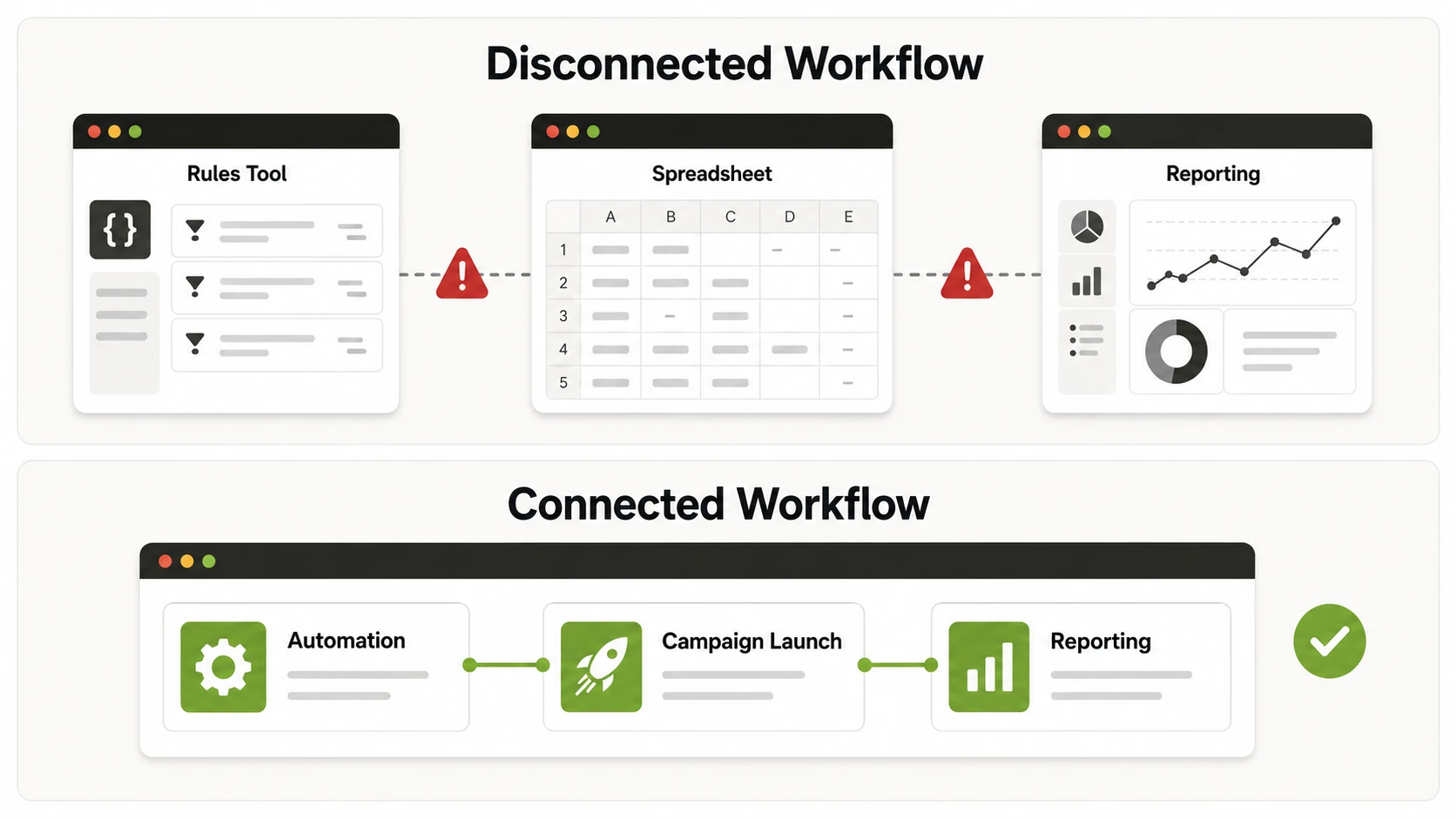
A category of standalone platforms extends what native rules can do: more condition types, finer scheduling, and more complex logic, often with a cleaner interface for building and auditing rules than Ads Manager offers, making them a common next step for teams that have outgrown basic facebook advertising automation offered natively. These tools are genuinely strong at automation as a discipline, but most were built as a layer on top of an ad account rather than a full workflow, so bulk campaign creation, creative generation, and structured cross-client reporting are absent or bolted on.
3. Combined Platforms Like FabFunnel
A smaller set of platforms combine automation with the adjacent work agencies spend time on: launching campaigns and reporting across clients. FabFunnel is campaign execution infrastructure across Meta, TikTok, and NewsBreak. Its automation rules engine, which includes FabFunnel’s Meta Ads Automation, runs continuously at the campaign, ad set, or ad level against agency-defined conditions such as CPA floors, ROAS thresholds, or frequency caps, with every action logged against the triggering condition and a timestamp, positioning it as facebook ads automation software built for agencies managing many accounts at once. Unlike native rules, these apply across connected accounts simultaneously rather than needing rebuilding per account. The platform also includes a bulk campaign launcher pushing 200 or more campaigns live in under two minutes across the three channels, an AI creative tool called Genie tied to a connected product catalogue, and multi-account reporting syncing spend, ROAS, CPR, CPC, and CTR roughly every 15 minutes into one dashboard. The tradeoff agencies accept knowingly: it will not out-specialize a single-purpose automation tool on every edge case, in exchange for one connected workflow instead of three.
4. Custom Automation Built on the Meta Marketing API
Larger agencies with in-house engineering resources sometimes build automation directly against Meta’s Marketing API instead of buying a tool, trading ongoing engineering cost for full control over conditions, actions, and reporting format. This fits agencies with a dedicated engineering function and a specific need no packaged tool addresses well, but rarely fits as a default choice.
5. Meta’s Built-In Bid and Budget Automation
Separate from automated rules, Meta also automates bidding and budget allocation through features such as Advantage+ campaign budget, shifting spend across ad sets toward the best performers automatically. This optimizes within Meta’s own algorithm rather than executing conditions an agency defines. It will not pause a campaign because CPA crossed a threshold the agency set, and it does not extend across accounts or other platforms.
6. Standalone Cross-Account Reporting and Alerting Tools
Some agencies separate the automation problem from the visibility problem and adopt a dedicated reporting tool that pulls data from every connected account into one place, with alerting layered on top. These tools are strong at aggregation across many accounts, but they generally do not take action themselves; a person still has to make the change. That fills a gap for an agency with a separate automation tool needing better visibility, but adds one more login for an agency trying to reduce vendor count.
7. Agency Operations Platforms With Automation Modules
The last category is broader agency management software, built primarily for client billing, approvals, or project tracking, that has added a lightweight automation module as a secondary feature. Some agencies prefer to keep automation in the same system they already run their business through. That capability is typically basic compared to a purpose-built rules engine or a combined execution platform, since automation was never the primary product.
Comparing the Categories
The table below lines up the seven categories against what matters most for agency workflows: whether rules apply across accounts at once, whether the tool includes creative or bulk launch capability, and how reporting works.
| Tool Category | Cross-Account Rule Execution | Creative & Bulk Launch Tooling | Reporting |
|---|---|---|---|
| Native Meta automated rules | No, configured separately per account | None | Basic, inside Ads Manager only |
| Third-party rule-based automation tools | Varies by vendor, typically per-account setup | Limited to none | Automation-focused dashboards, not campaign reporting |
| FabFunnel (combined platform) | Yes, across connected accounts simultaneously | Yes, bulk launch across Meta, TikTok, NewsBreak plus AI creative via Genie | Multi-account dashboard synced roughly every 15 minutes |
| Custom scripts on the Marketing API | Yes, if engineered for it | None built in | None built in |
| Meta native bid and budget automation | No, per account, within Meta’s algorithm | None | Basic |
| Standalone cross-account reporting and alerting tools | No, alerts only, does not take action | None | Strong, purpose-built for aggregation |
| Agency operations platforms with automation modules | Rarely, automation is a secondary feature | Sometimes limited asset storage, not launch tooling | Varies, usually billing focused |
Choosing Between Them
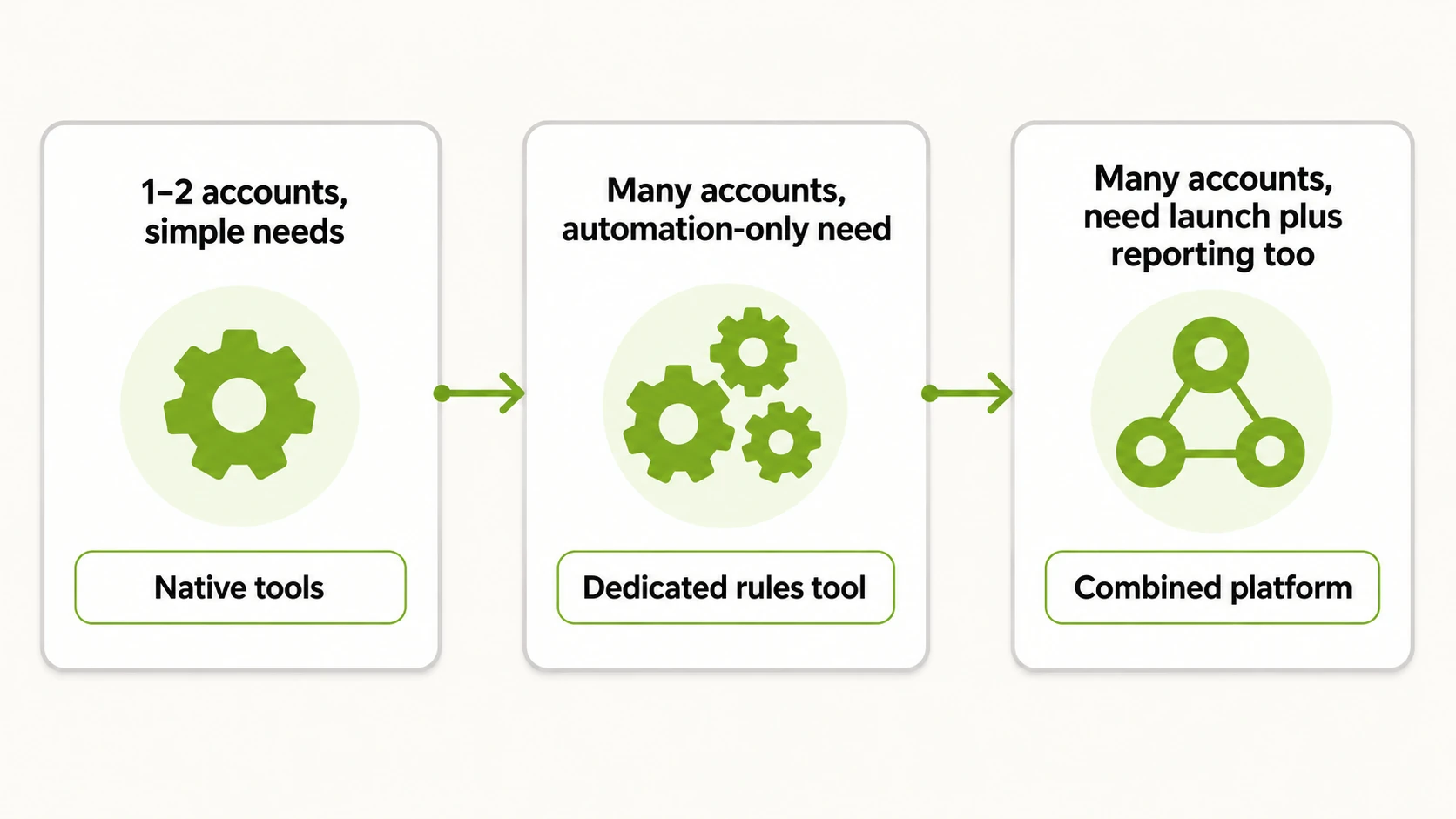
There is no universally correct answer, and an agency’s existing tool stack matters as much as any feature comparison. An agency with one or two large clients and a comfortable manual process might get by on native rules alone. An agency running many mid-sized accounts, where the same rules must apply everywhere and a client can ask for an audit trail at any moment, benefits most from cross-account automation, the core promise of facebook campaign automation done at scale, whether through a dedicated rules tool paired with separate launch and reporting software, or through a combined platform that keeps all three in one workflow. The tradeoff is specialization versus consolidation: a combined platform will not match a single-purpose tool feature for feature, but it removes the cost of stitching three tools into one client-facing process.
FAQs
1. What is facebook ad automation and how is it different from Meta’s Advantage+ features?
It generally refers to condition-based rules an advertiser defines, such as pausing an ad set when CPA crosses a threshold. Advantage+ features automate a narrower task, shifting bid and budget within Meta’s own algorithm toward better performers. Both run automatically, but one executes rules an agency sets and the other optimizes inside Meta’s system.
2. Can an agency apply the same automation rule across every client account at once?
With native Meta automated rules, no, each account requires the rule configured separately. Combined platforms like FabFunnel are built so a rule defined once applies across every connected account simultaneously, the main structural advantage agencies look for over native tools.
3. Do third-party rule-based automation tools replace the need for a media buyer?
No. These tools execute conditions a media buyer defines and remove the need to check dashboards constantly, but someone still decides what the rules should be and handles the creative and strategic work automation does not touch.
4. Is native Meta automated rules enough for a small agency running two or three accounts?
For a small number of accounts with straightforward needs, native rules are a reasonable starting point since they are free and require no additional tool. The limitation shows as account count grows, since each new client means rebuilding the same rules from scratch.
5. How do agencies prove to a client what an automation rule actually changed?
This depends on whether the tool logs actions in detail. An engine that records the triggering condition, the action taken, and a timestamp for every execution gives an agency a defensible audit trail; tools without detailed logs leave the agency guessing after the fact.
6. Does automation for Facebook campaigns extend to TikTok and NewsBreak too?
Native Meta rules apply only to Meta accounts, and some third-party rule tools are Meta-specific as well. FabFunnel’s automation rules engine runs across Meta, TikTok, and NewsBreak for agencies managing more than one of those platforms.
7. What should an agency check before switching from native rules to a paid tool?
Check whether the tool applies rules across accounts or per account, whether it logs actions with enough detail for client reporting, and whether it covers other manual work such as campaign launch or reporting, since consolidating that is often the bigger time saving.
8. Is paid automation software worth the cost for a small agency?
It depends on account volume and how much manual monitoring time it removes. Pricing models vary by vendor and typically scale with ad spend, account count, or team seats, so the calculation is specific to each agency’s roster size and current monitoring cost.
Getting Started
This kind of consolidated, cross-platform workflow is part of what FabFunnel’s AI advertising platform is built around. Agencies that have outgrown native rules and want cross-account automation connected to bulk launch and unified reporting can start with FabFunnel, or see how the AI creative tooling works.