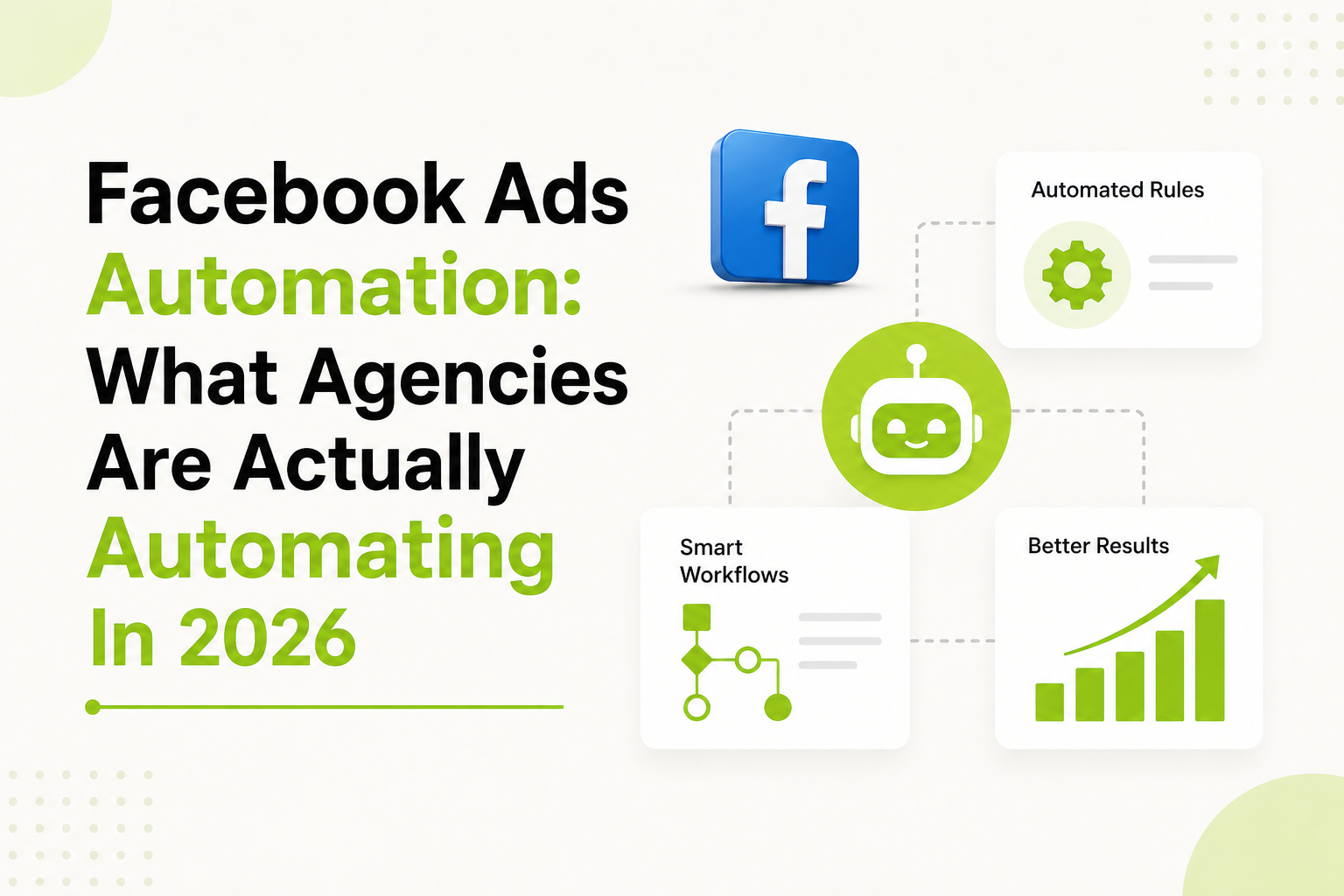
Facebook ads automation is not a feature. It’s an operating model. The confusion starts because Meta has trained advertisers to equate automation with Advantage+ – the algorithm managing creative, audience, and placement inside a single campaign type. That’s one layer. Agencies running at scale automate across a much wider surface: campaign creation, spend management, creative rotation, performance rules, and reporting across dozens or hundreds of ad accounts simultaneously.
Most conversations about Facebook marketing automation tools ask which tools exist. The more useful question is what should be automated, in what sequence, and what breaks when you automate the wrong things – or stop maintaining the Facebook ads automation you’ve built.
This article covers the full Facebook ads automation stack in 2026: what each layer does, where native Meta automation ends and third-party tools take over, how to evaluate a Facebook ad automation tool for agency operations, and the automation failure mode most teams don’t see until it’s already costing them.
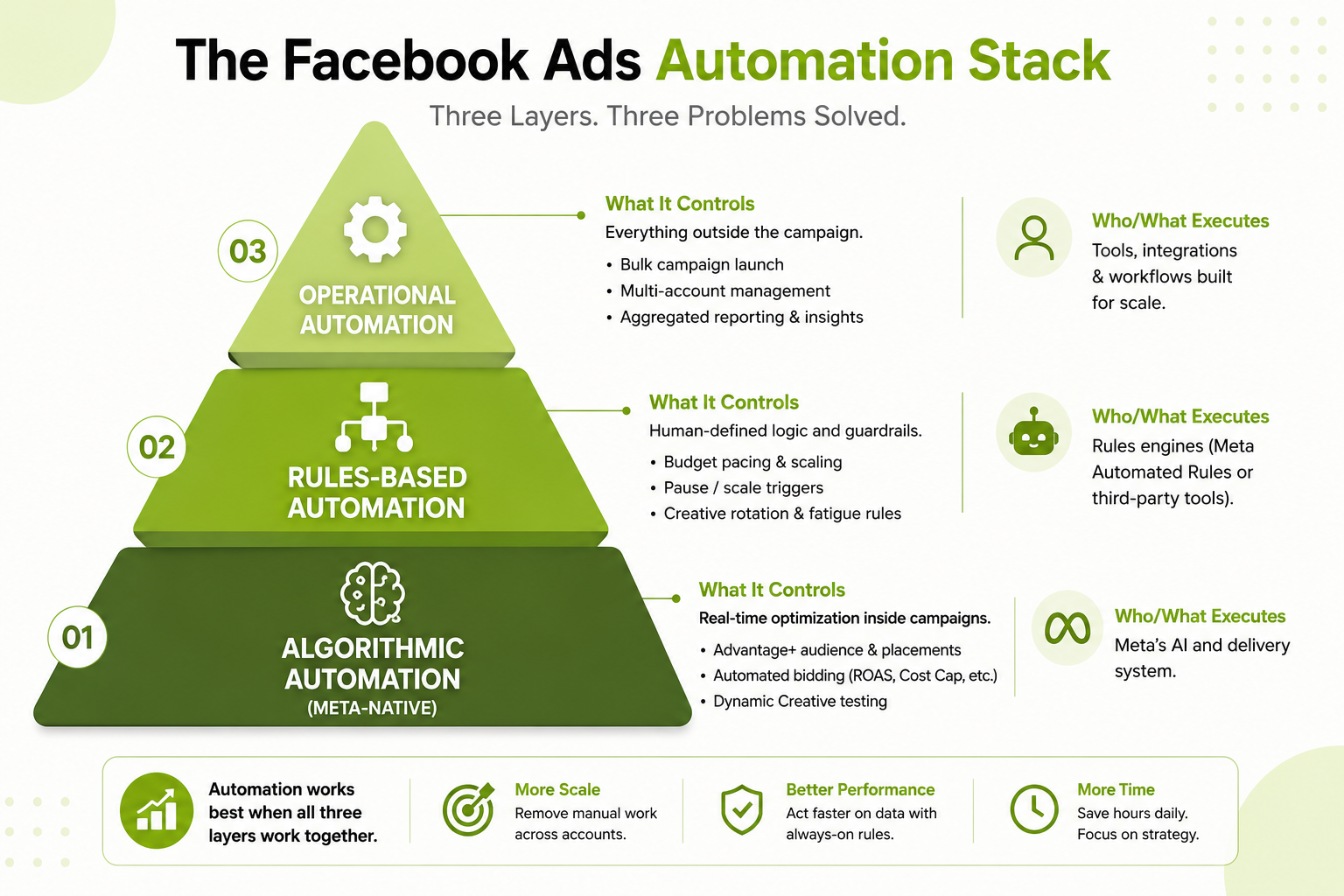
The Facebook Ads Automation Stack: Three Layers, Three Problems
Facebook ads automation doesn’t operate at a single layer. Agencies running efficiently in 2026 have automation working at three distinct levels – each solving a different part of the execution problem.
Layer 1: Algorithmic Automation (Meta-Native)
This is what Meta controls. Advantage+ campaigns automate creative, audience, and placement selection based on conversion data. Automated bidding (Lowest Cost, Cost Cap, Bid Cap, ROAS targets) adjusts bids in real time based on auction dynamics. Dynamic Creative tests asset combinations automatically.
This layer is non-negotiable – every advertiser on Meta runs some form of algorithmic automation whether they’ve configured it deliberately or not. The question isn’t whether to use it. It’s how to structure campaigns to give the algorithm the conversion signal density it needs to optimize correctly.
Layer 2: Rules-Based Automation
This is where human-defined logic takes over from the algorithm. Automated rules – native Meta rules or third-party rule engines – monitor campaign metrics and trigger actions: pause underperforming ad sets, scale budgets when ROAS exceeds a threshold, kill creative when frequency climbs above 2.5.
Facebook ads automation at this layer is conditional logic running 24/7 against your account data. Well-configured rules eliminate the most time-consuming manual decisions and protect campaign performance outside business hours. Poorly configured rules create a different problem – but that comes later.
Layer 3: Operational Automation
This is the layer most agencies ignore until it becomes the bottleneck. Operational automation covers everything outside the campaign itself: how campaigns are built, how budgets are allocated across accounts, how performance is aggregated into reporting, and how creative is rotated at scale.
At 5 ad accounts, operational overhead is manageable manually. At 20, it accumulates. At 50+, it becomes the constraint on revenue – not media buying skill, not creative quality, not targeting logic. The build-and-manage overhead is what caps growth. This is where Facebook marketing automation tools operating at the account-management layer – not just the campaign layer – deliver the most leverage.
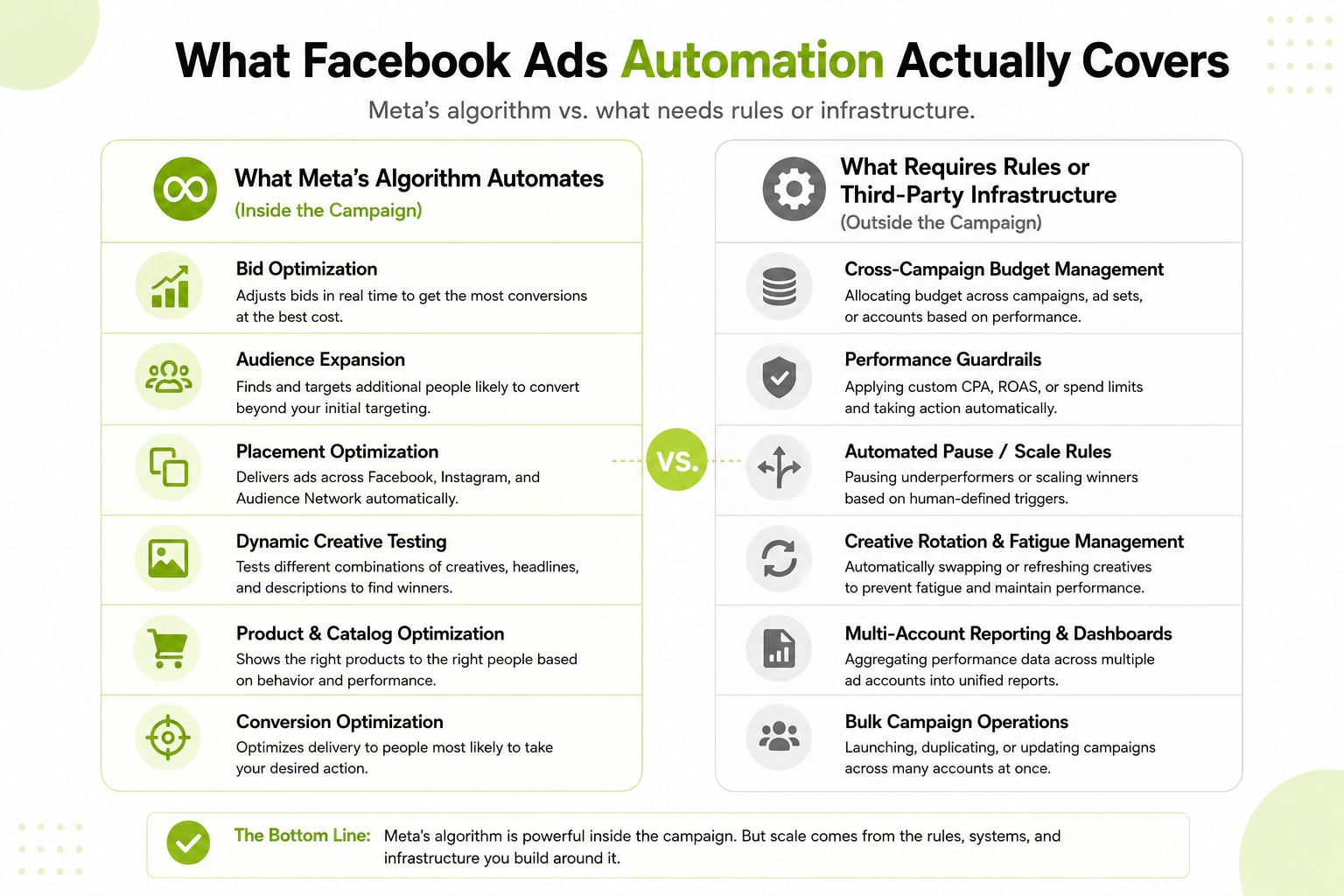
What Native Meta Automation Can (And Can’t) Do
Automated ads on Facebook have expanded significantly since 2022. Meta’s Advantage suite now covers creative (Advantage+ Creative), audience (Advantage+ Audience), shopping (Advantage+ Shopping Campaigns), and app installs (Advantage+ App Campaigns).
What Algorithmic Automation Handles Well
| Capability | Description |
| Real-time bid optimization | Optimizes against conversion events dynamically |
| Dynamic creative testing | Tests asset combinations automatically |
| Audience expansion | Expands targeting when manual targeting is restrictive |
| Placement optimization | Optimizes delivery across Facebook, Instagram, and Audience Network |
What It Doesn’t Handle
| Limitation | Description |
| Cross-campaign budget logic | No portfolio-level ROAS management |
| Human-defined performance floors | Cannot apply custom CPA guardrails |
| Bulk campaign creation | No structured multi-account launch workflow |
| Aggregated reporting | No portfolio-wide reporting infrastructure |
| Creative rotation | Doesn’t proactively rotate fatigued creatives |
| Account-level mirrored rules | No centralized cross-account rule management |
The gap between what algorithmic automation manages and what still requires rules-based or operational infrastructure is where most agency overhead lives. Fb automated ads are optimized within a campaign – not across campaigns, accounts, or the broader portfolio.
Rules-Based Facebook Ads Automation: The Decision Layer
Rules-based automation is the bridge between Meta’s algorithm and human judgment. The logic: when [condition], then [action]. Simple structure. High operational leverage when configured correctly.
Budget Scaling Rules
When ROAS exceeds target by X% for Z days, increase daily budget by Y%. When CPA drops below target, allow spend to scale. Run on a 24-hour lag to account for attribution delay before actioning. This replaces the manual budget review that otherwise happens once or twice a day with continuous monitoring – catching scaling opportunities at midnight on a Friday the same as at noon on a Tuesday.
Performance Floor Rules
When CPA exceeds hard limit for Z days, pause ad set. When CTR drops below threshold, flag for creative review. When frequency exceeds 2.5 and engagement rate falls, retire the creative. These rules protect ROAS during off-hours and weekends when no one is actively watching dashboards.
Creative Rotation Rules
When impressions-per-creative exceed a saturation threshold, rotate in the next asset. When CPM rises more than 20% week-over-week on the same creative, trigger a fatigue review. The most common cause of a performance cliff in Facebook ads automation is creatives running past their effective window – rules that catch this proactively prevent the cliff rather than responding to it.
Bid Management Rules
When winning auction rate drops below threshold, increase bid cap. When placement CPM exceeds portfolio average by X%, pause that placement and reallocate. Manual bid management at scale is not operationally viable. Rules-based automation is the only way to maintain bid discipline across a large account portfolio without proportional headcount growth.
The governing principle: rules don’t replace judgment. They execute decisions you’ve already made – consistently, at 3am on a Sunday, across every account in the portfolio simultaneously. That’s the core value proposition of rules-based Facebook ads automation: not intelligence, but execution discipline at scale.
Evaluating A Facebook Ad Automation Tool: Agency Requirements
Not every Facebook ad automation tool is built for agency-scale operations. The requirements that separate adequate from excellent:
Multi-Account Architecture
A Facebook ad automation tool that requires account-by-account configuration doesn’t scale past 10 clients. Agency tooling needs to apply rules, budgets, and campaign structures across accounts simultaneously – not replicate the same manual setup 40 times.
Bulk Campaign Launch Capability
Agencies launching campaigns across multiple clients face a structural bottleneck at the point of creation. A Facebook marketing automation tool that only manages existing campaigns misses half the workload. The build phase – campaign structure, audience configuration, creative assignment, budget setting – needs to be automatable at launch, not just in ongoing management.
Cross-Account Performance Aggregation
Reporting across 20+ ad accounts manually is a full-time job that produces data too stale to act on effectively. Facebook marketing automation tools that operate at the individual account level force manual consolidation for cross-account analysis. Portfolio-level visibility – where to scale, where to pull back, where creative is fatiguing – requires aggregated reporting infrastructure, not account-by-account exports.
Rule Execution Frequency
Automated rules that run once per day miss intraday performance swings. Fb automated ads performing efficiently at 9am can be burning budget at a $200 CPA by 2pm if rules aren’t running frequently enough. Hourly rule execution on budget and CPA thresholds outperforms daily execution at any meaningful spend level.
Audit Logging
When an automated rule takes an action – pauses an ad set, scales a budget, retires a creative – it needs to be logged with enough context to explain why. Facebook ads automation without auditability creates accounts in states no one deliberately chose, with no record of the decision chain that produced them. Auditability is what separates Facebook ads automation that builds institutional knowledge from Facebook ads automation that creates black-box risk.
Automation Debt: The Hidden Cost Of Unmanaged Rules
The most underdiagnosed problem in agency Facebook ads automation isn’t building too little automation. It’s accumulating what operations teams increasingly call Automation Debt: the pile of stale rules, misconfigured conditions, and conflicting logic that accretes in ad accounts over time.
Automation Debt Forms When:
- Rules built for one campaign structure are inherited by a different one without review
- Conditions reference metrics that have since changed definition or tracking methodology
- Multiple rules with overlapping logic compete for the same ad set
- Budget rules operate on attribution windows that no longer match campaign settings
- Creative rotation rules were never updated after a major creative refresh
The symptom: automation that appears to be running correctly but is producing decisions based on outdated logic. Accounts in automation debt show inexplicable performance volatility – things scale when they shouldn’t, pause when they’re working – and nobody can explain the pattern because the log of automated actions isn’t being read.
The fix is not more automation. It’s a quarterly audit of every active rule against the current campaign structure, naming conventions, and performance benchmarks. Facebook ads automation that’s maintained is leverage. Facebook ads automation that isn’t maintained is liability.
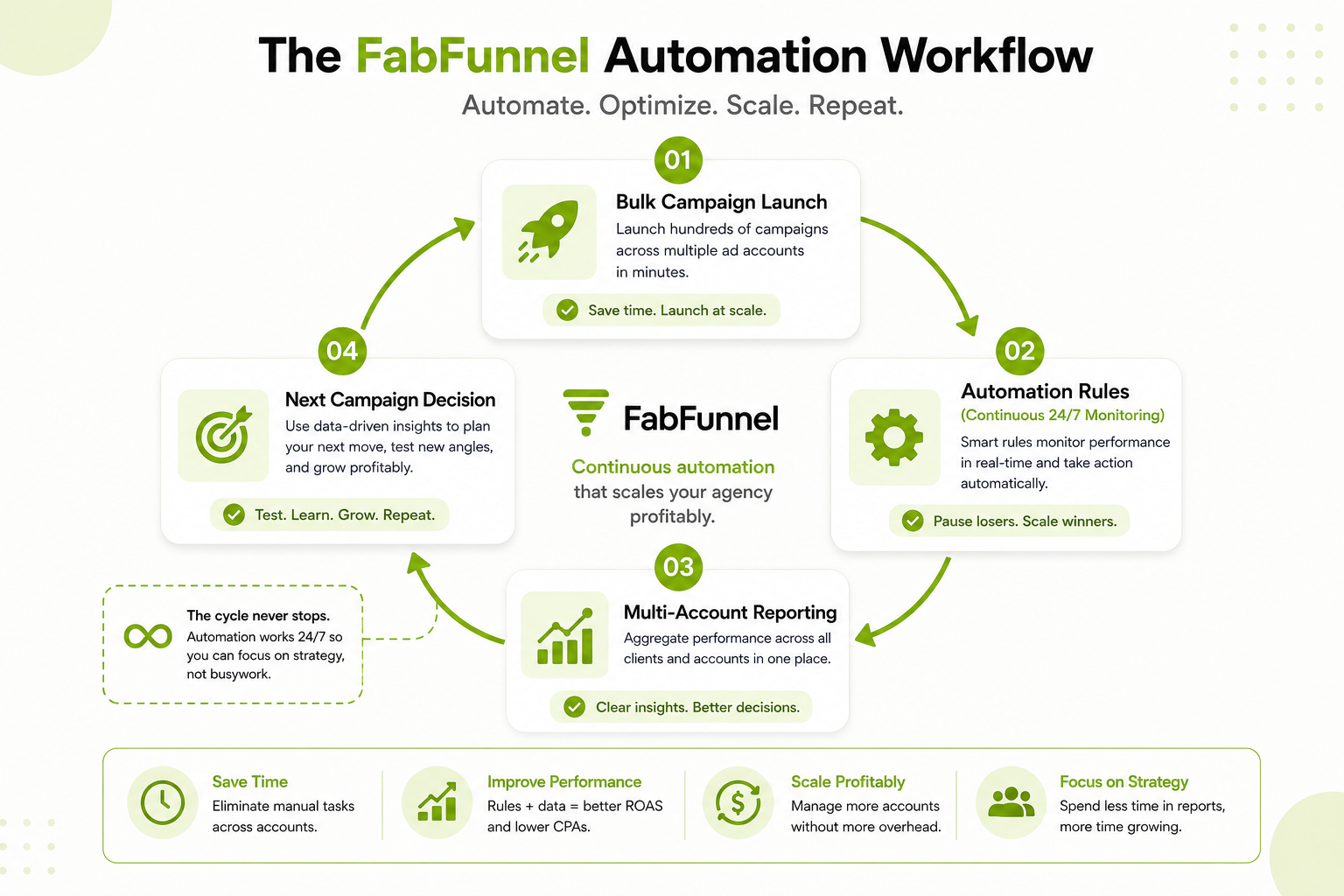
How FabFunnel Covers The Full Stack
FabFunnel addresses the layer most Facebook marketing automation tools leave uncovered: the operational infrastructure between strategy and live campaign execution.
Automation Rules (24/7)
FabFunnel’s automation layer runs rules-based logic continuously – pause underperformers, scale winners, enforce CPA floors, rotate fatigued creative – without the monitoring overhead. Rules execute on conditions you define, at the cadence required, across every account in the portfolio simultaneously. Not once a day. Not account by account.
Bulk Campaign Launch
The most immediate automation gap for agencies is at the point of campaign creation. FabFunnel’s Bulk Campaign Launcher lets you launch 1000+ campaigns in under 5 minutes – campaign parameters, audience configuration, creative assignment, and budget allocation applied in bulk. What typically takes an ads team hours per client becomes a single workflow that fires across accounts in parallel. The launch infrastructure automates the build, not just the management of what’s already live.
Multi Ad Account Reporting
Portfolio-level visibility without manual data consolidation. FabFunnel’s reporting aggregates performance across ad accounts into a single view – so decisions about where to scale, where to pull back, and where creative is approaching fatigue don’t require manual export and reconciliation.
The three layers operate together: Bulk Launch builds the structure, Automation Rules manage performance 24/7, and Reporting surfaces the portfolio signal to drive the next decision. That’s the complete Facebook ads automation stack – not a single feature sitting on top of a manual workflow.
Common Facebook Ads Automation Mistakes
Automating Before Validating The Strategy
Facebook ads automation executes your decisions faster and at scale – but strategy validation must come first. If the underlying strategy is wrong – wrong conversion objective, wrong audience structure, wrong creative format – automation amplifies the mistake rather than catching it. Validate manually first. Automate what’s proven.
Building Rules Without Testing Them
Automated rules on live campaigns affect real budget. A misconfigured CPA floor rule that pauses your best-performing ad set because of a tracking delay isn’t a minor inconvenience – it’s a budget loss that compounds until someone catches it. Test rules on low-stakes campaigns before deploying at scale.
Not Reading Automation Logs
Most Facebook ad automation tools produce action logs. Most agencies don’t read them. Logs are the only way to verify that automated decisions match intended logic and catch cases where rules are misfiring against the wrong conditions. Review weekly at minimum.
Over-Automating Audience Decisions On New Accounts
Advantage+ Audience expansion is powerful when your account has strong conversion history – typically 50+ conversion events per week. On new accounts with limited data, full audience automation can spend the learning phase on the wrong people. Start with defined targeting, expand automation as data accumulates.
Not Maintaining Rules Through Campaign Restructures
When you restructure campaigns – new naming conventions, new objective types, new budget hierarchies – audit every automated rule against the new structure before pushing live. Rules targeting old campaign logic are one of the primary sources of automation debt.
Conclusion
Facebook ads automation in 2026 operates across three layers: Meta’s algorithmic optimization, rules-based decision logic, and operational infrastructure. Agencies winning at scale have all three running – not just the first one.
The most common gap isn’t in algorithmic performance. It’s in the operational layer: how campaigns are built, managed, and reported across multiple accounts without proportional headcount growth. That’s where the constraint actually lives for agencies growing past 10-15 active clients.
Build the rule logic. Maintain it. Audit it quarterly. And make sure the launch infrastructure – where the real time cost lives – is part of the Facebook ads automation stack, not the manual step that brackets otherwise automated campaigns.
If bulk campaign launch and 24/7 automation rules are the operational constraint, FabFunnel is built specifically for this.
Frequently Asked Questions
Q1: What is Facebook ads automation?
Facebook ads automation refers to any system that executes campaign decisions without manual intervention in real time. This includes algorithmic (Advantage+, automated bidding, dynamic creative), rules‑based (conditional logic to pause/scale/adjust), and operational automation (bulk creation, multi‑account, reporting). Effective Facebook ads automation in 2026 uses all three layers – not just Meta’s algorithmic layer..
Q2: What is the best Facebook ad automation tool for agencies?
The best Facebook ad automation tool for agencies depends entirely on which layer of automation you need most. If your priority is rules-based management, then you require a tool that runs conditions continuously – not just once per day – and can apply those rules across multiple accounts simultaneously, without any manual replication. For operational automation, the requirement is bulk campaign launch and aggregated cross-account reporting. FabFunnel covers the full agency stack: 1000+ campaign launches in under 5 minutes, 24/7 automated rules across the entire account portfolio, and multi-account performance reporting in a single view.
Q3: What are automated ads on Facebook?
Automated ads on Facebook include Meta’s native Advantage+ formats: Advantage+ Shopping Campaigns (e-commerce), Advantage+ App Campaigns (app installs), and standard campaigns running Advantage+ Creative and Advantage+ Audience automation. These formats let Meta’s algorithm handle creative combination, audience selection, and placement optimization based on your conversion objective. Automated ads on Facebook perform best when the account has sufficient conversion history – typically 50+ conversion events per week – for the algorithm to optimize effectively without the learning phase spending against poor signals.
Q4: How do Facebook marketing automation tools differ from Meta’s native automation?
Meta’s native automation handles algorithmic decisions inside campaigns – bidding, audience, creative. Facebook marketing automation tools extend that into rules-based and operational logic Meta doesn’t provide natively: pausing campaigns when CPA exceeds a custom threshold, scaling budgets across accounts based on portfolio-level ROAS, launching hundreds of campaigns through a structured workflow, and aggregating performance data across accounts for analysis without manual export. The two operate in parallel – third-party Facebook marketing automation tools complement what Meta’s algorithm does, not replace it.
Q5: What are Facebook automated rules and how should agencies use them?
Facebook automated rules are conditional logic statements that trigger campaign actions when performance metrics hit defined thresholds – pause ad set when CPA exceeds $X, increase budget when ROAS exceeds Y, retire creative when frequency exceeds 2.5. Meta provides a native rules builder inside Ads Manager, but native rules apply account-by-account and run on Meta’s schedule rather than in real time. Third-party Facebook ad automation tools extend this with cross-account rule deployment and higher execution frequency. Agencies should use rules to enforce CPA floors, scale ROAS winners, manage creative fatigue, and control budget pacing – replacing the daily manual monitoring that otherwise requires constant team attention.
Q6: What is automation debt and how do agencies avoid it?
Automation debt is the hidden cost of stale, misconfigured, or conflicting rules in ad accounts. It causes unexplained volatility: ad sets pausing while working, budgets scaling on bad signals, creative staying past fatigue. The fix? Audit your rules quarterly. Test new ones on low‑stakes campaigns first. And check your automation logs weekly. Don’t let zombie rules run your ads.