Quick Answer: AI ad copy generator output converts when it swaps vague benefit language for specific numbers, outcomes, and product detail, and when the hook matches the platform it runs on. Generic drafts fail because they read the same on Meta feed, Reels, and TikTok. Treat the output as a fast first draft, not a finished ad, and run a short human pass for tone, nuance, and brand voice before it ships.
The Problem With Most AI Ad Copy Generator Output
Run the same product through five different tools, a common first step for teams experimenting with ai for ad copy across their catalogue, and the drafts start to blur together. An ai ad copy generator trained on broad ad libraries defaults to phrasing that sounds correct but says nothing: “transform your routine,” “designed for comfort,” “the perfect solution for busy days.” None of that is wrong. It is also not specific enough to make anyone stop scrolling, which is the usual complaint about ad copy ai generator output.
The gap between AI copy that converts and copy that gets ignored rarely comes down to grammar or structure. A model strings together a headline, a body line, and a CTA without effort. What it struggles with is committing to a claim specific enough to be memorable, and picking a tone that matches how the platform’s audience talks. Generic language and mismatched hooks account for most of the difference between a draft you can ship and one that needs a rewrite.
Specificity vs. Vague Benefit Language
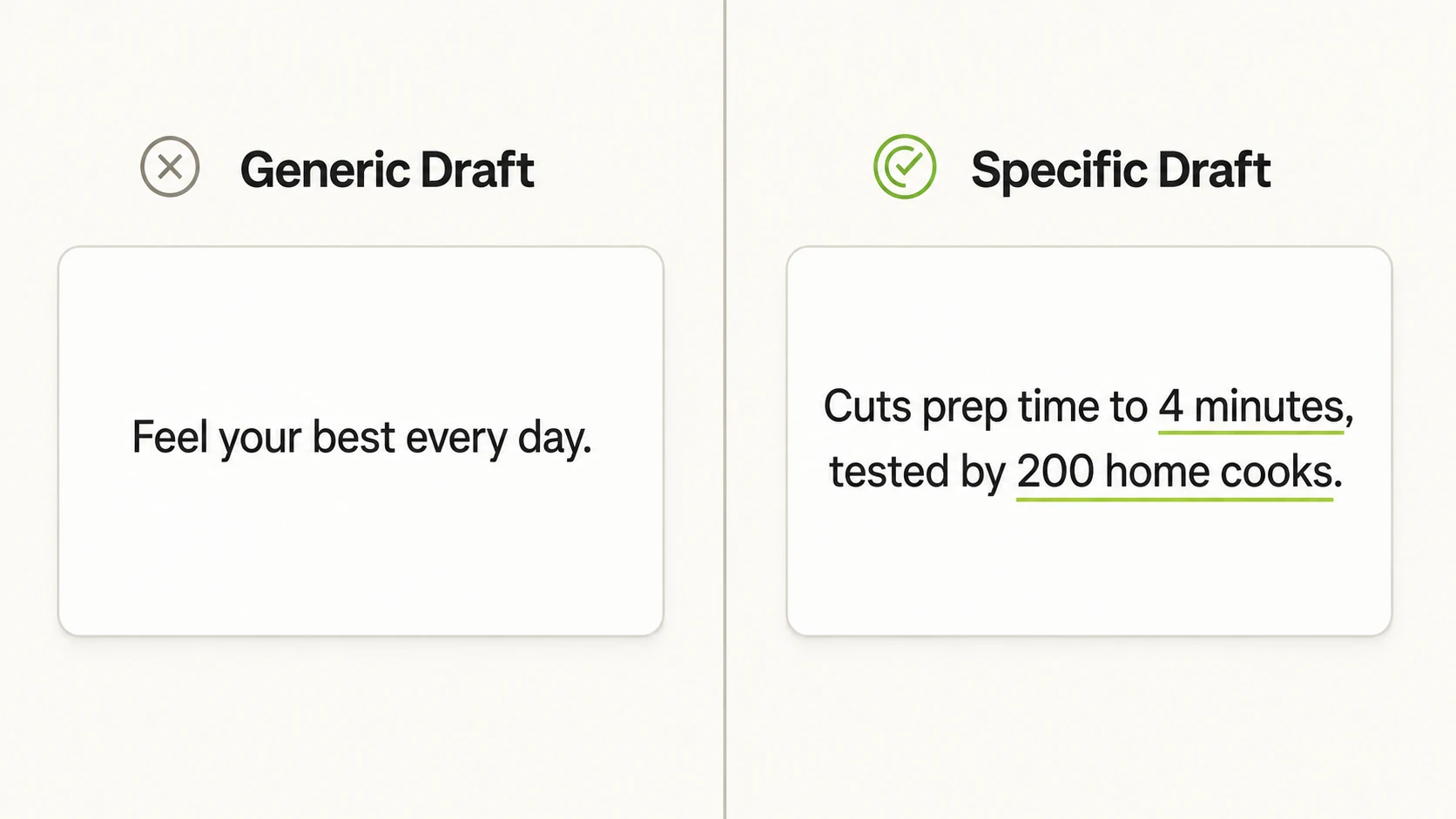
The single biggest lever in AI-generated ad copy is specificity. A vague benefit claim asks the reader to imagine the outcome, which is exactly the gap that separates strong ai generated ad copy from filler. A specific claim shows it to them.
Compare “helps you feel more confident” against “fits true to size across 12 body types, based on our return data.” Compare “save time on your morning routine” against “cuts your routine from 20 minutes to 6.” The second version in each pair gives the reader something to picture and verify.
An ai ad copy generator produces the vague version by default because vague language is safe across every product category the model has seen. Specificity requires real input: actual numbers, product attributes, customer language. Feed the generator a return rate, a material spec, or a real review, and the output sharpens immediately. Feed it a generic description and the copy stays generic.
The fix is not a better prompt template. It is better input. Pull three or four concrete facts about the product before generating anything, and force at least one into the headline.
Matching Hook Style to the Platform
A hook that performs on Meta feed can flop on TikTok, and the reverse is just as common. Platform mismatch is the second most common reason AI-generated ad copy underperforms, and most generators do not correct for it unless the prompt accounts for it.
Meta Feed
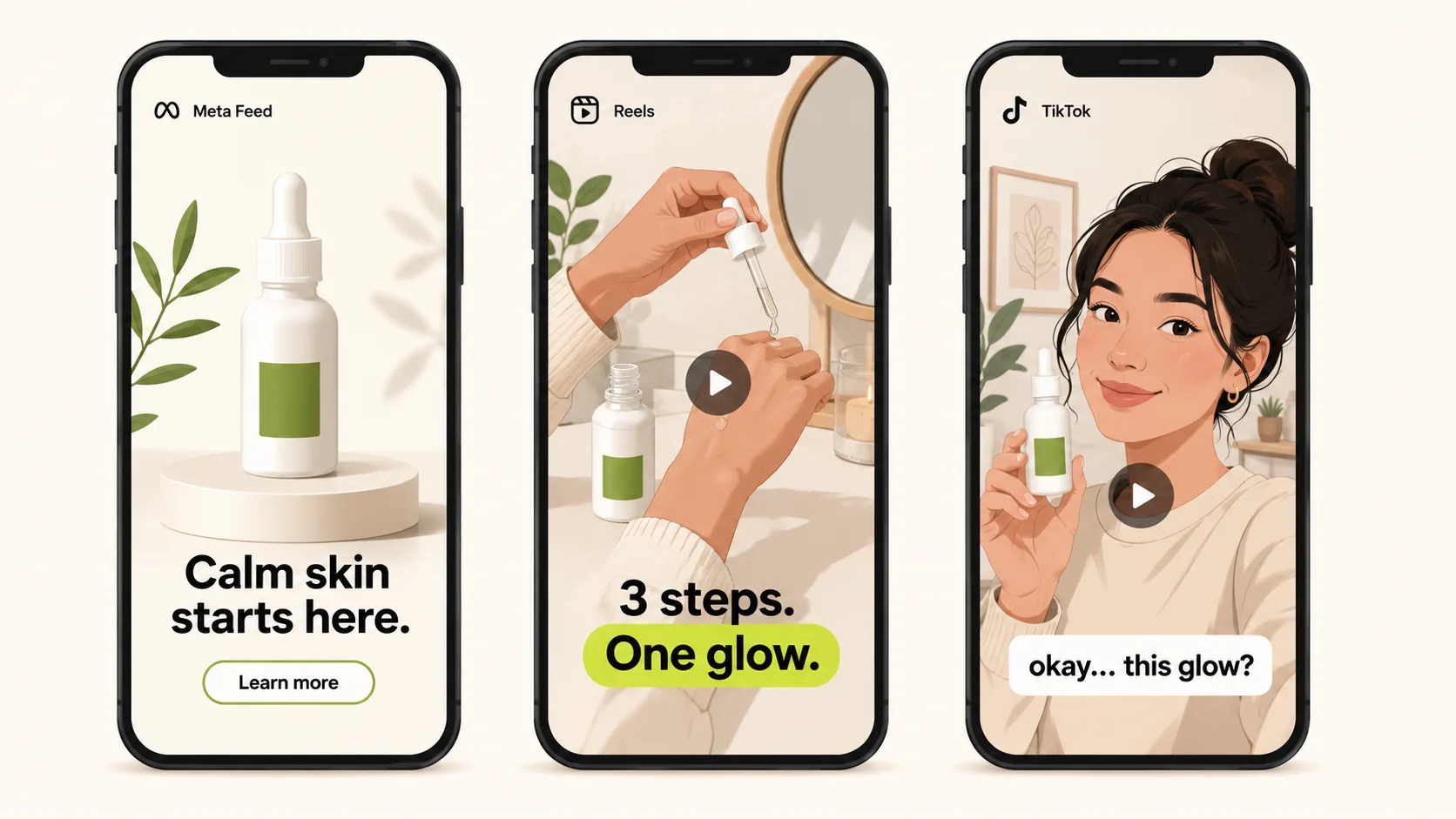
Feed placements sit next to organic posts from friends and pages people already follow. Copy that reads like an ad, with capital-letter urgency and stacked exclamation points, stands out for the wrong reason. A plain, outcome-led headline followed by body copy that reads like a recommendation performs better.
Reels
Reels hooks live in the first half second of on-screen text, competing against entertainment content, not other ads. The copy needs to work as a caption over motion: short, with a pattern interrupt or a direct question up top, not a brand statement.
TikTok
TikTok audiences respond to copy that sounds like a person talking, not a brand announcing. First-person framing and casual phrasing outperform polished ad language. A generator prompted with “write a TikTok ad” but no platform-specific direction often hands back Meta-style copy with the word TikTok pasted on top.
Prompt for the platform explicitly, and give the generator one or two examples of native content from that platform to match, not just an instruction to follow.
When an AI Ad Copy Generator Draft Is Ready to Ship
Not every ad needs a human pass before it goes live. An ai ad copy generator draft is usually safe to ship as-is when the stakes are low and the goal is volume: prospecting variants, retargeting copy for a product with an established voice, or bulk variations meant to find a winning angle through split testing.
The draft only needs to clear a basic bar: no factual errors, no unsubstantiated claims, no tone that clashes with the brand. If it clears that bar, launching it and letting performance data decide is often faster than editing it by hand.
When It Still Needs a Human Pass
Tone
A generator optimizes for what performs on average. It does not know a brand’s audience responds to dry humor, or that a phrase reads as condescending to a specific segment. Tone mismatches rarely show up as an obvious error, which is why they need a person to catch them.
Cultural Nuance
Idioms and humor that land in one market can confuse another. A generator producing copy for a global campaign often defaults to US-centric phrasing, since that is where most of its training data comes from. Campaigns outside a single home market should assume every draft needs a local read.
Competitor-Sensitive Claims
Generators do not know a brand’s legal exposure or which comparative claims legal has already flagged. Any copy referencing a competitor by name, or implying a direct comparison, needs a human check every time.
Brand Voice
A generator can be prompted with brand guidelines, but it will not consistently hold a specific voice across dozens of variations the way a person who lives in that voice every day will. The drift is small, a slightly more formal word choice here, a missing signature phrase there, but it accumulates, and an audience notices even when they cannot say why an ad feels slightly off.
Generic Pattern vs. What to Fix
A short reference table earns its place here because these patterns repeat across almost every category, and having them side by side makes the fix easier to apply during a review pass.
| Generic AI Copy Pattern | What to Fix |
|---|---|
| “The perfect solution for [problem]” | Replace with the specific outcome and how it happens: what changes, by how much, in what timeframe |
| “Transform your [routine/life/day]” | Swap for a concrete before-and-after detail from real product data or customer feedback |
| Identical hook style across every platform | Rewrite the first line for how that platform’s audience reads: plain statement for feed, pattern interrupt for Reels, first-person for TikTok |
| Vague comparative claims (“better than the rest”) | Cut the comparison or replace with a specific, substantiated claim |
| Uniform, brand-neutral tone across variations | Check against 2 to 3 reference lines that sound unmistakably like the brand |
| Broad claims with no source | Attach a real number, spec, or data point, or remove the claim |
Where This Fits Into a Real Workflow
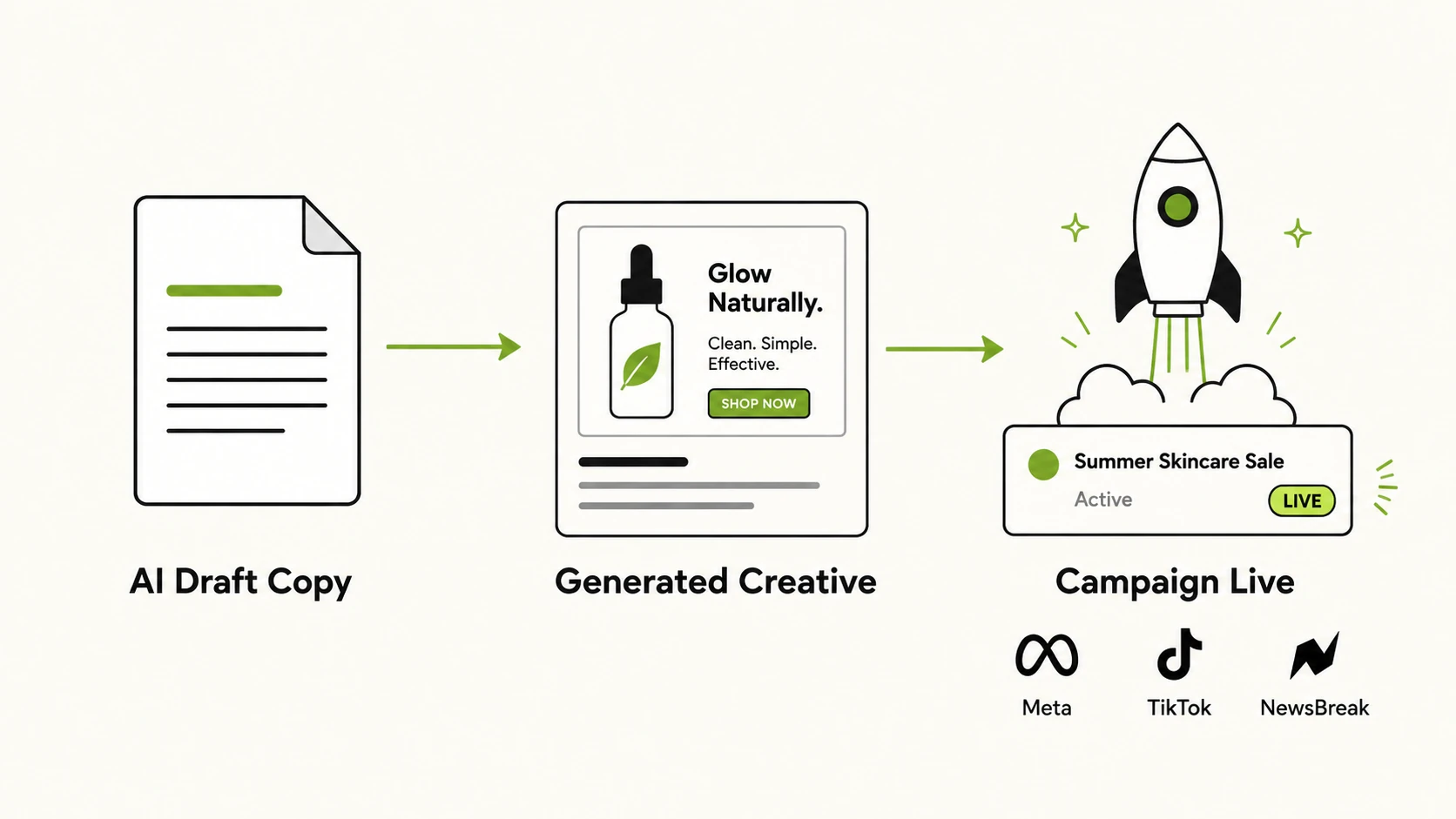
Ad copy is one half of the creative. The visual side needs the same specificity and platform match, and pairing the two manually is where teams lose time. FabFunnel’s Genie generates the visual side (Product Ad, Brand Ad, Product Shoot, Performance Ad, static and video) pulling brand guidelines and product data from a connected catalogue, across Meta, TikTok, and NewsBreak, from scratch, as a variation, or from one of 200 pre-built frameworks, then moves straight into the Bulk Campaign Launcher with no export step.
That workflow does not replace the judgment this article is about. It removes the manual assembly work, so the time saved goes toward the human pass that separates copy that converts from copy that gets scrolled past.
FAQs
1. Does an AI ad copy generator ever produce copy good enough to launch without edits?
Yes, for high-volume, low-stakes tests like prospecting variants or retargeting copy for an established product. The bar is no factual errors, no unsubstantiated claims, no obvious tone mismatch. A major launch still deserves a human read first.
2. Why does AI-generated ad copy so often sound the same across different tools?
Most generators train on similar ad libraries, so they converge on the same safe, benefit-forward phrasing. Feeding the generator specific product facts and real customer language instead of a generic description is the way out.
3. How much does hook style actually matter between Meta, Reels, and TikTok?
More than most other copy decisions, since each placement competes against different content. A hook built for one rarely performs on the other two without a rewrite.
4. Can AI ad copy generators write copy that accounts for cultural differences between markets?
Not reliably. Models default toward the cultural context most represented in their training data, usually US-centric. Multi-market campaigns should route every draft through a local reviewer before launch.
5. What is the fastest way to get more specific output from an AI ad copy generator?
Give it specific input. A return rate, a material spec, or a concrete before-and-after number consistently produces sharper copy than a well-written but generic prompt.
6. Is it risky to use AI-generated copy that mentions or implies a comparison to a competitor?
Yes. Generators have no awareness of legal exposure or existing competitive claims, so comparative language needs a human check before it runs.
7. How do teams keep brand voice consistent across dozens of AI-generated variations?
By reviewing against 2 to 3 reference lines that sound unmistakably like the brand, rather than a one-time prompt with guidelines attached. Voice drift is gradual, so the check has to repeat.
8. Does pairing AI ad copy with AI-generated creative save meaningful time?
It can, mainly by removing the manual handoff between writing copy and briefing a designer. Genie generates the visual side directly from brand and product data into campaign launch, though the copy still benefits from a human pass. This kind of pairing is part of what FabFunnel’s ad creative automation covers, cutting the manual handoff between copy and creative.
Start testing your own AI ad copy generator drafts at FabFunnel’s Fab AI, or set up a campaign.