The question is no longer “Should we use AI?”—it’s “How do we use it to win?” AI-powered ad platforms are shaking up the industry with promises of higher click-through rates and lower costs. But does AI-generated ad copy actually convert on Meta, or does it just sound like every other ad in the feed?
The debate between AI speed and human nuance has been intense in 2026, but here’s the reality: both sides are partially correct. That said, when you look at over 50,000 ad variations, AI‑generated creative consistently outperforms human‑made ads on click‑through rate. In fact, some studies report that AI ads achieve roughly 12% higher CTR on Meta. Yet human-generated copies outperformed AI in 9 out of 12 cases for cost-effectiveness.
So what’s the winning move? By the end of this blog, you’ll know exactly which approach converts better across different ad formats, and how FabFunnel’s AI Ad Copy Generator combines the scalability of AI with the nuance of human brand voice to help you scale high-performing campaigns.
What “Ad Copy” Actually Means on Meta (And Why It’s More Complex Than You Think)
When most marketers talk about writing ad copy, they’re thinking of a single block of text. But on Meta, ad copy has different distinct components, each with its own job:
- Primary text: The main body text above your creative
- Headline: This appears in bold below the creative; often the highest-converting element
- Description: The small line of text beneath the headline; frequently overlooked but critical for context
- Creative overlays and captions: Text embedded within your image or video asset
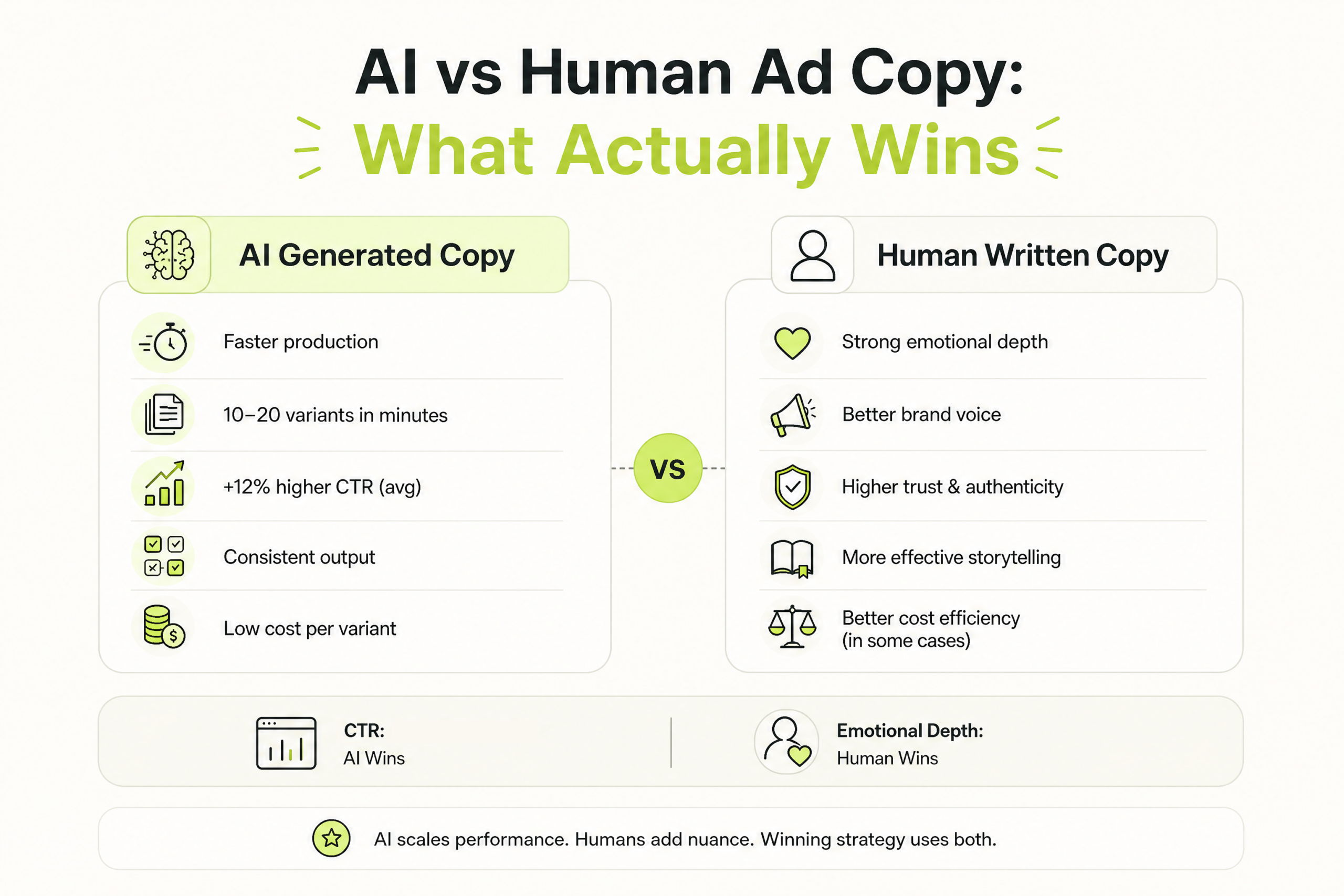
A headline needs to be punchy and direct, while primary text can be more narrative-driven. The description demands clarity and value, not cleverness. And most crucially, your copy and creative must be aligned. Mismatched messaging between visual and text is one of the most common conversion killers on Meta.
This complexity creates a challenge. What works for a headline won’t work for a description, and what works for a brand awareness ad may flop in a retargeting campaign. That’s why a one-size-fits-all approach to copy – whether AI or human – almost always fails.
The Case for AI Generated Ad Copy on Meta
AI is absolutely winning in certain domains. Meta’s own internal tests show that campaigns using AI-generated images saw an 11% higher click-through rate and a 7.6% higher conversion rate compared to those that didn’t. Across a massive corpus, the results are consistent: AI-generated ads achieve an average CTR of 1.82% compared to 1.54% for human-made creatives.
Where AI wins:
- Speed: Generate 10–20 copy variants in minutes, not days
- Volume: Essential for proper A/B testing; you need multiple angles to find the winner
- Consistency: On-brief every time, no off days, no creative blocks
- Pattern recognition: Trained on high-performing ad formats and proven conversion structures
- Cost efficiency: Dramatically lower per-unit cost at scale
When AI excels: Direct response and lead generation campaigns, retargeting sequences, abandoned cart reminders, and any benefit-led, offer-driven, or urgency-based copy.
Case in point: One team generated 100 AI-created Meta ads in just 2.5 hours for $147. A 14-day, $7,000 test delivered a 1.87% CTR, 3.2x ROAS, and $21.80 CPA.
The Case for Human Written Ad Copy on Meta
But before you fire your copywriters, consider the counter-evidence. In a direct comparison, human-generated copies outperformed AI in 9 out of 12 cases for cost-effectiveness, with similar CTR performance between both groups.
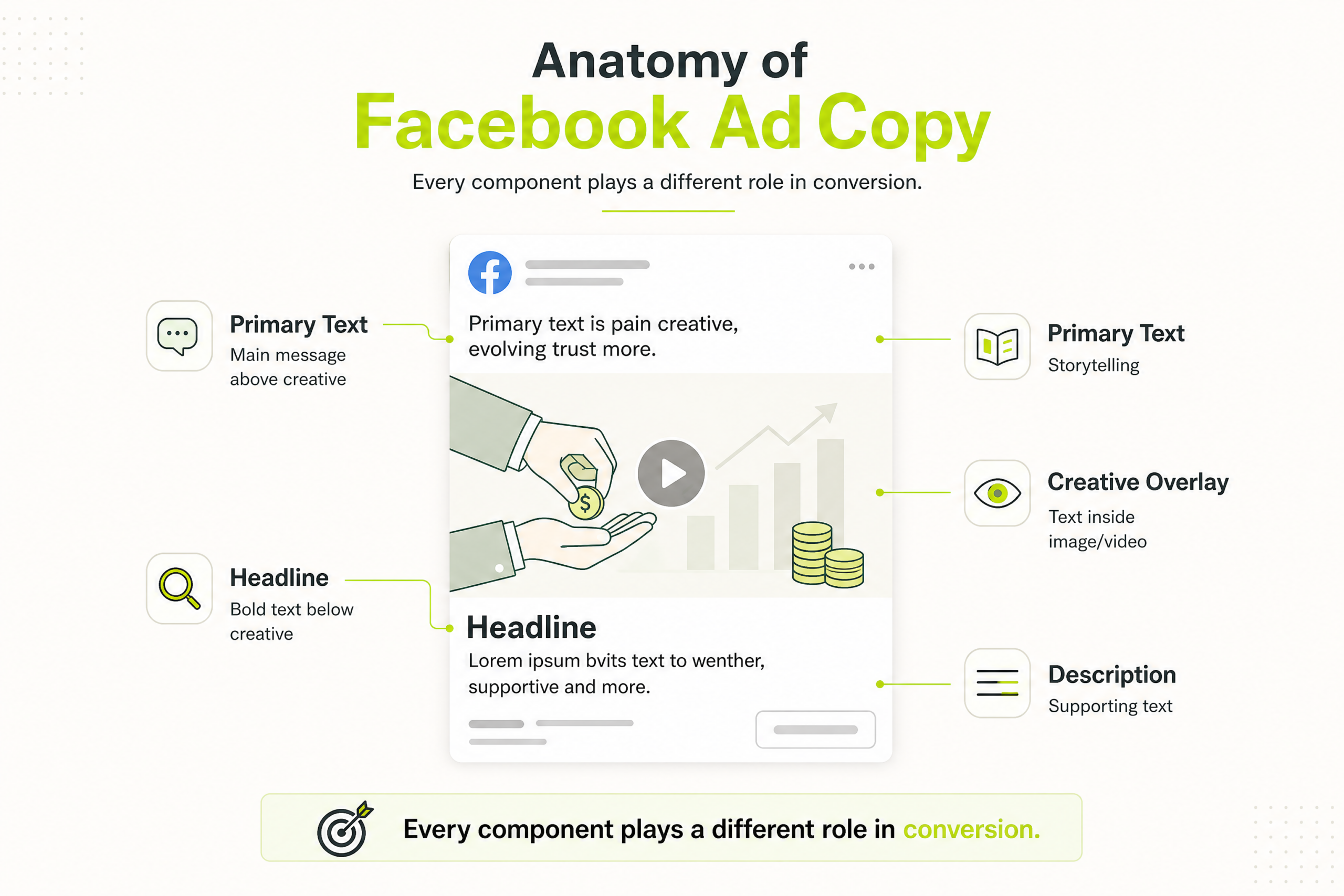
Why? Because AI has real, documented limitations when it comes to emotional resonance. Research shows AI‑authored emotional messages reduce word‑of‑mouth and loyalty versus human copy. Consumers detect machine marketing, hurting trust and brand perception. Knowing content is AI‑generated lowers engagement.
Where human writers win:
- Brand voice: True nuance of tone, cadence, and personality
- Emotional intelligence: Complex emotional triggers (humor, nostalgia, shame, aspiration) are harder for AI to land authentically
- Cultural fluency: Idioms, trending references, niche community language
- Storytelling: Long-form narrative copy like origin stories, founder angles, UGC-style confessional copy
- When humans excel: Brand awareness campaigns, storytelling formats, UGC-style testimonials, and any ad where authenticity is the primary conversion driver.
The honest limitation: Human copy is irreplaceable for certain formats, but it cannot scale to the volume modern Meta advertising demands. The constraint isn’t quality – it’s throughput. Your best copywriter can produce maybe 3–5 high-quality ad angles per week. A performance marketing team needs dozens.
Head-to-Head: AI vs Human Copy Across 5 Key Meta Formats
Here’s where the debate gets practical. The “winner” depends entirely on what type of ad you’re running:
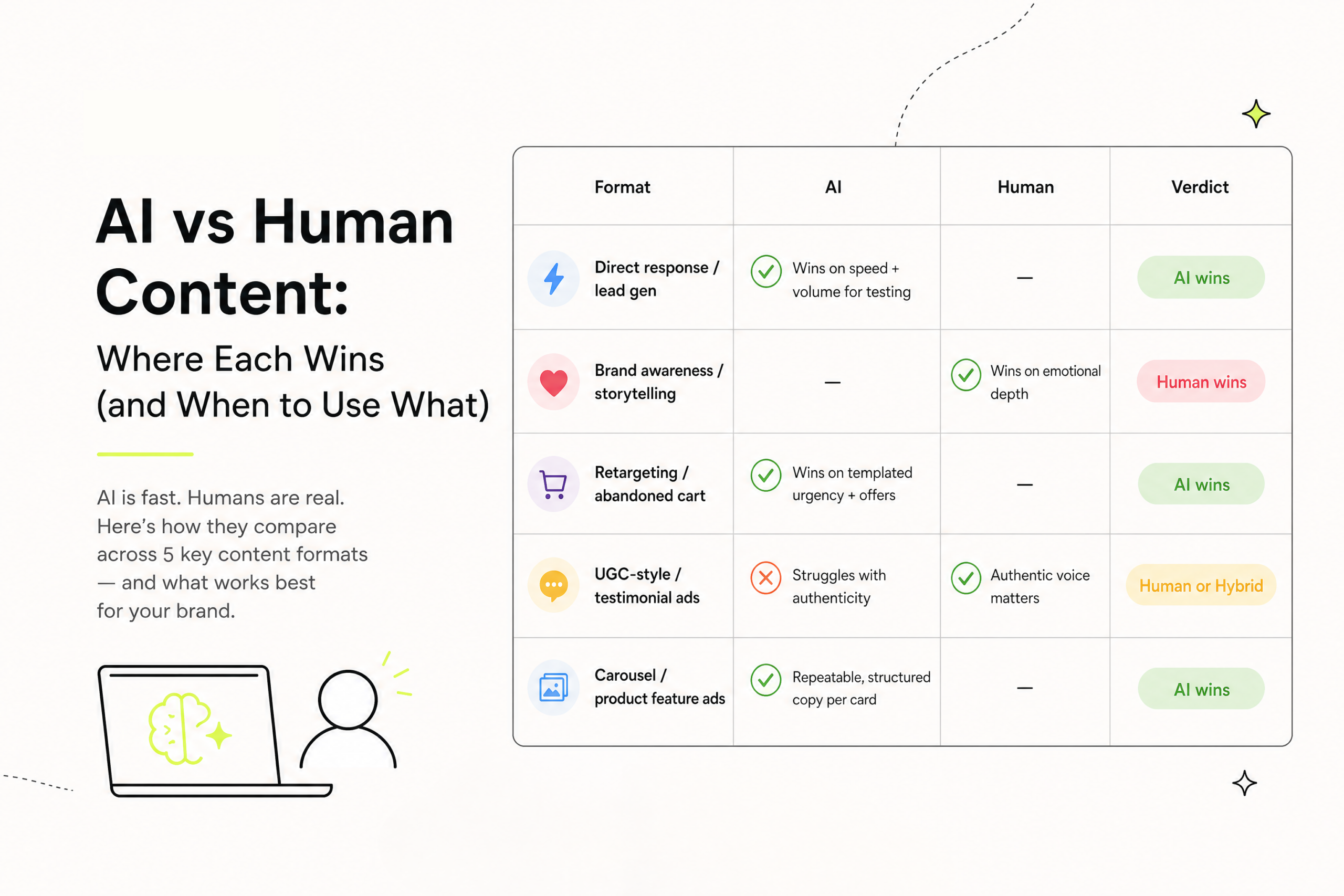
For most Meta advertisers running a mix of these formats, you need both capabilities. The real question isn’t “AI or human?” – it’s “how do you integrate both into a single, efficient workflow?”
Why the Real Answer Is “Neither Alone” – And How FabFunnel Solves This
The debate is a false binary. The highest-converting Meta advertisers don’t choose AI or humans. They use AI to generate volume and human judgment to curate and refine.
That’s exactly why we built FabFunnel’s AI Ad Copy Generator.
Before FabFunnel: Brief a copywriter → wait 2–3 days → receive one angle → launch → wait for data → repeat.
After FabFunnel: Enter product, audience, and offer → 5 on-brand copy variants across all ad components → test-ready in under 10 minutes.
Most AI copy tools produce generic output that sounds like everyone else’s ads. FabFunnel‘s AI Ad Copy Generator is built differently. It’s trained on direct-response conversion frameworks, not general-purpose language patterns, and it’s built specifically for high-volume, cross-channel ad operations.
Core capabilities:
- Generates multiple copy angles per ad
- Produces all ad copy components
- Brand voice calibration
- Copy and creative generated together
- Test-ready output
The result? You get the scale and speed of AI with the nuance and alignment of strategic human direction – without the bottleneck of waiting on a writer or an agency.
How to Get the Best Results From AI Ad Copy on Meta: 5 Professional Principles
Even the best Ad Copy AI Generator isn’t magic. Here are five professional principles for getting maximum performance from AI-assisted ad copy:
- Brief with specificity
If you give the AI vague inputs, it will return generic output. To avoid that, provide your specific offer, target audience, desired emotion, and any proven winning angles from past campaigns. As a rule, the more context you supply, the stronger and more effective the AI’s output becomes.
- Generate for volume, edit for brand
Use AI to create 5–10 versions. Then use human judgment to pick the best 3 and improve them. The human role shifts from “writer” to “creative director.”
- Test copy angles, not just creative
Most advertisers test visuals but recycle the same headline and primary text. Copy testing unlocks a completely separate performance lever – and you’re leaving massive gains on the table by ignoring it.
- Keep copy and creative aligned
Mismatched messaging between visual and text is one of the most common Meta conversion killers. Generate your copy and creative together, from the same brief, using a unified tool.
- Build a copy learnings log
Track which angles win by audience segment and offer. Feed those insights back into your next brief. The best Meta advertisers log experiments, archive winners, and iterate relentlessly.
Putting It Together: Generate, Test, and Scale Copy With FabFunnel
Here’s exactly what the end-to-end workflow looks like with FabFunnel:
- Step 1: Enter your product, offer, target audience, and campaign objective inside FabFunnel’s dashboard
- Step 2: Generate multiple ad variants across proven angles – benefit-driven, urgency, social proof, curiosity, and problem-solution
- Step 3: Review all generated ad components – primary text, headlines, and creatives are already aligned and structured
- Step 4: Select the variants you want to test and proceed – no manual copy-paste or setup required
- Step 5: Launch campaigns directly from FabFunnel – ad sets, creatives, and naming are automatically configured
- Step 6: Track performance inside the dashboard – identify winning angles based on real data
- Step 7: Iterate and scale – regenerate new variants from top-performing angles and launch again in minutes
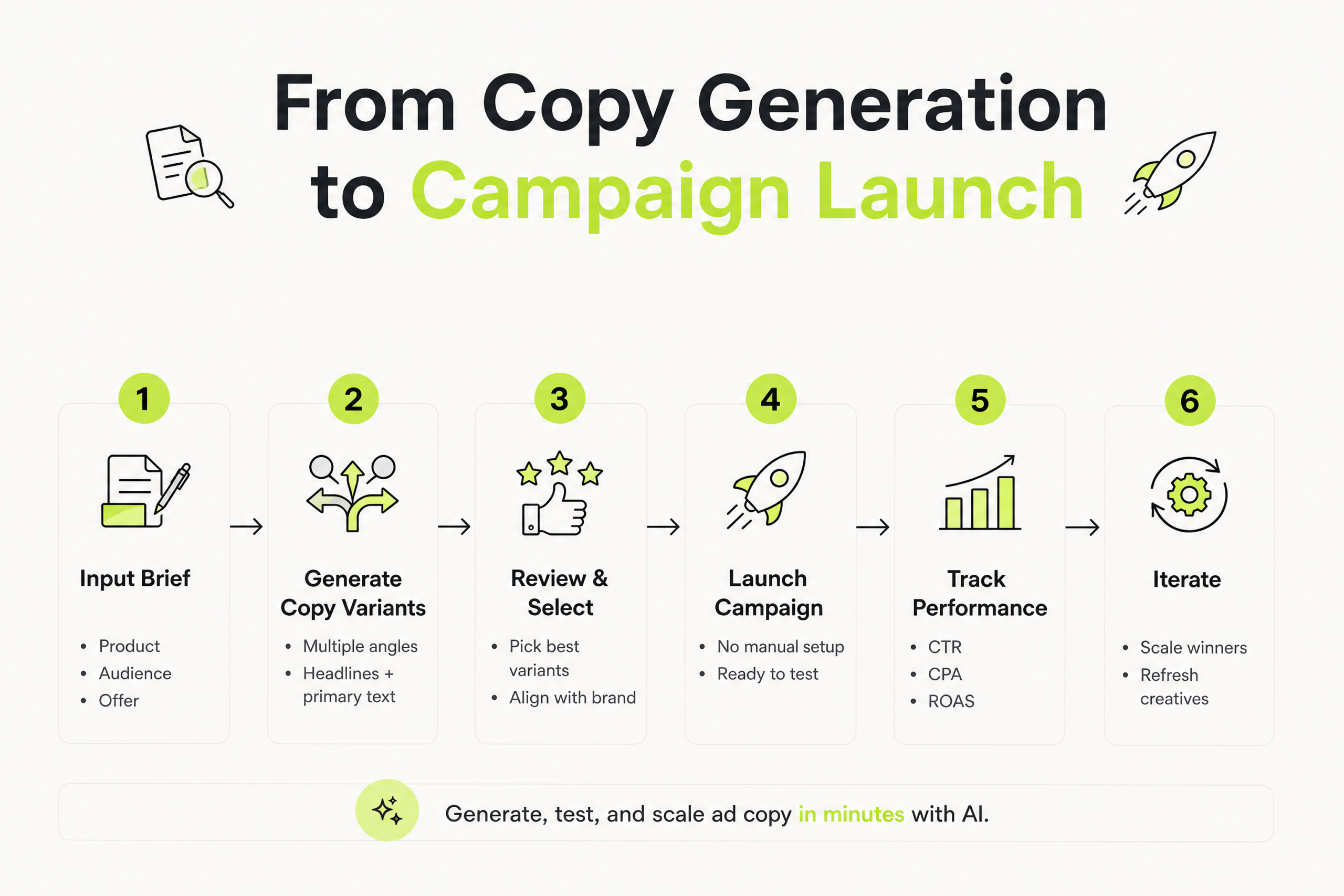
FabFunnel doesn’t replace your human copywriting instinct – it gives it the production infrastructure to operate at Meta’s speed and scale.
Conclusion: Stop Writing One Ad at a Time
Neither AI nor human copy wins universally. The winner is the advertiser who tests the most variants at the highest quality, across every ad component and format.
FabFunnel makes that possible without a copywriting team or agency retainer.
Stop paying per headline. Stop waiting for briefs. Stop flying blind on what actually converts. Start generating, testing, and scaling at the speed of high-performance media.
Book a demo → see FabFunnel generate your first AI Generated Ad Copy variants live, tailored to your brand and ready to test in under 10 minutes.
Frequently Asked Questions
1. How does FabFunnel’s AI Ad Copy Generator differ from ChatGPT or generic AI writing tools?
Generic tools like ChatGPT produce general ad copy – it often sounds generic because it’s trained on broad internet text, not conversion frameworks. FabFunnel’s Ad Copy AI Generator is purpose-built for Meta advertising.
2. Which Meta ad formats perform best with AI-generated ad copy?
AI generally performs strongest on direct response and lead generation campaigns, as well as retargeting sequences and carousel or product feature ads. On the other hand, human‑written copy typically outperforms AI when the goal is brand awareness, storytelling, or emotionally nuanced campaigns—scenarios where authenticity is absolutely critical.
3. How many copy variants should I test per campaign?
Most Meta advertisers under‑test copy by a wide margin, which leaves performance on the table. To fix that, we recommend testing at least 5–10 distinct copy angles per campaign, and at least 2–3 distinct hooks within those angles. FabFunnel makes this easy by generating multiple variants in just minutes, so you can run robust A/B tests without overwhelming your team.
4. Does using AI for ad copy affect ad delivery or performance on Meta’s algorithm?
No negative impact has been documented. In fact, Meta itself has built its own internal AI for ad creative, and its Advantage+ campaigns increasingly leverage AI-generated variants to optimize delivery. FabFunnel’s outputs are structured as standard Meta Ad Manager assets.
5. How quickly can I get started with FabFunnel’s AI Ad Copy Generator?
Most users go from account creation to launching test-ready ads in under 30 minutes. FabFunnel returns 5–10 fully structured copy variants within 10 minutes, complete with aligned creative suggestions.