Quick Answer
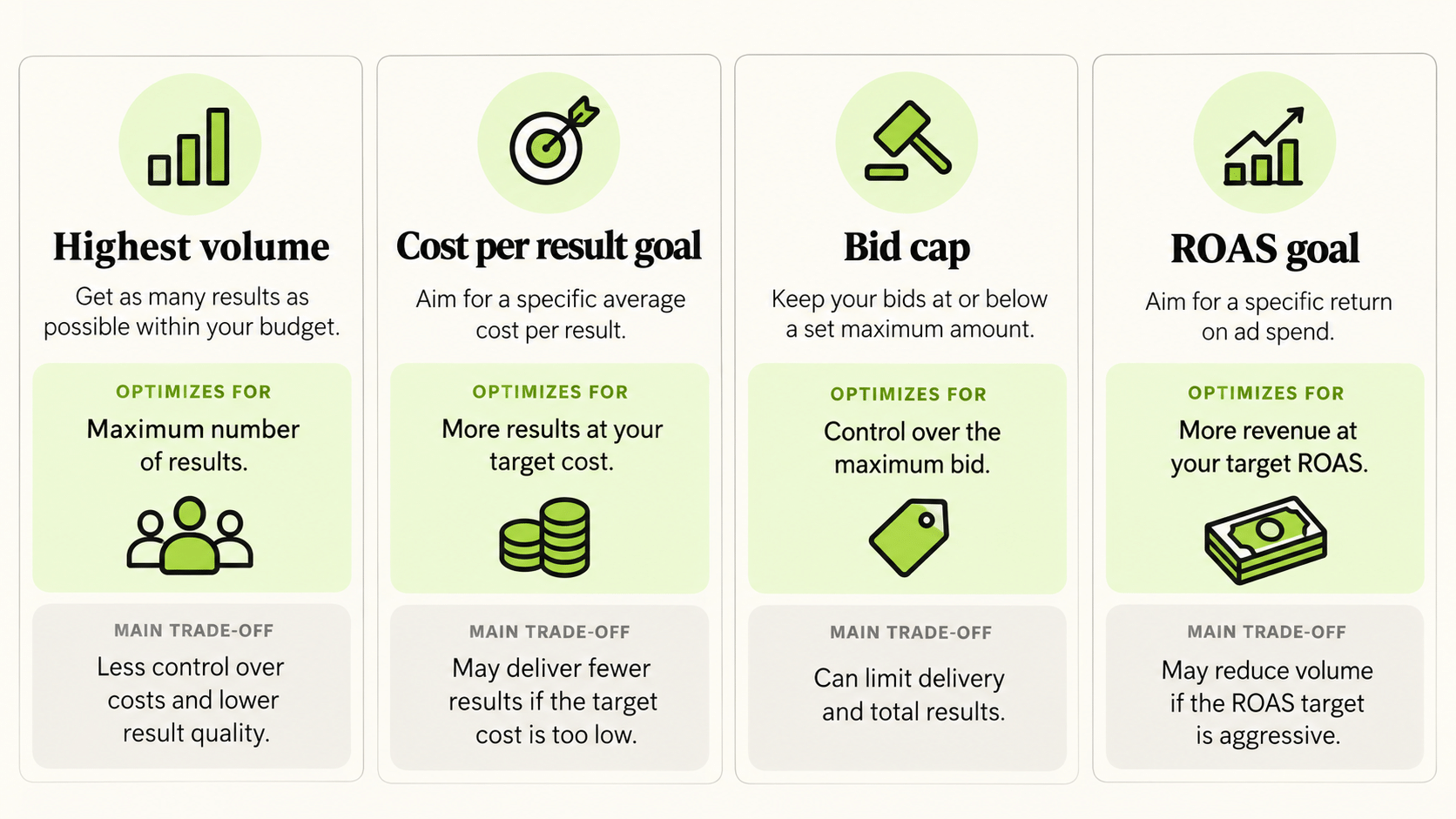
Facebook bidding strategies tell Meta how to spend your budget in the ad auction. Meta’s help pages describe four: highest volume, which aims for the most results from your budget; cost per result goal, which aims to hold costs near a target you set; ROAS goal, which targets a return on ad spend and requires value optimization; and bid cap, which sets a maximum bid in each auction. Highest volume is the default when you set no control amount. Controls trade volume for cost predictability, and a goal set too tight can slow or stop delivery. Start with highest volume, learn your real cost per result, then test a control.
What Are Facebook Bidding Strategies?
Facebook bidding strategies are the settings that govern how Meta bids on your behalf when your ad enters an auction. You set a budget and an optimization goal, such as purchases, and the strategy decides how aggressively to bid to reach that goal.
Naming is not consistent. Some Meta help pages use older terms such as cost per result goal and ROAS goal, while newer ones use cost cap and minimum ROAS. The behavior described is similar, so read the exact labels in your own Ads Manager before you follow any guide.
What Types of Facebook Bidding Strategies Are There?
| Strategy | What it aims for | Main trade-off |
|---|---|---|
| Highest volume | The most results for your budget | Cost per result can fluctuate |
| Cost per result goal | Average cost near your target | Spend may be slower; adherence is not guaranteed |
| ROAS goal | A target return on ad spend | Delivery may stop if the goal is too high |
| Bid cap | A maximum bid per auction | Needs good knowledge of conversion rates; can limit delivery |
Meta’s help pages state that highest volume is used when you do not enter a control amount. They also say a ROAS goal is available only when you optimize for value, and that a bid cap does not cap the cost per action you see in reporting, since it limits the bid in the auction, not the final average cost.
When Should You Use Highest Volume Among Facebook Bidding Strategies?
Highest volume suits situations where getting results matters more than holding an exact cost: new campaigns with no history, testing, or limited budgets where you need enough data to learn. Because it spends the budget to maximize results, your cost per result may vary from day to day.
It is also the right place to learn your baseline. Run a campaign on highest volume for long enough to see a stable cost per result, and use that number as a reference for any control you set later.
When Should You Use a Cost Per Result Goal in Facebook Bidding Strategies?
A cost per result goal suits advertisers who know what a result is worth and want costs to hover around a number. Meta’s help pages note that adherence is not guaranteed, spend may be slower than with highest volume, and the learning phase can last longer.
Set the target near your measured baseline, not below it. If you set a target far below what the market will allow, delivery slows because the system struggles to find results at that cost. Step the target in small moves, and wait for results to settle before moving again.
When Should You Use a ROAS Goal?
A ROAS goal fits ecommerce and other advertisers who optimize for purchase value and care about return. It needs value optimization and accurate value tracking. Meta’s help pages warn that if the goal is too high for Meta to meet, delivery may stop and budget may go unspent.
Before you use a ROAS goal, check that purchase values arrive correctly, and set the goal using your break-even return, not a wish. Remember that reported return uses Meta’s attribution rules, so compare it with your store’s actual revenue.
When Should You Use a Bid Cap Over Other Facebook Bidding Strategies?
A bid cap is the most hands-on control. It limits what Meta may bid in any auction. Meta’s help pages describe it as meant for advertisers who understand predicted conversion rates and can calculate the right bid. Set it too low and you may win few auctions. Set it too high and it behaves like no cap at all.
Use it when you have solid conversion data and a firm limit on what an auction is worth, and monitor delivery closely after you set it.
How Do You Choose the Best Bid Strategy for Facebook Ads?
The best bid strategy for Facebook ads depends on your data and your goal. Use this order of questions.
- Do you have stable conversion history? If not, start with highest volume.
- Do you have a firm cost target? If yes, test a cost per result goal near your baseline.
- Do you optimize for value and know break-even return? If yes, consider a ROAS goal.
- Do you know what each auction is worth? If yes, a bid cap is an option.
There is no best campaign bid strategy for Facebook in general. The right answer is the one that meets your goal in your account, so test it.
How Do You Test Facebook Bidding Strategies Fairly?
A fair test needs equal conditions. Use the same creative, audience, and budget, and change only the strategy. Run each long enough to leave the learning phase and gather results, and compare cost per result, volume, and spend. If one strategy underspends, note it. Underspending is a result, and sometimes a signal that the control is too tight.
Avoid changing a control amount repeatedly in a short period, since large or frequent edits can reset learning. Record each change with its date so you can connect results to settings.
How Do Learning and Budget Interact With Facebook Bidding Strategies?
Every one of the facebook bidding strategies above works inside the same learning process. After you create or significantly edit an ad set, Meta’s delivery system needs time and enough results to settle. A tight control lengthens that period, because fewer auctions meet your limit. A small budget does the same, since each day produces few results.
Plan the budget with the strategy in mind. If you want a cost per result goal of a given amount, make sure your daily budget can fund several results at that cost each day. Otherwise the system has too little to learn from, and the numbers swing without telling you anything useful.
How Does Budget Setup Affect Facebook Bidding Strategies?
If you use campaign budget optimization, Meta’s help pages say you choose the bid strategy at the campaign level and then set the control amount within each ad set. If you set budgets at the ad set level, you choose the strategy there. Check which level your campaign uses before you edit, because the control may live in a different place than you expect.
How Does FabFunnel Fit Into Facebook Bidding Strategies?
FabFunnel does not choose bid strategies for you, and this article does not claim it does. Bid strategy is set in Meta’s own tools. FabFunnel helps with the surrounding workflow. Bulk Launcher launches campaigns on Meta, TikTok, and NewsBreak, with a stated speed claim of 200+ campaigns in under two minutes once setup is done, which helps when you test several strategies side by side. Automation is rule-based and works at campaign, ad set, and ad level. Multi Ad Account Reporting shows Meta, TikTok, and NewsBreak alongside Google and Snapchat, with columns that follow each platform’s own metrics. Copilot answers questions and recommends; it does not change your account.
Speed claims depend on your setup, so measure them yourself. This article does not describe how bid settings are handled inside FabFunnel launch flows, so confirm that with the product before you plan around it.
What Mistakes Should You Avoid With Facebook Bidding Strategies?
Common mistakes include setting a cost target well below your baseline, using a ROAS goal without accurate value tracking, changing controls too often, judging a strategy before it has enough data, and leaving a bid cap in place after conditions change. Another is treating a control as a guarantee: Meta’s help pages are clear that results are not guaranteed.
FAQs
What are Facebook bidding strategies?
They are settings that control how Meta bids for you in the ad auction.
What is the default Facebook bid strategy?
Meta’s help pages say highest volume is used when you do not enter a control amount.
What is the difference between a cost cap and a bid cap?
A cost cap aims for an average cost around a target, while a bid cap limits the maximum bid in each auction.
Which bid strategy is best for Facebook ads?
It depends on your data and goal. Start with highest volume, then test controls.
Why did my ad set stop spending?
A control that is too tight, such as a high ROAS goal or low bid cap, can limit delivery.
Does FabFunnel set bid strategies?
Bid strategy is set in Meta’s own tools. FabFunnel helps with launching, reporting, and automation around them.
Where to Start
Run a campaign on highest volume to find your baseline, then test one control with the same creative and audience. To launch and compare variations at scale, try FabFunnel or explore the full toolset at Fab AI. Teams often search for a “Facebook ads bid strategy”, the “best campaign bid strategy Facebook” advertisers can use, or the “types of bid strategy in Facebook ads”; all three questions require the same objective-and-constraint comparison.