Quick Answer
PPC advertising management is the ongoing work of planning, launching, monitoring, and improving pay-per-click campaigns so that spend produces results at an acceptable cost. It has five parts: account structure, targeting and bids, creative and copy, tracking, and a regular review routine. The strongest accounts are not the most complex. They have clean structure, trustworthy conversion data, and a weekly habit of pausing waste, testing one change at a time, and recording what happened. Automate repeated tasks, but keep a person responsible for budget and strategy.
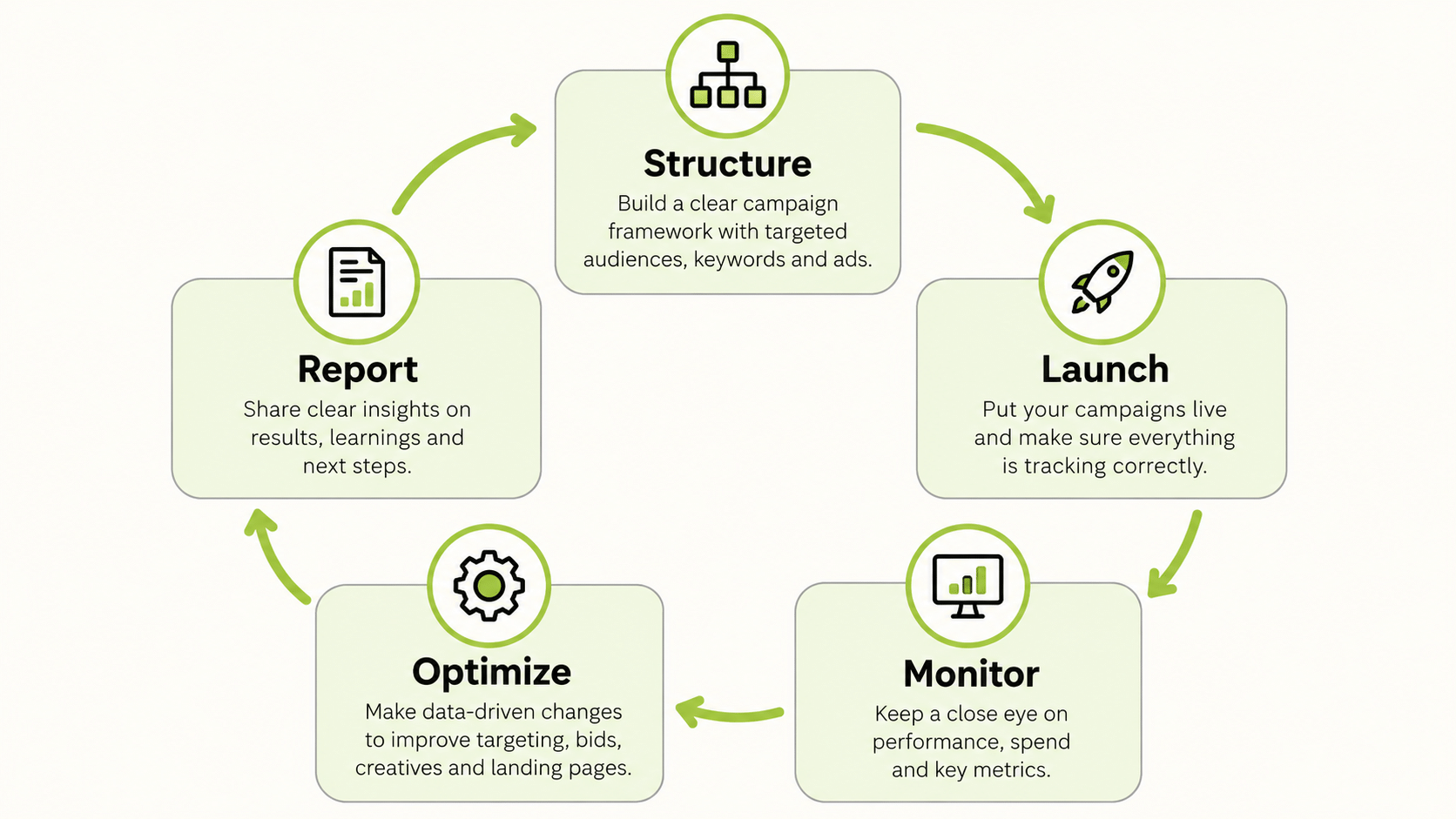
What Is PPC Advertising Management?
PPC advertising management covers everything between deciding to run pay-per-click ads and reading the results. Pay-per-click means you pay when someone clicks, which is the billing model for search ads and many social and display formats, though platforms also offer other billing models.
The work divides into setup and upkeep. Setup includes goals, account structure, tracking, audiences, creative, and budgets. Upkeep includes monitoring delivery, adjusting bids and budgets, refreshing creative, and reporting. Most accounts lose money in upkeep, not setup, because campaigns drift when nobody reviews them.
How Should You Structure Campaigns for PPC Campaign Management?
Structure decides how clearly you can read results. Group campaigns by goal, product line, or audience, and keep ad groups or ad sets tight enough that the ads inside them fit the same intent.
| Level | What it should hold | Common mistake |
|---|---|---|
| Account | Clear naming and conversion goals | Mixed goals with no labels |
| Campaign | One objective and one budget logic | Too many objectives in one campaign |
| Ad group or ad set | One theme or audience | Broad groups that hide what works |
| Ad | A distinct creative or message | Tiny variants with no real test |
Use naming conventions that include platform, goal, product, and date. When an account has hundreds of campaigns, good names are the difference between a quick audit and an afternoon of guessing.
What Are the Core Levers of PPC Campaign Optimization?
PPC campaign optimization works through a short list of levers.
- Targeting. Narrow or widen audiences, keywords, and placements based on results.
- Bids and budgets. Move spend toward what returns more, using the bidding options each platform provides.
- Creative and copy. Test hooks, offers, and formats. Weak creative is the most common cause of poor results.
- Landing pages. Match the page to the ad promise and remove friction.
- Tracking. Fix missing or duplicated conversions before you optimise anything else.
Change one lever at a time. If you change targeting, bids, and creative together, you will not know which one helped.
How Do You Run a Weekly PPC Ad Campaign Management Routine?
A repeatable routine matters more than clever tactics. A simple weekly rhythm looks like this.
- Check delivery. Did each campaign spend its budget? If not, find the constraint: bid, audience, or approval.
- Check tracking. Are conversions recording as expected?
- Compare cost per result with target. Look at the trend, not a single day.
- Cut waste. Pause ads, keywords, or placements that spent without results, once they have enough data to judge.
- Choose one test. Write the hypothesis, the change, and the date.
- Record the outcome. A short log makes the next review faster.
Monthly, step back: review structure, audience overlap, creative fatigue, and budget allocation across campaigns.
How Does Google PPC Campaign Management Differ From Social?
Google PPC campaign management is largely intent-led. People search for something, and your ads respond. Keyword match types, negative keywords, search terms reports, and quality signals matter, along with Shopping or Performance Max campaign types where they fit your goals. Google’s tools also offer automated bidding, which works best when conversion data is accurate and plentiful.
Social platforms such as Meta and TikTok are interruption-led. People are not searching, so creative and audience signals carry more of the load. Frequency, creative fatigue, and audience saturation matter more here.
The routine is the same on both, but the levers differ. Do not copy a Google structure onto a social account or the reverse.
What Tools Help With PPC Advertising Management?
Native tools in each platform handle the basics. Third-party tools become useful when you manage many accounts or platforms. Compare them on four things: which platforms they act on and which they only read, how they handle rules and approvals, what reporting they offer, and how cost scales with accounts.
Be cautious with automation. A rule that pauses or scales spend is useful and also dangerous when thresholds are wrong. Start with a narrow scope, log every action, and review rules weekly.
How Does FabFunnel Fit Into PPC Advertising Management?
FabFunnel positions itself as campaign execution infrastructure for the repeated parts of PPC advertising management. Bulk Launcher launches campaigns on Meta, TikTok, and NewsBreak, with a stated speed claim of 200+ campaigns in under two minutes once setup is done, using five launch flows: New Launch, Relaunch, Clone, Creative Library Folder Launch, and launching from Genie. Automation is rule-based and works at campaign, ad set, and ad level. Multi Ad Account Reporting shows Meta, TikTok, and NewsBreak alongside Google and Snapchat, with columns that follow each platform’s own metrics. Copilot answers questions about account performance and recommends actions; it does not change your account.
Boundaries to note: launch and automation apply to Meta, TikTok, and NewsBreak, so Google PPC campaigns are managed in Google’s own tools, and Google is connected for reporting only. This article does not describe specific rule triggers, so check the product for what is available. Speed claims depend on your setup, so measure them yourself.
How Do Teams Divide PPC Advertising Management Work?
In small teams one person handles PPC advertising management end to end. As spend grows, the work splits. One person owns strategy and budgets, another builds and launches campaigns, a third produces creative, and someone owns tracking and reporting. Without clear owners, tasks fall between roles, and weekly reviews quietly stop.
Agencies face a sharper version of the same problem because each client has its own accounts, goals, and reporting needs. For agencies, PPC advertising management depends on templates: a standard structure, standard naming, and a standard report that can be adapted per client. Templates make quality repeatable and make it easier to hand an account to a new person.
Whatever the size, write down who owns each part of PPC advertising management, and review that list when the team changes. A short ownership table is enough, as long as it is current.
What PPC Advertising Management Mistakes Cost the Most?
Costly mistakes repeat across accounts: running without reliable conversion tracking, judging ads on too little data, changing several things at once, leaving underperformers running because nobody checked, and scaling budgets before results are stable. Another is chasing a platform’s reported return without checking it against real revenue and margin.
A good guard is a short pre-launch checklist. Confirm tracking, confirm the landing page works on mobile, confirm budgets and schedules, and confirm that someone owns the weekly review.
How Do You Report on PPC Advertising Management?
Reports should answer what happened, why, and what you will do next. Lead with spend, results, and cost per result against target. Add one or two insights, such as the creative that carried the month or the audience that stopped working. End with the next test.
When you report across platforms, state which attribution window each platform uses. Platform totals use different rules, so compare trends within a platform and use backend revenue as the check on the total.
FAQs
What is PPC advertising management?
It is the ongoing work of planning, launching, monitoring, and improving pay-per-click campaigns.
How often should I optimize PPC campaigns?
Review delivery and tracking weekly, make one considered change at a time, and do a structural review monthly.
What is the difference between PPC campaign management and optimization?
Management covers the whole process. Optimization is the improvement work within it.
Can FabFunnel manage Google PPC campaigns?
No. FabFunnel launches and automates on Meta, TikTok, and NewsBreak. Google is reporting only.
Should I automate PPC management?
Automate repeated tasks with narrow rules and logs, and keep a person responsible for budget and strategy.
What should a PPC report include?
Spend, results, cost per result against target, key insights, and the next test.