Quick Answer: Give a test a minimum of three to seven days of live delivery, and hold off on a final call until each variant clears roughly 1,000 impressions and 50 to 100 conversions on your decision metric. Below those marks, day of week swings and audience rotation can flip the apparent winner. Sound creative testing respects time and sample size, not just spend.
Why Creative Testing Needs a Time Axis, Not Just a Spend Budget
Most teams size a test by budget: run $500 per variant and see what wins, a common shortcut in ad creative testing that skips the calendar entirely. That ignores how unevenly ad delivery moves across a day or a week. Auction pricing and audience saturation shift independently of how much money has cleared the account, so a test that hits its spend target in six hours has not necessarily seen enough real-world variation to produce a trustworthy answer.
Creative testing is a statistics problem wearing a marketing costume. The question is whether an observed gap in CTR, CVR, or CPA reflects a real difference in creative quality, or noise from a small, lopsided sample. Time matters because it guarantees exposure to different days and different slices of the audience. Spend can be front-loaded into an afternoon; time cannot.
If you want a structured process for running these tests, see FabFunnel’s creative testing framework for Meta and TikTok ads.
Sample Size: How Many Impressions and Conversions Before a Result Means Anything
There is no formula that fits every account, but the logic holds across them for creative ab testing on any platform. Impressions establish whether a CTR difference is real. A common rule of thumb is at least 1,000 to 3,000 impressions per variant before treating a CTR gap as meaningful, leaning toward the higher end when the gap is under half a point, a threshold that applies equally to dynamic creative testing where several assets rotate at once.
Conversions are the harder threshold, since conversion events are rarer than clicks by a wide margin. A useful floor is 50 conversions per variant for a rough read, and 100 or more before treating a CPA or ROAS difference as something worth defending. Below 50, a single high-value order or one tracking hiccup can swing the apparent winner entirely. These are general statistical guardrails, not numbers unique to any platform, since conversion differences are mathematically harder to detect than click differences.
The Day-of-Week Problem: Why a Minimum Window Beats a Spend Target
Even a well-funded account cannot skip the calendar. A B2B audience often converts differently on Tuesday than on Saturday, and e-commerce audiences frequently show weekend spikes that do not reflect weekday intent. If a test starts Thursday and gets killed by Sunday, the “winner” may just be the ad that happened to run during the weekend spike.
This is why a minimum window matters independently of how fast spend accumulates. A test that clears its budget in 36 hours because of a cheap auction still has not seen a full week of behavior. Hold every test open for at least a week when the goal is a final decision, even if impression and conversion thresholds are cleared earlier. A shorter window is fine for an early-kill call, not a final one, since audience delivery mix also shifts as a campaign matures from mostly cold traffic toward warm and retargeting segments.
Early-Kill Checkpoint vs. Final-Winner Checkpoint
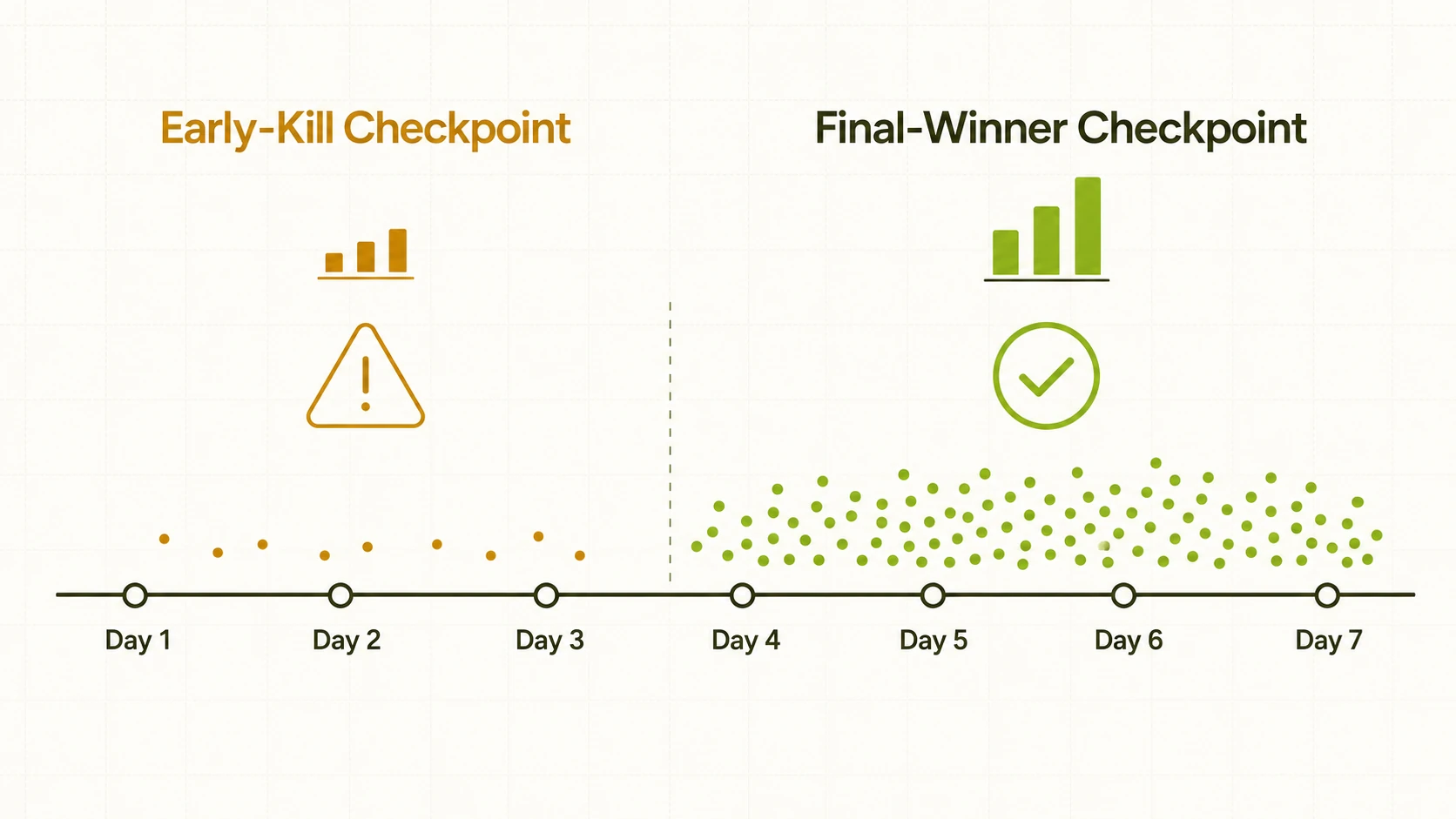
Not every checkpoint carries the same weight, and treating them as interchangeable is where bad calls come from. An early-kill checkpoint exists to catch creative that is clearly broken: a hook with almost no engagement, a CTR far below account average, or a landing mismatch. A final-winner checkpoint exists to make a scaling decision, and it needs a much higher bar of evidence.
| Checkpoint type | Minimum threshold | Purpose |
|---|---|---|
| Early kill | 500 to 1,000 impressions, 24 to 48 hours | Catch obviously broken creative before wasting further budget |
| Mid-test check | 1,000 to 2,000 impressions, 3 to 4 days, 25 to 50 conversions | Directional read only, not a scaling decision |
| Final winner | 1,000+ impressions per variant, 5 to 7+ days, 50 to 100+ conversions per variant | Statistically defensible call to scale or permanently kill a variant |
| Reconfirmation | Additional 3 to 5 days after scaling | Confirms the winner holds once budget and audience size increase |
The common mistake is applying final-winner confidence to an early-kill read. Pausing an ad after 40 impressions of visibly soft CTR is fine budget hygiene. Declaring it the permanent loser and reallocating the full test budget is a different decision requiring different evidence.
Meta vs. TikTok: How Baseline CTR and CVR Change the Timeline
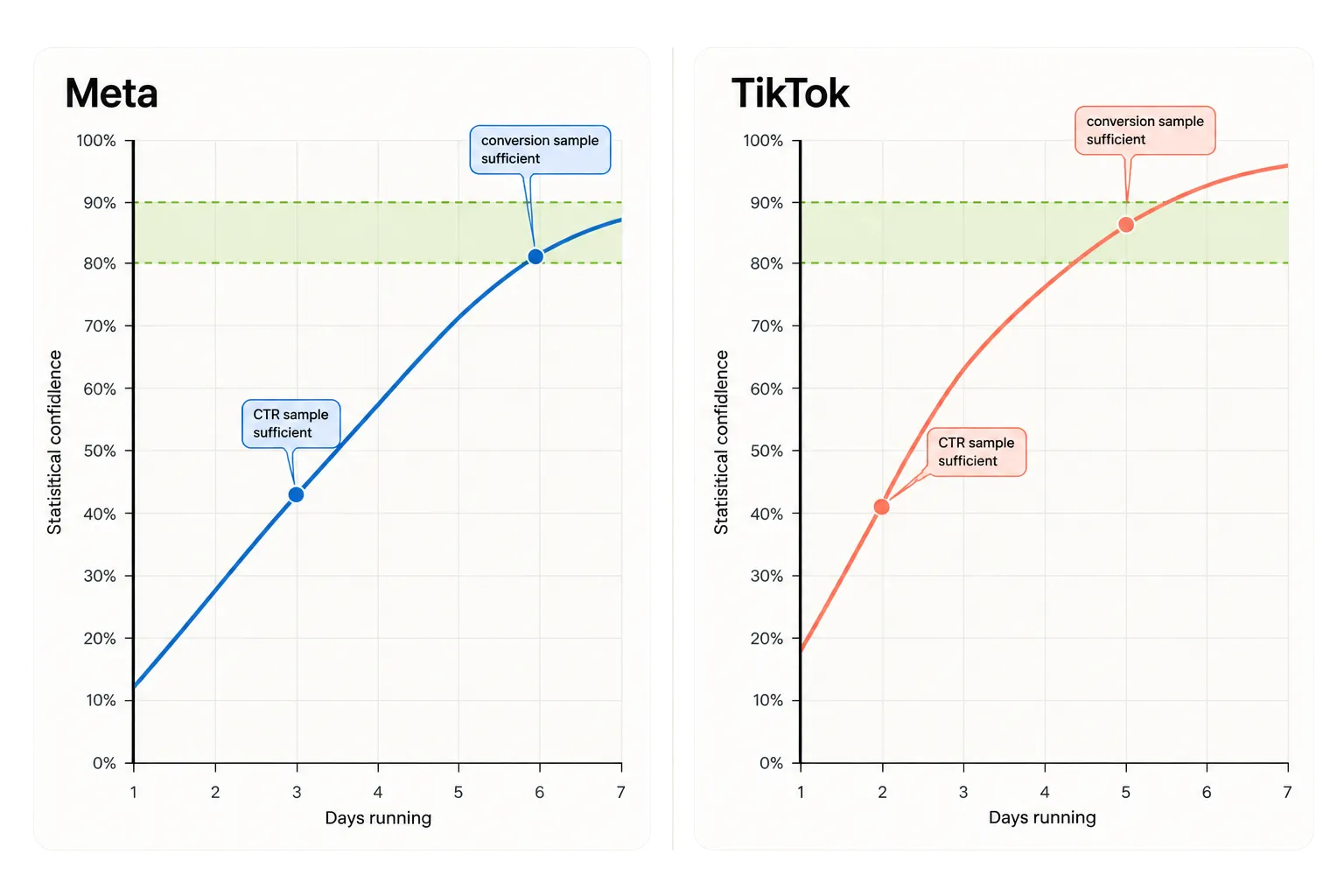
Platform behavior changes how fast a test can honestly reach significance, which is part of why a fixed time window is a better anchor than a fixed spend target. TikTok’s feed environment typically produces a higher baseline CTR than Meta’s feed and stories placements, so a TikTok test can accumulate a stable click sample somewhat faster than an equivalent Meta test running the same budget, a pattern that also holds true for facebook creative testing specifically.
Conversion rate is harder to generalize across platforms, since it depends more on vertical, offer, and landing page than on platform mechanics. This is why a fixed multi-day minimum window travels better across Meta, TikTok, and NewsBreak than a fixed impression or spend number: day-of-week and audience-rotation effects apply regardless of which platform is delivering the ad, even when the raw numbers differ. A TikTok test can sometimes reach a defensible early read a day or two faster, but the minimum window for a final decision should not shrink just because click data arrived faster. Conversion volume, not click volume, is usually the binding constraint.
The Cost of Calling a Winner Too Early
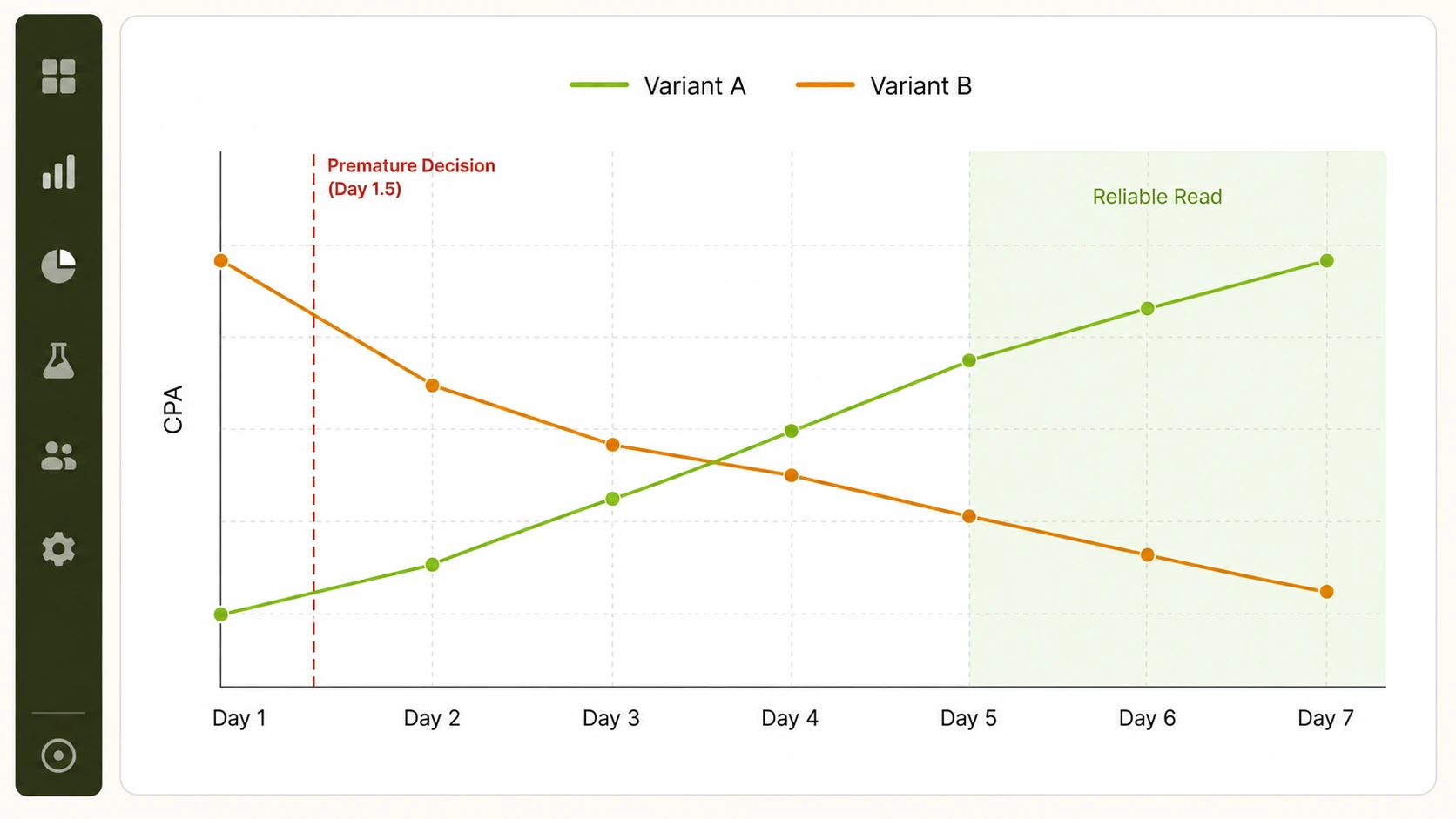
Consider a mid-size DTC brand running two variants against the same audience and budget on Meta. Variant A spends $600 in the first 30 hours and shows a CPA of $18 against a $25 target. Variant B spends $600 over the same window and shows a CPA of $31. Variant A looks like the clear winner, and a team under pressure kills Variant B and shifts the full daily budget to Variant A.
The problem: Variant A had converted on 14 orders in that window, Variant B on 9. Neither clears even the early-kill threshold for a conversion-based decision, let alone a final one. Over the following five days, Variant B’s CPA would likely have settled closer to $22 as its delivery mix normalized, while Variant A’s CPA often drifts upward once its cheapest, most responsive audience slice saturates in the first day.
The cost is not abstract. The brand scales a creative that has already used up its cheapest audience segment, watches CPA climb over the next two weeks, and shelves a creative that may have performed better at scale. That lost signal does not show up as a line item. It shows up as a slower refresh cycle and a false story about which hook or script “worked,” carried into the next round of briefs.
Where Automation Helps, and Where It Can Break a Test
Automation is useful for protecting budget once a decision has been made, but it can undermine a test still in progress if rules are not scoped correctly. FabFunnel’s automation rules engine lets you define conditions such as CPA ceilings, ROAS floors, or frequency caps, running continuously across connected accounts with every action logged against the condition and timestamp that triggered it.
The risk during an active test is a rule that pauses or reallocates budget away from a variant based on a CPA reading taken before the test has cleared a trustworthy sample size. A rule set to pause anything above a $30 CPA, applied to a variant with only 12 conversions, can end a test before it produces a real signal, and the log entry will look clean and defensible even though the underlying data was not stable yet. The fix: exclude active test campaigns from aggressive rules, or set the rule’s minimum conversion count higher than your early-kill floor.
Multi Ad Account Reporting syncs spend, ROAS, CPA, CPC, and CTR across every connected account roughly every 15 minutes, making it easier to check where a test stands against these thresholds without switching between platform dashboards. Once a winner is confirmed, Video Sage can break down the winning creative’s hook, script, and structure, useful for understanding why it won rather than just that it won.
FAQs
How long should a creative test run on a limited daily budget?
The time floor does not shrink just because spend is lower. A limited budget usually means the test needs more calendar days, since it takes longer to accumulate 1,000 impressions and 50 to 100 conversions per variant.
Can a test ever be trusted after only 24 to 48 hours?
Only for an early-kill decision, such as pausing a variant with an obviously broken hook or a technical issue. A 24 to 48 hour read should not declare a permanent winner, since it has not passed through a full day-of-week cycle or reached a defensible conversion sample.
Why does TikTok sometimes reach significance faster than Meta?
TikTok’s feed format typically produces a higher baseline CTR than Meta’s placements, so a TikTok test can build a stable click sample in less time. Conversion volume, which depends more on offer and landing page than platform, is usually the slower threshold on both.
What happens if two variants are still statistically tied after a week?
A tie after a full window with adequate sample size is a legitimate outcome, not a failed test. Run both and let a secondary metric, such as frequency or CPA stability, break the tie rather than forcing a winner from a marginal gap.
Should automation rules be turned off during an active creative test?
Not entirely, but rules with aggressive CPA or ROAS thresholds should exclude active test campaigns, or use a minimum conversion count above the test’s early-kill floor. Otherwise a rule can pause a variant based on a reading taken before the test produced a trustworthy result.
Does a higher daily budget shorten the minimum test window?
It shortens the time needed to reach impression and conversion thresholds, but it does not remove the need for a minimum calendar window. Day-of-week and audience rotation effects apply regardless of spend level, so even well-funded tests benefit from staying open a full week before a final call.
How many variants should run in one creative testing cycle to keep timelines reasonable?
Testing more variants at once splits the same budget and audience across more paths, slowing how quickly each one reaches its sample size threshold. Two to three variants per test is a more practical ceiling than four or five if the goal is a trustworthy read within a reasonable window.
What is the difference between statistical significance and a good enough directional read?
Statistical significance means the observed gap between variants is unlikely to be explained by random sample noise, requiring adequate volume and enough elapsed time to smooth out day-of-week effects. A directional read is a lower-confidence signal useful for early-kill decisions, not for a final call.
Where FabFunnel Fits Into Creative Testing
Consistent test tracking like this is part of what FabFunnel’s creative testing framework is built to support. If you are running creative testing across Meta, TikTok, and NewsBreak and want reporting synced across accounts to check these thresholds in one place, explore Multi Ad Account Reporting or see how Video Sage can help diagnose winning and underperforming video creatives.
For teams that want to move from testing manually to a connected creative workflow, FabFunnel’s Creative Generations can help turn test ideas into new ad variations, while the Automation Rules Engine can handle predefined performance actions after the test has produced a usable signal.
Explore FabFunnel to see how creative generation, testing, campaign automation, and performance reporting fit into one workflow.