Video has been the dominant ad format on TikTok and Meta for a while now. What’s changed is how the best-performing teams are producing it.
The advertisers scaling fastest in 2026 aren’t running bigger production budgets. They’re using AI video ads tools to generate more creative volume, test faster, and keep content fresh without rebuilding their entire production process every two weeks. The tools have matured enough that the output is competitive – and the teams ignoring them are producing less, testing less, and learning slower.
This article covers how top TikTok and Meta advertisers are using AI video ads in their workflow, which tools are doing the actual work, and what tactics separate the teams getting results from the ones just generating content.
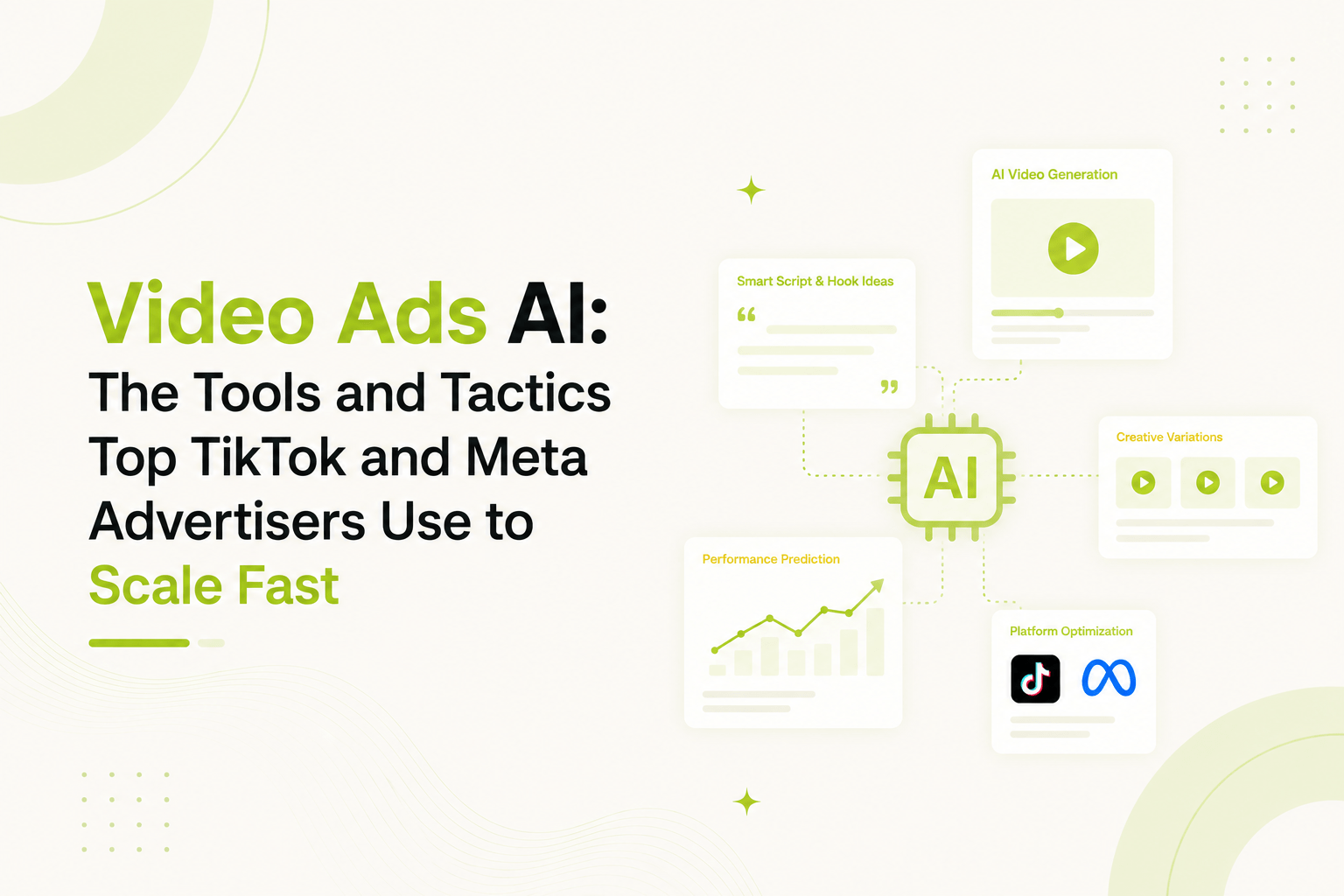
Video ads AI is the use of AI to create, analyze, and adapt video ads. Top TikTok and Meta advertisers use it in four ways: generating UGC-style variations, testing more hooks in parallel, refreshing creatives before they fatigue, and adapting one video to every placement. What decides the results is brief quality, analysis before generation, and selective testing.
Why Did Video Ad Production Become a Bottleneck?
Because TikTok and Meta both reward a steady flow of fresh creative, and standard production teams weren’t built to keep up with it. The volume problem hit before the tools caught up.
TikTok’s algorithm favors fresh content. Creative fatigue on Meta sets in faster than most teams expect – performance commonly drops off after 7-14 days of running the same creative. And both platforms reward native-looking, non-polished content over anything that looks like a traditional ad.
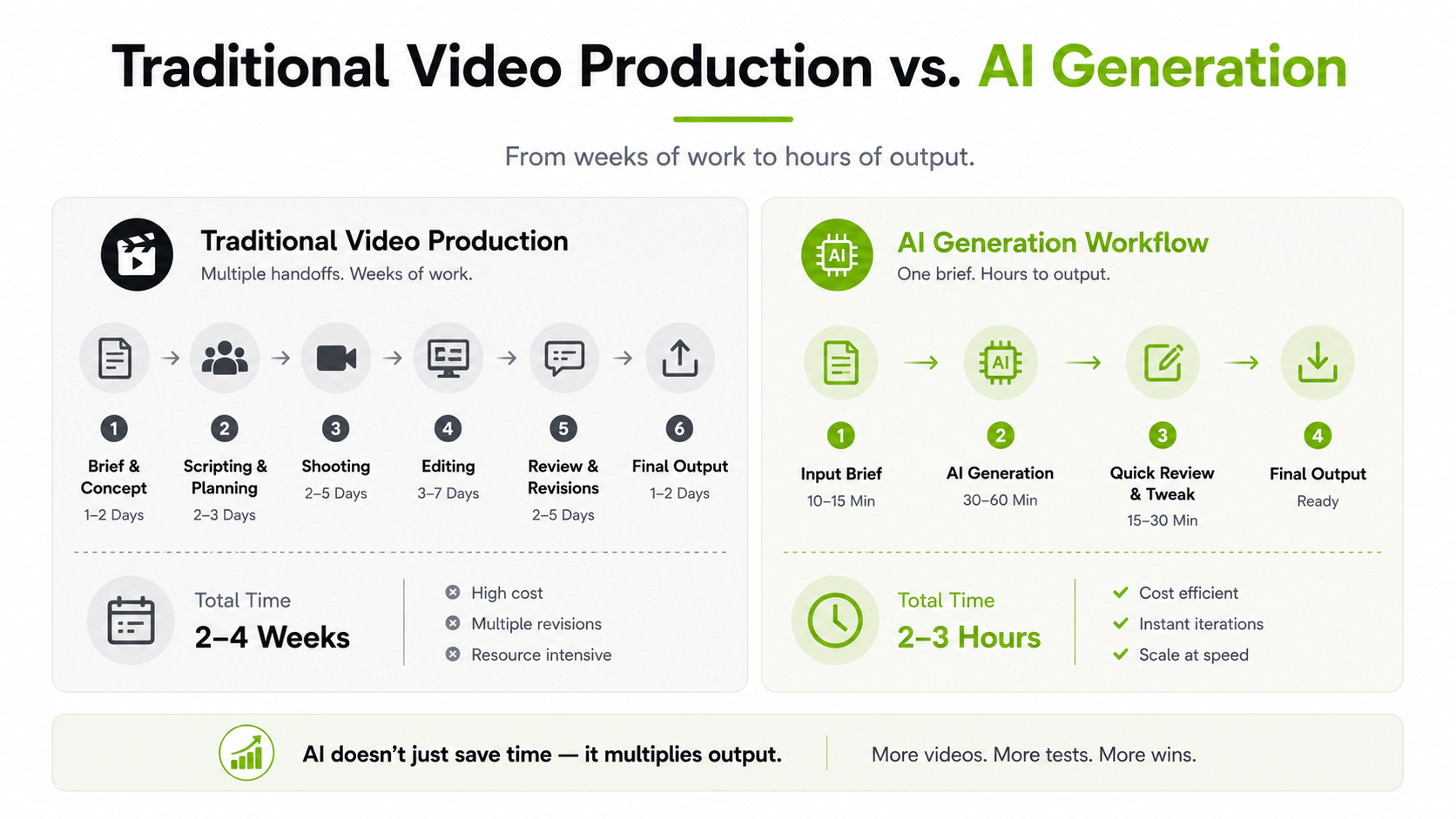
That combination created a production requirement that standard creative teams weren’t built for. A team that produces 4-6 video ads a month cannot keep up with an algorithm that rewards weekly refreshes across multiple ad sets. Agencies managing multiple clients hit the same wall faster.
The response wasn’t to hire more video editors. It was to change the production model entirely. AI video ads became the core of that new model.
How Are Top Advertisers Using AI Video Ads?
Top advertisers use AI video ads in four ways: UGC-style production, hook testing, creative refreshes, and format adaptation.
Generating UGC-Style Content at Scale
UGC – user generated content style video – often outperforms polished production on both TikTok and Meta Reels. The format is familiar to platform users, feels less like an interruption, and tends to hold attention longer in the first three seconds where drop-off is highest.
AI video models now generate UGC-style footage from a product brief, offer details, and basic creative direction. No talent booking, no filming, no editing timeline. The output mimics the aesthetic of organic creator content – handheld framing, direct-to-camera delivery, natural pacing.
This doesn’t replace authentic creator partnerships for brands where that matters. But for performance-focused advertisers who need 20 UGC variations to test messaging angles, AI generated video ads are faster and usually cheaper than sourcing 20 individual creators. It’s one of the strongest use cases for AI video ads today.
Testing More Hooks Without More Production
The hook – the first 2-3 seconds of a video ad – is the highest-leverage variable in video performance. Same product, same offer, same CTA. Different hook. Completely different results.
Most teams test 2-3 hook variations per ad set because production cost and time make more impractical. With an AI video ad creator, the same creative concept can be rendered with 10-15 different opening frames, different text overlays, different visual treatments – all generated from the same brief, reviewed in a single session, and moved into testing simultaneously.
The learning cycle compresses. Instead of finding your best hook over weeks of sequential testing, you’re running a parallel test across 10 variations and getting a signal in days.
Refreshing Creatives Before Fatigue Hits
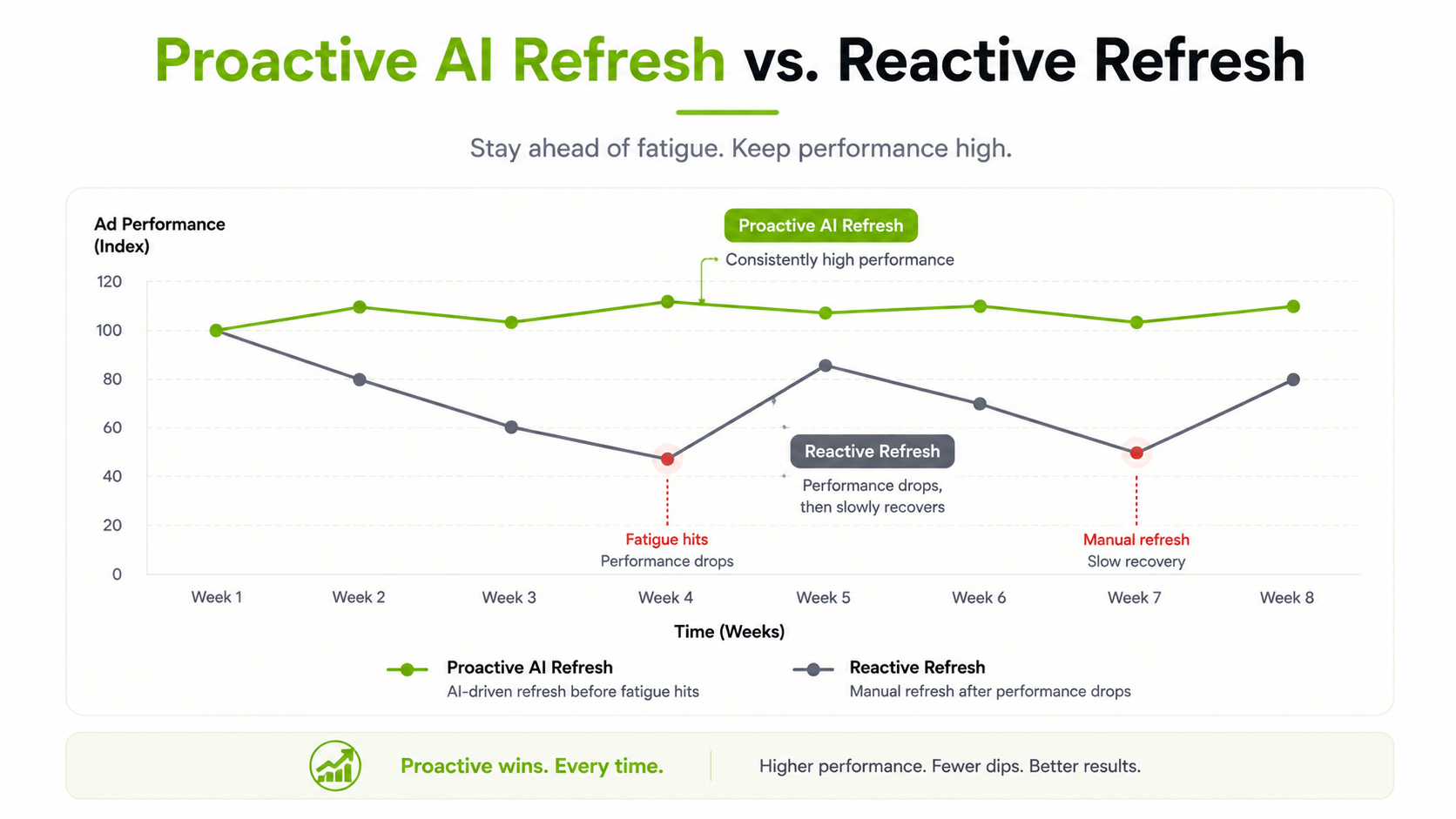
Most teams refresh creatives reactively – they wait until performance drops, then scramble to produce new content. By that point they’ve already burned through the efficiency window.
AI video generation makes proactive refreshing practical. You don’t need a production cycle to replace a fatigued creative. You generate a new variation, review it, and swap it in. The turnaround is hours, not weeks. Teams using this approach maintain performance consistency instead of riding a boom-bust cycle tied to creative freshness.
Adapting One Creative Across Platforms and Formats
A video that works on TikTok in 9:16 vertical format needs to be resized, reformatted, and often re-edited for Meta placements, Stories, and Reels. Done manually, that’s a significant production overhead for every single creative.
AI video ads handle format adaptation automatically – taking a core creative and producing platform-specific variations without rebuilding from scratch. One input, multiple outputs, all formatted correctly for each placement.
| Placement | Common aspect ratio |
|---|---|
| TikTok and Reels | 9:16 |
| Feed placements | 1:1 |
| YouTube pre-roll | 16:9 |
Which AI Video Ads Tools Are Doing the Work?
Every serious AI video ads tool handles a different part of the stack.
- AI video generation – Veo, Seedance, and others – turn a prompt plus product context into footage. Output ranges from UGC-style clips to product showcases to short-form offer ads. The quality jump this past year is real: side by side, AI-generated UGC and creator-shot UGC are getting harder to tell apart. Many of these platforms double as an AI video ad creator, turning a single brief into several ready-to-launch clips.
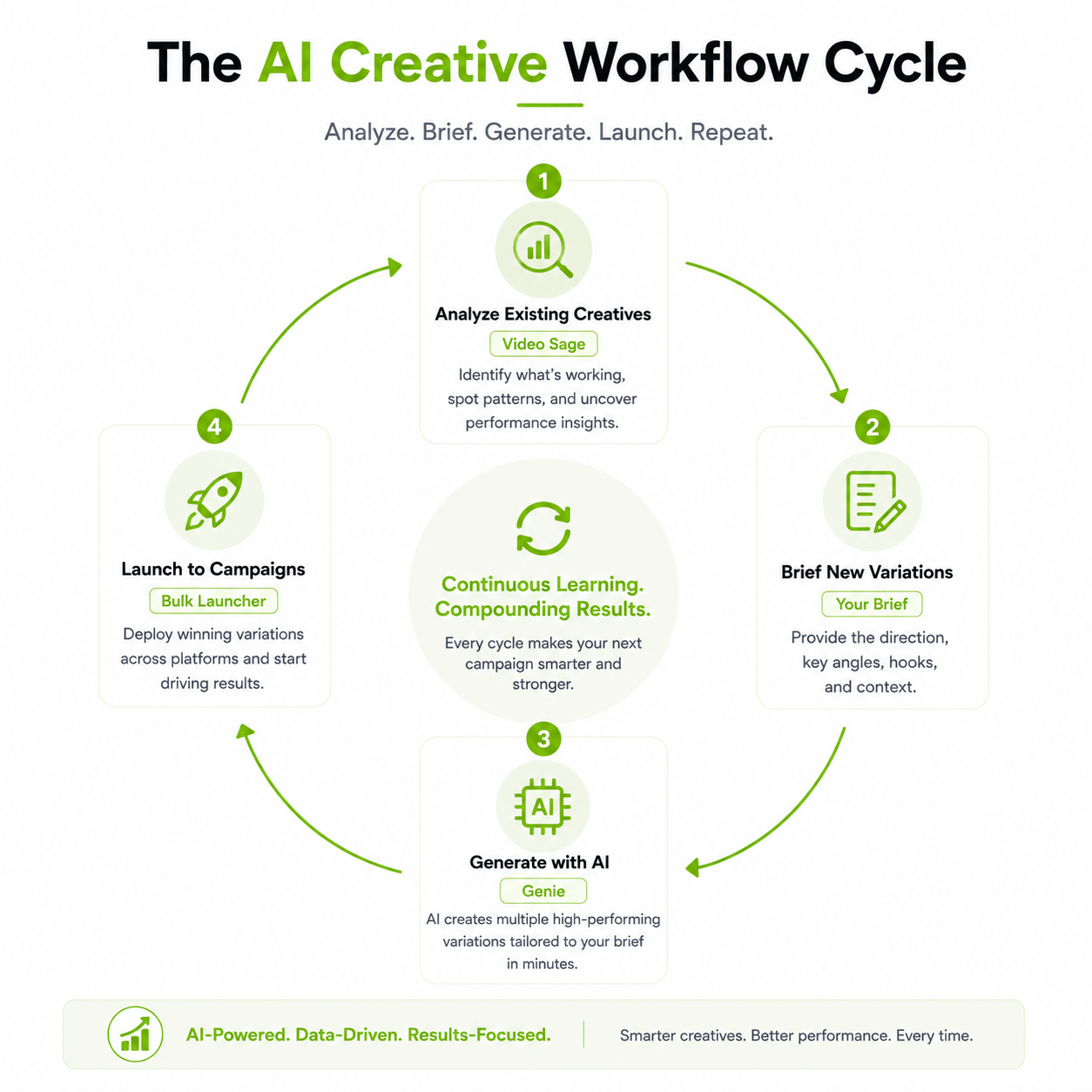
- Creative analysis – before generating new video, top teams analyze what’s already working. Video analysis tools break down existing ad creatives to identify which elements – hook type, pacing, visual treatment, CTA placement – correlate with performance. That analysis informs the brief for the next generation run.
- Campaign workflow integration – the most efficient setups connect generation directly to campaign launch. Creative goes from brief to generated output to live ad set without manual export, reformatting, or platform switching. Bulk campaign launch handles that last step.
FabFunnel’s workflow covers both ends of this – Video Sage analyzes existing video ad creative to surface what’s working, and Genie generates new video variations based on that direction, with direct launch into TikTok and Meta campaigns from the same platform.
How to choose an AI video ads tool: check whether it exports the aspect ratios you run, how much control you get over the brief, whether it can learn from your own past performance, and whether you can launch without leaving the platform.
What Separates Teams Getting Results from Teams Just Generating Content?
Three habits: better briefs, analysis before generation, and selective testing.
Having access to AI video ads tools doesn’t automatically produce better results. A few things separate teams that are using it well from teams that are just producing more mediocre content faster. Treating AI generated video ads as a shortcut instead of a discipline is where most teams go wrong.
Brief quality drives output quality. Vague prompts produce generic video. The teams getting strong output are specific – they define the hook type, the offer framing, the audience pain point, the visual aesthetic, and the CTA before they generate anything. AI amplifies the quality of the brief, not the quality of the idea.
Analysis before generation. The best-performing teams aren’t generating blind. They’re analyzing what their current top performers have in common – hook structure, pacing, format – and using that as the brief for the next round. Generation without analysis is just producing more content. Generation informed by analysis produces better content.
Selective testing, not mass launching. AI generation makes it easy to produce 50 video variations. That doesn’t mean you should test all 50. The discipline is reviewing the output, selecting the 8-10 that represent genuinely different hypotheses, and running structured tests – not flooding ad accounts with undifferentiated variations that cannibalize each other. A simple way to do this: group variations by what they test (hook, angle, or offer) and change only one of those per test.
The Takeaway: The Video Production Bottleneck Is Gone for Teams Using AI Video Ads
The constraint that limited how many video creatives a team could test in a month no longer exists for teams using AI video ads tools properly.
That’s not a small efficiency gain. It’s a structural change in how fast you can learn what works, how long you can maintain performance before fatigue sets in, and how much of your budget goes toward optimized creative versus underperforming holdovers.
The top TikTok and Meta advertisers in 2026 aren’t producing more video because they have bigger teams. They’re producing more because they changed the production model. The output is higher volume, faster to generate, and informed by analysis of what’s already working – which is a combination that manual production workflows simply can’t replicate at the same cost.
Ready to try it? Start your free trial or try Fab AI to analyze your winning creatives, generate new variations, and launch them from one place.
Frequently Asked Questions
What Is Video Ads AI?
Video ads AI is the use of AI to create, analyze, and adapt video ads. “Video ads AI” gets used for three different things: models that generate footage from a prompt, tools that analyze existing creative for what’s driving performance, and platforms that auto-adapt one format across placements. Worth splitting out – most people mean the first one, but the real infrastructure play is usually the second and third.
Do AI Generated Video Ads Actually Perform on TikTok and Meta?
Yes, particularly for UGC-style and direct response formats. AI generated video ads that mimic organic creator content can perform strongly on both platforms. The key is brief quality – well-directed AI video is competitive with creator-shot content in performance contexts.
How Often Should Video Ad Creatives Be Refreshed on Meta and TikTok?
Every 7-14 days as a baseline, though this varies by spend level and audience size. Higher spend levels exhaust creative faster. AI generation makes proactive refreshing practical – you don’t need a production cycle to replace a fatigued creative.
What Makes a Strong Hook in a Video Ad?
The hook needs to stop the scroll in the first 2-3 seconds. Strong hooks address a specific pain point directly, open with an unexpected visual, or make a claim specific enough to create curiosity. Testing multiple hook variations on the same underlying creative is the fastest way to find what works for a specific audience.
Can an AI Video Ad Creator Handle Different Platform Formats?
Yes. Most current AI video ads tools produce output in multiple aspect ratios and can adapt a single core creative to different platform specs – 9:16 for TikTok and Reels, 1:1 for feed placements, 16:9 for YouTube pre-roll. This removes the manual reformatting overhead.
What’s the Difference Between AI Video Generation and AI Video Analysis?
Generation makes new videos from a brief. Analysis goes the other way – it looks at creative that’s already live and figures out why some of it performs: hook type, pacing, where the CTA lands, visual treatment. Do both and it stops being two separate tasks. You analyze what’s working, then generate variations that build on it instead of starting from a blank brief again.
How Many AI Video Ad Variations Should I Test at Once?
There’s no fixed number, but 8-10 genuinely different variations is a sensible range. Pick variations that test different ideas (a different hook, angle, or offer) instead of near-duplicates that compete for the same budget.