Quick Answer: TikTok video ads: 9:16 vertical, 1080x1920px, 5–60s, under 500MB, MP4/MOV/MPEG/AVI/3GP. Images: JPG/JPEG/PNG under 10MB; carousels need 2–35 images plus ≥2s audio. Copy limits vary by placement – check before finalizing.
You finish creative on a Thursday. Launch is Monday morning, timed to a promo, a product drop, or a budget window that doesn’t move. Saturday afternoon, the ad sits in “Under Review.” Sunday night, it flips to “Rejected” – wrong aspect ratio, text covering too much of the frame, or a claim that tripped a filter. Now you’re re-cutting a video at 11 PM with no buffer left before launch. Most rejections trace back to a handful of tiktok ad specs and policy misses that are easy to catch before you hit submit, not after.
This post is a working tiktok ad specs checklist: video specs, image specs, ad copy specs, and policy tripwires that account for the bulk of avoidable rejections. Run your creative against it before every launch, not just the first one.
TikTok Video Ad Specs
Video is the placement most teams get wrong, usually because they reuse a cut built for Meta or YouTube without adjusting it. A wrong aspect ratio or oversized file kills the ad before a reviewer even looks at the content. The table below breaks down the tiktok ad specs that matter for In-Feed and TopView placements:
| Spec | Requirement |
|---|---|
| Aspect ratio | 9:16 (vertical) is the standard and best performer in-feed. 1:1 and 16:9 are accepted but underperform and are more likely to get flagged for letterboxing. |
| Resolution | 1080 x 1920px recommended; 720 x 1280px is the practical minimum. Anything below that gets rejected for quality, not policy. |
| Length | 5 to 60 seconds for standard In-Feed ads (up to 10 minutes on some non-Spark placements), though TikTok’s own benchmarks favor 9 to 15 seconds for completion rate. TopView runs 5 to 60 seconds. |
| File size | Under 500MB, with a practical minimum around 4KB, not a corrupted or empty file, which trips more uploads than you’d expect. |
| File format | MP4, MOV, MPEG, AVI, or 3GP. |
| Frame rate | 24, 30, or 60 fps. 30 fps is the safest default for consistent playback across devices. |
| Bitrate | Aim for 2,000+ kbps at 1080p; higher (6,000 to 8,500 kbps) for fast motion or fine detail that compresses poorly. |
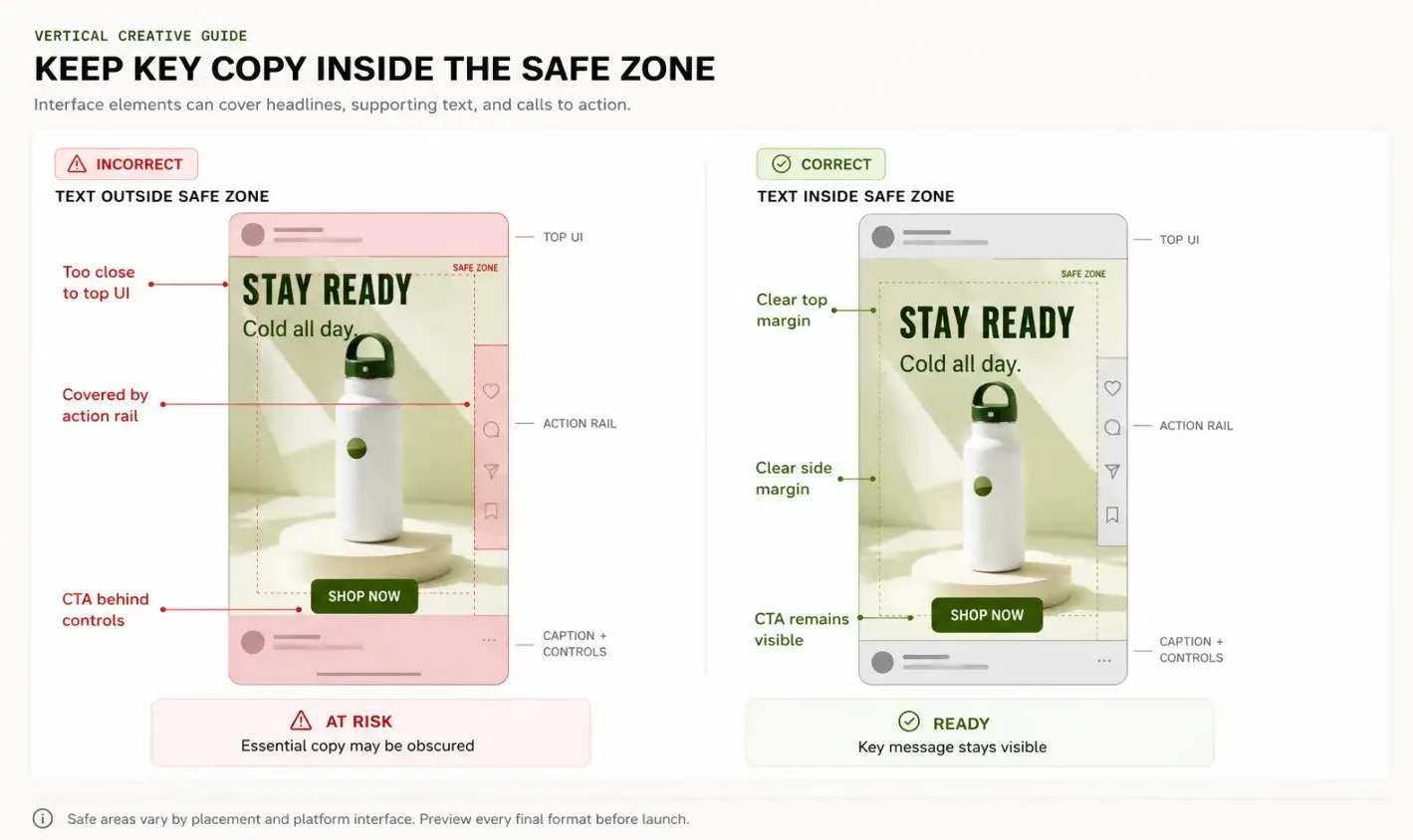
| Safe zone | Keep captions, CTAs, and logos out of the top ~150px and bottom ~350px of the frame, where TikTok’s native UI (caption, music sticker, engagement buttons) overlays your video. |
If you’re building creative in bulk across TikTok, Meta, and NewsBreak, this is the single tiktok ad specs set most likely to get pulled from the wrong template. Confirm your tiktok video ad specs match the placement you’re actually running, not the one you built the master file for.
TikTok Image and Static Ad Specs
Static ads get less scrutiny in planning than video, which is exactly why they get rejected for dumb reasons – wrong format, oversized file, missing cover image. The table below covers the tiktok ad specs for images, static ads, and carousels; get these right and most of that goes away.
| Spec | Requirement |
|---|---|
| Image formats | JPG, JPEG, or PNG. |
| File size | 10MB or less for standard image ads; carousel images are capped much lower, around 100KB each, a bulk upload built at print resolution will bounce. |
| Resolution | Minimum 600 x 600px; cover images for video ads are commonly requested at 800 x 800px. |
| Aspect ratio | 1:1, 9:16, and 16:9 are all supported depending on placement. |
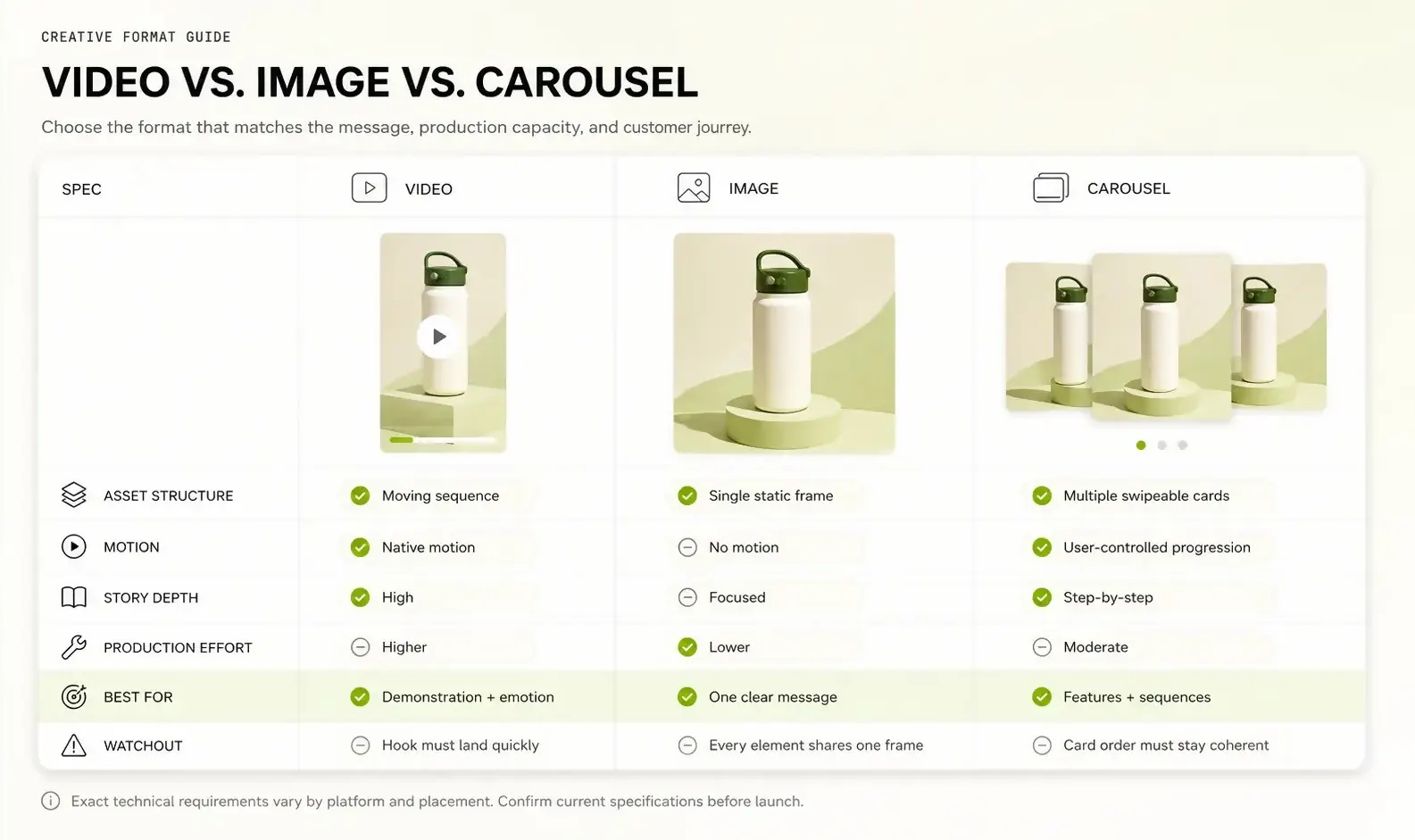
| Carousel images | 2 to 35 images per carousel, supporting 1200 x 628px (horizontal), 640 x 640px (square), or 720 x 1280px (vertical). |
| Carousel audio | Required: at least 2 seconds, MP3, WAV, M4A, or FLAC. No sound file means rejection, regardless of image quality. |
These are the tiktok ads creative specs, and more broadly, the tiktok ads specs, that trip up teams who treat TikTok like a second Meta placement rather than its own format. The audio requirement on carousels alone accounts for a chunk of “why did this get rejected, the images are fine” tickets.
TikTok Ad Copy Specs
Copy limits are where teams guess instead of checking, because the character counts are inconsistent across ad units and easy to misremember. Getting tiktok ad specs right on copy fields is less about creativity and more about not tripping a banned character or an oversized caption.
- Ad text (In-Feed primary text): No hard character limit, but practically capped by how much displays before truncation, keep it under 100 characters for full visibility. No “&”, “<“, “>”, or bare URLs in the text field.
- Ad description/caption: 1-100 half-width characters or 1-50 full-width characters (roughly 12-100 Latin, 6-50 Asian-language characters). Emojis are fine; curly braces { } and # are not.
- Carousel caption and title: Carousel placements often cap the caption at 20 characters and the title at 40 characters, noticeably tighter than standard In-Feed. Emojis are not supported in carousel text fields.
- Headline / brand name: 48 characters maximum, 24 characters or fewer recommended for legibility on mobile.
- Call-to-action: Pulled from TikTok’s fixed CTA list, not freely written like some other platforms allow.
These tiktok ad copy specs vary enough by placement that a single copy doc for “TikTok” isn’t good enough – you need the limit for the specific unit you’re launching (In-Feed vs. Carousel vs. Spark Ads with a caption pulled from an organic post).
Common Rejection Reasons Beyond TikTok Ad Specs
Matching tiktok ad specs gets an ad through technical review. Policy is a separate gate, and it’s the one that actually rejects most creative that looks fine on screen.
- Absolute or unverifiable claims: Language like “get slim legs right away,” guaranteed income claims (“$500 a day”), or cure claims for chronic conditions gets filtered automatically. Comparative superlatives (“#1”, “best”) without proof are a frequent flag in finance, health, and beauty.
- Before/after transformation content: Weight loss, skin, and wrinkle before/afters are heavily restricted regardless of copy, the visual itself is the problem.
- Creative-to-landing-page mismatch: TikTok’s review compares what the ad promises against what the landing page delivers. A discount not live on the page, or a product different from the one being sold, gets caught here.
- Text overlay coverage: Heavy text blocks that cover a large portion of the frame, or text that obscures the product/subject, get flagged for quality even without a policy violation.
- Audio and sound quality: Distorted audio, missing audio on a format that expects it (like carousels), or unlicensed commercial music not cleared through TikTok’s Commercial Music Library can each trigger rejection.
- Unlicensed music or unauthorized likeness: Using a creator’s face or voice without a valid Spark Ads authorization code, or a soundtrack outside TikTok’s licensed library, is an IP issue, fix it before upload, not after appeal.
- Missing required disclosures: Unlabeled AI-generated content and regulated categories (supplements, financial products, crypto) missing disclaimers are both fast rejections.
- Prohibited or restricted categories: Some products need pre-approval or aren’t eligible, check category eligibility before building creative.
Final TikTok Ad Specs Pre-Launch Checklist
Run this tiktok ad specs and policy check against every asset before it goes into ad manager:
- Aspect ratio matches the placement (9:16 for In-Feed/TopView unless testing 1:1 or 16:9 deliberately)
- Resolution is at least 720 x 1280px, ideally 1080 x 1920px
- Video length falls inside the 5-60 second window for the placement (9-15s if optimizing for completion)
- File size and format are within limits (MP4/MOV under 500MB; images under 10MB, carousel images under 100KB)
- Safe zones are clear of captions, CTAs, and logos
- Carousel has an audio file attached (2+ seconds, supported format)
- Ad text, description, and headline are within character limits for the specific unit
- No banned characters in copy fields (“&”, “<“, “>”, “{ }”, “#” where restricted)
- No absolute, guaranteed, or unverifiable claims in copy or on-screen text
- No unauthorized before/after transformation content
- Landing page matches the offer and product shown in the creative
- Music is cleared through TikTok’s Commercial Music Library or owned outright
- Any AI-generated content is labeled per current disclosure requirements
- Product category is eligible and pre-approved if required
Keep this list next to your creative brief template, not buried in a doc nobody opens before launch day.
FAQs
1. How long does TikTok ad review actually take?
Most ads clear within a few hours; TikTok cites up to 24 hours as the standard window. Build in a full business day of buffer, same-day upload-and-launch is the biggest reason teams get caught by a rejection with no time to fix it.
2. Do TikTok ad specs differ between Spark Ads and standard In-Feed ads?
Yes. Spark Ads run off an existing organic post, so video and copy inherit that post’s format, and they require an authorization code from the creator. Standard In-Feed ads follow the upload specs in this checklist, confirm which ad type you’re building before assuming one spec sheet covers both.
3. What’s the fastest way to fix a rejected ad?
Read the specific rejection reason in ad manager instead of guessing, it names a category like misleading content, low quality, or prohibited product. Fix that exact issue and resubmit rather than re-cutting the whole asset.
4. What’s the maximum file size for a TikTok video ad?
Video ads need to stay under 500MB regardless of length or resolution. Most compressed 1080 x 1920px files running under a minute land far below that ceiling, so hitting the limit usually means the export wasn’t compressed for delivery rather than the clip being too long.
5. Can I use text overlays on TikTok video ads?
Yes, but heavy text blocks that cover a large portion of the frame get flagged for quality even without breaking a specific policy. Keep overlay text out of the top ~150px and bottom ~350px safe zones, and avoid covering the product or subject with copy.
6. What image size does TikTok require for carousel ads?
Carousel ads support 1200 x 628px (horizontal), 640 x 640px (square), or 720 x 1280px (vertical) images, with 2 to 35 images per carousel. Every carousel also needs an attached audio track of at least 2 seconds in MP3, WAV, M4A, or FLAC, or the submission gets rejected regardless of how the images look.
7. Why did my TikTok ad get rejected for “low quality” instead of a policy violation?
Low quality rejections usually trace back to resolution below 720 x 1280px, a bitrate too low for the motion in the clip, or text overlays covering too much of the frame. These aren’t content policy issues, they’re technical spec misses, so re-checking the export settings against the tiktok ad specs checklist fixes most of them without touching the creative concept.
8. Do TikTok video ad specs allow square or horizontal video, not just vertical?
Yes. 1:1 and 16:9 are both accepted alongside the standard 9:16 vertical format, but they underperform in-feed and are more likely to get flagged for letterboxing. Vertical 9:16 at 1080 x 1920px remains the safest default for standard In-Feed placements.
Checking tiktok ad specs and policy manually across every TikTok, Meta, and NewsBreak launch doesn’t scale past a handful of campaigns a week. FabFunnel’s Fab AI helps teams catch creative and workflow issues before they cost a launch window – worth a look if this checklist is currently a manual step.