TikTok ad creative is not a video. It’s a performance system. The difference matters. A video is a production asset. A TikTok ad creative is a hypothesis – a specific combination of hook, format, audio, pacing, and call-to-action that you test against an audience, measure against a conversion event, and iterate on based on what the data tells you. Most brands treat TikTok ads creatives like polished brand videos. That’s the single most expensive mistake in TikTok advertising.
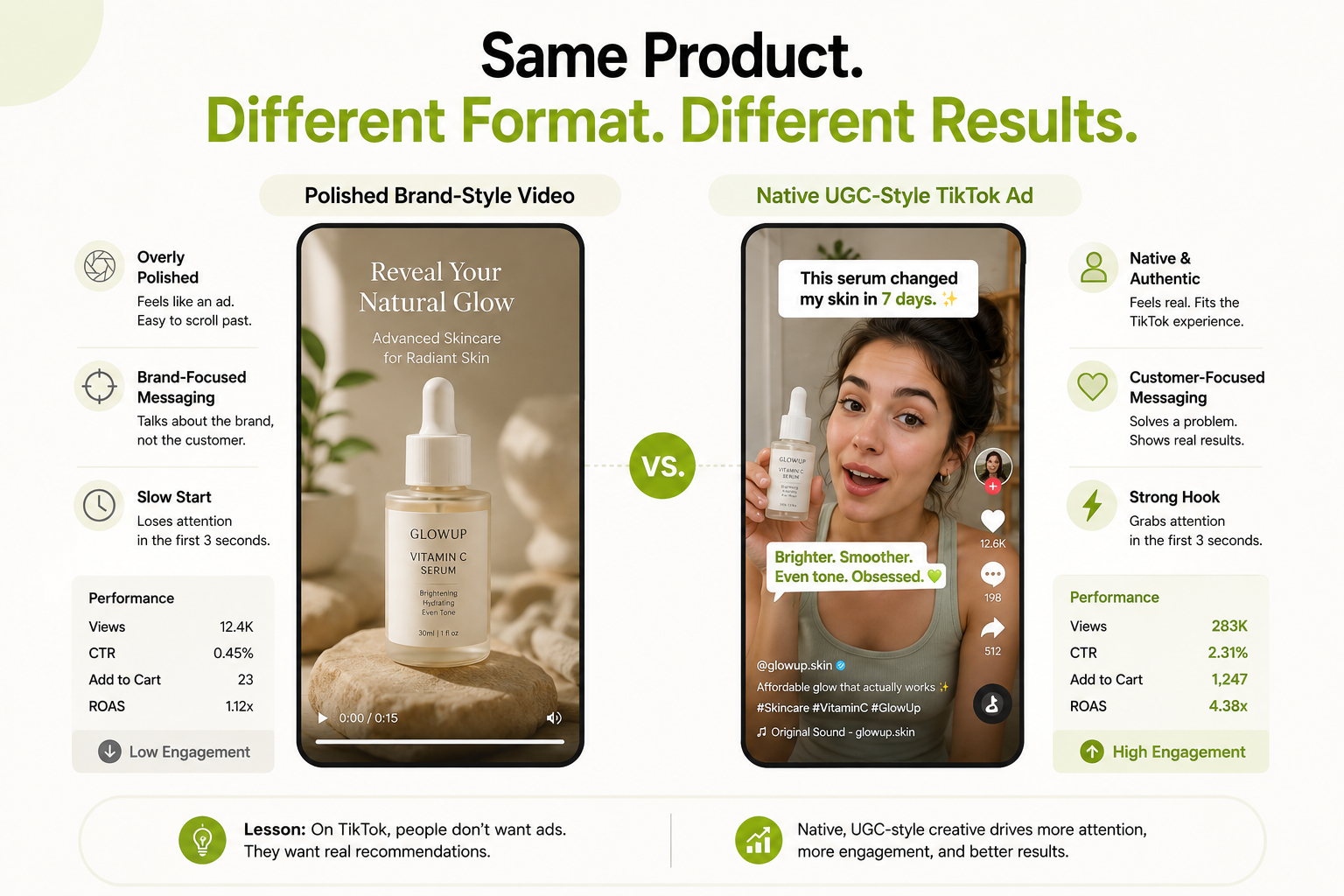
TikTok’s algorithm rewards content that looks and feels like it belongs in the feed. Polished production signals “advertisement.” Native-style content signals “content.” The platform’s entire recommendation engine is built to surface the latter and deprioritize the former. A high-budget creative that reads as an ad will consistently underperform a low-budget creative that reads as content – not because of production quality, but because of format fit.
This article covers what makes TikTok ad creative work in 2026: the anatomy of a high-performing creative, testing frameworks, TikTok automated creative optimization, and how to build a creative operation that produces winning ads without burning through budget on creative that misses.
Why TikTok Ad Creative Operates By Different Rules
Every major ad platform has creative standards. TikTok’s are the most unforgiving.
On Meta, strong targeting can compensate for weak creative. A well-built audience will find a mediocre ad. On TikTok, the algorithm decides what content surfaces based on how people engage with it – creative quality is the primary signal, not audience parameters. Weak TikTok ad creative gets deprioritized regardless of how well-defined your audience is.
The format rules are equally strict:
Native-first
TikTok ads creatives must blend with organic content. If it looks like a television commercial, it will perform like a banner ad.
Sound-on
Over 90% of TikTok content is consumed with sound on. TikTok creative ads that rely on silent-readable text miss the platform’s primary engagement mechanism.
Vertical video only
9:16 aspect ratio, full-screen. Repurposed landscape or square content creates immediate pattern interruption – the wrong kind.
Hook-dependent
The first 2–3 seconds determine whether viewers continue or scroll. TikTok ad creative with a slow opener loses the audience before the message lands.
The Anatomy of High-Performing TikTok Ads Creatives
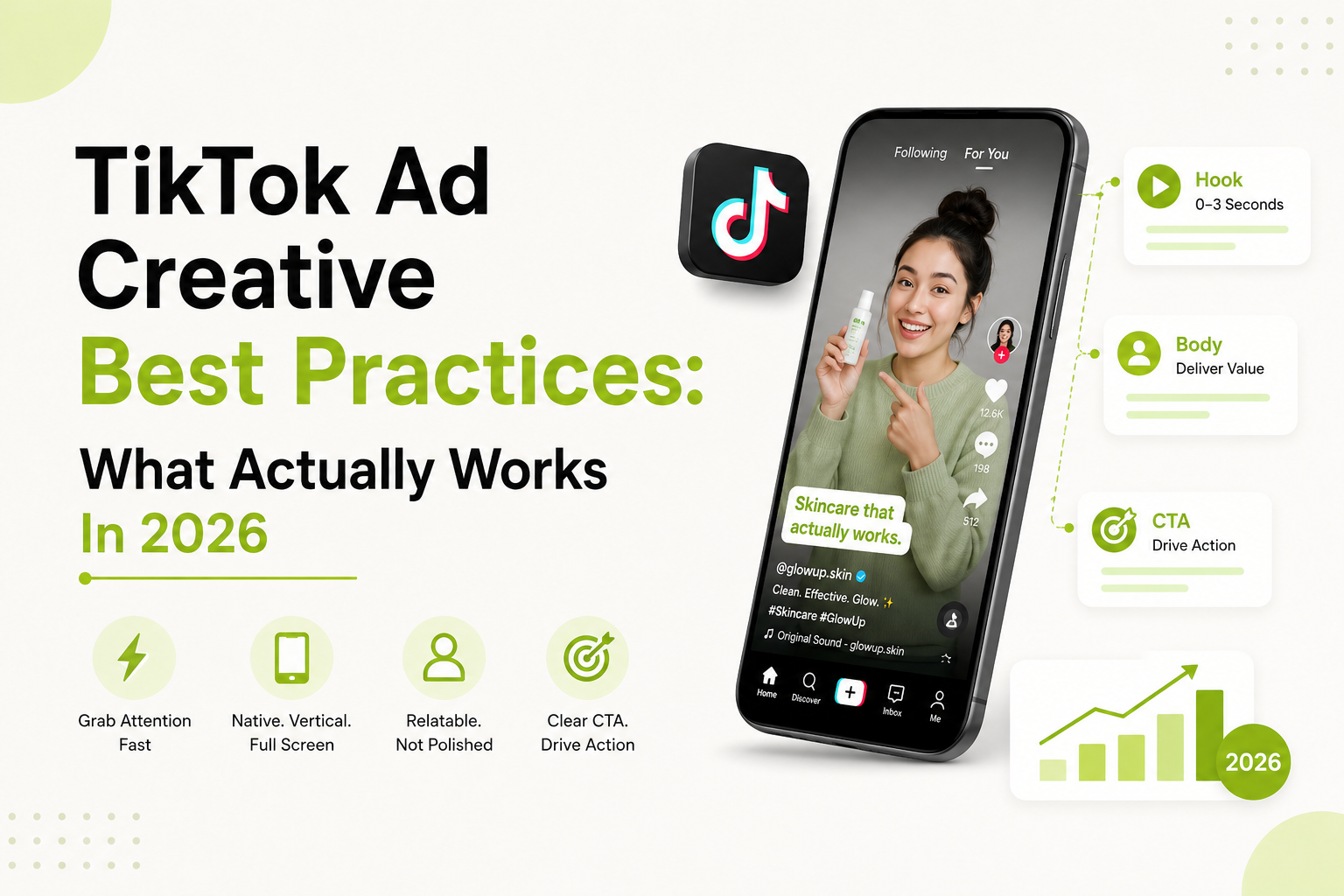
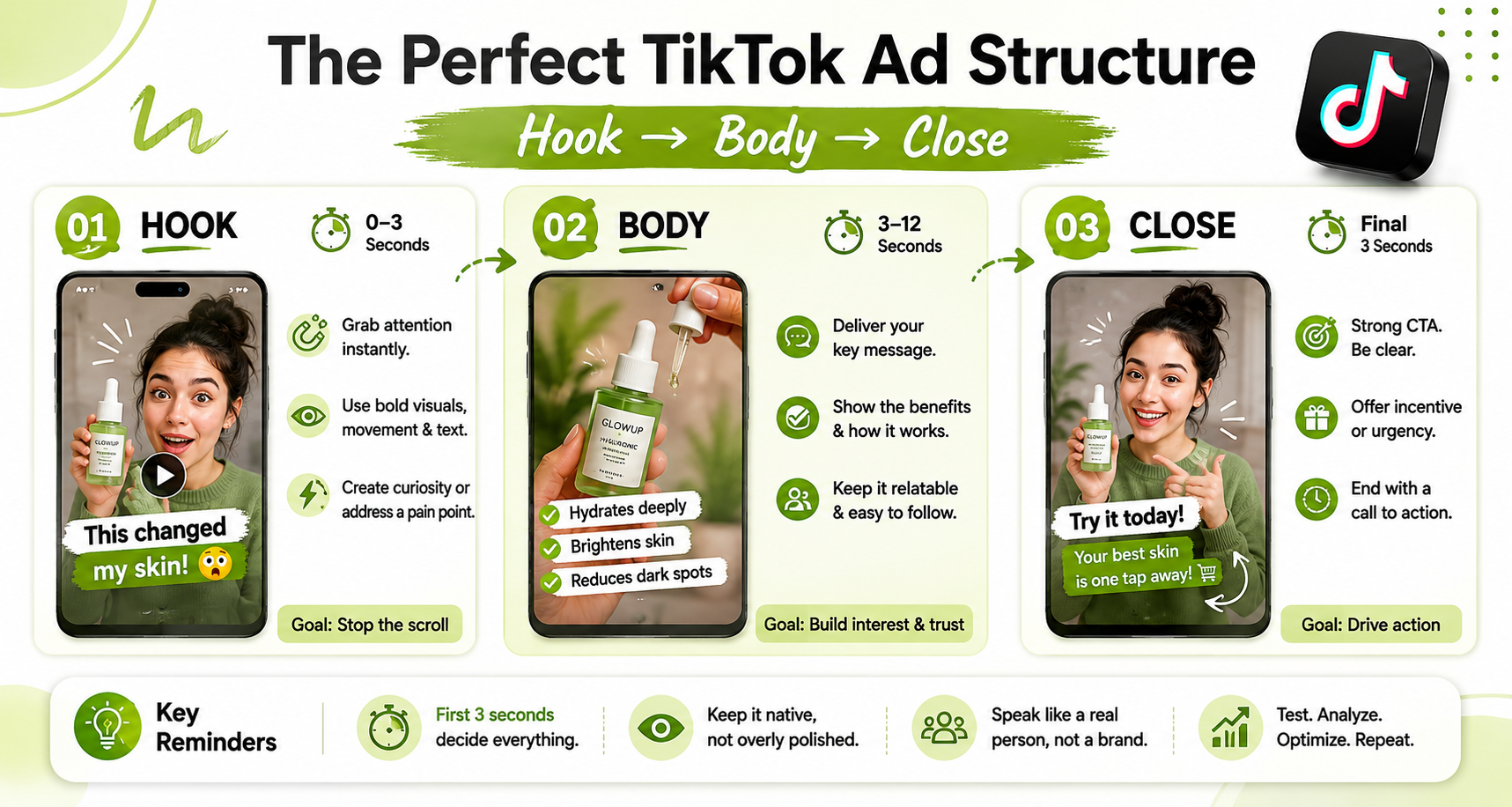
Every strong TikTok ad creative follows a structure, even when it looks spontaneous. Three components – hook, body, close – each doing specific work.
The Hook (0–3 seconds)
The hook’s only job is to stop the scroll. It must answer one implicit question: “why should I keep watching?” Strong TikTok ad creative hooks do this through pattern interruption, a visual that creates curiosity, a bold claim, or a problem statement that resonates immediately.
What works in 2026:
- Direct address
- First-frame visual contrast
- Sound-driven hooks and
- Counter-intuitive statements.
What doesn’t:
- Logo slaps
- Slow reveals
- Brand intros or
- delaying value past 3 seconds.
The Body (3–12 seconds)
The body delivers the value proposition – what the product does, why it matters, and why now. The best TikTok ads creatives keep this section tight. One claim. One proof point. One visual demonstration if the product allows it.
Resist the instinct to pack the body with features. TikTok ad creative that tries to say too much says nothing. Compression is the skill: one specific benefit, demonstrated or stated with enough credibility that the viewer believes it.
The Close (Final 2–5 seconds)
The close drives the action. Strong TikTok creative ads closes are direct and match the conversion objective.
- “Shop now” for direct purchase
- “Learn more” for consideration
- “Get yours” for urgency-driven products
The CTA should appear as text overlay AND in the voiceover – both reinforcing the action simultaneously.
TikTok Ad Creative Formats: Strategic Tradeoffs
Format selection isn’t a technical decision – it’s a budget allocation and creative investment decision. Here’s what the platform documentation doesn’t tell you.
In-Feed Ads
The workhorse of TikTok ad creative. CPMs typically run $9–$12, making it the most cost-efficient format for conversion objectives.
The tradeoff: it’s also the most competitive placement, where creative quality has the highest leverage on performance. An In-Feed TikTok ad creative with a weak hook competes for the same inventory as organic content – and loses.
This format fails when creative is polished-but-generic: it gets served, generates impressions, and produces nothing because the audience scrolls before the message lands.
Creative requirement:
- 9:16 native vertical video
- 15–60 seconds
- Sub-3-second hook that stops the scroll cold
Spark Ads
The highest native-feel TikTok ad creative format because the ad IS an organic post.
CPMs are comparable to In-Feed but engagement rates tend to run higher because the format carries social proof signals (likes, comments, shares from the original post).
The failure mode: amplifying organic content that performed well socially but wasn’t built around a conversion objective. Views and shares don’t always correlate with purchase intent.
Operational tradeoff:
Requires an active organic TikTok presence to pull from – accounts that only run paid without organic have no Spark Ad inventory.
TopView Ads
CPMs run $30–$65 – 3–5x In-Feed rates.
Appears when the app opens, guaranteeing maximum attention.
This format’s failure mode is buying attention you can’t hold: a strong TopView TikTok ad creative needs an exceptionally compelling opening 3 seconds because the user hasn’t scrolled into a content mindset yet.
It’s not a performance creative format – it’s a reach format. Using it for conversion objectives against a cold audience is a reliable way to spend 4x more per click than In-Feed delivers.
Collection Ads
E-commerce format that combines TikTok ads creatives video with a product catalog grid below the video.
CPMs sit between In-Feed and TopView.
The creative requirement here is different:
- The video drives curiosity or intent
- The product grid closes it
Fails when the video creative and the product selection aren’t aligned – a lifestyle hook that leads to an inconsistent product catalog creates drop-off at the catalog level, not the video level.
Creative and merchandising decisions need to be made together.
Spark Ads vs. In-Feed: The Operational Reality
For most performance accounts, running both:
- In-Feed TikTok ad creative for new audience acquisition
- Spark Ads for warm retargeting
…produces the strongest combined results.
The format mix matters more than creative volume alone.
TikTok Automated Creative Optimization
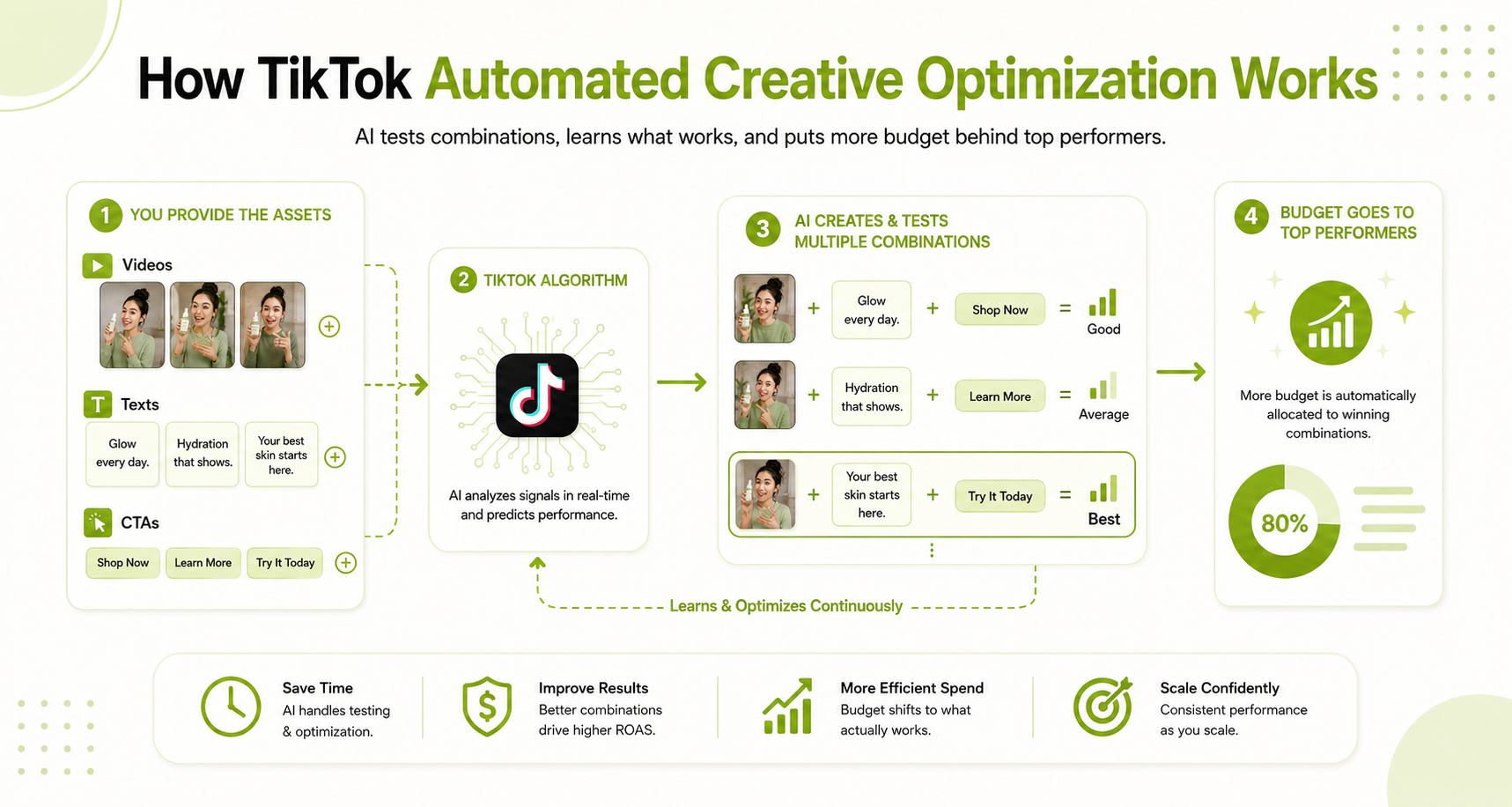
TikTok Automated Creative Optimization (ACO) lets the platform automatically combine creative assets – videos, images, copy, CTAs – into multiple ad variations and test them against your audience in real time.
How TikTok Automated Creative Optimization Works
You upload component assets:
- Up to 10 videos or images
- 5 ad texts
- 5 CTAs
TikTok’s algorithm assembles combinations, tests performance, and allocates spend toward the combinations generating the strongest results.
When TikTok Automated Creative Optimization Works
- You have a solid library of creatives with different hooks and formats
- You’re optimizing for conversions or app installs
- you’re spending at least $100/day
When To Avoid TikTok Automated Creative Optimization
- You’re still testing early creative and don’t have proven winners
- You need to know exactly which creative is working
- You have fewer than five unique ads. ACO is a scaling tool, not a testing tool.
The trade-off:
TikTok automated creative optimization accelerates testing but reduces visibility.
You’ll know which asset combinations performed – you won’t always know exactly why.
For creative learning, manual split testing produces better intelligence.
For scale efficiency, ACO wins once you have validated base creatives.
Building A TikTok Ad Creative Testing Framework
Creative testing at scale requires a system, not gut instinct.
The structure that produces the most learning per dollar spent:
Step 1: Isolate One Variable Per Test
Hook vs. hook.
Body format vs. body format.
CTA vs. CTA.
Testing multiple variables simultaneously creates noise – you can’t attribute performance to a specific element.
Strong TikTok ad creative testing changes one thing at a time against a controlled baseline.
Step 2: Set Spend Floors Before Reading Results
TikTok ads creatives need minimum exposure before performance data is meaningful.
Run each creative to at least $50–75 in spend before making kill or scale decisions.
Below that threshold, variance in delivery creates false signals.
Step 3: Test Hooks First, Then Body, Then CTA
Hook performance is the highest-leverage variable in TikTok ad creative.
A strong hook with a weak body will still outperform a strong body with a weak hook – because a weak hook means no one sees the body.
Identify your top 2–3 hooks before optimizing downstream elements.
Step 4: Retire Creatives Before They Fatigue
TikTok ads creatives fatigue faster than any other platform.
An audience saturates in days, not weeks, at meaningful spend levels.
Watch frequency and engagement rate in parallel – when frequency climbs and watch-through rate drops, the creative is done.
Replace proactively, not reactively.
The TikTok Ad Creative Lifecycle
Most advertisers manage TikTok ads creatives as individual assets – launching, watching performance, killing what underperforms.
The accounts generating consistent ROAS manage them as a lifecycle with four distinct phases, each requiring a different creative type.
Discovery Creative
The first wave – broad concepts, varied hooks, multiple formats – designed to answer:
What resonates with this audience?
Discovery TikTok ad creative is deliberately low-production.
The goal isn’t to produce a polished winner; it’s to identify which problem statements, visual styles, and hook structures generate the highest engagement-to-click conversion.
Spend allocation:
- 20–30% of creative budget
- Wide variation
- Short test periods ($50–75 per creative before making cut decisions)
Scale Creative
Once discovery identifies a winning concept, scale creative takes the validated hypothesis and executes it with higher production quality, tighter messaging, and optimized CTAs.
This is where the budget concentrates.
Scale TikTok ad creative should maintain the native feel of the discovery winner – the instinct to “polish it up” at this stage is the most common way to kill a winning concept.
Spend allocation:
- 50–60% of creative budget
- Focused on 2–3 proven top performers
Retention Creative
As scale creative frequency climbs, a warm audience that’s seen the winning ad multiple times needs variation that assumes prior exposure.
Retention TikTok ads creatives build on what the audience already knows – referencing the original hook concept but approaching it from a new angle, deeper benefit, or social proof layer.
Same audience, different creative posture.
Spend allocation:
- 15–20% of creative budget
- Targeted at warm retargeting segments
Fatigue Replacement Cadence
The lifecycle closes when creative performance degrades – typically when:
- Frequency exceeds 2.5
- Watch-through rate drops more than 20% week-over-week
The critical operational discipline:
Replacement TikTok ad creative must be in production before the current generation peaks.
The replacement cycle for accounts spending $300+/day on TikTok creative ads typically runs every 10–14 days.
Accounts that wait until creative has fully fatigued before briefing new work experience a performance cliff between creative generations.
The teams running the most efficient TikTok ad creative operations aren’t producing more creative – they’re managing the lifecycle more precisely.
How FabFunnel Accelerates TikTok Ad Creative Performance
The bottleneck in TikTok ad creative is rarely strategy.
It’s speed:
How fast you can identify what’s working, produce more of it, and get it into market before the winning creative fatigues.
FabFunnel’s Video Analysis breaks down creative performance at the element level – identifying:
- Which hooks generate the strongest view-through rates
- Which formats drive the highest conversion lift
- Which creative components correlate with top-performing TikTok ads creatives
Not just “this video worked” – but why it worked, and what to replicate.
FabFunnel’s Creative Generation takes that intelligence and produces new TikTok ad creative variations built around the winning elements:
- Different hooks against a proven body format
- Different visual treatments on a validated concept
- New CTAs against a top-performing structure
The creative iteration loop that typically takes days of briefing, production, and review cycles gets compressed.
The result:
- More creative hypotheses tested per week
- Faster identification of winners
- A systematically improving TikTok ad creative library rather than a collection of one-off bets
Common TikTok Ad Creative Mistakes
Opening With The Brand
TikTok users don’t care about your brand in the first 3 seconds – they care about whether the content is worth watching.
A logo opener or brand name reveal is a guaranteed scroll trigger.
Lead with the hook, not the identity.
Producing For Meta And Repurposing For TikTok
16:9 landscape video cropped to 9:16, or static image carousels reformatted as slideshows, are immediately recognizable as off-platform content.
TikTok ad creative must be built natively for the format – not adapted from other placements.
Ignoring Audio
A TikTok ad creative without intentional audio strategy is missing the platform’s primary engagement driver.
This includes:
- Background music selection
- Voiceover tone and pacing
- Sound effects that create pattern interruption
Testing Too Many Variables Simultaneously
Running five different TikTok ads creatives simultaneously with different hooks, bodies, and CTAs produces data that can’t be acted on.
You’ll know which ad won – you won’t know what to replicate.
Scaling Creatives Past Their Fatigue Point
The most common way to destroy a winning TikTok ad creative is to keep spending on it after frequency starts climbing.
Scale fast, retire early, and have the next creative ready before the current one peaks.
Conclusion
TikTok ad creative is a performance discipline, not a production one.
The brands winning in 2026 aren’t spending more on creative – they’re testing faster, learning from each iteration, and systematically replacing what fatigues with what the data says will work next.
Build the hook library first.
Validate the format.
Understand why your winners win.
Then produce more of it at speed.
If creative analysis and production velocity are the bottleneck – FabFunnel’s Video Analysis and Creative Generation are built to close that gap.
Frequently Asked Questions
Q1: What Makes TikTok Ad Creative Different From Other Platforms?
The algorithm. TikTok surfaces content based on engagement signals—watch time, shares, replays – not audience parameters. Creative quality is the primary targeting mechanism.
Q2: How Long Should A TikTok Ad Creative Be?
15–30 seconds for conversion objectives. The constraint isn’t total length – it’s the first 3 seconds. Optimize the hook before optimizing duration. A 45-second creative with a compelling hook will outperform a 15-second creative with a slow opener in almost every test.
Q3: What Is TikTok Automated Creative Optimization And Should I Use It?
TikTok ACO is your personal creative mixologist. It takes your videos, words, and buttons, shuffles them into fun little combos, then allocates budget at the ones that crush it. Automatically.
Use it when:
- You have 5–10 validated assets
- You have $100+/day in budget
Avoid it during early discovery testing when you need to know exactly which specific creative is driving results. ACO gives you combination-level data, not asset-level clarity.
Q4: What Types Of TikTok Ad Creative Perform Best For E-commerce?
Three formats consistently outperform:
- Problem-solution UGC
- Demonstration-led content
- Social proof formats
Product-first openers – where the item appears before the problem is established – consistently underperform. Lead with why it matters, then show what it is.
Q5: How Do I Know When A TikTok Ad Creative Is Fatiguing?
Watch frequency and watch-through rate together.
When:
- Frequency exceeds 2.5
- Watch-through rate drops more than 20% week-over-week
…the creative is fatiguing. At $200+/day spend, this cycle typically runs 7–12 days.
The operational discipline: have replacement TikTok ad creatives in production before the current generation peaks – not after performance drops.
Q6: How Does Creative Analysis Improve TikTok Ad Creative Performance?
Creative analysis identifies which specific elements – hook style, visual format, audio type, CTA phrasing – correlate with your top-performing TikTok ad creatives. Instead of knowing “this ad worked,” you know what to replicate in the next wave.
FabFunnel’s Video Analysis surfaces these patterns across your creative library, so each new production brief is built on what the data says works – not what the team thinks worked.