Most creative testing strategies fail for a simple reason – not enough volume.
A team that produces 3-4 video variations per week, runs them for 10 days each, and then reviews performance is operating on a learning cycle that takes months to find a winning creative. By the time they’ve identified what works, the audience has shifted, the offer has changed, or competitors have already found the same angle.
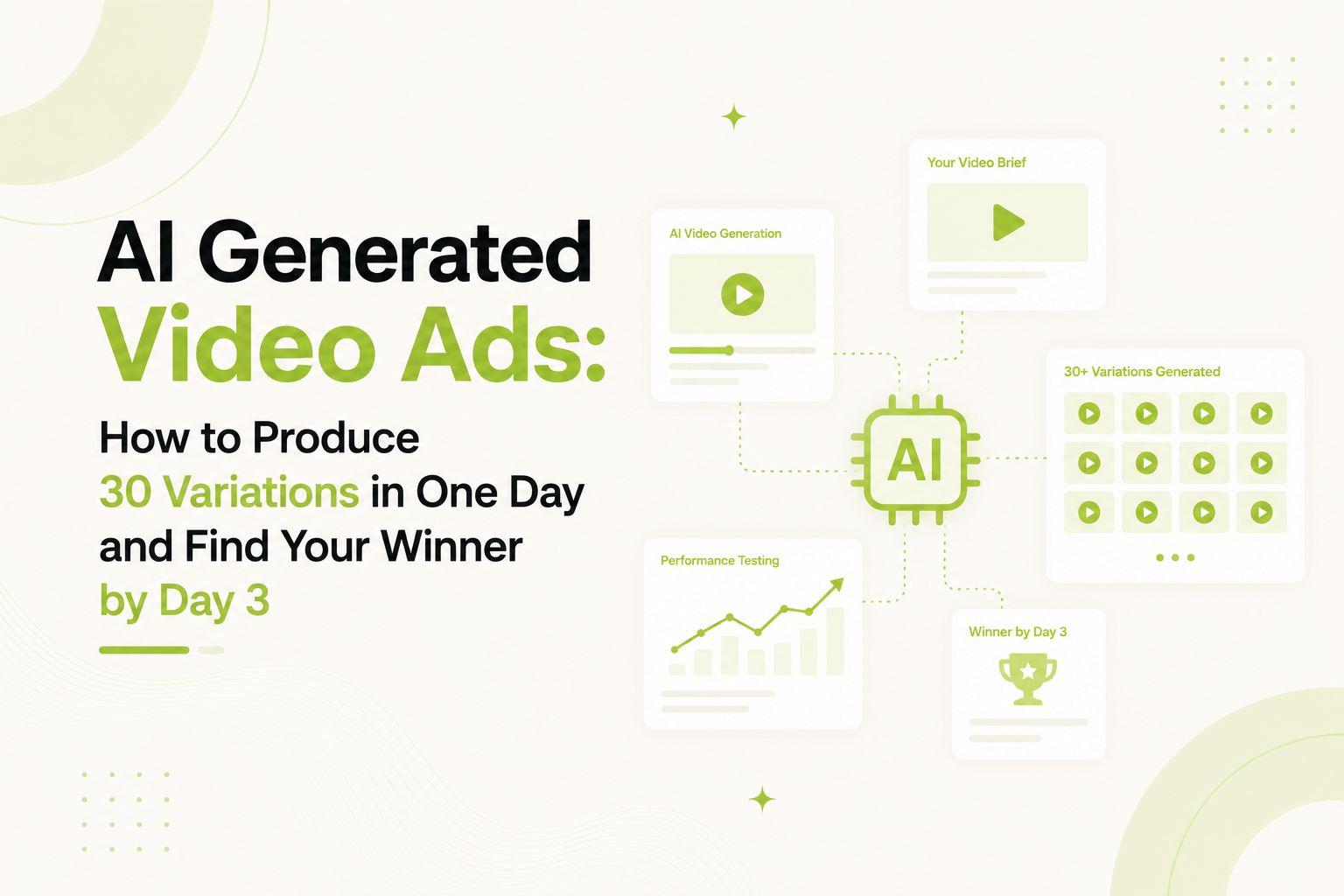
AI generated video ads change the math entirely. Thirty variations in a day is not a theoretical ceiling – it’s a realistic production output for a team with the right workflow. Finding your winner by day 3 follows from that volume. This article explains exactly how. Choosing the right ai video ad generator is the first decision that determines whether this workflow is even possible.
Why 30 Variations in One Day Is the Right Target
The number isn’t arbitrary.
Meta’s algorithm needs creative signal to optimize. The more variations you give it at launch, the faster it identifies which creatives are resonating with which audience segments. Launching 3 variations gives the algorithm limited signal. Launching 30 gives it enough to find genuine winners quickly – and the budget efficiency that comes with faster optimization.
On TikTok, the content volume requirement is even more direct. The platform’s discovery mechanism rewards fresh content. More variations mean more entry points into the algorithm, more chances to catch an audience in a receptive moment, and more data about what’s actually working.
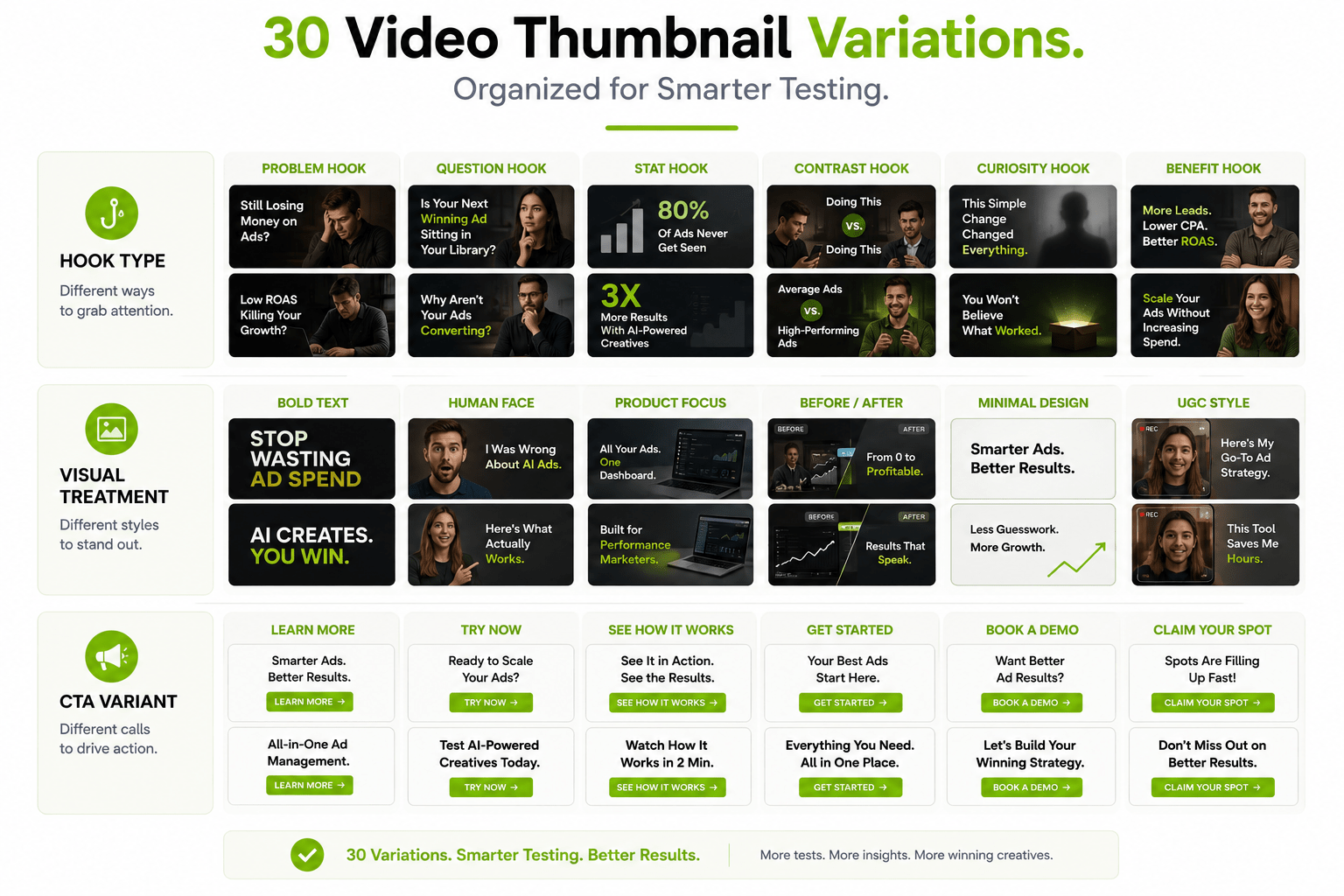
Thirty variations doesn’t mean 30 completely different concepts. It means 30 distinct hypotheses – different hooks, different visual treatments, different offer framings, different CTAs – built around the same core product or offer. The ai video ad generator handles the production. The marketer handles the strategy behind what each variation is testing.
The Workflow: Brief to 30 Variations in One Day
This isn’t a rough estimate. Here’s exactly how the day breaks down. Each block below assumes you already have an ai video ad generator connected to your ad accounts.
Morning: Build the Brief (1-2 Hours)
The brief is the highest-leverage part of the process. Everything the ai video ad generator produces flows from it. A strong brief defines:
- The product or offer – what it is, what it does, what problem it solves
- The audience – who they are, what they care about, what they’re skeptical about
- The hook types to test – pain point, curiosity, bold claim, social proof, contrast
- The visual aesthetic – UGC-style, product showcase, testimonial, founder-led
- The CTA – what action you want and how direct the ask should be
For 30 variations, you’re typically testing 4-5 hook types across 2-3 visual formats with 2-3 CTA variants. That combination generates the variation set without producing redundant outputs.
Spend time here. A weak brief produces 30 generic videos. A strong brief produces 30 genuine hypotheses. Whether you call it an ai video ad maker or an ai video ad generator, the output is only as strong as the brief you feed it.
Late Morning: Generate the First Batch (1-2 Hours)
Feed the brief into your ai video ads generator. Most current tools let you configure variables – hook type, format, visual treatment – and generate multiple outputs from a single run.
Generate in batches by hook type. Run all pain-point hooks first, then curiosity hooks, then social proof. This keeps the review session organized and makes it easier to compare within hook types rather than across all 30 at once.
At this stage, you’re generating more than 30 – aim for 40-50 to give yourself culling room. This is the stage where you truly generate video ads with ai at a volume no manual production team could match.
Early Afternoon: Review and Select (1-2 Hours)
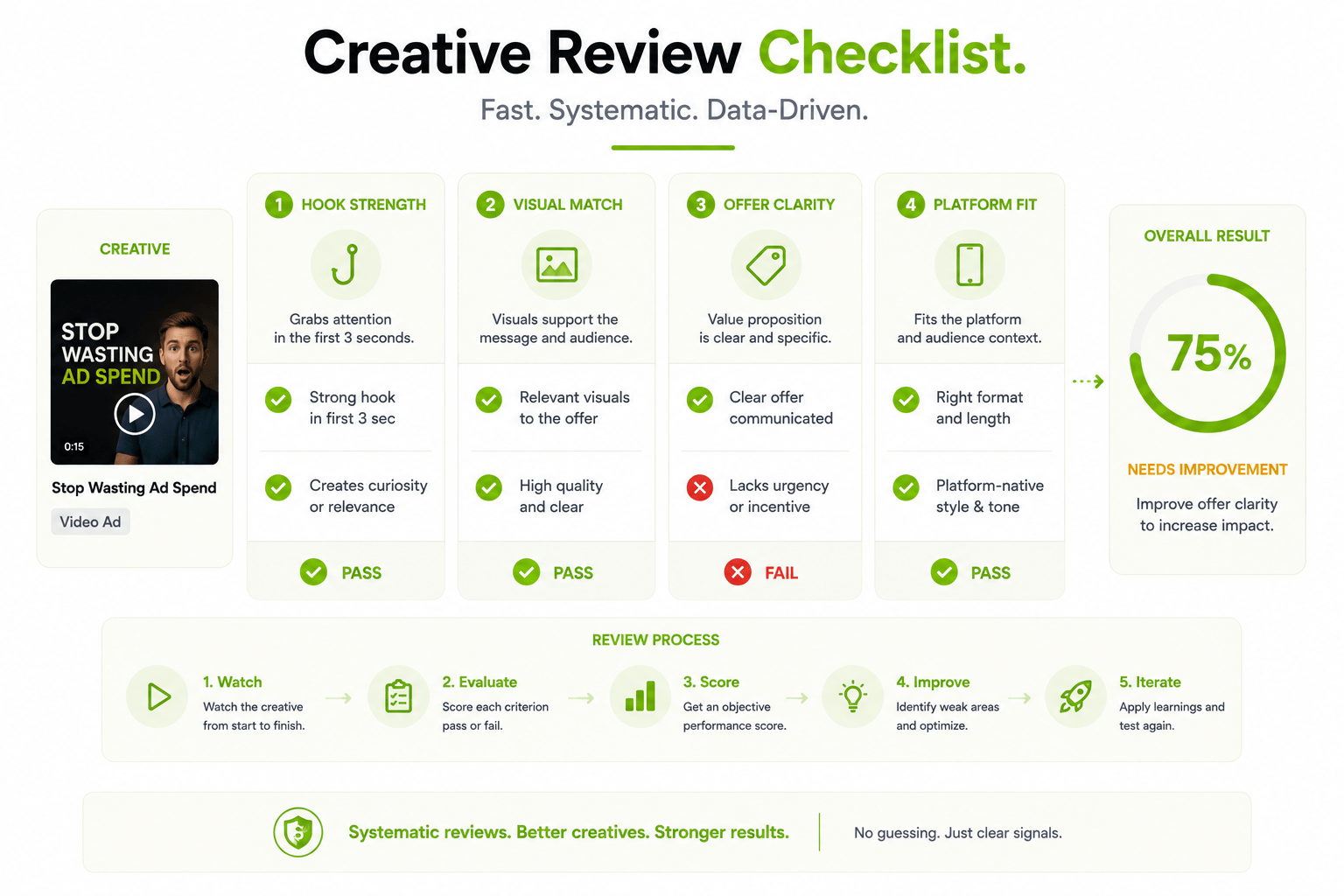
Watch each output once. The review criteria are simple:
- Does the hook land in the first 2-3 seconds?
- Does the visual match the aesthetic you briefed?
- Is the offer clear?
- Does it feel native to the platform?
Cut anything that fails any of these. You’re not looking for perfect – you’re looking for testable. By the end of the review session you should have 30 variations that represent distinct, genuine hypotheses worth putting budget behind. A reliable ai video ad generator makes this review fast because every output follows the same brief structure.
Afternoon: Set Up Campaigns (1-2 Hours)
Load the 30 selected variations into your campaign structure. How you organize them depends on what you’re testing:
- If you’re testing hook types, group by hook – one ad set per hook type, multiple creatives per set
- If you’re testing formats, separate UGC from product showcase from testimonial
- If you’re testing CTAs, keep everything else constant and vary only the CTA
The goal is to set up the test so you can read the results clearly. Thirty variations with no structure produces noise. Thirty variations organized by hypothesis produces signal.
Platforms that connect generation directly to campaign launch – rather than requiring manual export and upload – compress this step significantly. Look for an ai video ad generator that offers this kind of direct publishing integration.
Finding Your Winner by Day 3
Volume at launch is what makes the 3-day timeline possible. None of this works without an ai video ad generator capable of producing that volume on day one.
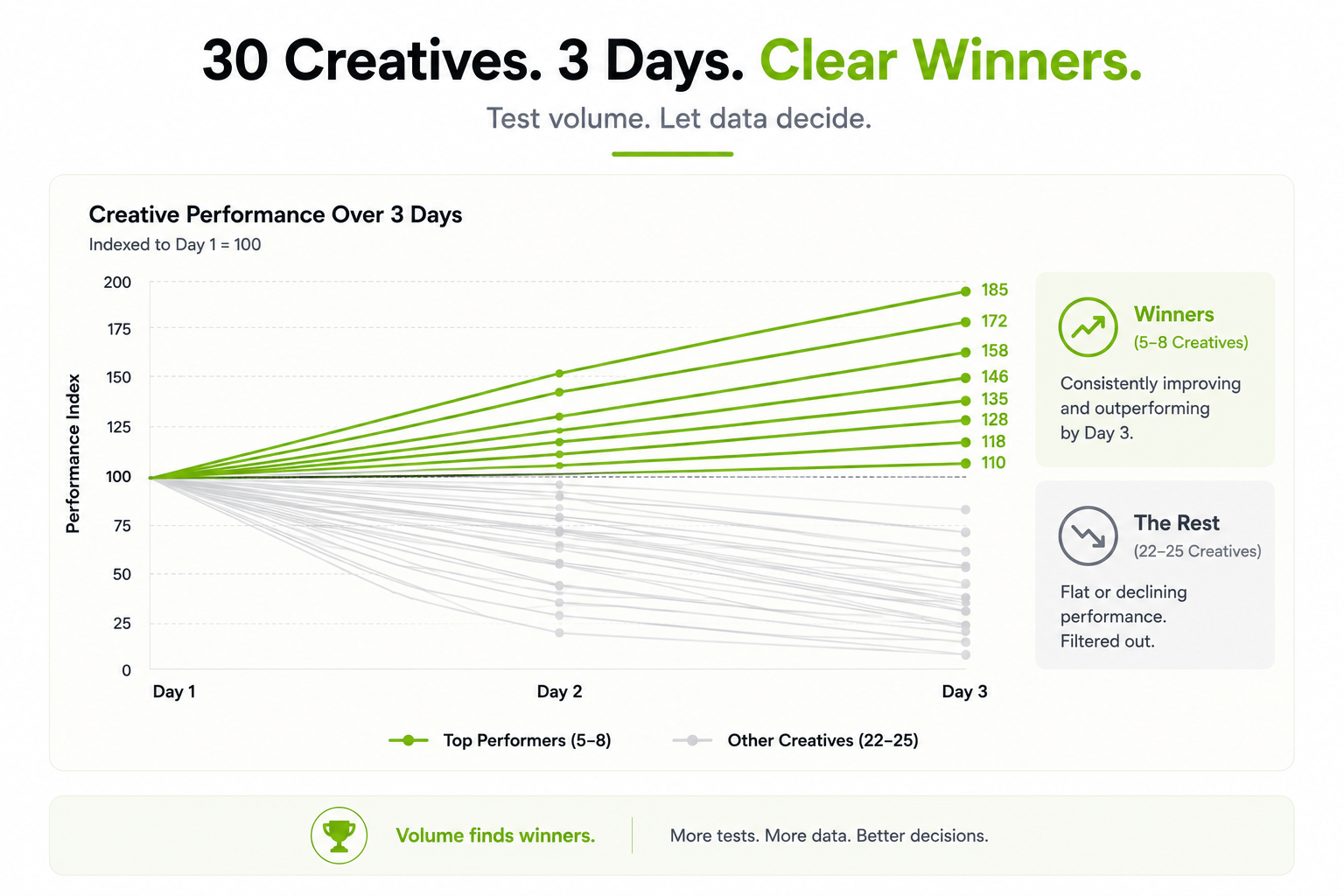
With 30 variations live simultaneously, the algorithm has enough creative signal to start surfacing performance differences within 48-72 hours. You’re not waiting for statistical significance on 3 creatives – you’re looking at relative performance across 30.
What to Look for on Day 1
Early signals: cost per ThruPlay, hook rate (what percentage of people watch past 3 seconds), and CPM. These tell you which hooks are stopping the scroll and which formats are getting traction without waiting for conversion data.
Don’t make decisions yet. Day 1 data is directional, not conclusive. Use this window to confirm your ai video ad generator is producing genuinely distinct creative, not near-duplicates.
What to Look for on Day 2
By day 2 you have enough data to identify the bottom third. Creatives with significantly higher CPMs, low hook rates, and no conversion signals can be paused. This is not a final cut – it’s removing noise so the remaining budget concentrates on the variations with actual signal. Most ai video ad generator platforms surface these metrics automatically, so you’re not exporting data by hand.
What to Look for on Day 3
By day 3 a clear performance tier should be visible. The top 5-8 creatives will be pulling ahead on cost per result. These are your winners – not just the best of this batch, but the input for the next brief. What hook type won? What visual format? What CTA?
The winner analysis is as important as the winner itself. You’re not just finding a creative to scale – you’re learning which hypotheses were right so the next 30 variations are better than the first 30. Feed those learnings straight back into your ai video ad generator for the next round of briefs.
Where AI Generated Video Ads Fit in the Stack
The 30-in-a-day workflow isn’t just a production hack. It’s a systematic approach to creative testing that only works if the generation quality is high enough to produce testable hypotheses. In practice, this means your ai video ad generator sits below the strategy layer, not above it.
Current ai video ad generator models – including those powering tools like FabFunnel‘s Genie – produce output across multiple formats: UGC-style video, product showcase, testimonial format, and offer-driven short-form. The ai video ad generator handles visual generation, pacing, and basic editing from a structured brief. The marketer’s job is the brief, the review, and the analysis.
What this doesn’t replace is creative judgment. An AI video ad generator produces from the brief it receives. The strategic thinking behind what to test, what the audience responds to, and how to interpret the results stays with the marketer.
The Takeaway: Volume Is the Variable Most Creative Testing Strategies Are Missing
Most teams aren’t losing because their creative instincts are wrong. They’re losing because they don’t have enough volume to test those instincts quickly enough to act on what they learn.
Thirty ai generated video ads in one day changes that constraint. It gives the algorithm the signal it needs to optimize fast, gives the team the data to identify winners in days rather than weeks, and produces a learning output – which hypotheses worked, which didn’t – that compounds into better briefs and better results with every testing cycle.
The 3-day winner timeline isn’t the best case. It’s what happens when you give the algorithm enough to work with at launch. Pick an ai video ad generator that fits your workflow, and this pace becomes the new normal rather than the exception.
Also Read – Video Ads AI: The Tools and Tactics Top TikTok and Meta Advertisers Use to Scale Fast
Frequently Asked Questions
How many video ad variations should I test at once?
For meaningful algorithmic signal on Meta and TikTok, 15-30 variations is a practical range. Fewer than 10 limits how fast the algorithm can optimize. More than 30 in a single launch can spread budget too thin to generate clear signal per creative. Most ai video ad generator tools let you cap output per launch, so you can stay inside that range.
What should each variation actually test?
Each variation should represent a single hypothesis – a different hook type, a different visual format, a different offer framing, or a different CTA. Testing one variable per variation set keeps results readable. Changing multiple variables at once makes it impossible to know what drove the performance difference.
How long does it take AI to generate a video ad?
Generation time varies by tool and output length. Most current AI video ad generator tools produce a 15-30 second video in 2-5 minutes per variation. A batch of 40-50 variations can be generated in 2-3 hours depending on the tool and configuration.
What makes a strong ai video ad generator brief?
Specificity on five dimensions – the product and its core benefit, the target audience and their primary objection, the hook types to test, the visual aesthetic and format, and the intended CTA. The more specific the brief, the less generic the output.
How do I know when I’ve found my winning creative?
A winner shows consistently lower cost per result than the field, a hook rate above your account average, and stable or improving performance over 3-5 days. One good day isn’t a signal. Consistent outperformance across a 3-day window with sufficient spend behind it is.
Can I use AI generated video ads on Google or YouTube?
The format principles apply across platforms, but the production specs differ. For Meta and TikTok specifically, the UGC-style and short-form formats AI generates natively match what the algorithms reward. YouTube pre-roll has different length and format requirements – AI generation can handle these but the brief needs to account for the format difference.