Quick Answer: A media buying platform saves more time for teams running paid campaigns across multiple accounts or channels, because it collapses setup, monitoring, and reporting into one workflow. In-house buying with native ad managers and spreadsheets still works fine for small, single-platform operations with low campaign volume. The gap between the two widens quickly as accounts, platforms, and campaign count grow.
What In-House Media Buying Actually Costs in Hours
In-house media buying looks free because there is no new software line item on the budget. The real cost shows up in hours, spread across a few predictable places that rarely make it into that budget conversation.
Manual Campaign Setup, Multiplied
Every campaign built by hand in Meta Ads Manager (the primary tool for facebook media buying), TikTok Ads Manager, or a NewsBreak dashboard means clicking through the same structure again: objective, ad set targeting, budget, placements, creative upload, naming convention. For one campaign this takes minutes. For twenty variations across three platforms for a single launch, it turns into a full day of repetitive clicking, and every manual step is a chance to misconfigure a budget field or a targeting setting.
Reporting Reconciliation Nobody Budgeted For
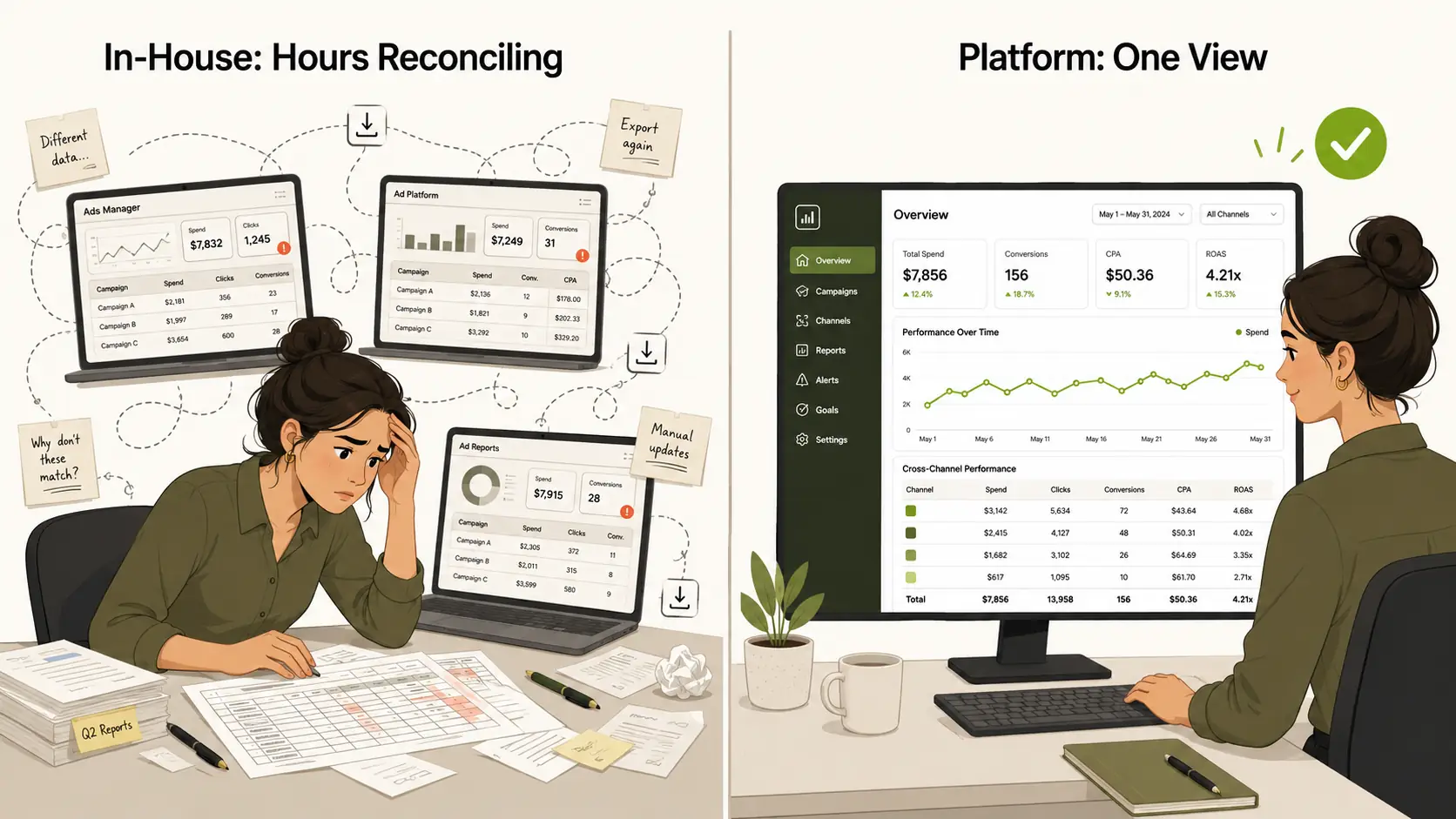
Native ad managers report on their own platform and nothing else. A team running Meta, TikTok, and NewsBreak ends up exporting three separate reports, normalizing column names, aligning date ranges and time zones, and pasting the result into a spreadsheet before anyone can answer a basic question like which platform is driving the best cost per result this week. That reconciliation work repeats every reporting cycle, and it scales with the number of accounts, not with the number of people doing it.
No Cross-Platform View
Without a shared view, decisions get made platform by platform instead of across the whole media mix. A media buyer might pause a Meta campaign for underperforming while a comparable TikTok campaign with a worse cost per result keeps spending, simply because nobody had both numbers in front of them at the same time.
What a Media Buying Platform Actually Replaces
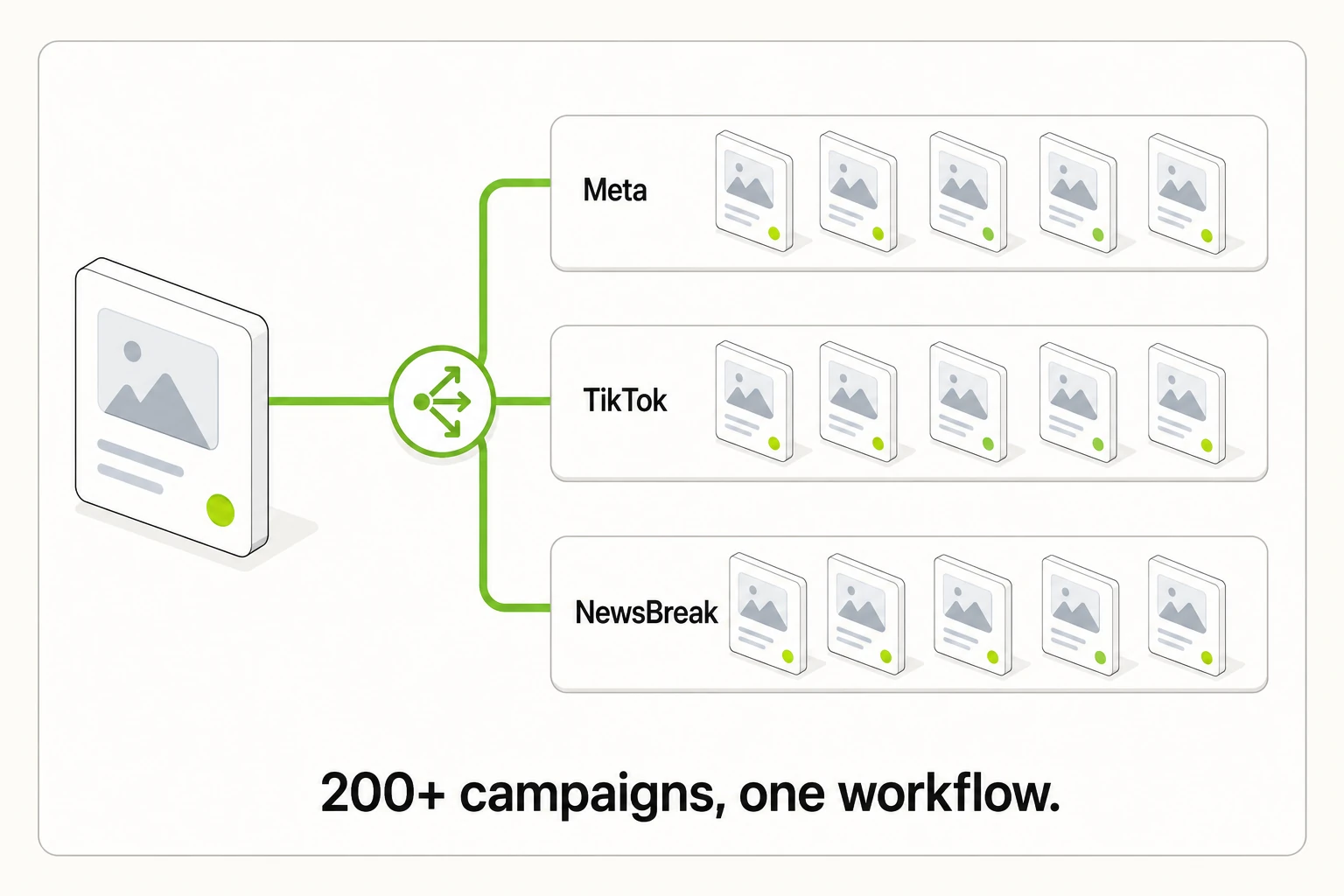
A media buying platform like FabFunnel is built to remove the repetitive, cross-account mechanics of in-house buying, not the strategy behind it, which is why teams often just call this category media buying software. Bulk Campaign Launcher pushes 200 or more campaigns live in under two minutes across Meta, TikTok, and NewsBreak from one workflow, which turns a day of manual setup into a few minutes of configuration. Multi Ad Account Reporting syncs spend, ROAS, CPR, CPC, and CTR roughly every 15 minutes across every connected account, with timezone selection, so the reconciliation step disappears instead of repeating every week. An automation rules engine runs conditions a team defines, such as CPA floors, ROAS thresholds, or frequency caps, continuously across accounts, with every action logged, which functions as media buying automation, taking over the manual monitoring and spreadsheet rule-checking a buyer would otherwise do by hand.
What It Doesn’t Replace
None of this replaces strategy or judgment. The platform will not decide what audience to target, what offer to run this quarter, or when a creative concept has gone stale for reasons a report can’t fully capture. Genie, FabFunnel’s AI creative generation tool, produces creative variations tied to brand and product data from a connected Catalogue, but a person still has to judge what fits the campaign and what doesn’t. What gets removed is the mechanical hours. What stays is the need for someone who understands the account.
A Decision Framework: Team Size, Platforms, Accounts, Volume
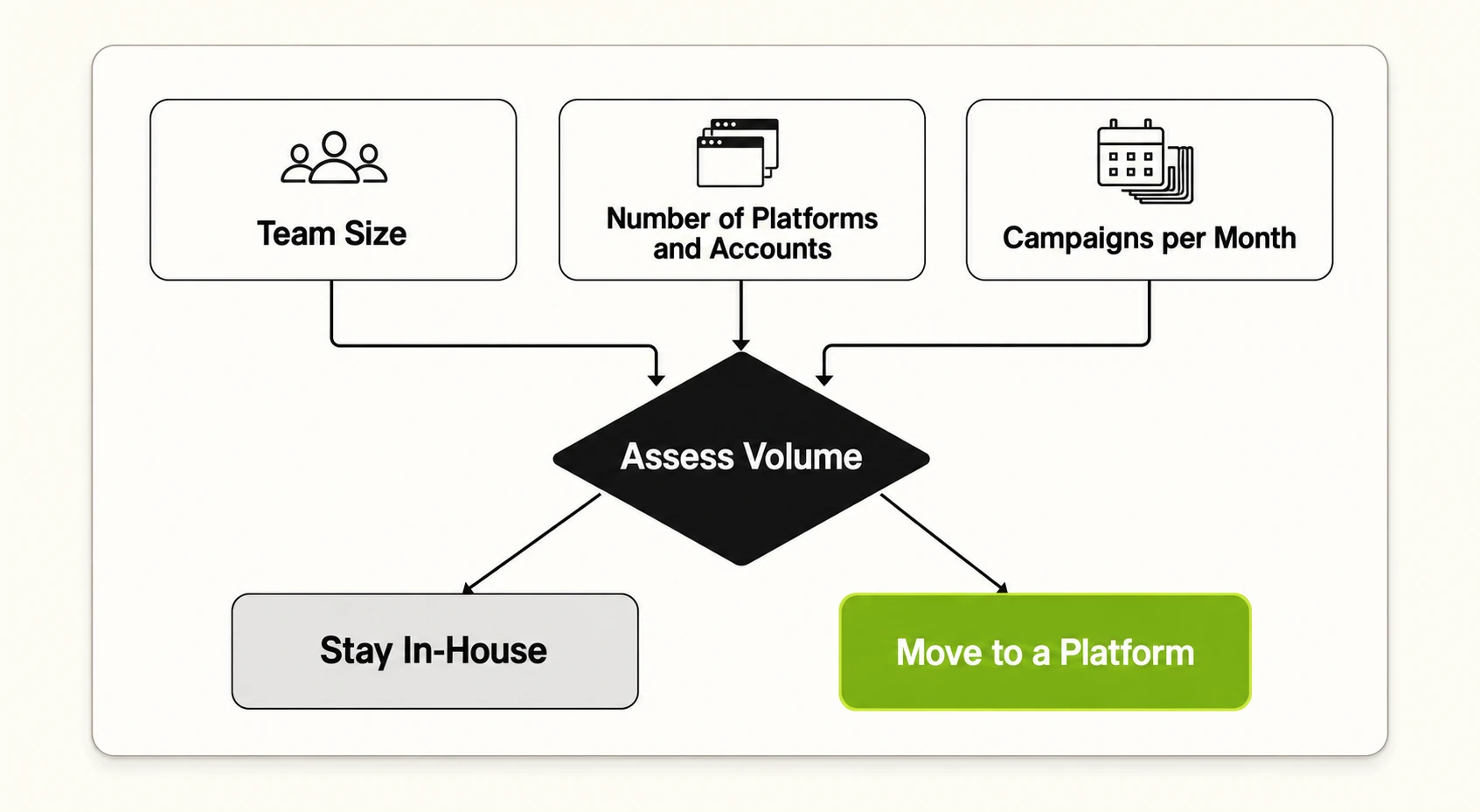
The honest answer to buy versus build depends on three variables: how many people are running paid media, how many platforms and accounts are in play, and how many campaigns launch in a given month. The table below is a starting point, not a hard rule.
| Decision Factor | Leans In-House | Leans Media Buying Platform |
|---|---|---|
| Team size | Solo marketer or one generalist running ads part time | Two or more people dedicated to paid media |
| Platforms in use | Single platform, for example Meta only | Multiple platforms, for example Meta plus TikTok plus NewsBreak |
| Ad accounts | One or two accounts | Three or more accounts, especially across clients or brands |
| Campaign volume | Under 10 campaigns launched per month | Dozens of campaigns launched per month, or recurring bulk launches |
| Reporting need | A single native dashboard answers most questions | Cross-account, cross-platform reporting is a weekly requirement |
| Rule-based optimization | Manual checks a few times a week are manageable | Budgets or bids need continuous monitoring against defined thresholds |
Teams that land on the left side of most rows are often better served staying in-house a while longer. Teams that land on the right side of three or more rows are usually already losing hours to the exact problems this table describes.
The Switching Costs and Learning Curve Nobody Mentions
Adopting a platform is not instant. Connecting Meta, TikTok, and NewsBreak accounts, rebuilding naming conventions so bulk launches stay organized, and setting automation rules that reflect actual account history all take real setup time before any time gets saved. A team used to native ad managers has to learn a new interface, and the first few campaign launches through a new workflow are usually slower than the fiftieth, simply because muscle memory has not formed yet, a learning curve common to most media buying tools during onboarding.
There is also a judgment cost worth naming honestly. Automation rules only work as well as the thresholds a team sets. A CPA floor copied from a different account, or a frequency cap set without historical context, can do damage faster than a person checking manually once a day, because the rule runs around the clock. That is not a reason to avoid switching. It is a reason to plan for a real onboarding period rather than expecting savings from the first campaign.
So Which Saves More Time?
For a solo marketer running one platform and a handful of campaigns a month, in-house buying with native ad managers is often still the right call, and adopting a platform would be overhead the team does not need yet. For a team managing multiple platforms, several ad accounts, or campaign volume that requires bulk launches and daily monitoring, the math changes fast. FabFunnel’s own numbers reflect that gap at scale: connected accounts report 40% less time in Ads Manager, across more than $2B in ad spend managed and 8M+ ads launched on Meta, with a 3.8x average ROAS. The time saved comes from removing repetitive setup and reconciliation work, not from replacing the decisions a media buyer still has to make.
FAQs
1. Does a platform like FabFunnel replace the need for a media buyer?
No. This kind of platform removes repetitive setup, monitoring, and reporting work, but strategy, targeting decisions, and creative judgment still require a person who understands the account and the market. Tools like Genie speed up creative production, but someone still has to decide what fits the campaign.
2. How long does it take to switch from in-house buying to a platform?
It depends on account count and how many naming conventions and automation rules need to be rebuilt. Teams should expect a setup period where connecting accounts and configuring rules takes real time before the workflow starts saving hours, rather than assuming savings from the first campaign.
3. Is switching to a platform worth it for a single-platform team?
Usually not yet. If a team runs one platform, one or two accounts, and fewer than ten campaigns a month, native ad managers are often sufficient, and the time spent learning a new tool may outweigh the time saved in the near term.
4. Does FabFunnel support Google Ads?
No. FabFunnel currently supports Meta, TikTok, and NewsBreak. Teams that need Google Ads coverage as part of a unified workflow should account for that gap when evaluating fit.
5. What does the automation rules engine actually monitor?
It runs conditions a team defines, such as CPA floors, ROAS thresholds, or frequency caps, continuously across connected accounts, with every action logged. It does not set those thresholds on its own; a person still has to define what good and bad performance means for that account.
6. How often does cross-account reporting update?
Multi Ad Account Reporting syncs spend, ROAS, CPR, CPC, and CTR roughly every 15 minutes across every connected account, with timezone selection, which removes the need to manually export and reconcile reports from each platform separately.
7. Can a platform launch campaigns across multiple ad channels at once?
Yes. Bulk Campaign Launcher can push 200 or more campaigns live in under two minutes across Meta, TikTok, and NewsBreak from a single workflow, which is the main mechanical time saving compared with building each campaign manually in separate native ad managers.
8. What is the biggest risk in adopting a platform too early?
For a small team with low campaign volume, the risk is spending onboarding time on a workflow built for scale before that scale exists. The decision framework based on team size, platform count, and campaign volume is meant to catch that mismatch before switching.
FabFunnel operates as an AI advertising platform that unifies campaign launch and reporting across Meta, TikTok, and NewsBreak. Ready to see whether FabFunnel fits your setup? Try it, or explore Genie’s AI creative tools.