The smartest advertisers on Facebook rarely start from scratch. Instead, they study what’s already working – and build from there.
Monitoring Competitor Facebook Ads is one of the highest-leverage activities a media buyer or performance marketer can do. Why spend weeks testing dozens of creatives when your competitors have already done that work for you? Their ads are publicly visible, their messaging is on display, and their strategy is sitting right there – waiting for you to analyze it.
Facebook (Meta) makes it surprisingly easy to find and view competitor Facebook ads. But knowing what to look for and how to turn those insights into campaign wins is a different skill entirely.
In this guide, you’ll get a step-by-step breakdown of how to spy on competitors’ Facebook ads, what elements to analyze, which research tools make it faster, and how to go from insight to launched campaign without the usual manual grind.
Why Monitoring Competitor Facebook Ads Matters
Running Facebook ads without studying the competition is like entering a race blindfolded. You might get somewhere – but you’ll waste a lot of energy figuring out a path that others have already mapped.
Consistent competitor research compounds. Done right, it gives you:
- Reduced testing costs: When you see what’s already working in a competitor’s account, you stop burning budget on ideas already proven wrong in your market.
- Early sight of winning creatives: An ad that’s been live for 60 days isn’t a mistake – it’s profitable. You didn’t need 40 tests to learn that.
- Real-time messaging intelligence: Three competitors suddenly shift to urgency copy in the same week? That’s a signal, not a coincidence – something changed in the market.
- Offer clarity: Not just what they sell, but how they frame it. The gap between ‘40% off’ and ‘free first month’ tells you exactly where the market’s head is at.
- Audience angle discovery: Positioning is half the battle. How a competitor enters the conversation in a prospect’s mind tells you precisely how to show up differently – or sharper.
A competitor running the same video ad for 90 days isn’t lazy – they’re profitable. That’s your signal to pay attention.
Whether you’re managing campaigns for an e-commerce brand, running affiliate offers, or scaling a client’s media budget, building a habit of reviewing Competitor Facebook Ads systematically is a skill that compounds over time.
How To Find Facebook Ads Of Competitors
Meta provides a free, publicly accessible tool called the Meta Ad Library that lets you find Facebook ads of competitors in seconds. Here’s how to use it:
- Go to facebook.com/ads/library in your browser. No account is required to view ads.
- Pick your country and select ‘All Ads’.
- Then search for a competitor’s name, Page, or a keyword that matters to you.
- Use the filters: date range, platform (Facebook, Instagram, Messenger, Audience Network), and ad status – to zero in on active ads.
- Review what’s working. Note the format, the copy, the creative, and especially how long each ad has been running.
- Then save everything – screenshots, run durations, and patterns in a spreadsheet.
That’s your free competitive edge updated in real time, and covers every active ad across Meta’s platforms.
The limitation? The Ad Library doesn’t show engagement data, estimated spend, or audience targeting. For that, dedicated research tools – covered below – provide additional depth.
How To View Competitor Facebook Ads Properly
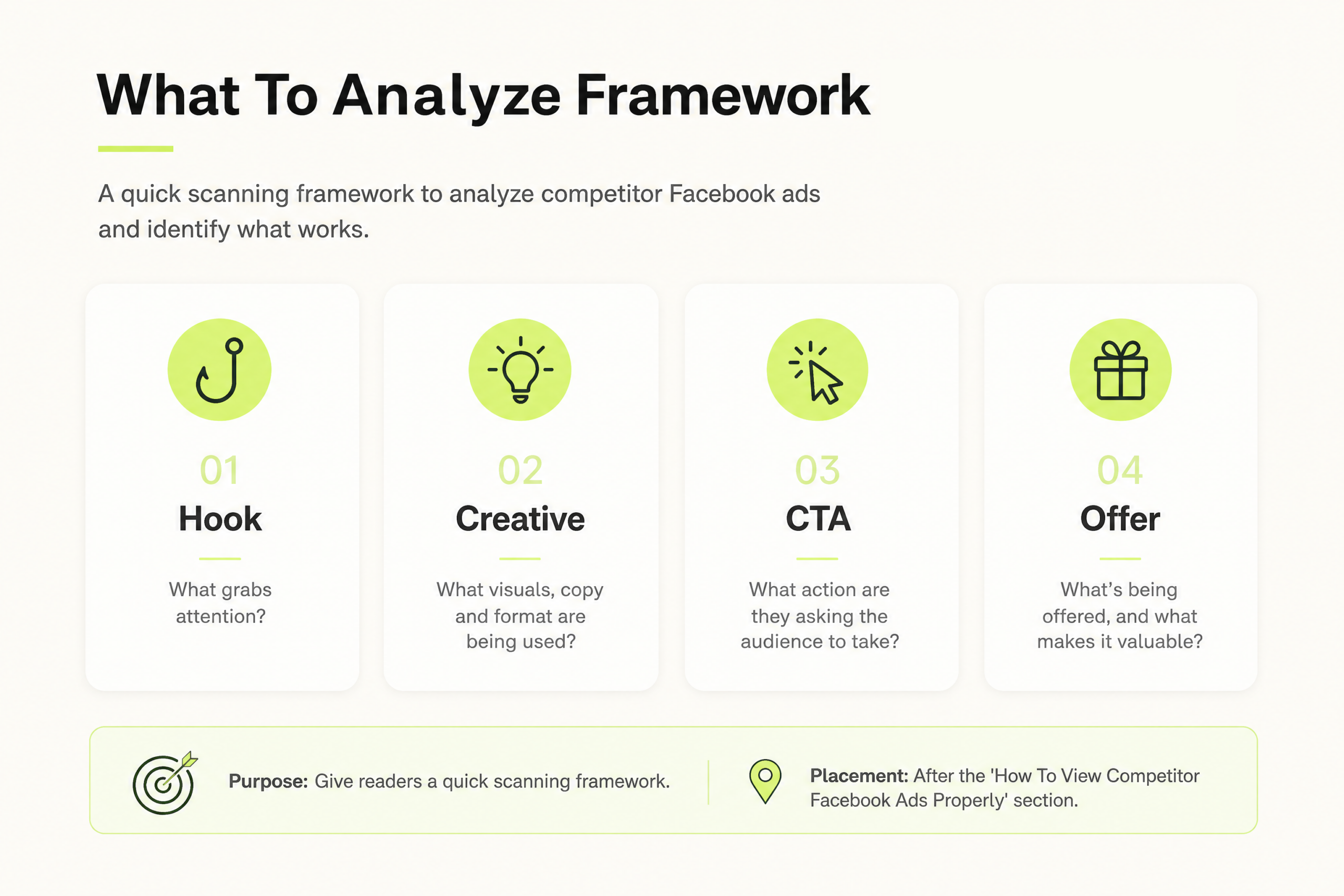
Finding ads is the easy part. Knowing what to look at – and what it means – is where most advertisers drop the ball. When you view competitor Facebook ads, don’t just glance at the creative. Dig into the structure.
Creative Elements
- Images: Are they using lifestyle photography, flat product shots, or illustrated graphics? What colors dominate?
- Videos: Short-form UGC? Talking-head testimonials? Animated explainers? Video format often signals what’s converting in that niche.
- Design patterns: Should you use clean, minimal design patterns, or go busy with text overlays and callouts? The answer often lies in your audience. Visual density – how much visual information you pack in typically reflects the sophistication level of the people you’re trying to reach.
Copy Elements
- Headlines: Is the headline leading with a benefit, a problem, a question, or a bold claim?
- Hooks: The first line (or first 3 seconds of video) is everything. Collect these – they reveal what’s grabbing attention in your market.
- CTAs: ‘Shop Now’ feels different than ‘Learn More’, doesn’t it? That’s because each signals a different stage of the buyer’s journey.
- Offer language: ‘Save 40%’ vs ‘Free Shipping Today’ vs ‘Join 10,000+ customers’ – every single phrase is a test result.
Campaign Patterns
- Duration: An ad running for four weeks or longer? That’s a quiet signal that it’s working.
- Multiple variations: Five to eight variations of the same concept? They’re split-testing a likely winner.
- Repeated messages: See the same headline or offer across multiple ads? That message is resonating.
Competitor ad analysis is like reading a map someone else already drew. You don’t have to replicate the journey – you just need to understand the terrain.
What Winning Facebook Ads Usually Reveal
After studying many Competitor Facebook Ads across different verticals, the patterns become hard to miss. High-performing Facebook ads share some consistent structural traits:
Ad Hooks That Stop the Scroll
The opening line or visual is the single most important element of any ad. Winning ads typically rely on one of three hook styles.
- Question-based hooks: ‘Struggling to get leads without a massive ad budget?’ See how that goes straight for the pain?
- Pain-point hooks: ‘Most agency owners waste $3,000/month on ads that don’t convert.’ That one names the problem and creates urgency in one sentence.
- Curiosity hooks: ‘We tried something most brands are too afraid to do – and it tripled our ROAS.’ – pulls you in without revealing the answer.
Offers That Convert
The offer structure used by competitors reveals a great deal about what’s currently working in a market. Among high-performing Facebook ads, four common patterns emerge.
- Free trials or freemium – let people try before they buy.
- Percentage discounts with a hard deadline – ‘40% off – today only’ creates real urgency.
- Value stacks – ‘Buy the course, get the toolkit free’ makes the deal feel bigger.
- Risk removers – money-back guarantees, no contracts.
Creative Trends Worth Noting
- User-generated content – those authentic, slightly messy customer videos – almost always beats expensive studio ads.
- Testimonial ads work because real users = real trust.
- Short-form video (under 30 seconds): That’s built for mobile feeds where attention spans are brutally short.
Turning Competitor Research Into Campaign Execution
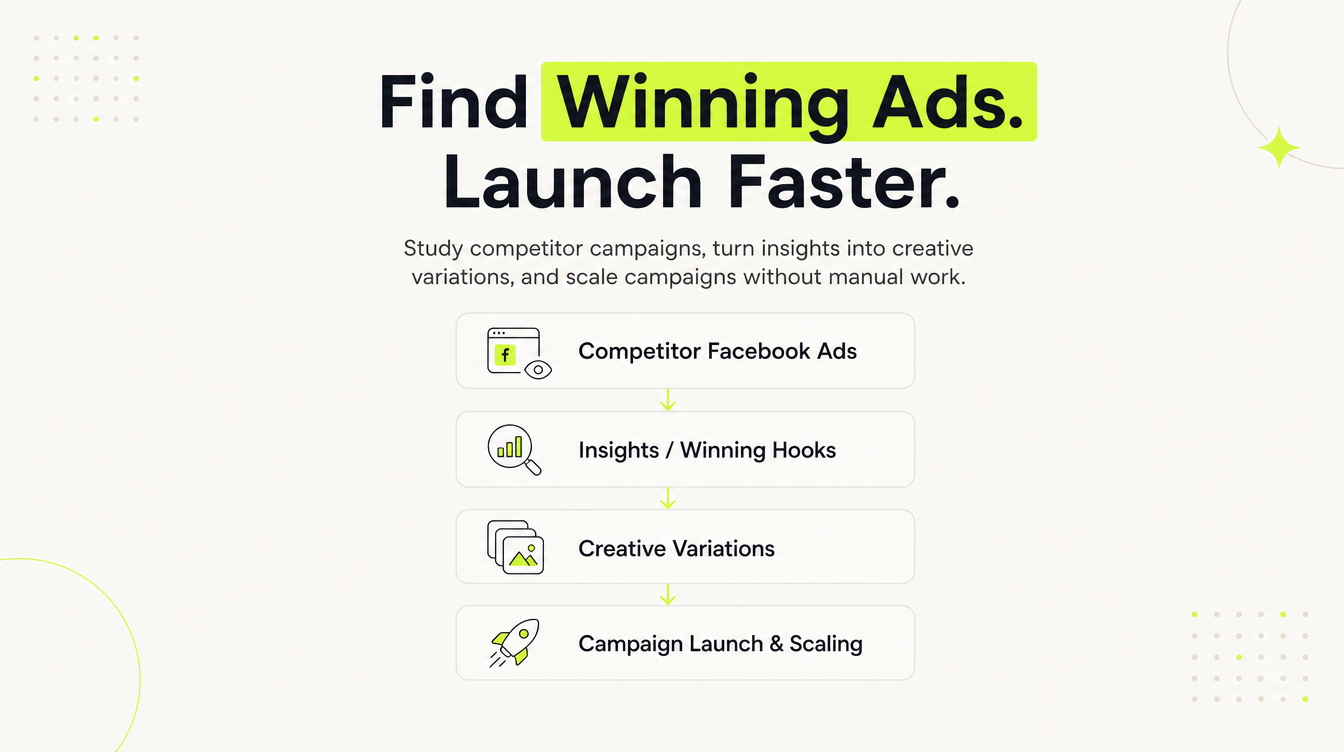
Research tools help you discover what competitors are doing. But discovery alone doesn’t launch campaigns. There’s always a gap between ‘I found a winning angle’ and ‘I have 20 variations live and scaling.’
That’s where FabFunnel fits in – not as a spy tool, but as an execution platform. Once you’ve gathered insights from your Competitor Facebook Ads research, FabFunnel helps you act on those insights faster through creative generation, bulk launch workflows, and campaign scaling tools.
Research tools tell you what’s working. FabFunnel helps you build and launch campaigns around it – without the manual bottleneck.
| Tool | Category | Purpose | Best For | Limitation |
|---|---|---|---|---|
| Meta Ad Library | Research | View all active Meta ads publicly | Free, instant checks on any brand | No performance data |
| AdSpy | Research | Search large ad databases with filters | Deep niche and keyword research | Paid; cost can add up |
| BigSpy | Research | Multi-network ad intelligence | Cross-platform ad monitoring | Can feel overwhelming |
| Minea | Research | Product + ad intel for e-commerce | Dropshippers tracking winning products | Limited outside e-commerce |
| FabFunnel | Execution | Turn research insights into campaigns at scale | Generating, launching & scaling creative variations | Focused on post-research workflow |
Choosing The Right Facebook Ads Research & Execution Platform
You find winning ad patterns from competitors. Next problem: executing fast. Some tools only help you discover ads. Others automate campaigns, produce creatives, and scale workflows.
Understanding where each platform sits helps you choose tools that complement each other rather than overlap.
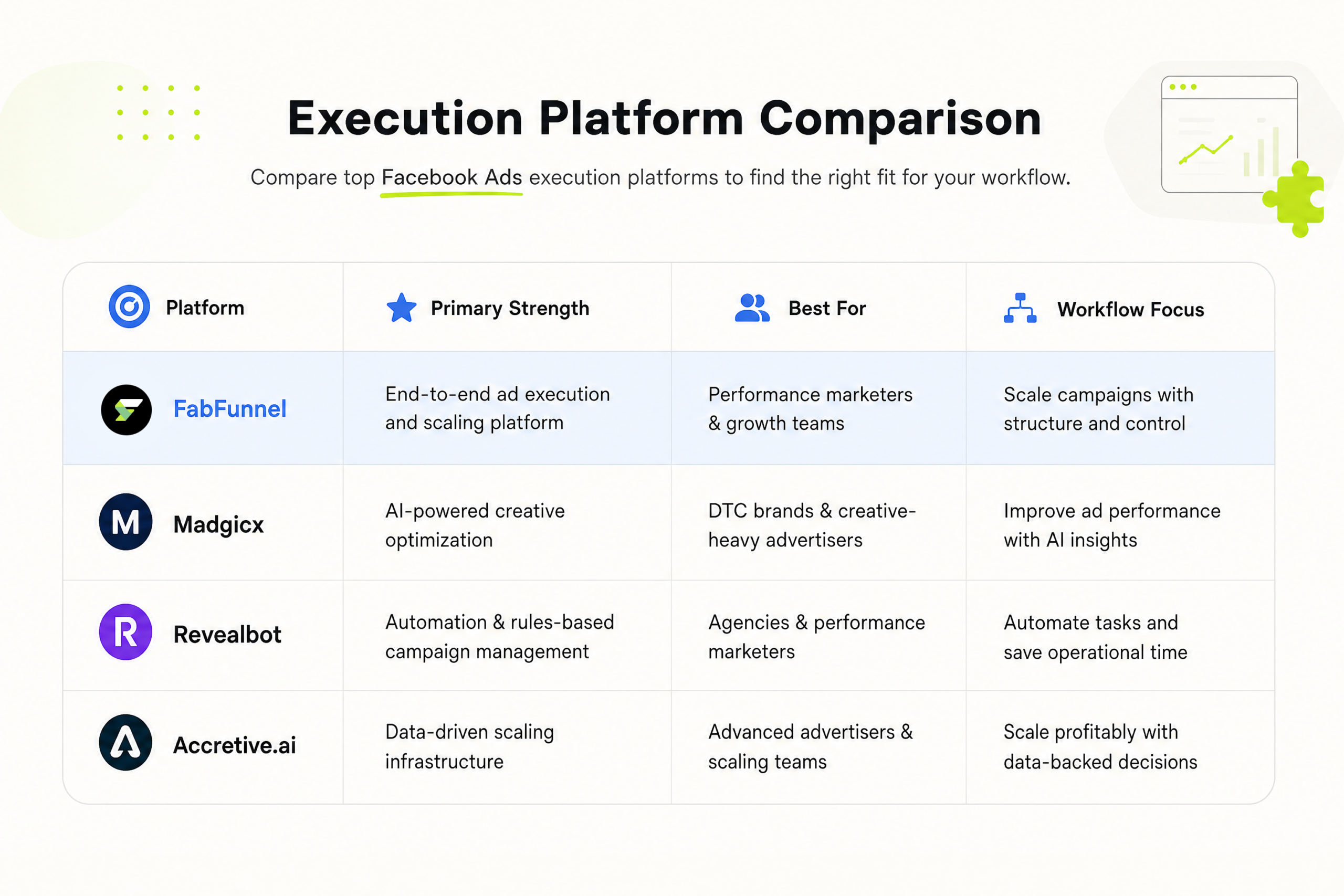
Some ad platforms help you optimise your ads better – by changing how much you bid, moving your budget around, or getting better results. Other platforms focus on automation to handle boring, repeated jobs for you, so your team doesn’t have to do them by hand once everything is set up.
For high-volume advertisers, the bottleneck is rarely finding ideas – it’s producing enough creative variations fast enough to sustain scaling.
FabFunnel‘s positioning is different. It focuses on compressing the time between identifying a winning angle – from Competitor Facebook Ads research or otherwise – and launching scalable creative variations around it. The emphasis is on creative production speed, bulk launch workflows, and scaling execution, rather than campaign management after the fact.
For teams that have the research done and need to move fast, that distinction matters more than any feature overlap.
From Competitor Research To Campaign Launch
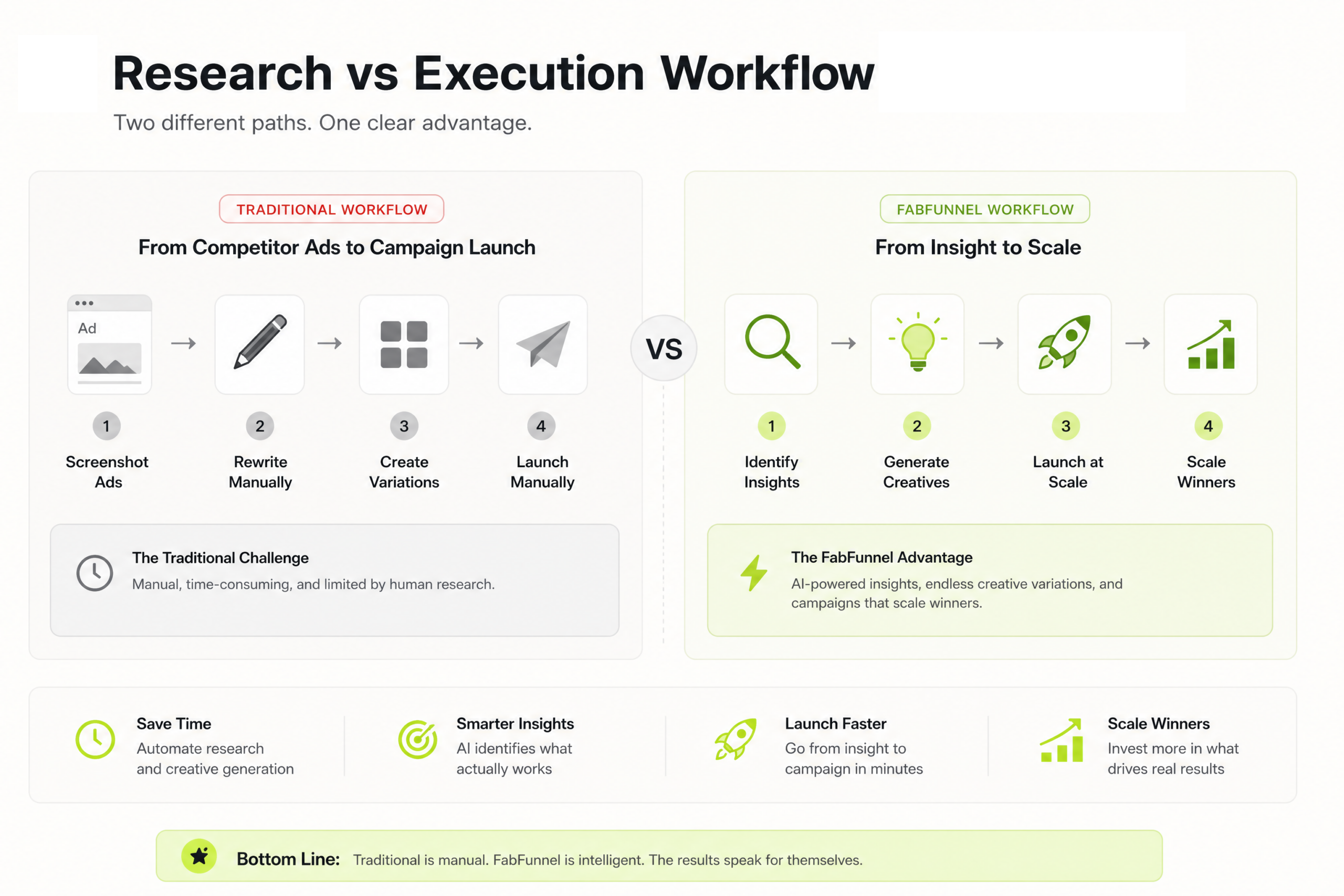
Understanding the workflow gap makes it clear why research alone isn’t enough. Here’s what the process typically looks like – with and without a dedicated execution platform:
| Traditional Workflow | With FabFunnel |
|---|---|
| ✗ Find a competitor ad | ✓ Identify winning hooks from your research |
| ✗ Save screenshots manually | ✓ Generate 20–50 creative variations |
| ✗ Rewrite copy by hand | ✓ Launch campaigns at scale in one workflow |
| ✗ Create multiple ad versions individually | ✓ Monitor and scale winning variations faster |
| ✗ Launch campaigns one by one | |
| ✗ Monitor results manually |
The traditional workflow isn’t broken – it’s just slow. Each manual step adds hours of work between insight and launch. Compressing that timeline is where campaigns gain a real competitive edge.
How FabFunnel Helps Turn Competitor Research Into Winning Campaigns
Studying Competitor Facebook Ads is only half the job. The other half is moving from insight to execution – quickly and at scale.
Once you’ve identified the winning patterns, FabFunnel handles the execution. Feed in the hooks and offer structures you’ve validated through research — it generates creative variations without blank-canvas guessing. Launch at scale in one workflow instead of building campaigns one by one. As early data comes in, scale the winners faster without rebuilding from scratch. The manual grind gets compressed; the time goes back to strategy.
The goal isn’t to copy competitor campaigns – it’s to extract the strategic logic behind them and apply it smarter. FabFunnel is where that logic becomes a live campaign.
Mistakes To Avoid When You Spy on Competitors Facebook Ads
Learning to spy on competitors’ Facebook ads is valuable. But there are several pitfalls that turn this research process into wasted effort – or worse, underperforming campaigns.
- Copying ads word-for-word: Lifting a competitor’s copy or creative directly may get flagged by Meta and is unlikely to perform – because their audience, funnel, and offer context differ from yours.
- Ignoring audience differences: A hook that works for a seasoned SaaS buyer won’t land the same way with a first-time e-commerce shopper. Adapt the principle, not the literal copy.
- Following short-term trends blindly: An ad that went viral last month might already be fatigued. Look for patterns that persist over time, not just what’s trending this week.
- Looking only at visuals: The design is easy to notice – but the real insight is often in the copy, the offer structure, and the CTA. Don’t stop at the creative.
- Missing the offer analysis: What the ad says matters less than what it’s offering. Many advertisers review Competitor Facebook Ads and walk away without understanding the underlying offer mechanics that make the ad work.
The best competitor research is structured and recurring – not a one-time exercise you do before a campaign launch and forget.
Conclusion
Studying Competitor Facebook Ads isn’t about copying. It’s about learning – faster, smarter, and with less wasted budget.
Every active campaign a competitor runs becomes another source of market intelligence. The hooks they use, the offers they promote, the creatives they keep running – all of it is public information that sharpens your own campaigns before you spend a cent.
The advertisers who win consistently aren’t the ones who guess the best – they’re the ones who observe, adapt, and execute quickly. Monitoring Competitor Facebook Ads is how the research phase starts. Building efficient execution workflows is how it compounds into a real advantage.
Use the research tools and methods in this guide to build a systematic competitor analysis habit. And when you’re ready to move from insight to launched campaign – without the manual bottleneck – see how FabFunnel helps marketers generate and scale winning campaigns faster.
Frequently Asked Questions
Q1: Can I legally view competitor Facebook ads?
Yes. Meta’s Ad Library lets anyone view competitor Facebook ads for free – no account needed. It’s an official Meta transparency tool, not a workaround. The one thing to avoid is reproducing their creative or copy directly, which can raise IP concerns.
Q2: How can I find Facebook ads of competitors?
Start with the free Meta Ad Library – it shows every active ad for any brand. But that’s just the surface. You need advanced filters, historical data, and niche discovery? Then move fast to dedicated tools like AdSpy, BigSpy, or Minea. They go significantly deeper.
Q3: What are the best Facebook ads competitor analysis tools?
For research: Meta Ad Library (free), AdSpy, BigSpy, Minea. For execution – turning those findings into launched campaigns – FabFunnel. Facebook ads competitor analysis tools find what’s working; FabFunnel helps you build and scale around it before the window closes.
Q4: How do I know if a competitor ad is performing well?
Exact conversion data is private – no tool can access it. The strongest free signals are run duration (ads live for 4+ weeks are almost certainly profitable), multiple creative variations around the same concept (a sign they’re scaling a winner), and repeated hooks or offers across campaigns. Once you’ve spotted a pattern worth acting on, FabFunnel helps you move from that insight to launched creative variations – fast.
Q5: Can I copy competitor Facebook ads directly?
No. Direct copying is a losing game – Meta policy violations and IP issues wait for no one. The right move is clear: study the competitor’s hook, offer framing, and CTA, then adapt those principles to your own brand and audience. FabFunnel delivers exactly that capability. Feed it a validated angle. It generates campaign-ready variations. No starting from scratch. No guesswork.
Q6: What should I analyze besides ad creatives?
Offer mechanics, copy structure, campaign duration, variation volume, and landing page alignment. When you spy on competitors’ Facebook ads properly, the most valuable intelligence is almost always in the offer and the copy – not the image or video. Once you’ve identified what’s working at that level, the next question is execution speed. That’s where FabFunnel compresses the gap between insight and live campaign.