In This Article
- The scale problem every advertiser faces
- Why manual campaign creation breaks at scale
- What “launching at scale” actually means
- The 3 methods to launch campaigns at scale
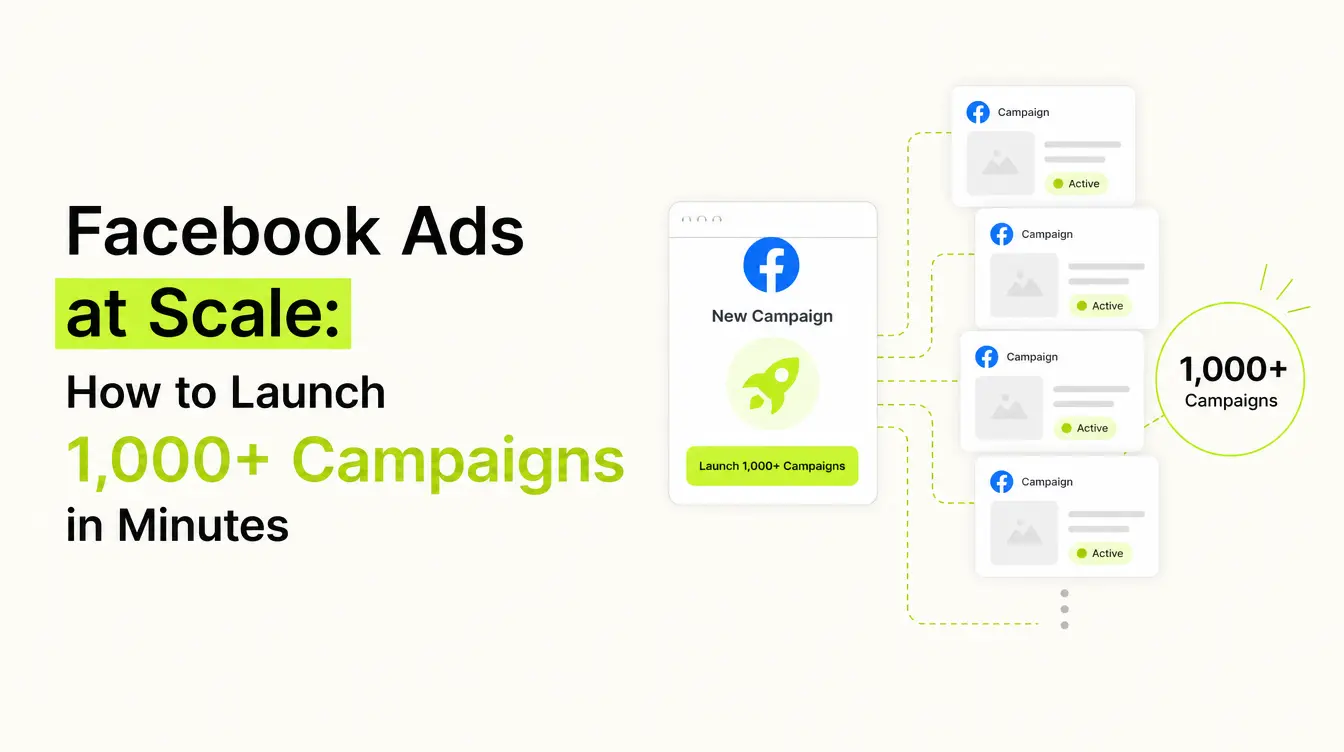
- Step-by-step: 1,000 campaigns in minutes with FabFunnel
- Real-world results: case study + what scale unlocks
- Two things FabFunnel does differently
- Common pitfalls and how to avoid them
- Ready to scale?
The Scale Problem Every Advertiser Faces
Picture this: it is Monday morning. Your creative team just handed you 20 new ad concepts. Your strategist has mapped out 15 audience segments. Your media plan calls for testing 4 different objectives across 3 budget tiers. That is 3,600 potential campaign combinations. And you are doing it manually. If Facebook ads campaigns take just 5 minutes to set up, the time adds up fast. With 3,600 campaign combinations, that is 300 hours of setup work. And that is before you have spent a single dollar. This is the scale problem. And it is not a you problem – it is a structural problem with how Facebook Ads Manager was designed. This becomes even more evident when managing a Facebook advertising campaign across multiple audiences, creatives, and budget variations. It works beautifully for a handful of campaigns. It becomes a bottleneck the moment you try to run a proper testing operation.The Core Insight
Facebook’s algorithm rewards advertisers who give it more data, faster. Volume is not vanity; it is the engine of learning. Brands that can run 500 experiments simultaneously learn what works 10x faster than brands running 50. And that is exactly why volume becomes your greatest lever for learning: when building your Facebook ads campaign strategy, volume is your primary competitive advantage. This post is for the performance marketers, growth leads, and agency teams who have hit that ceiling – and want to break through it. We will cover what scaling really means, the three ways to do it, and exactly how to launch 1,000+ campaigns in minutes using FabFunnel, an all-in-one ad engine for Meta, TikTok, and more.Why Manual Campaign Creation Breaks at Scale
Manual campaign setup does not just slow you down – it actively degrades the quality of your advertising operation in ways that compound over time.The time cost is brutal
Even a seasoned media buyer takes 4–8 minutes per campaign when working carefully: naming, audience selection, creative upload, budget, placement, review. Multiply that by hundreds of campaigns, and you are not running a marketing operation – you are running a data entry business.Human error is inevitable at volume
When you are on your 47th campaign of the day, things slip. Wrong audience attached to a campaign. Budget set to daily instead of lifetime. A creative uploaded to the wrong ad set. Naming conventions fall apart. These errors are silent – they corrupt your data, waste budget, and make your results uninterpretable.Slow iteration means slow learning
Facebook’s algorithm is a learning machine. It needs impressions to optimize. If it takes you three weeks to build out a proper test matrix that a tool could assemble in 10 minutes, you have lost three weeks of learning. In a competitive category, that is a meaningful disadvantage.The Real Cost
Your competitors running automation are testing 20 creatives against 30 audiences simultaneously. You are testing 3 against 5 because that is what your team can handle manually. The leverage gap is structural, and it compounds every week.What “Launching at Scale” Actually Means
Before we get into the how, it is worth being precise about what scale actually means. There are three distinct types, and confusing them leads to wasted effort.Budget scaling
Most people think scaling Facebook ads means increasing the budget on campaigns that are already working. That matters, but it is not what we are focusing on here. Budget scaling is output. What we are focused on is input.Audience scaling
Expanding reach by layering in new targeting parameters – lookalike audiences, broad interest stacks, geographic expansion. Useful, but still manually intensive if done campaign-by-campaign. This is especially true for teams running a Facebook lead generation campaign, where multiple audience segments and creatives need to be tested simultaneously to identify high-quality leads.Volume scaling – the multiplier effect
This is the lever that changes everything. Instead of running one campaign and optimizing it, you multiply a single concept across its variables simultaneously:The Multiplication Formula
1 offer x 20 creatives x 15 audiences x 3 placements x 4 budget tiers = 3,600 campaign variants. You are not creating 3,600 campaigns by hand – you are defining the variables once and letting automation assemble the matrix.The Multiplication Formula
1 Offer × 20 Creatives × 15 Audiences × 3 Placements × 4 Budget Tiers = 3,600 Campaign Variants
The 3 Methods to Launch Campaigns at Scale
There is no single right way to scale campaign creation. Your ideal method comes down to three things: your team’s technical skill, your budget, and how much control you actually need. Get these right, and you win.Method 1: Facebook’s native bulk tools
Use the bulk import feature. Upload a structured CSV. Done. Massive efficiency, right at your fingertips. You define your campaigns in a spreadsheet, format them to Facebook’s spec, and upload the file. It works – but it has significant limitations. The CSV format is rigid and error-prone. One formatting mistake and your entire upload fails. There is no preview layer, no rule-based logic, and no way to apply dynamic naming conventions automatically. For most teams, this method maxes out around 50–100 campaigns before the spreadsheet management becomes its own problem.Method 2: The Facebook Marketing API
If your team knows how to code, Facebook’s Marketing API is a total game-changer. You can automate everything and plug it right into your own systems. Just keep in mind: it’s powerful, but it’s a bigger commitment to build and look after. A proper API integration requires developer time, ongoing upkeep due to Facebook’s API versioning changes, and meaningful technical infrastructure. It is the right choice for large teams with engineering resources, not for a 3-person growth team that needs to move fast.Method 3: Automation platforms
This is where most performance marketers will find the right balance of power and accessibility. FabFunnel makes the Marketing API easy to use. You don’t need to be an engineer. Media buyers can use it. You just tell FabFunnel what you want – like templates, different audiences and creative combinations, and how to name things. FabFunnel does all the hard computer work in the background. No CSV formatting. No code. No waiting on engineering.| METHOD | SPEED | FLEXIBILITY | TECH SKILL NEEDED | BEST FOR |
|---|---|---|---|---|
| Native bulk import (CSV) | Moderate | Low | Spreadsheet-level | Small batches (<100 campaigns) |
| Marketing API | Fastest | Highest | Engineering team required | Large orgs with dev resources |
| Automation platform | Very fast | High | None | Growth teams, agencies, ecom brands |
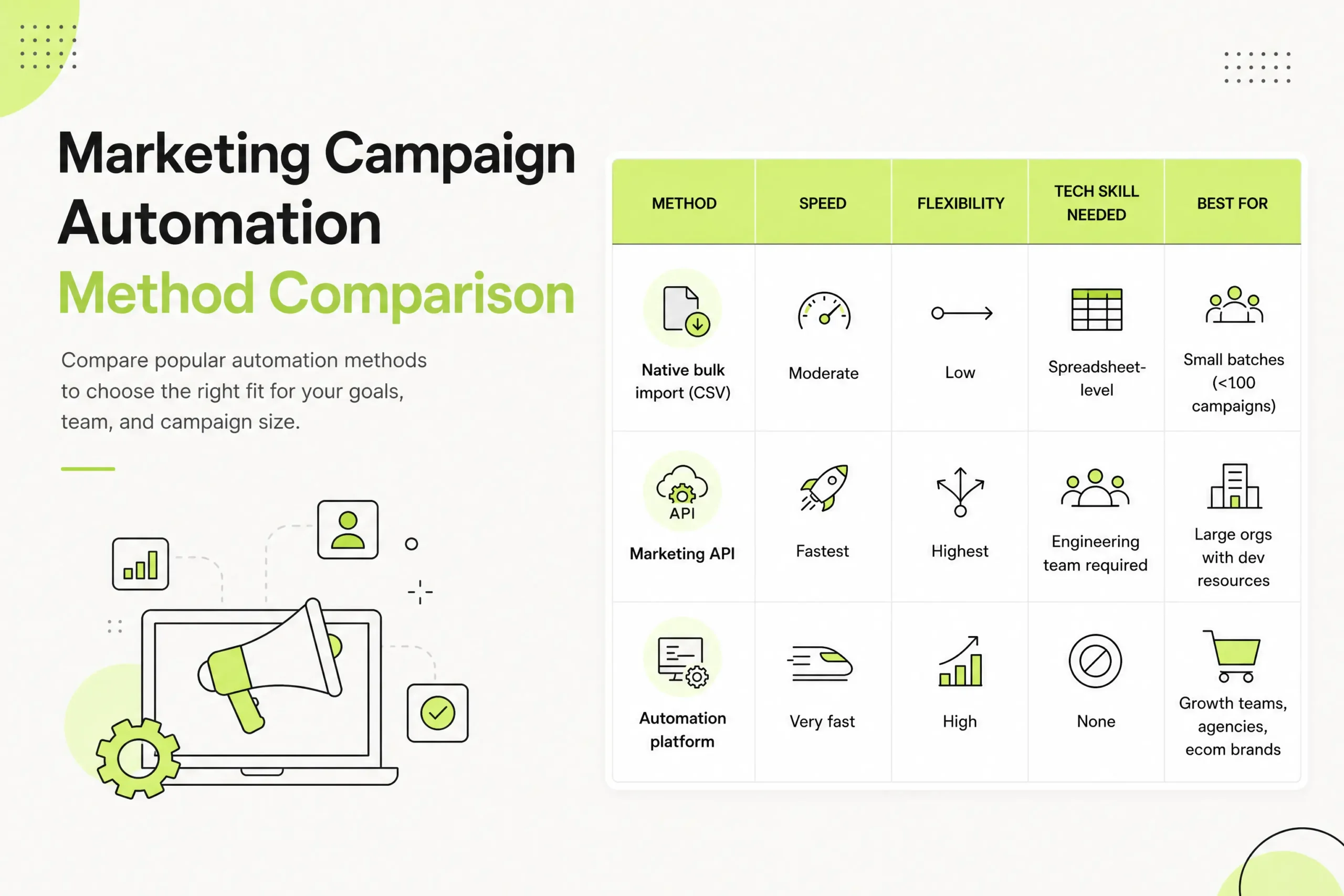
How to create a Facebook ads campaign at scale using FabFunnel
Here is exactly how the process works inside FabFunnel. Once you have set up your first template, the workflow is highly efficient. Note on setup time: Your first template setup takes 30–45 minutes. Every subsequent bulk launch using that template takes under 15 minutes.- Build your campaign template: Start by defining the structure that will be replicated across all your variants. This includes your objective, budget logic, bidding strategy, and your naming convention template. FabFunnel supports dynamic naming tokens – giving you clean, parseable data from day one.
- Define your variation matrix: This is where the multiplication happens. Upload your audience list, your creative assets, and define your budget tiers. FabFunnel’s matrix builder shows you how many campaigns will be generated before you commit.
- Upload assets and configure automation rules: Bulk-upload your creative assets directly in FabFunnel. Set post-launch rules once and let automation do the rest. Pause campaigns when CPM gets too high. Scale budgets on campaigns crushing your ROAS targets. Or simply flag others for review. Your time is better spent on strategy, not monitoring.
- Preview, validate, and launch: FabFunnel generates a full preview of every campaign that will be created. Catch errors here without any of them reaching Facebook. Once you approve the preview, click launch.
- Let automated monitoring do the heavy lifting: Post-launch, FabFunnel’s monitoring layer tracks every campaign against the rules you defined. Winners get an extra budget. Losers get paused. You move from being a campaign manager to being a strategist.
Real-World Results: What Scale Actually Unlocks
The business case for launching at volume is not theoretical. Here is what it looks like when a real team makes the switch.Case Study · Affiliate Marketer
From 20 campaigns a day to 20 accounts before lunch A solo affiliate was manually building campaigns account by account – maxing out at around 20 per day and spending over 20 hours per week on setup alone. After switching to FabFunnel, the same operator automated bulk launches across all platforms and used AI-driven creative generation to continuously feed the testing pipeline.- 5x ROI achieved within 30 days of launch (at a consistent daily spend)
- 20+ Hours per week reclaimed for strategy
- 20x More winning creatives identified per month
Key Metrics to Watch When Running High-Volume Campaigns
At 1,000+ campaigns, watch systemic metrics:- Average CPM trend: Rising CPM? That means audience saturation or creative fatigue.
- Frequency by campaign age: Campaigns older than 2–3 weeks with frequency above 3 need a creative refresh.
- Auction overlap score: Campaigns competing against each other inflate your own CPM.
- Learning phase completion rate: Campaigns stuck in learning typically signal budget fragmentation.
Three Things FabFunnel Does Differently
Most ad automation tools help you go faster. FabFunnel changes the entire campaign lifecycle, optimizing not just the speed of your execution, but the intelligence behind every dollar you spend.- Bulk Launcher: This is the machine that brings your strategy to life. Connect your account, upload your matrix, and push hundreds of campaign variations live in minutes—not hours. You eliminate the human error of manual setup, reclaim hundreds of hours, and ensure your testing matrix is executed with machine-like precision.
- Creative Generation: Stop waiting days for designers to build variations. Our engine allows you to take a winning angle and instantly generate 200+ high-quality creative variations. You move from an abstract concept to a full library of testable assets in a single session.
- Industry Insight: Before you launch a single campaign, FabFunnel shows you what creative formats, angles, and offers are generating results in your category today. You are not guessing what to test – you are building hypotheses on live market signals.
Common Pitfalls When Scaling Facebook Ads (and How to Avoid Them)
Launching 1,000 campaigns is easy. Launching 1,000 campaigns that actually work – and do not create a management nightmare – requires discipline. Scale only works when supported by sufficient budget; volume without spend leads to fragmented learning. FabFunnel helps you consolidate your budget into winning variants quickly to avoid this. Here are the most common mistakes to avoid:- Audience overlap: Use Facebook’s Audience Overlap tool and segment your audience list.
- Budget fragmentation: Fewer ad sets with adequate budget will almost always outperform many ad sets with fractional budget.
- Creative fatigue: Monitor frequency at the creative level, not just the campaign level.
- Policy violations: Review every creative against Facebook’s advertising policies before bulk launch.
- Naming convention chaos: Establish your naming convention before you launch a single campaign.