Facebook ads automation breaks down into three decisions that agencies get right or get wrong every day: when to pause, when to scale, and how automated rules govern both.
Most teams handle at least one of these manually. That works at five clients. At twenty, the gaps compound – budget leaking into dead ad sets, scaling opportunities missed over weekends, proven campaign structures rebuilt from scratch for every new account.
This article covers how all three automation decisions work, what conditions should trigger each, and how FabFunnel handles them as a unified system.
The Three Core Decisions in Facebook Ads Automation
Auto-Pause
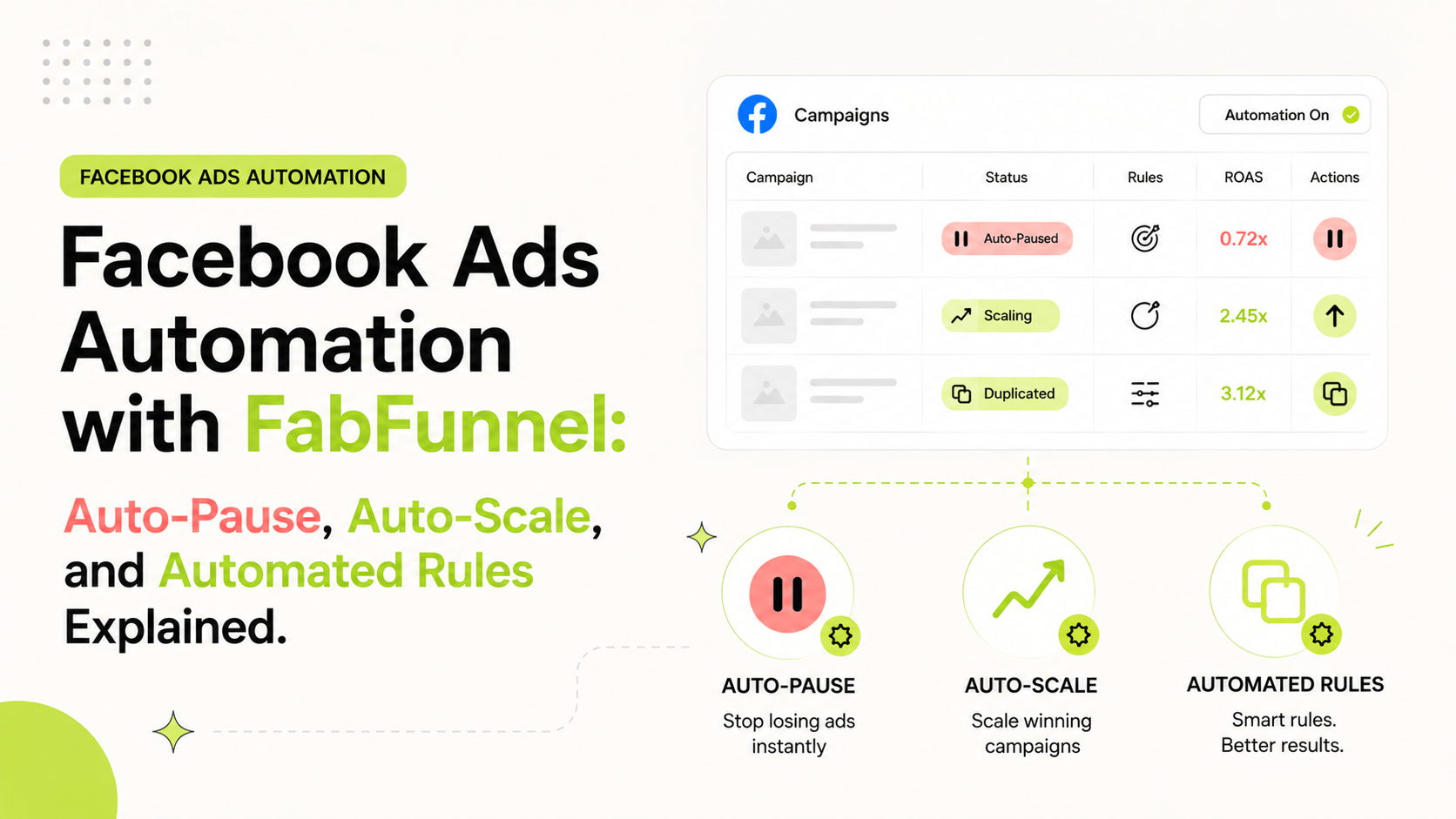
Auto-pause is the most commonly implemented form of facebook automated rules – and the most commonly misconfigured.
The logic: define a performance floor, and when a campaign or ad set drops below it for long enough to be meaningful, pause it automatically. No waiting until Monday’s report. No budget continuing to flow into ad sets that have already shown they won’t hit target.
The window matters as much as the threshold. A single bad day doesn’t warrant pausing – attribution delays and day-of-week variance produce temporary dips that recover. Pause conditions should require sustained underperformance: CPA exceeding a hard limit for 3–7 days, or ROAS falling below the floor for a defined window.
The most common mistake: setting pause rules that reference a 1-day lookback when the campaign optimizes on a 7-day click window. That fires on incomplete data and cuts off ad sets that are actually working.
Auto-Scale
Auto-scale captures the upside that manual review misses. When an ad set exceeds ROAS target by a meaningful margin for long enough to be statistically valid – scale it immediately, not at next week’s budget review.
Performance windows on Meta don’t wait. An ad set converting at 3x target on a Tuesday afternoon may be responding to a fresh creative, a lower-competition auction window, or a specific audience composition. That window closes. Facebook ads automation that waits for manual authorization leaves real volume on the table.
Scale incrementally – 15–20% budget increases at a time – to avoid resetting the learning phase. Require a minimum conversion volume before the rule fires. Scaling two conversions isn’t the same signal as scaling forty.
Automated Rules
Automated rules are the conditional logic layer that sits above Meta’s algorithmic automation. Where Advantage+ optimizes how Meta buys, automated rules define what you do with the results – and when. The rule format is always the same: when [metric] meets [condition] for [window], execute [action].
Pause and scale are the most visible applications, but they’re not the ceiling. The same rule structure governs creative retirement, budget reallocation, and adjustments triggered by account-wide performance signals. The more conditions you define, the less triage happens manually.
The compounding advantage of well-configured automated rules isn’t any single action – it’s the elimination of latency between a performance signal and a response. Manual review cycles operate on days. Rule-based automation operates on hours. At meaningful spend levels, that difference compounds.
The Automated Campaign Triage Framework
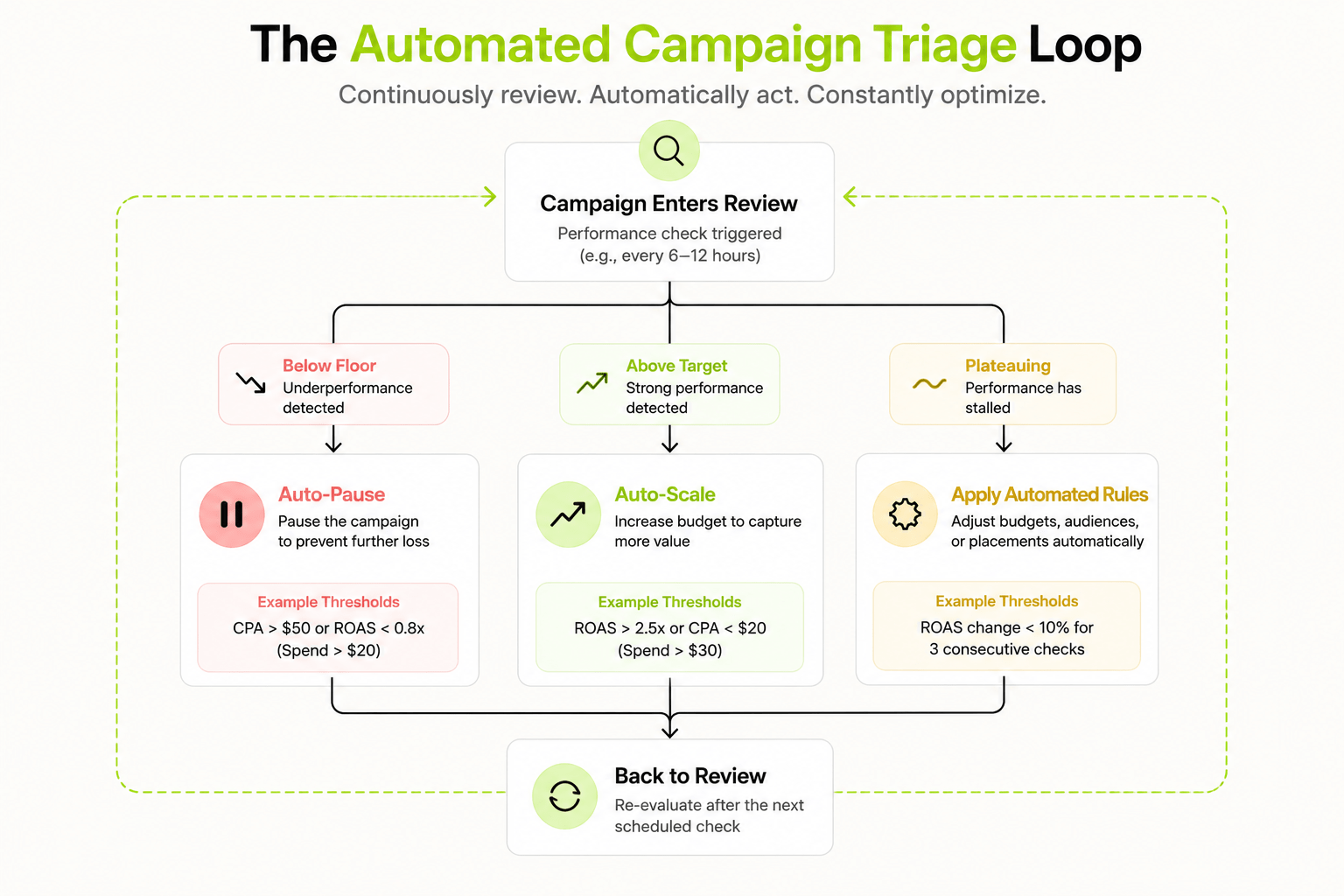
Pause, scale, and automated rules aren’t separate decisions – they’re three branches of one continuous loop: Automated Campaign Triage.
Every active campaign passes through triage constantly:
- Below the floor – Auto-pause. Stop the bleed.
- Above target with headroom – Auto-scale. Capture the window.
- At target but plateauing – Adjust the rules. Retire stale creative, test new audiences, or trigger a budget cap check.
Most facebook ads automation implementations handle one or two of these. The gaps are where overhead accumulates – campaigns leaking budget, scale opportunities missed, rule sets that haven’t been updated since launch.
What a Facebook Ad Automation Tool Needs to Support All Three
Not every facebook ad automation tool handles the full triage loop, especially at agency scale.
Cross-account execution. Rules that require account-by-account configuration reintroduce manual work at the setup layer. Facebook ads automation software needs to apply consistent triage logic across all accounts simultaneously.
Execution frequency. Daily rule execution misses intraday swings. Automated ads on Facebook can shift from efficient to wasteful within hours at meaningful spend levels. Near-real-time execution is the difference between catching a bad ad set at $50 of waste versus $500.
Audit logs. Every automated action needs to be logged with the condition that triggered it. Without auditability, facebook ads automation produces accounts in states no one deliberately chose. Logs turn automation into institutional knowledge.
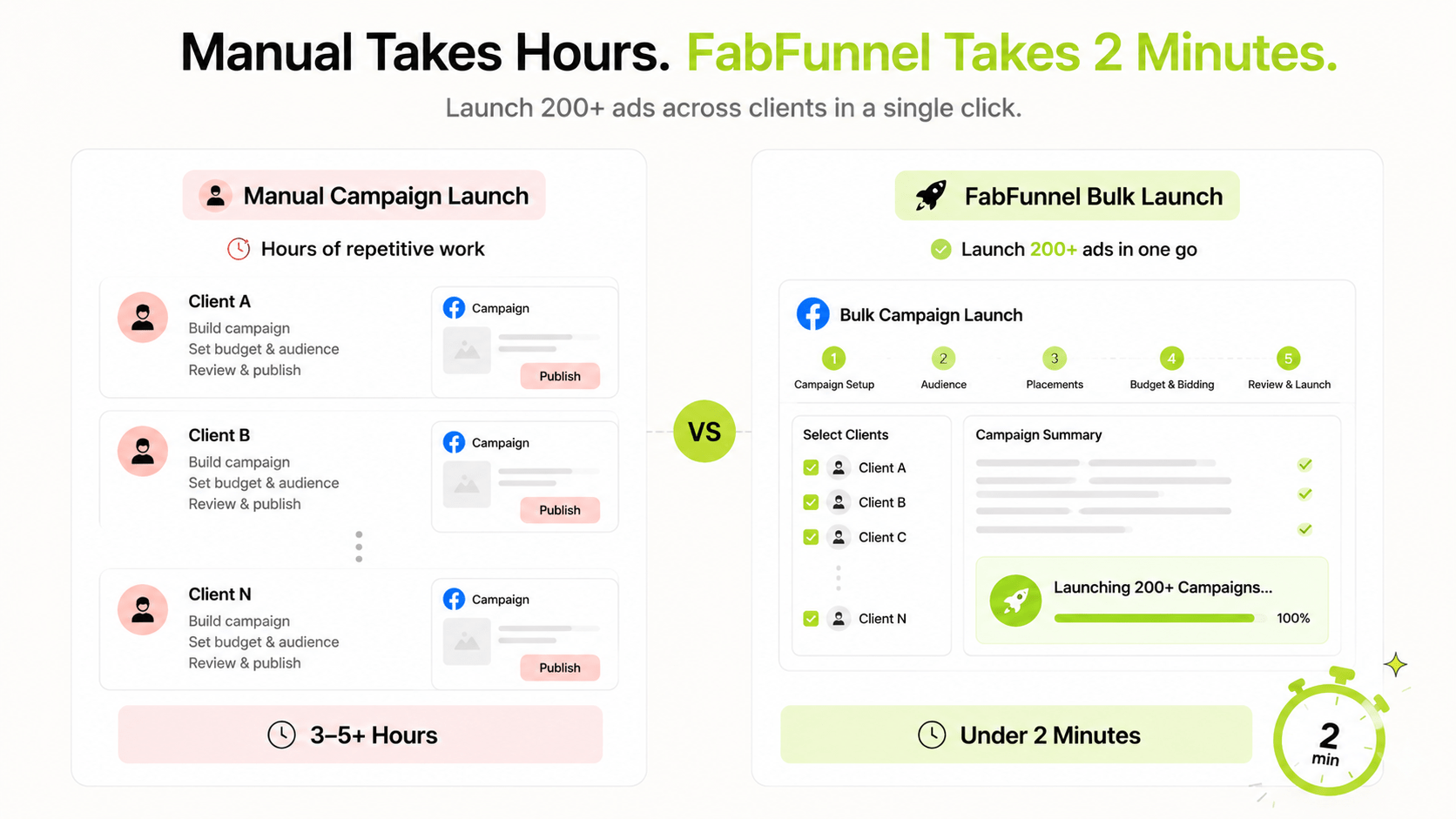
Bulk launch at creation. The duplication bottleneck isn’t usually in ongoing management – it’s at launch. Campaign structures rebuilt manually for every new client or offer is where the real time goes.
How FabFunnel Handles All Three
FabFunnel covers the full Automated Campaign Triage loop as a unified system – not three separate tools.
Automation Rules (Auto-Pause and Auto-Scale)
FabFunnel’s rules engine runs 24/7 at campaign, ad set, and ad level. Define the conditions – CPA floors, ROAS thresholds, frequency caps – and FabFunnel executes continuously across every account in your portfolio. Every action is logged: which rule fired, against which campaign, on what condition.
Bulk Campaign Launcher
FabFunnel’s Bulk Campaign Launcher solves the duplication problem at launch. Launch 200+ campaigns in under 2 minutes across Meta, TikTok, and NewsBreak – campaign structure, audience, creative, and budget applied in bulk. The manual rebuild that typically takes hours per client becomes a single workflow that fires across accounts in parallel.
Conclusion
Facebook ads automation that covers all three triage decisions – pause, scale, and automated rules – is what separates agencies that grow without proportional headcount from those that add operational overhead with every new client.
Auto-pause protects your budget floor. Auto-scale captures performance before the window closes. Automated rules govern both – and every other condition you define.
If the full triage loop isn’t automated yet, FabFunnel is built to close it.
Frequently Asked Questions
Q1: What is Facebook ads automation?
Facebook ads automation runs campaign decisions – pausing, scaling, budget changes based on performance conditions, without manual work. It has three layers: Meta’s algorithmic automation (Advantage+, automated bidding), rules-based automation (your own conditional logic), and operational automation (bulk creation, cross-account management).
Q2: What should trigger auto-pause in Facebook ads automation software?
Auto-pause triggers on sustained underperformance: CPA above a hard limit or ROAS below a floor for 3–7 days. Single-day dips are normal and recover. Use a lookback window that matches your attribution window, or the rule will fire on incomplete data.
Q3: What are Facebook automated rules?
Facebook automated rules are conditional statements: when [condition], then [action]. They sit above Meta’s algorithmic automation (Advantage+) and let you define actions – pause when CPA exceeds $X, scale when ROAS exceeds Y, retire creative when frequency exceeds 2.5.
Q4: How do automated rules differ from Advantage+ on Facebook?
Advantage+ controls how Meta buys (bidding, targeting, placements). Automated rules control what you do with results (pause losing ad sets, scale winners, retire creatives). Both run simultaneously. Advantage+ shapes auction behavior; automated rules govern the operational layer above it.
Q5: What should I look for in a Facebook ad automation tool for agencies?
Key requirements: cross-account rule execution (not per-account setup), hourly rule frequency (daily is too slow at meaningful spend), full audit logging, and bulk campaign creation at launch. Most tools handle ongoing management well; the real time sink is launching campaigns – rebuilding structures per client takes hours.
Q6: How do I avoid automation debt with Facebook automated rules?
Automation debt happens when rules no longer fit their campaigns – wrong conditions, mismatched attribution windows, or conflicting rules. Fix it with a quarterly audit: (1) match conditions to current metrics, (2) align attribution windows, (3) remove rule conflicts.