Running ads without AI in the creative process is still possible in 2026. It’s just slower, more expensive, and increasingly outpaced by teams that aren’t doing it that way.
AI generated ads have moved past the experimental phase. They’re now a primary production method for many performance marketers who need creative volume, faster testing cycles, and consistent output without scaling headcount alongside spend. The question isn’t whether to use them – it’s understanding how they actually work so you can use them well. Whether you’re searching for an AI ad generator, an ad generator AI, or simply AI ad creation, the tools point to the same workflow: input a brief, generate variations, review, and launch.
In short, AI generated ads are ads created with AI models instead of being built by hand. Teams use them to produce more variations, test faster, and launch without adding headcount.
What Are AI Generated Ads?
AI generated ads are advertising creatives – images, video, copy, or complete ad units – produced with the assistance of AI models rather than built manually from scratch. In practice, this is what most people mean when they ask how to create ads with AI.
The definition of AI ad creation spans a wide range. At the simpler end, it’s a marketer using AI to generate headline variations or resize a static ad for different placements. At the more advanced end, it’s a full ad unit – visual, copy, format, and platform spec – produced from a product brief and brand guidelines with no manual design work involved.
Most production use in 2026 sits in the middle. AI generates the visuals, copy variations, and format tweaks. Marketers pick what’s worth testing and run it in campaigns. The human doesn’t disappear from the process – the split between what the AI does and what the human does varies by tool and workflow.
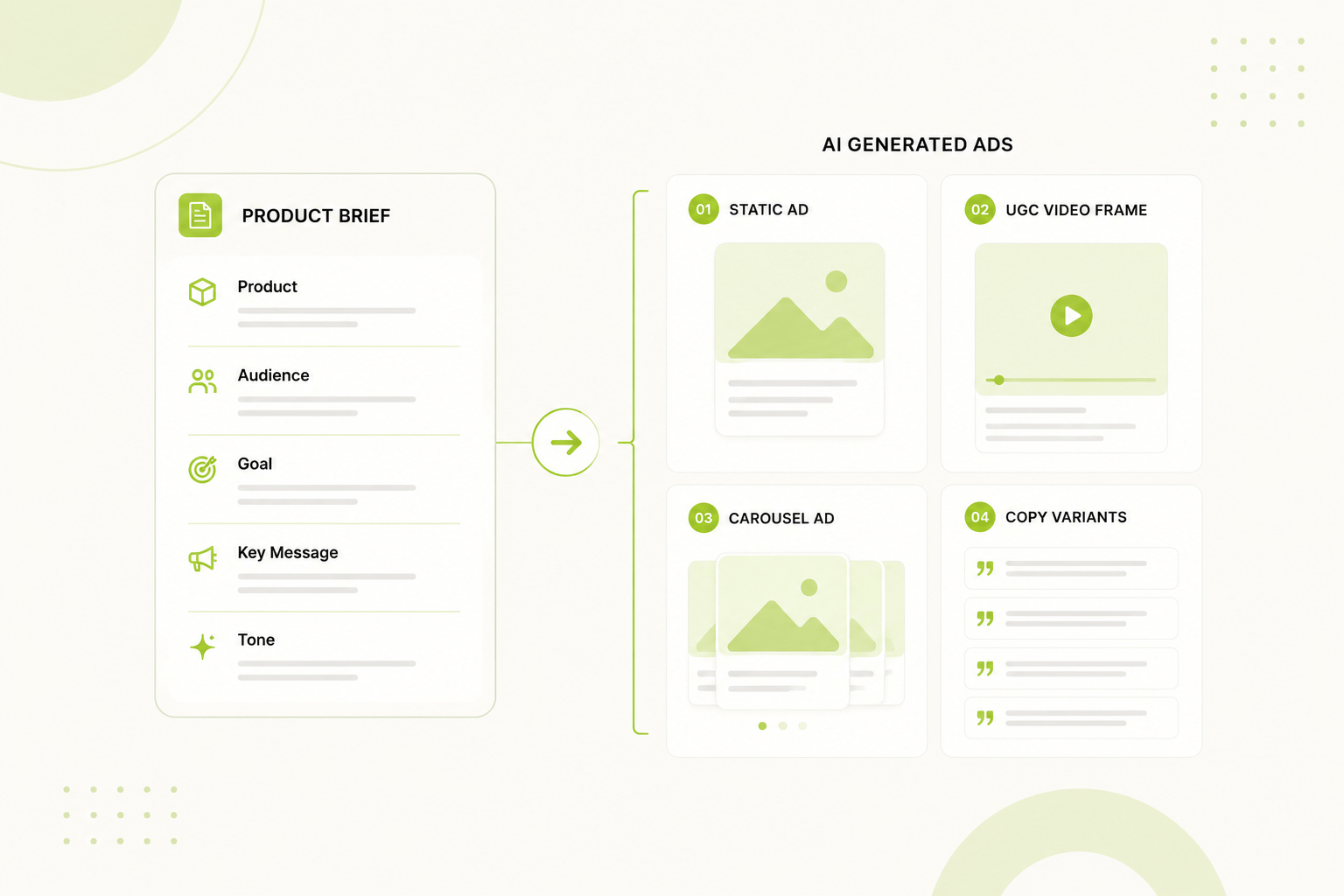
Output types that fall under AI generated ads:
- Static image ads – product shots, lifestyle visuals, offer-driven creatives
- Video ads – UGC-style, product showcase, testimonial format
- Ad copy – headlines, body text, CTAs across multiple variations
- Complete ad units built to platform spec for Meta, TikTok, or NewsBreak
How Do AI Generated Ads Actually Work?
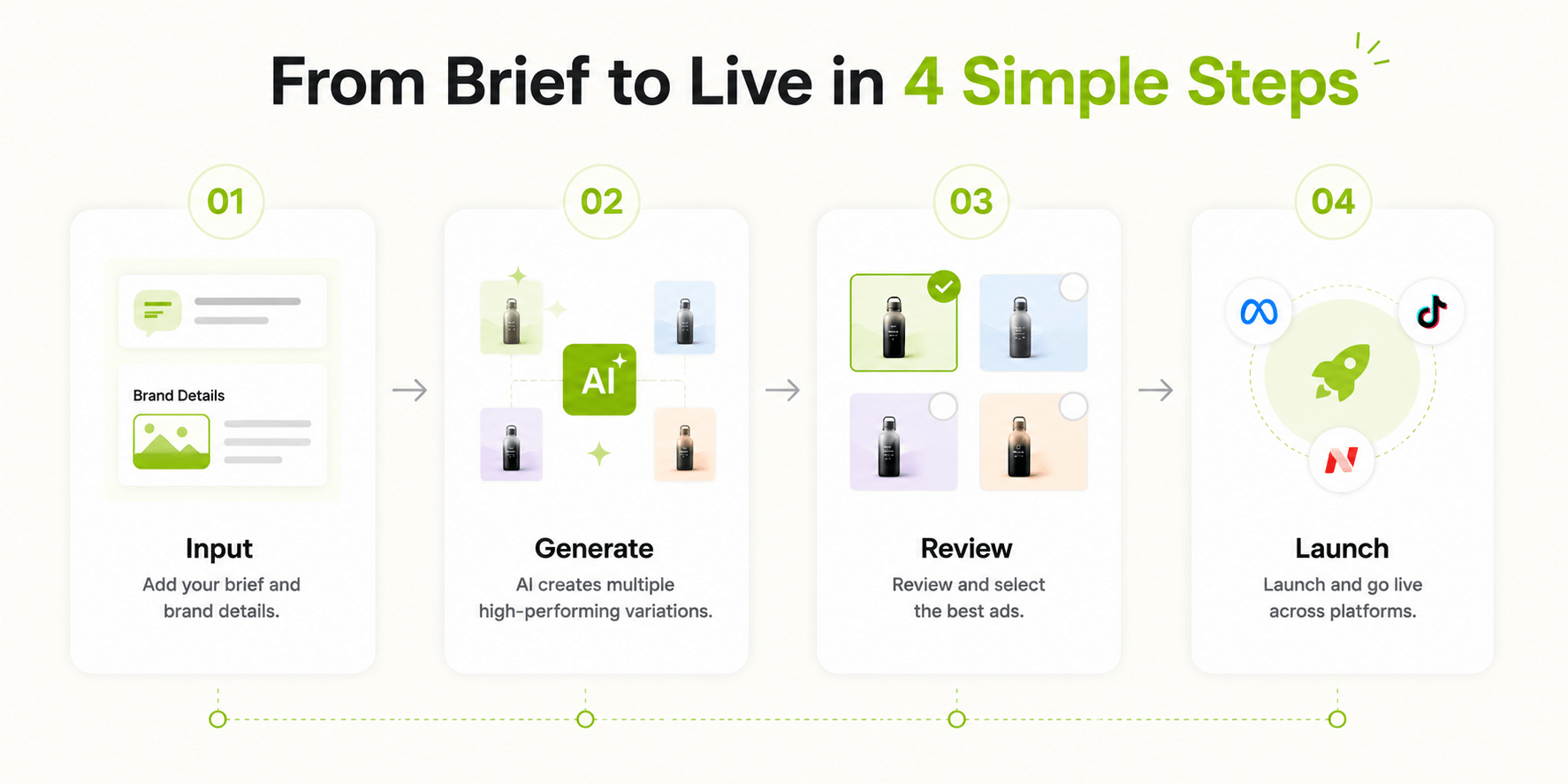
AI generated ads work in four steps: input, generation, review and selection, and launch. The mechanics differ by tool and output type, but the core process to create ads with AI is consistent.
| Step | What happens | Who does it |
|---|---|---|
| Input | Product or offer, brand guidelines, audience, format, and platform | Marketer |
| Generation | Images, video, and copy variations produced from the brief | AI |
| Review and selection | Strong outputs picked, weak ones discarded or refined | Marketer |
| Launch | Selected creatives move into campaigns | Marketer, or the platform if it connects to your ad accounts |
Input
The AI needs context to produce something usable. That input typically includes the product or offer, brand guidelines (colors, tone, visual direction), target audience, desired format, and platform. The more specific the brief, the more on-target the output. Generic prompts produce generic ads.
Generation
The AI uses that input to produce creative assets. For image ads, diffusion models generate visuals from the brief. For video, AI models synthesize footage based on product context and creative direction – formats like UGC-style, product showcase, and offer-driven video are all generatable without a camera or a studio. For copy, large language models write variations calibrated to the offer, platform, and audience angle.
Most ad generator AI tools generate multiple variations in a single run – different hooks, visual treatments, CTAs – so you’re evaluating a set of options rather than a single output. For a closer look at how creative AI platforms generate and score assets, see our ad creative AI guide.
Review and Selection
AI ad creation is not a one-click publish workflow. The output goes to a marketer for review. Strong outputs get selected. Weak ones get discarded or used as a starting point for refinement. This is where strategic judgment happens – the AI produces volume, the marketer decides what to test.
Launch
Once selected, creatives move into the campaign. Platforms that connect generation directly to ad accounts remove the manual export-import loop, so creatives go from generation to live without switching tools.
Why Are AI Generated Ads Replacing Manual Production in 2026?
Because they remove the limits of manual production: platforms need more creative volume, testing speed decides who wins, and the cost per creative has dropped. The shift isn’t driven by novelty. Three compounding pressures have made manual creative production hard to justify at scale.
Creative Volume Requirements Have Gone Up
Many media buyers aim for 10-20 creative variations per ad set to give the algorithm enough signal to optimize effectively. On TikTok, creatives commonly need refreshing every 7-14 days before fatigue sets in. That’s not a creative team problem – it’s a production infrastructure problem. A team producing 5 creatives a week can’t keep pace with an algorithm that needs 20. AI generated ads close that gap without adding headcount.
Testing Speed Determines Who Wins
In performance marketing, the team that finds its winning creative first has a structural advantage over everyone still iterating manually. AI generation lets you test more angles, more formats, and more hooks in less time – and identify what’s working before competitors catch up. Manual production puts a ceiling on how many hypotheses you can run in a given week. AI removes that ceiling.
Cost Per Creative Has Dropped
High-quality creatives that required a studio or a freelance designer in 2022 can now be produced in minutes. For ecom brands testing new products, affiliates running multiple offers, or agencies managing large client portfolios, the cost reduction can be significant. More hypotheses can be funded, more markets can be tested, and more products can go live simultaneously without a proportional increase in creative spend.
What Do AI Generated Ads Work Best For?
They work best for static performance ads, UGC-style video, copy variations, and product catalogue ads. Not every format benefits equally from AI generation. Current strengths:
Performance-focused static ads (offer-driven creatives, direct response formats, product-on-background shots) are where AI handles high-volume production and placement adaptation well. This is also where tools branded as an AI Facebook ad generator tend to focus first, since static formats are cheaper to iterate on than video.
Take UGC-style video. AI models can now produce footage that looks like it came from a creator’s phone, not a studio, and that matters because native-looking video keeps beating polished production on TikTok and Meta Reels. For a deeper look, see our guide to AI video ads.
Copy variations are the easier win: headlines, hooks, body copy across different audience angles. Useful for testing messaging before anyone commits a budget to visual production.
Product catalogue ads are where the scale argument holds up. Connect AI generation to a catalogue and you get SKU-specific creative for every product, which manual production can’t keep pace with.
FabFunnel’s Genie fits into this by letting marketers generate image and video ad creatives inside the campaign workflow itself. Feed in brand context, pick a format, and the assets are ready to launch, no need to switch platforms.
What AI Generated Ads Still Can’t Replace
Strategic creative direction – AI generates from the brief you give it. If the brief reflects a weak audience insight, the output reflects that too. Deciding what angle to test, what the audience responds to, and what makes a creative worth running are still human calls.
Brand-defining creative work – campaigns built around a distinct visual identity, a founder’s voice, or a culturally specific moment require judgment that current models don’t handle well without significant human direction.
Winning creative analysis – understanding why a creative performed, what element drove the result, and how to iterate intelligently sits outside the generation layer entirely.
AI handles production volume. Strategy, judgment, and creative insight remain human responsibilities.
The Takeaway: AI Generated Ads Are Now a Production Standard, Not a Shortcut
The teams using AI generated ads in 2026 aren’t cutting corners. They’re building a production capacity that manual methods can’t match at the same cost or speed.
The economics have shifted. The volume requirements have increased. And the tools have matured to the point where AI output is genuinely competitive with manually produced creative – often faster and cheaper.
The competitive gap between teams that have integrated AI generation into their workflow and those still producing creatives manually is compounding. More tests, faster learning cycles, and lower cost per variation mean the lead grows with every week of production.
Ready to try it? Start your free trial or try Fab AI to generate image and video ads and launch them from one place.
Frequently Asked Questions
What Are AI Generated Ads?
AI generated ads are advertising creatives – images, video, or copy – produced using AI models rather than built entirely by hand. Output ranges from copy variations to complete ad units ready for launch on platforms like Meta and TikTok.
Are AI Generated Ads Effective?
Yes, in the right contexts. They do well in direct response: offer-driven creatives, product ads, UGC-style video. How well depends on the brief and whether someone’s actually judging and testing what comes out, not just publishing the first batch.
How Do I Create Ads with AI?
You feed in context: product details, brand guidelines, audience, format. The AI generates creative from that. A person then reviews it and picks what’s worth running. The selected creatives then go live in your campaigns.
What Does an Ad Generator AI Tool Do?
An ad generator AI tool takes a brief – product details, brand guidelines, audience, and format – and produces ad creatives such as images, video, and copy variations. It doesn’t replace the review step: a person still picks what’s worth testing.
Can an AI Facebook Ad Generator Make Video Ads?
Yes. Current models can do UGC-style footage, product showcase videos, and short-form content built for TikTok and Meta Reels. Quality tracks with the model and how specific the brief is. Most AI Facebook ad generator tools still start with static formats, though, because static is cheaper to iterate on.
How Many Variations Should I Generate and Test?
A common baseline is 10-20 creative variations per ad set. AI generation gets you there without the cost scaling the same way manual production does. Start with variations on hooks or visual treatment, then let the data decide what runs next.
Will AI Ad Creation Replace Human Creative Teams?
Not in full. AI handles production volume. Strategic direction, brand judgment, and analysis of what’s actually working still require human input. The shift is that teams spend less time on production and more time on the decisions that actually move performance.