Creative has always been the variable that separates campaigns that scale from campaigns that plateau. The best targeting in the world can’t compensate for an ad that doesn’t stop the scroll. For years, the constraint was production capacity – creative teams can only produce so many variations, and many media buyers were working with just 3–5 creatives per ad set across the entire campaign.
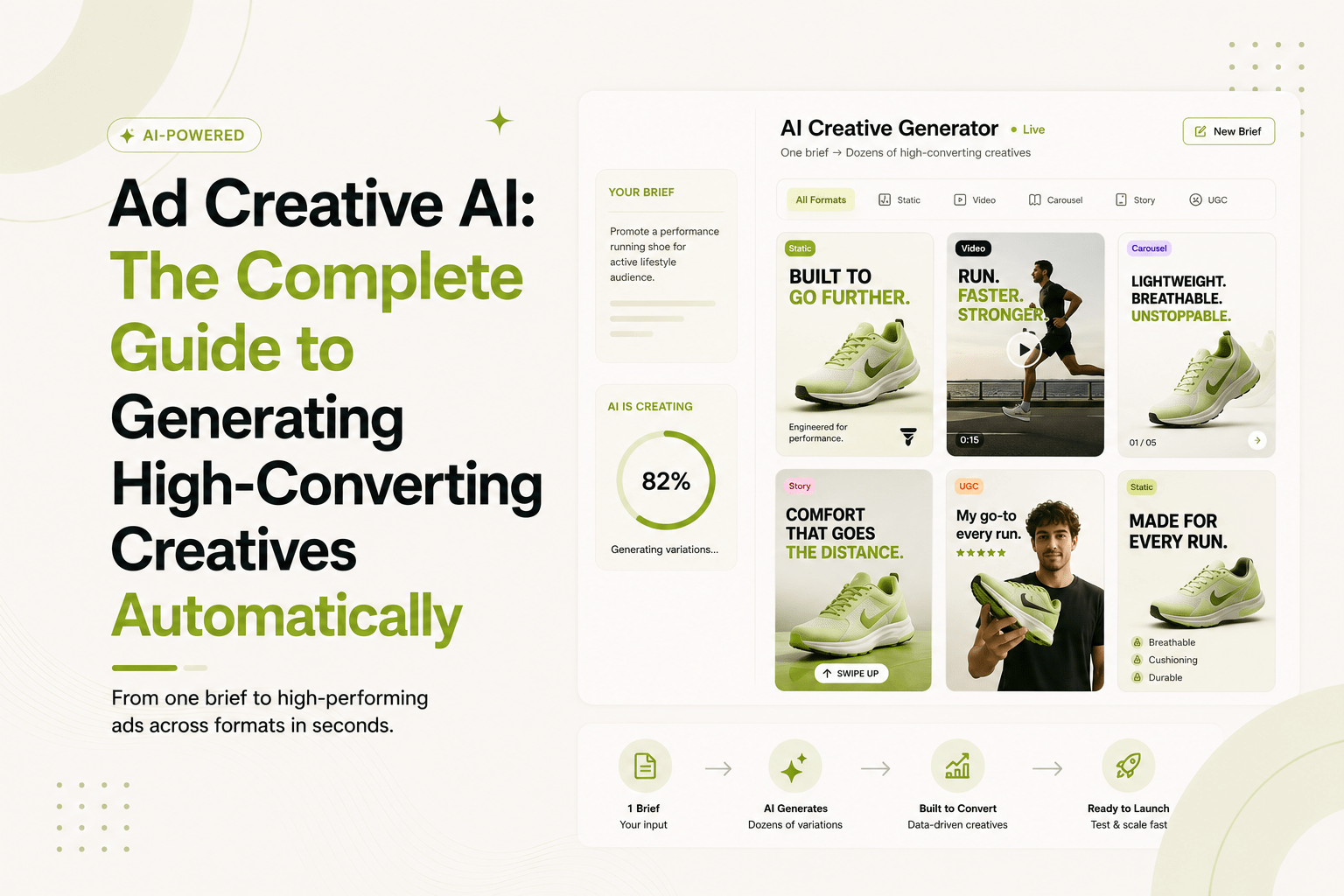
Ad creative AI changes that constraint. The question is no longer how many creatives your team can produce in a sprint – it’s how many creatives you can meaningfully test and act on. This guide covers the full picture: how ad creative AI works, what makes AI-generated creatives actually perform, how to evaluate an AI creative platform, and how to build AI into a creative workflow that drives results.
In short, ad creative AI generates ad images, video, and copy sized for each platform, so you can test more variations in less time. It performs best with a strong brief, a systematic testing plan, and a human review step before launch.
What Is Ad Creative AI?
Ad creative AI (sometimes called creative ad AI) refers to artificial intelligence systems purpose-built for generating advertising creative – including static images, video, copy, and full ad assets – with the goal of producing high-performing output at scale.
This is distinct from general-purpose generative AI tools. A general image generator produces images. Ad creative AI produces images formatted for specific ad placements, with copy that fits platform character limits, sized for Feed vs. Stories vs. Reels, and optimized based on what has historically driven performance in paid advertising contexts.
The core value proposition: compress the time between “we need more creative variations to test” and “those variations are live in campaigns.”
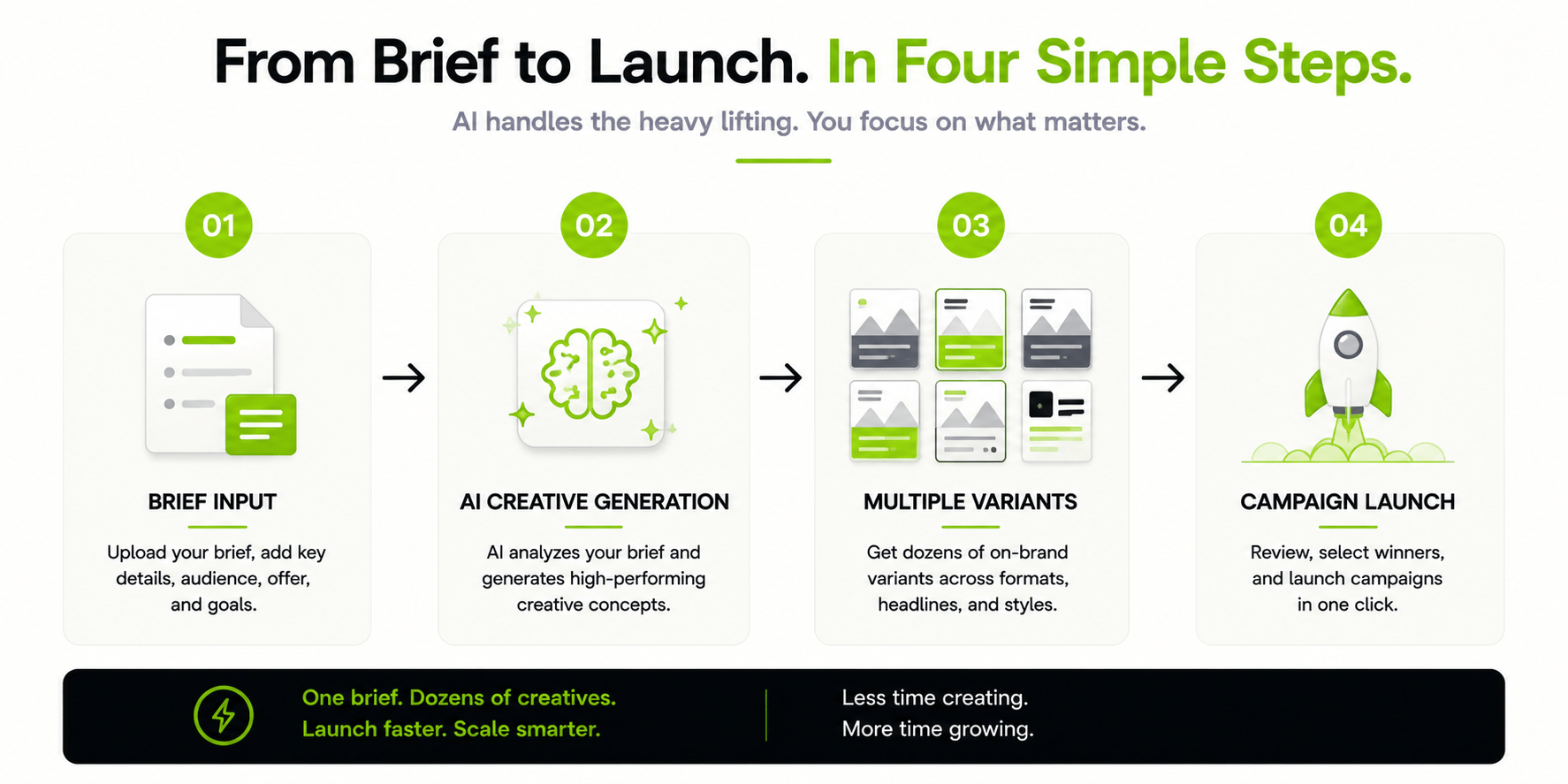
How Does Ad Creative AI Generate Creatives?
Different ad creative AI platforms use different approaches, but the core mechanics fall into a few categories:
Template-based generation fills structured layouts with your product imagery, copy, and brand elements. Fast, brand-safe, low variation – good for spinning one asset into multiple size formats.
Generative image AI builds visuals from prompts or product inputs instead of a template. More variety, but quality is inconsistent – some outputs ship, some don’t. Good for lifestyle and background scenes, bad for anything needing product accuracy or precise control.
Copy generation uses language models to produce headline, primary text, and CTA variations from a brief. The better AI ad creative generator tools understand platform conventions – Facebook’s recommended 125-character primary text length, the direct-response patterns that outperform in paid social, the difference between a conversion-oriented CTA and a brand awareness hook.
Predictive performance scoring adds a layer of AI that evaluates generated creatives against performance signals before they run – scoring predicted CTR, engagement likelihood, or conversion probability based on historical data. This helps teams prioritize which variants to test rather than running everything.
| Approach | Best for | Watch out for |
|---|---|---|
| Template-based generation | Turning one asset into multiple size formats | Low variation |
| Generative image AI | Lifestyle and background scenes | Inconsistent quality; weak on product accuracy and precise control |
| Copy generation | Headline, primary text, and CTA variations | Output quality depends on how well the tool understands platform conventions |
| Predictive performance scoring | Deciding which variants to test first | Only as good as the historical data behind it |
The practical reality: most AI creative platforms combine several of these approaches. The best ones handle the full workflow from brief to launch-ready asset, not just the generation step.
What Makes AI Creative Advertising Actually Convert?
AI can produce volume. Volume without a performance signal is noise. The teams getting real results from AI creative advertising are applying a few key principles:
Brief quality determines output quality. Garbage in, garbage out is truer for AI than for human designers who can infer intent from ambiguous briefs. The more specific your inputs – product benefit, audience pain point, emotional angle, offer mechanism, visual direction – the better the AI output. Teams that invest in systematic brief structures tend to get better creative output than teams that write two-sentence prompts.
Variation should be systematic, not random. The value of AI-generated creative is generating testable hypotheses. Each variant should isolate a specific variable: different hooks, different value propositions, different visual treatments, different CTAs. Random variation produces noise. Systematic variation produces learning.
Volume without a testing framework wastes the advantage. If you can now produce 20 creative variants instead of 5, you need the campaign infrastructure to actually test and differentiate between them. This means proper UTM structures, creative-level reporting, and a framework for declaring winners and moving budgets – not just more creatives in the same ad set.
AI handles production; humans handle judgment. Reviewing AI output with the same critical eye you’d apply to a designer’s work – assessing on-brand alignment, factual accuracy, aesthetic quality – is not optional. AI creative output needs a QA layer.
How Do You Evaluate an AI Creative Platform?
The market for ad creative AI platforms is growing fast and marketing claims outpace actual capability. Here’s what to evaluate in any AI creative platform:
Platform specificity: Does the tool produce assets formatted for your actual ad platforms – Meta, TikTok – at the right aspect ratios and within copy character limits? Generic creative generation tools require significant reformatting before assets are usable in campaigns.
Creative variation quality: Generate a set of variants and assess: do they look meaningfully different, or do they all feel like slight color and layout shifts of the same concept? Genuine creative variation is the point. Cosmetic variation wastes testing cycles.
Copy quality: Test the tool’s copy output against what your best-performing ads actually look like. Does it understand hooks, value propositions, and direct-response conventions? Or does it produce generic copy that no media buyer would actually run?
Performance data integration: Does the platform connect to your ad account data? If it learns from your actual campaign performance, output improves over time. If it’s just running on generic training data, it won’t.
Workflow integration: Can the tool’s output flow directly into your campaign setup, or does it produce files you then manually upload and organize? The less manual handoff, the more of the production bottleneck the tool actually eliminates.
Speed: How long does generation take? As a rough guide, a tool that takes 20 minutes per creative set doesn’t fundamentally change your production capacity. A tool that generates a full test set in under 5 minutes does.
How FabFunnel Approaches Creative AI
FabFunnel’s AI ad creative generator is built as part of a campaign execution workflow – not a standalone creative tool.
The distinction matters: generating creatives and launching creatives are two different problems. Most ad creative AI platforms solve only the first. FabFunnel’s approach is to connect AI-assisted creative generation directly to bulk campaign launch across Meta and TikTok accounts – so the workflow goes from brief to live campaign rather than from brief to file.
For teams running multiple accounts or high launch cadence, this removes the gap between “we have the creative” and “the creative is in market testing.” The creative output feeds directly into structured campaign builds that deploy across accounts in bulk. For video, the same approach applies to AI video ads.
How Do You Build AI Into Your Creative Workflow?
Adopting ad creative AI effectively is a workflow redesign, not a tool swap. The practical steps:
- Audit your current creative bottleneck. Is the constraint ideation, production, or iteration speed? AI helps most with production and iteration. If the real bottleneck is strategy and brief quality, adding a generation tool doesn’t solve the underlying problem.
- Standardize your brief format. Build a structured input template – product, offer, audience, emotional angle, visual direction, platform, CTA – so AI generation starts from consistent, high-quality inputs every time.
- Define your testing framework first. Before generating 20 variants, know how you’ll test them. Ad set structure, budget allocation to creative testing, and how you’ll determine winners should be defined before you scale creative production.
- Set a QA process. Everything goes through review before launch. Define what “approved” means – brand alignment, factual accuracy, quality threshold – and put someone’s name on that step.
- Measure iteration speed, not just output. The metric that matters is how quickly you can move from “we need new creative” to “new creative is live and generating data.” That’s the operational value AI creative brings.
Conclusion
Ad creative AI is a production multiplier, not a creative strategist. Teams that understand this distinction – and build the brief quality, testing infrastructure, and review processes to match – see real compounding value: faster iteration cycles, more data per testing period, and better creative coverage across audiences and offers.
The teams still treating ad creative AI as a novelty or a cost-cutting play are leaving the main advantage on the table: velocity. The ability to test more hypotheses per quarter, learn faster from what the market responds to, and iterate creative strategy based on actual performance data rather than intuition.
Ready to try it? Start your free trial or try Fab AI to generate creatives and launch them in bulk across Meta and TikTok.
Frequently Asked Questions
What Is Ad Creative AI?
Ad creative AI is AI built specifically for ad assets – images, copy, video – sized and formatted for the platform they’ll run on. General-purpose AI doesn’t know a Meta placement size from an Instagram Story crop. Ad creative AI does, along with what actually tends to perform in paid ads.
How Is Creative Ad AI Different from General-Purpose AI Tools?
Creative ad AI is built for advertising, while general-purpose AI tools are built to generate anything. That means ad-specific tools produce assets sized for Feed, Stories, and Reels, write copy that fits platform character limits, and draw on what has historically performed in paid ads. A general image generator only produces the image.
How Does an AI Ad Creative Generator Work?
AI ad creative generators take structured inputs – product information, target audience, platform, offer, tone – and produce creative variations using a combination of generative image AI, language models, and template-based systems. More advanced platforms also score predicted creative performance and learn from your account’s historical data over time.
Can AI Generate High-Converting Ad Creatives?
AI can generate ad creatives that convert when the input brief is strong, the output is properly reviewed before launch, and the creative is tested systematically rather than randomly. AI handles production volume and variation.
What Should I Look for in an AI Creative Platform?
Key evaluation criteria: platform-specific output formatting (Meta, TikTok), genuine creative variation quality, copy quality within platform character limits, integration with your ad account performance data, and workflow connectivity that allows creative output to move directly into campaign setup. Speed of generation is also practically important.
How Is AI Creative Advertising Different from Traditional Creative Production?
Traditional creative production is constrained by team capacity – the number of creatives you can produce is a function of designer and copywriter hours. AI creative advertising decouples production volume from headcount. The constraint shifts to testing capacity and brief quality.
How Do I Integrate AI Creative into My Existing Ad Workflow?
Standardize your brief format first. Then find the real bottleneck – briefing, generation, or review – and test AI on one account before going wider. QA everything before it launches. Track brief-to-live time and variants tested per week; if those don’t move, it’s not working.