Quick Answer
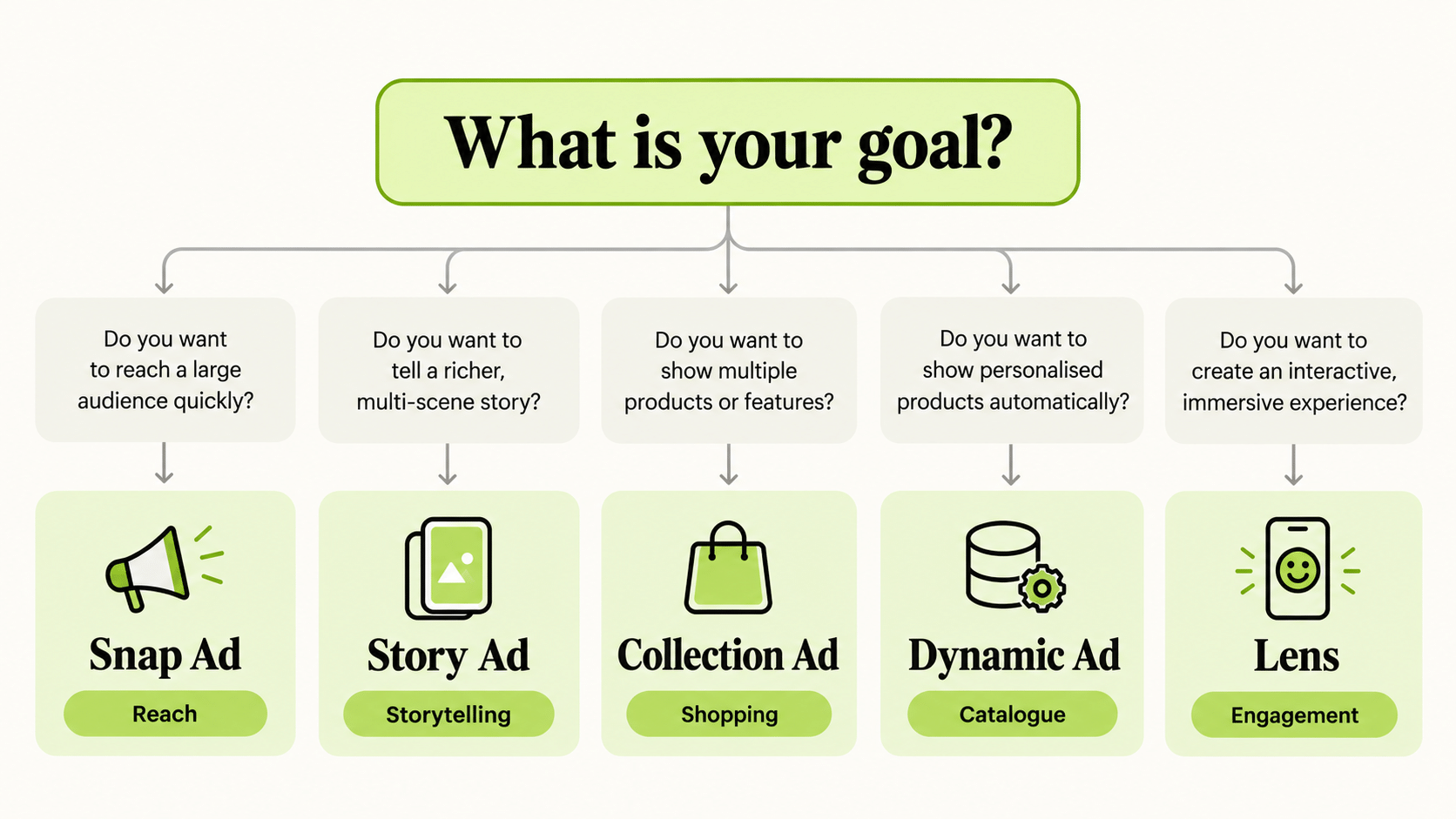
Snapchat ad types fall into a few families: single image or video ads (often called Snap Ads), Story Ads, Collection Ads, dynamic product ads, and branded augmented-reality Lenses, with some placement-based options such as Commercials added on top. Pick by goal, not by novelty. Use Snap Ads for reach, installs, and traffic, Story Ads for multi-frame storytelling, Collection and dynamic ads for ecommerce catalogues, and Lenses for engagement. Snapchat renames and reshuffles formats from time to time, so confirm the live list in Snapchat Ads Manager before you plan creative.
What Are the Main Snapchat Ad Types?
The main Snapchat ad types share one trait: they are built for a vertical, full-screen phone. What differs is how many frames you get, whether products are tappable, and how much interaction the viewer has.
| Format | What it is | Typical goal |
|---|---|---|
| Snap Ad (single image or video) | One full-screen vertical creative with a call to action | Reach, installs, traffic |
| Story Ad | A branded tile that opens into several frames | Launches, storytelling |
| Collection Ad | A main creative with tappable product thumbnails | Ecommerce, catalogues |
| Dynamic ad | Product ads assembled from a catalogue feed | Retargeting, large catalogues |
| Lens or filter | Branded augmented-reality effect applied to a Snap | Engagement, awareness |
| Commercials | Short video placed in selected content | Brand awareness |
According to Snapchat’s ad specifications, single image or video ads run at 1080 by 1920 pixels, with video lengths from 3 to 180 seconds. Collection Ads pair a full-screen main creative with square thumbnails of at least 160 by 160 pixels. Treat any figure here as a checklist item and verify it in the specification pages before you brief a designer.
What Are Snapchat’s Main Types of Ads for Beginners?
If you are asking what are Snapchat’s main types of ads for a first campaign, start with the simplest one. A single image or video Snap Ad takes the least production, has the fewest specifications to meet, and works with almost every objective. Once you have a creative that earns attention, you can extend it into a Story Ad, or feed your product catalogue into a Collection or dynamic ad.
The reason to start simple is learning speed. One format, one objective, and two or three creatives give you cleaner data than a launch with five formats at once. You can see which hook works, then reuse it everywhere else.
Which Snapchat Ad Types Suit Which Goal?
Match the format to the result you need and the effort you can afford.
- Awareness and reach. Snap Ads and Lenses. A Lens asks more of your creative team but invites the viewer to take part instead of watching.
- Traffic and installs. Snap Ads with a clear call to action, tied to a fast mobile page or an app store listing.
- Product sales. Collection Ads and dynamic ads, which show several products and let people tap through to the item they want.
- Launches and explanations. Story Ads, where several connected frames can show the product, the proof, and the offer in order.
- Retargeting. Dynamic ads and Snap Ads, aimed at people who already visited your site or app.
No format guarantees a result. A mismatch between format and goal is the more common failure: a Lens built for a goal that needs purchases, or a single Snap Ad stretched to carry a ten-point product story.
How Do Snap Ads and Story Ads Differ?
These are the two Snapchat ad types people confuse most. A Snap Ad is one creative that fills the screen. A Story Ad is a tile in the Discover area that the viewer chooses to open, and then taps through frames.
That difference changes the job each does. A Snap Ad has to land its message in seconds, because the viewer did not ask to see it. A Story Ad earns attention at the tile, so the first step is a strong tile image and headline, and the following frames can go deeper. Snapchat’s business help pages describe the tile as required when placement is automatic or in Discover, so check your placement settings if you plan to run Story Ads.
In practice, many accounts run both: a short Snap Ad to reach new people, and a Story Ad for people who show interest.
When Do Collection Ads and Dynamic Ads Make Sense?
Collection Ads are for businesses with products. The main creative sets the scene, and the thumbnails below let a viewer tap straight to an item. They suit a promotion or a themed set of products, such as a seasonal range.
Dynamic ads go a step further by building the ad from a product catalogue, so you do not hand-build every variation. They are most useful for large catalogues and retargeting, where you want to show people the product they looked at. Both Snapchat ad types depend on a clean product feed, so audit titles, images, and prices before you connect it. A broken feed produces broken ads at scale.
How Do Lenses Fit Into Snapchat Ad Types?
Lenses and filters are the most Snapchat-specific of the ad formats. Instead of showing a message, a Lens lets someone apply a branded effect to their own Snaps, which can then be shared. This format favours brands that can offer a playful experience, such as a try-on, a game, or a themed effect.
The trade-off is production. A Lens needs design and testing, and its payoff is engagement and awareness more than direct response. If your goal is a measurable sale this month, a Collection or dynamic ad is usually the shorter route. If your goal is brand presence among a younger audience, a Lens deserves a place in the plan. Confirm current availability, formats, and minimums with Snapchat before you commit budget.
What Should You Check Before Choosing Snapchat Ad Types?
Use this short checklist before you pick a format.
- Goal. Reach, traffic, installs, leads, or sales.
- Assets. Do you have vertical footage, a product feed, or a designer for a Lens?
- Budget. Snapchat’s pricing page lists a $5 daily minimum at the ad set level and suggests $20 to $50 per day so a campaign can finish its learning phase. Check the current figures in Ads Manager.
- Measurement. A Snap Pixel or app event setup is needed to measure web or app results.
- Time. Story Ads and Lenses take longer to produce than a single Snap Ad.
If you cannot answer two or more of these, start with a single image or video ad and add formats later.
How Do You Compare Snapchat Ad Types Across Platforms?
The harder question usually comes after launch: how does a Snapchat format perform next to the same offer on Meta or TikTok? Each platform names and counts things differently, so comparing them in separate dashboards is slow.
FabFunnel’s Multi Ad Account Reporting shows Snapchat results alongside Meta, TikTok, and NewsBreak, so you can see spend and performance side by side. Snapchat is connected for reporting only: FabFunnel launches campaigns on Meta, TikTok, and NewsBreak, and reports on Snapchat and Google. You still build your Snapchat ad types in Snapchat Ads Manager. The columns shown follow each platform’s own metrics, so check them before you use the dashboard for client reporting.
What Creative Habits Work Across Formats?
Whatever format you pick, a few habits carry over. Put the product or promise on screen in the first second or two. Add short on-screen text so the ad works with the sound off. Shoot vertically from the start instead of cropping horizontal footage. Keep one call to action per ad, and send people to a mobile page that repeats the offer they just saw.
Plan variations before you launch. Two hooks, two lengths, and two calls to action give you enough combinations to learn from without drowning the budget in tests.
How Do You Test Snapchat Ad Types Without Wasting Budget?
Test one variable at a time and give each ad set the same budget. A clean first test compares a single Snap Ad against a Story Ad that uses the same hook, with the same audience and the same daily budget. Wait for the learning phase to pass, then compare cost per result against your goal.
Keep a simple log with the format, creative, date range, spend, and result. After two or three tests, you will know which Snapchat ad types suit your offer, and you can move budget toward them. Refresh creative on a schedule, because frequency climbs fast on a small audience.
FAQs
What are the main Snapchat ad types?
Single image or video Snap Ads, Story Ads, Collection Ads, dynamic product ads, and branded Lenses, plus placement options such as Commercials.
What are Snapchat’s main types of ads for ecommerce?
Collection Ads and dynamic ads, which show several products and let people tap to the one they want.
What are the types of ads on Snapchat for awareness?
Snap Ads and Lenses are the usual choices for reach and engagement.
Which of the Snapchat ads types is cheapest?
Costs are set by the auction, not by the format, so no format has a fixed price. Production effort differs more than media cost.
Can I run every format at once?
You can, but it is better to start with one or two formats so you can read the results clearly.
Can I launch Snapchat ad types from FabFunnel?
No. FabFunnel launches on Meta, TikTok, and NewsBreak and reports on Snapchat. Build Snapchat ads in Snapchat Ads Manager.
Where to Start
Pick one goal and one format, build two vertical creatives, and run a four-day test before you add anything else. Once your Snapchat ad types are live, you can follow them next to Meta, TikTok, and NewsBreak at FabFunnel or explore the full toolset at Fab AI. Readers also phrase the choice as “what are Snapchat’s main types of ads?”, but the practical answer still depends on the campaign objective and available creative.