Quick Answer
Programmatic advertising platforms automate the buying and selling of ad impressions through software, usually in real time. Three pieces matter. A demand-side platform (DSP) is the tool advertisers use to buy. A supply-side platform (SSP) is the tool publishers use to sell. An ad exchange is the marketplace that connects them. When you compare programmatic advertising platforms, you are almost always comparing DSPs, so judge them on inventory access, targeting and data options, bidding controls, transparency, reporting, fees, and minimum spend. Examples commonly cited include Google Display & Video 360, The Trade Desk, Amazon DSP, and Yahoo DSP. Fees and minimums vary by contract, so ask for them in writing.
What Are Programmatic Advertising Platforms?
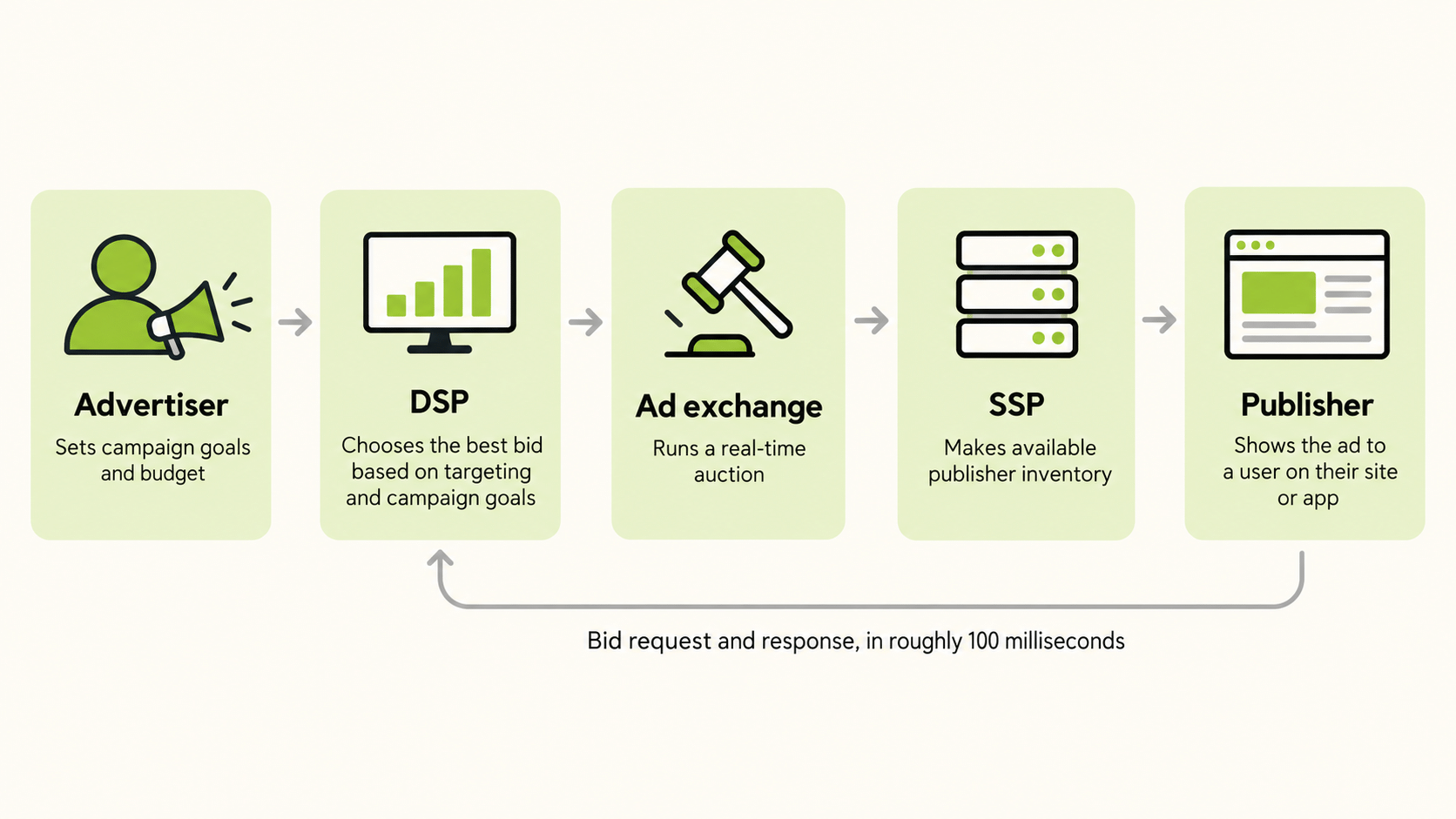
Programmatic advertising platforms are software systems that buy and sell digital ad space automatically, instead of through manual negotiation and insertion orders. When a person opens a page or app with ad space, an auction runs in the background and the winning ad is shown, usually within a fraction of a second.
The platforms sit on two sides. Advertisers use a DSP to set goals, audiences, budgets, and bids across many exchanges. Publishers use an SSP to manage and sell their inventory to multiple buyers. Between them, an ad exchange facilitates the real-time bidding. Sources describing the process agree on the sequence: the publisher’s SSP sends an ad request to the exchange with anonymised user and placement details, the exchange offers the impression to DSPs, and the highest bid wins.
How Does a Programmatic Auction Work?
The steps are the same in most descriptions.
- A person loads a page or app that has ad space.
- The publisher’s SSP sends a bid request to an exchange.
- The exchange passes the request to connected DSPs.
- Each DSP checks whether the impression matches its advertiser’s targeting and decides whether to bid.
- The winning ad is returned and shown.
Auction mechanics differ. Some use a first-price rule and some a second-price rule, and platforms have changed this over time, so check how a given exchange prices wins before you compare costs.
What Is the Difference Between a DSP, an SSP, and an Ad Exchange?
| Piece | Who uses it | What it does |
|---|---|---|
| DSP | Advertisers and agencies | Buys impressions, sets targeting, budgets, and bids |
| SSP | Publishers | Manages and sells ad inventory to many buyers |
| Ad exchange | Both, indirectly | Runs the marketplace where bids meet inventory |
Most advertisers will only log into a DSP. The other two matter because they shape what inventory you can reach and how much of your budget reaches a publisher after fees.
Which Programmatic Advertising Platforms Are Leading Tools?
Public descriptions of the market name a recurring set of DSPs: Google Display & Video 360, The Trade Desk, Amazon DSP, Yahoo DSP, Adobe Advertising DSP, and Roku OneView. They differ in the inventory they reach, the first-party data they can use, and the type of advertiser they suit.
| Platform | How it is commonly described |
|---|---|
| Google Display & Video 360 | Tied to Google’s ecosystem and inventory |
| The Trade Desk | Independent DSP across many publishers and formats |
| Amazon DSP | Strong for advertisers using Amazon’s shopper data and inventory |
| Yahoo DSP | Reaches Yahoo and partner inventory |
These descriptions are broad and drawn from vendor and industry sources, so confirm current capabilities, minimums, and contract terms directly. This article does not rank them, because the right choice depends on your audience, channels, and data.
What Should You Compare Across Programmatic Advertising Platforms?
Compare the tools on the same questions.
| Question | Why it matters |
|---|---|
| What inventory can you reach? | Display, video, connected TV, audio, and mobile are not equal across tools |
| What targeting and data options exist? | Decides how precisely you reach your audience |
| How transparent is the reporting? | Shows where ads ran and what fees were taken |
| What bidding controls do you get? | Affects how much you can steer spend |
| What are the fees and minimums? | Sets the true cost of a test |
| What brand safety tools are available? | Protects against poor placements |
| Can you export log-level data? | Lets you audit results independently |
Fee structures vary: some DSPs charge a percentage of media spend, some charge a platform fee, and some are sold through managed service. Ask for the full cost in writing before you compare.
When Do Programmatic Advertising Platforms Make Sense?
Programmatic suits advertisers who want reach across many sites and apps, who have enough budget to leave learning phases, and who can measure results beyond clicks. It is less suited to a first-time advertiser with a small budget and no conversion tracking, where a single search or social platform is usually a better starting point.
It also needs more oversight. Buying across many publishers raises questions about placement quality, invalid traffic, and fees. Plan for brand safety settings, regular placement reviews, and a clear reporting rule.
How Do You Measure Programmatic Campaigns?
Programmatic campaigns often reach people who never click, so click-based measurement understates impact. Decide in advance what counts: view-through conversions, lift tests, or conversions within a defined window. Be explicit about the attribution window, because different platforms and tools count differently.
Whatever you choose, keep one source of truth and use the others as directional checks. Compare programmatic results against your other channels on cost per result, measured the same way.
What Are the Risks of Buying Through Programmatic Advertising Platforms?
Automation brings reach, and it also brings risks that manual buying does not. Ads can appear on low-quality sites or apps if brand safety settings are loose. Some traffic is invalid, meaning bots or accidental clicks, and it can inflate delivery without producing value. Fees can stack, because money passes through several parties before it reaches a publisher, and the share that arrives is not always visible.
You can manage these risks. Use allow lists or block lists, review placement reports on a schedule, and ask each vendor how invalid traffic is filtered and credited. Request log-level data where it is offered so that you can check delivery independently. Treat transparency as a feature to compare, not an afterthought.
How Do Programmatic Advertising Platforms Handle Targeting and Data?
Targeting in programmatic advertising platforms usually combines several inputs: contextual signals about the page, audience segments built from behaviour or demographics, and first-party data that the advertiser brings, such as customer lists or site visitors. Platforms differ in which of these they can use and how they match identities, and privacy rules in different regions limit what is possible.
Ask each vendor three questions. Which data sources can you use, and which are available in your region? How does the platform match your first-party data to impressions? What happens to your data after the campaign? Clear answers on these points matter more than the length of a feature list.
How Should You Run a Pilot Before You Commit?
A pilot reduces the risk of a long contract. Pick one clear goal, such as cost per acquisition or cost per incremental conversion, and set a fixed test budget with a start and end date. Agree upfront on the measurement method, whether that is a holdout group, a lift study, or conversions within a fixed window.
Run two shortlisted platforms with the same creative and audience where possible, and compare them on the same metric. Record spend, delivery, placement quality, and results. At the end, decide using the numbers and the transparency each vendor provided, not the sales presentation.
What Mistakes Should You Avoid With Programmatic Advertising Platforms?
Frequent errors include signing a long contract before a pilot, ignoring placement reports, treating click-through rate as the main metric, and underestimating the creative variety that display and video need. Another is expecting programmatic to fix a weak offer: no platform can sell a product people do not want.
How Do You Compare Results With Your Other Channels?
When you run programmatic advertising platforms next to search and social, the challenge is reading all of the numbers together. FabFunnel’s Multi Ad Account Reporting shows Meta, TikTok, and NewsBreak alongside Google and Snapchat in one dashboard. FabFunnel launches campaigns on Meta, TikTok, and NewsBreak, while Google and Snapchat are connected for reporting only. FabFunnel is not a DSP, and this article does not claim it connects to the programmatic platforms above, so confirm what any reporting tool can ingest before you rely on it.
FAQs
What are programmatic advertising platforms?
They are software systems that automate buying and selling of ad impressions, usually in real time through auctions.
What is a programmatic demand side platform?
A DSP is the advertiser-side tool used to buy impressions, set targeting and budgets, and bid across multiple exchanges.
What are the best programmatic advertising platforms?
Commonly cited DSPs include Google Display & Video 360, The Trade Desk, Amazon DSP, and Yahoo DSP. The best one depends on your inventory, data, and budget needs.
What are programmatic ad buying platforms made of?
Typically a DSP for buyers, an SSP for sellers, and an ad exchange connecting them.
Are programmatic ad platforms good for small budgets?
Often not as a first step. Many have minimums or contract terms, so check before you commit.
Can FabFunnel launch programmatic campaigns?
No. FabFunnel launches on Meta, TikTok, and NewsBreak. Google and Snapchat are reporting only.