Programmatic advertising was already automated before AI entered the picture. What machine learning changed is where the automation operates and how much of the decision-making it handles.
The gap between what programmatic platforms were doing five years ago and what they’re doing now is significant enough that ai programmatic advertising deserves its own examination – separate from general programmatic mechanics. The bidding logic, the targeting approach, and the optimization layer have all changed in ways that affect how campaigns are set up, managed, and evaluated.
This article covers what’s actually different about AI in programmatic advertising in 2026 and what that means practically for performance marketers running paid media at scale.
What Programmatic Advertising Actually Means
Before getting into the AI layer, it’s worth being precise about what programmatic advertising is – because the term gets used loosely.
Programmatic advertising is the automated buying and selling of digital ad inventory through real-time auctions. When a user loads a webpage or opens an app, an auction runs in milliseconds – advertisers bid for that impression, a winner is selected, and the ad is served. The entire process happens before the page finishes loading.
The advertiser side of this process has always involved some level of automation – setting bid caps, defining audience parameters, selecting placements. What AI programmatic advertising changes is the depth of that automation and how much of the optimization runs without human input.
How Machine Learning Changed Programmatic Ad Buying
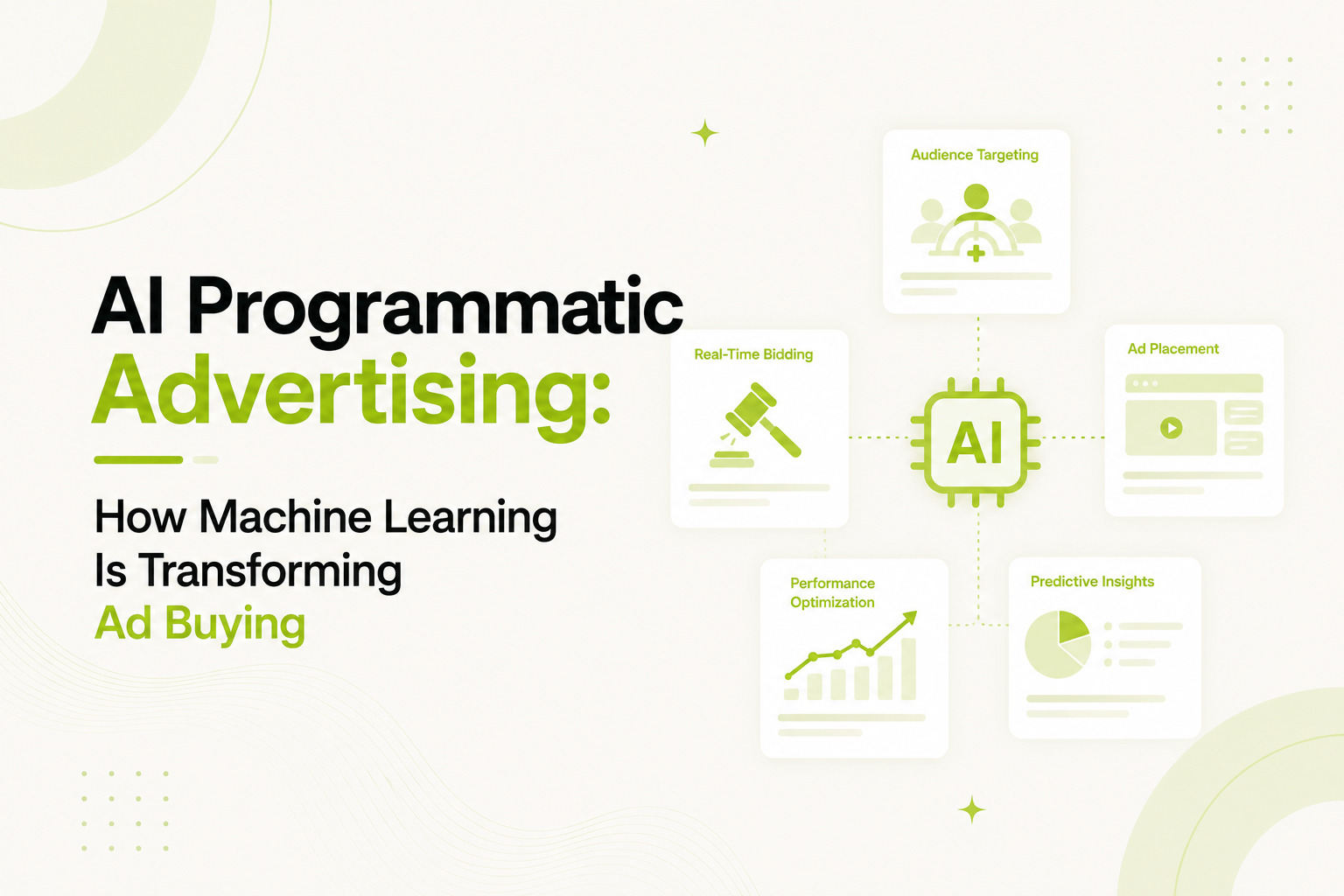
Much of today’s AI programmatic advertising is built around continuously learning from auction outcomes, user behavior, and conversion data to improve future bidding decisions.
Bidding That Adapts in Real Time
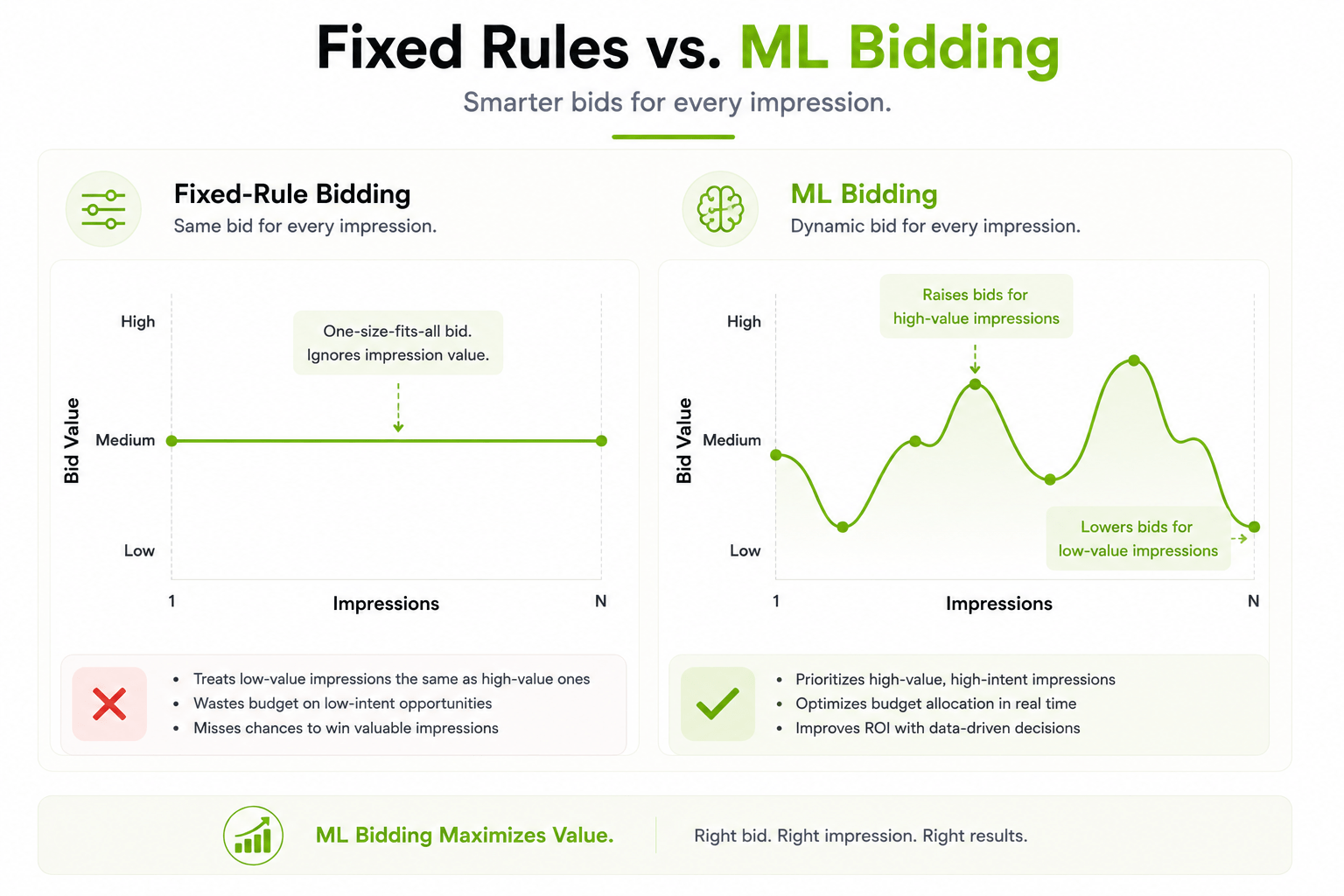
Traditional programmatic bidding used fixed rules. Set a maximum CPM, define the audience, let the platform bid up to that cap. The logic was static – the same bid ceiling applied regardless of context.
Machine learning-based bidding evaluates each impression individually against a much wider set of signals: the user’s behavior history, the time of day, the device, the content of the page, how similar users have responded to similar ads, and dozens of other contextual factors. The bid adjusts dynamically for each auction rather than applying a fixed cap uniformly.
The practical result is better budget efficiency. Budget concentrates on impressions most likely to convert rather than distributing evenly across all impressions that meet the basic audience criteria.
Audience Modeling That Goes Beyond First-Party Segments
Traditional audience targeting in programmatic relied on defined segments – demographic data, interest categories, retargeting lists. These are explicit segments: people who visited your site, people in a specific age range, people categorized as interested in a particular topic.
AI programmatic advertising adds lookalike and predictive modeling on top of defined segments. The system identifies patterns in your converting audience that aren’t captured by explicit demographic or behavioral categories – and finds users who match those patterns across the broader inventory pool.
This matters particularly as third-party cookie deprecation continues to reduce the availability of explicit behavioral data. AI modeling that works from first-party conversion signals rather than third-party behavioral tracking becomes more valuable as the data environment tightens.
Creative Optimization at the Impression Level
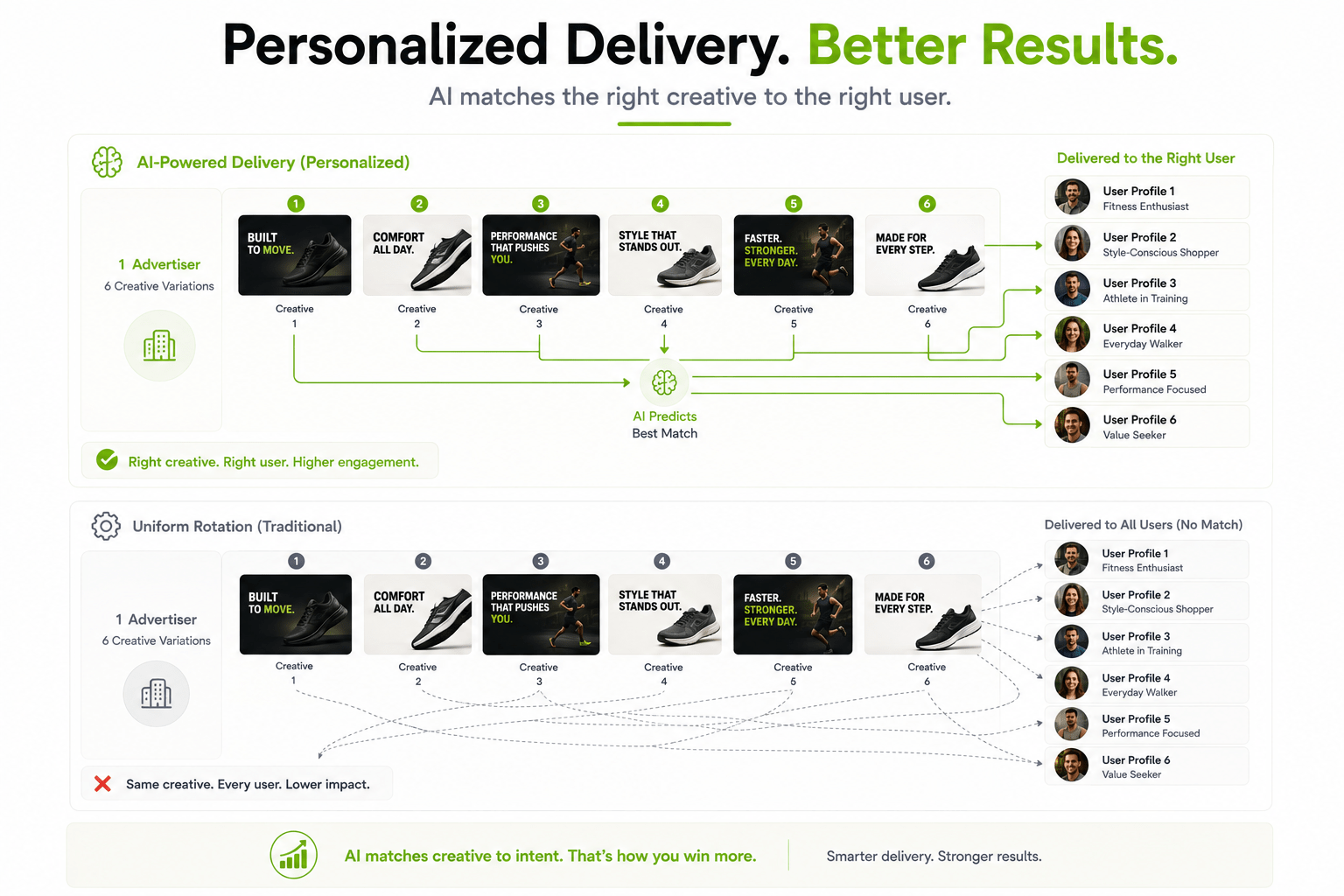
Programmatic platforms with AI creative optimization serve different ad variations to different users based on predicted response. Rather than serving the same creative to all users in a segment and waiting for aggregate performance data, the system tests variations across users simultaneously and routes impressions toward the creatives predicted to perform best for each individual.
For advertisers running multiple creatives at once, this shortens how long it takes to find what’s winning, and stops spend from going to variations the algorithm’s already flagged as dead weight.
Fraud Detection and Brand Safety
AI also runs on the supply side – checking inventory quality in real time and filtering out fraud, low-quality placements, and brand safety violations before the bid goes out.
Pre-AI, brand safety in programmatic relied on blocklists – manually maintained lists of sites and categories to exclude. AI-based brand safety evaluates content at a much more granular level – page-level context, real-time content classification – and makes decisions per impression rather than per domain.
For advertisers running significant programmatic spend, this is meaningful. Fraudulent and low-quality impressions are a real cost in programmatic – AI filtering reduces that cost without requiring manual blocklist maintenance.
Beyond fraud prevention, AI programmatic advertising continues to improve inventory quality by making faster, more contextual decisions about where and when ads should appear.
What This Means for How You Set Up and Manage Programmatic Campaigns
The shift toward AI programmatic advertising changes some fundamental campaign setup decisions.
Signal quality matters more than audience definition. When the system is learning from your conversion signals to find the right users, feeding it clean, accurate conversion data is more important than precisely defining your target audience upfront. Broad initial parameters with strong conversion signals often outperform narrow targeting with weak signals.
Creative volume is a lever, not just a production cost. The AI creative optimization layer needs variation to work with. More creative variations mean more hypotheses the system can test simultaneously. Teams treating creative volume as a production overhead – something to minimize – are reducing the input the AI needs to optimize.
Campaign structure affects learning speed. Fragmenting budget across too many ad sets or campaigns slows down the learning process because each unit needs sufficient data to optimize. Consolidating where possible gives the AI more signal per unit faster.
Reporting needs to look further down the funnel. Programmatic AI optimizes toward the conversion event you define. If you’re optimizing for clicks, it finds clicks. If you’re optimizing for purchases, it finds purchases. The quality of your outcome metric determines the quality of what the AI optimizes toward.
Where FabFunnel Fits
Programmatic platforms handle the real-time bidding and impression-level optimization. What they don’t solve is the creative production and campaign launch infrastructure that feeds them.
For performance marketers running AI programmatic advertising on Meta and TikTok – which have their own programmatic-style auction mechanics – FabFunnel handles the upstream workflow: bulk campaign launch, creative generation via Genie, and automation rules that act on performance signals without manual intervention. The AI on the platform side optimizes at the auction level. FabFunnel handles the operational layer above it.
Together, this creates a more complete AI programmatic advertising workflow, where campaign execution, creative production, and auction optimization reinforce one another.
The Takeaway: AI in Programmatic Has Shifted Where the Leverage Is
The biggest gains in AI programmatic advertising aren’t coming from smarter bidding alone – that’s table stakes at this point. They’re coming from better creative variation feeding the optimization layer, cleaner conversion signals guiding what the AI learns from, and consolidated campaign structures that let the algorithm accumulate data fast enough to act on it.
AI programmatic advertising can only optimize what you give it to work with. The relationship between AI and programmatic advertising is now less about replacing marketers and more about helping them make better decisions using stronger data, creative inputs, and automation. The teams getting the most from it in 2026 are the ones treating signal quality and creative volume as inputs to the AI – not as afterthoughts once the campaign is live.
Frequently Asked Questions
What is AI programmatic advertising?
AI programmatic advertising is the use of machine learning within automated ad buying systems to make real-time decisions about bidding, targeting, creative delivery, and fraud filtering – at the individual impression level, rather than applying fixed rules across all impressions uniformly.
How is AI programmatic advertising different from regular programmatic?
Regular programmatic automates the buying process but uses static rules for bidding and targeting. AI programmatic evaluates each impression individually against a wide set of contextual signals and adjusts decisions dynamically – bids change per auction, audiences expand through predictive modeling, and creatives rotate based on predicted performance per user.
Does AI programmatic advertising work without third-party cookies?
Better than cookie-dependent approaches. AI modeling that works from first-party conversion signals and contextual data is less affected by cookie deprecation than targeting approaches that rely on third-party behavioral tracking. This is one reason AI-based audience modeling has grown in adoption as the cookie environment has tightened.
What conversion events should I optimize for in programmatic campaigns?
The deepest funnel event you have sufficient data for. If you have enough purchase conversions, optimize for purchases. If purchase volume is too low for the algorithm to learn from, drop to add-to-cart or initiate checkout. The closer to revenue, the better the targeting lines up.
How much creative variation do I need for AI creative optimization to work?
5-10 variations minimum, so the system has something real to test. More helps up to a point – past 20-30 in one campaign, you’re just fragmenting budget and slowing learning. Enough variety to test real hypotheses, not so much you’re spreading impressions too thin to learn from any of them.
What’s the difference between Meta’s AI ad tools and third-party programmatic platforms?
Meta’s AI tools operate within Meta’s inventory – optimizing bids, audiences, and creatives across Facebook and Instagram placements. Third-party programmatic platforms operate across the open web, connected TV, and app inventory outside Meta’s ecosystem. Both use AI, but they’re accessing different inventory pools with different data environments.