Quick Answer
There is no single best among ad platforms, because each is built for a different job. Google Ads and Microsoft Advertising capture people who are searching. Meta, TikTok, and Snapchat create discovery inside social and short-video feeds. Marketplace platforms such as Amazon reach shoppers already in a buying mindset. Programmatic and native networks buy reach across many sites. Compare ad platforms by the job you need done, then by targeting depth, creative demands, cost model, and measurement. Published cost averages conflict from source to source, so use them as a rough range and decide using cost per result in your own account.
What Are Ad Platforms?
Ad platforms are the systems where advertisers set up campaigns, choose audiences, upload creative, set budgets and bids, and read results. Some belong to publishers, such as search engines and social networks. Others are networks and exchanges that sell inventory across many sites and apps.
The practical difference is control and context. On a publisher’s own platform, you get detailed targeting and measurement for that publisher’s audience. On a network, you get reach across many properties but less direct knowledge of each placement. Either can be right, depending on the job.
Which Are the Best Ad Platforms by Use Case?
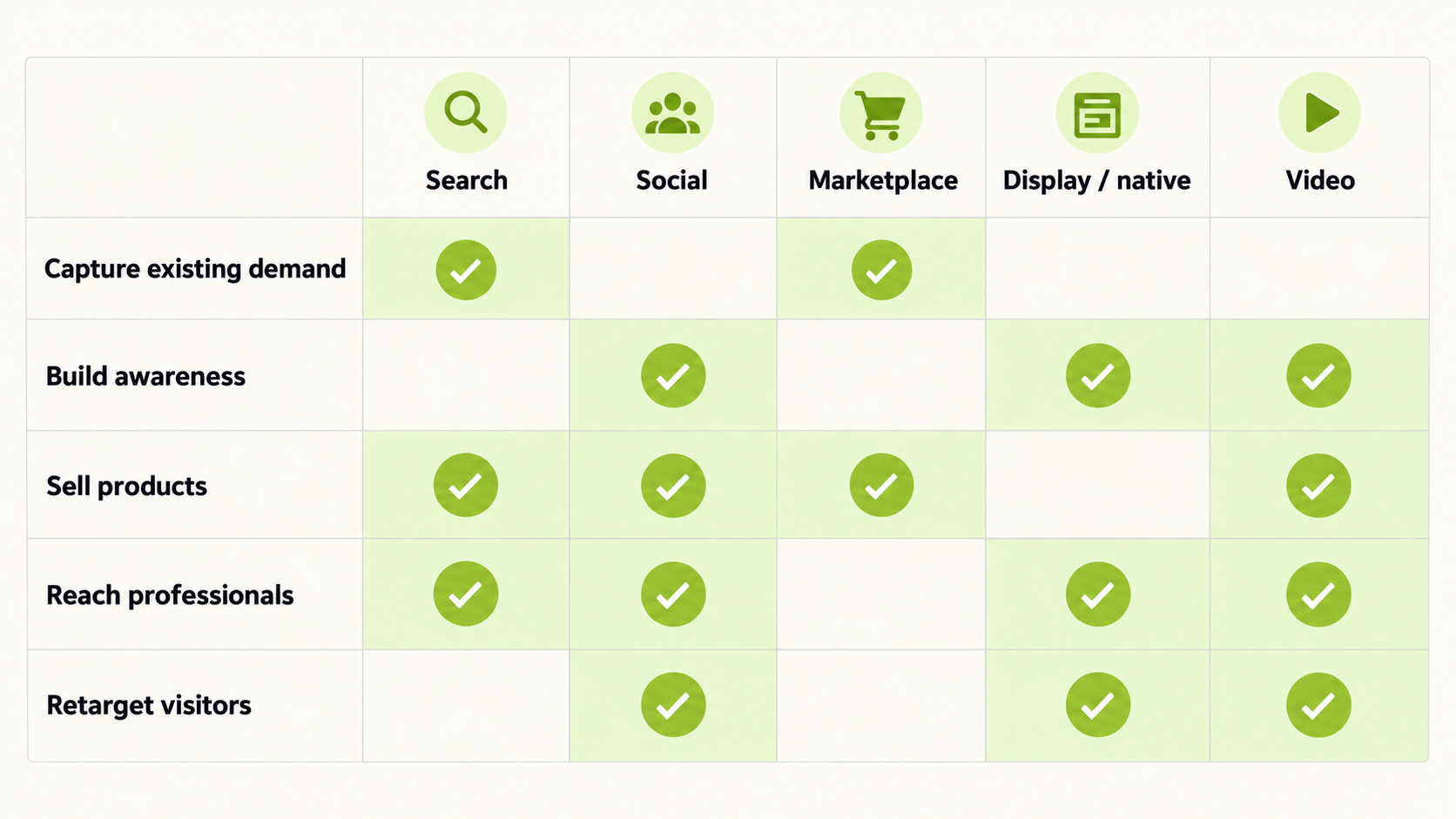
The most useful way to compare the best ad platforms is by what you need them to do.
| Use case | Platforms commonly used | Why |
|---|---|---|
| Capture existing demand | Google Ads, Microsoft Advertising | Ads match what people search for |
| Create demand and discovery | Meta, TikTok, Snapchat | Ads reach people in feeds based on interests and behaviour |
| Sell products to ready shoppers | Amazon and other marketplaces | Ads appear where people already shop |
| Broad reach across the web | Programmatic and native networks | Inventory spans many publishers |
| Reach professionals | Targeting uses professional attributes |
This table describes how each family is typically used, not a ranking. Whether any of them is the right fit for you depends on your audience, product, and margin.
What Features Should You Compare?
Feature lists are long, but only a few features decide outcomes.
| Feature | What to check |
|---|---|
| Targeting | Which audience signals and your own data can you use? |
| Formats | What creative will you need to produce? |
| Bidding | Can you set goals, caps, or automated bidding? |
| Conversion tracking | How are web, app, and offline results measured? |
| Reporting | What breakdowns and exports are available? |
| Minimums | What spend or contract is required to start? |
Where possible, read each platform’s current help documentation and ask to see your own data in the interface before you commit. Features change, so a comparison written months ago may be out of date.
How Do Costs Compare Across Platforms?
Costs depend on the pricing model and the auction. The common models are cost per click, cost per thousand impressions, and cost per action. Search platforms usually charge per click, with prices that vary widely by industry. Social platforms often charge per thousand impressions or optimise towards an action. Marketplace and programmatic platforms have their own structures and, in some cases, minimums.
Third-party benchmarks give wide and conflicting ranges. One blog’s average click cost may be double another’s because they count different things, such as all clicks versus link clicks, or because they cover different industries and years. Treat the numbers as a rough range, and replace them with your own results after a test.
A fair comparison uses cost per result, such as cost per purchase or cost per lead, measured the same way on every platform. A cheap click that does not convert is not cheap.
What Does a Realistic First Quarter Look Like?
A realistic plan starts narrow. In month one, choose one platform for your main goal, install tracking, and run a test with two or three creatives. In month two, review cost per result, keep what worked, and add a second platform with a different job, for example social for discovery next to search for demand. In month three, compare both against your margin, set the reconciliation rule for reporting, and decide where the next budget goes.
Resist the urge to add a platform each week. Every new platform adds creative work, tracking, and reporting overhead. A small, well-measured mix usually beats a wide, thinly funded one, and it leaves you with clear numbers to show a manager or a client.
How Do You Pick From the Best Ad Platforms for Your Business?
Use five steps.
- Define the job. Do you need orders now, or awareness for a new product?
- Check your audience. Where do your buyers already spend time? Use your customer data rather than generalisations.
- Count your creative capacity. Social platforms need a steady supply of fresh visual assets. Search can run on a few ads and a strong landing page.
- Set a budget that can learn. A budget too small to produce results gives you no signal.
- Confirm you can measure. Without conversion tracking, you cannot judge any platform.
If two platforms look equally good, choose the one you can measure more easily and test it first.
How Should You Test Platforms Against Each Other?
A fair test uses a single goal and metric, comparable budgets, and a fixed review date. Use the same offer on each platform, adapted to its format, and apply one attribution rule so that the numbers are comparable. Run each test long enough for the platform’s learning phase to finish.
Keep a simple log: platform, dates, spend, and result. After two or three tests, you will have benchmarks that fit your business. Those benchmarks are worth more than any published average.
If a platform needs more creative than your team can supply, include that effort in the comparison. A platform that looks cheap but demands ten new videos a month may cost more than one that runs on a handful of good ads.
Why Do Ad Platforms Report Different Numbers?
Each platform measures conversions with its own attribution window and counting rules. A sale can appear in more than one platform’s report, because each credits itself under its own rules. Time zones, lag in conversion data, and estimated conversions add further differences.
The fix is a written reconciliation rule. Name the source of truth, such as your store’s backend sales, state the attribution window you will use, and note the expected lag. Use platform figures as directional checks, not as accounting.
How Do You Read Several Ad Platforms in One Place?
Once you use more than one of the ad platforms above, reading results together becomes the hard part. FabFunnel’s Multi Ad Account Reporting shows Meta, TikTok, and NewsBreak alongside Google and Snapchat in one dashboard. FabFunnel launches campaigns on Meta, TikTok, and NewsBreak, while Google and Snapchat are connected for reporting only. This article does not claim FabFunnel connects to Amazon, LinkedIn, Microsoft Advertising, or programmatic platforms, so confirm that before you plan around it. The columns follow each platform’s own metrics, so check them before you use the dashboard for client reporting.
What Mistakes Should You Avoid When Choosing?
Common mistakes include picking a platform because a competitor uses it, splitting a small budget across too many platforms, launching without conversion tracking, judging a test in the first few days, and expecting one platform to do every job. Another is trusting a “best of” list without checking whether its criteria match your goal. A list ranked by reach tells you nothing about cost per customer in your category.
Also watch for lists that blend very different things. A ranking that puts a search engine, a marketplace, and a programmatic exchange in one column compares tools built for different jobs, and the order tells you little. Ask what each entry is for before you read its position.
Review your mix on a fixed rhythm: delivery weekly, cost per result monthly, and the whole mix quarterly.
FAQs
What are the best ad platforms?
It depends on the job. Google Ads and Microsoft Advertising suit search demand, Meta, TikTok, and Snapchat suit discovery, and marketplaces suit ready shoppers.
What are the top platforms for small businesses?
Search and social are the usual starting points. Choose by goal, audience, creative capacity, and budget.
What are the best online ad platforms for ecommerce?
Google Shopping, Meta, TikTok, and marketplaces are common choices. Test against your own margin.
How much does paid advertising cost?
There is no fixed price. Costs depend on the auction, industry, audience, and creative, so compare cost per result in your own account.
How many platforms should I start with?
One or two, so that each gets enough budget to produce readable results.
Can FabFunnel launch campaigns on every platform?
No. FabFunnel launches on Meta, TikTok, and NewsBreak. Google and Snapchat are reporting only.
Where to Start
Define the job, shortlist two platforms, and run a measured test with comparable budgets and one attribution rule. To read results from several platforms in one place, try FabFunnel or explore the full toolset at Fab AI. Lists of the best advertising platforms or top ad platforms are useful starting points, but the right choice still depends on audience, objective, and measurement.