Quick Answer
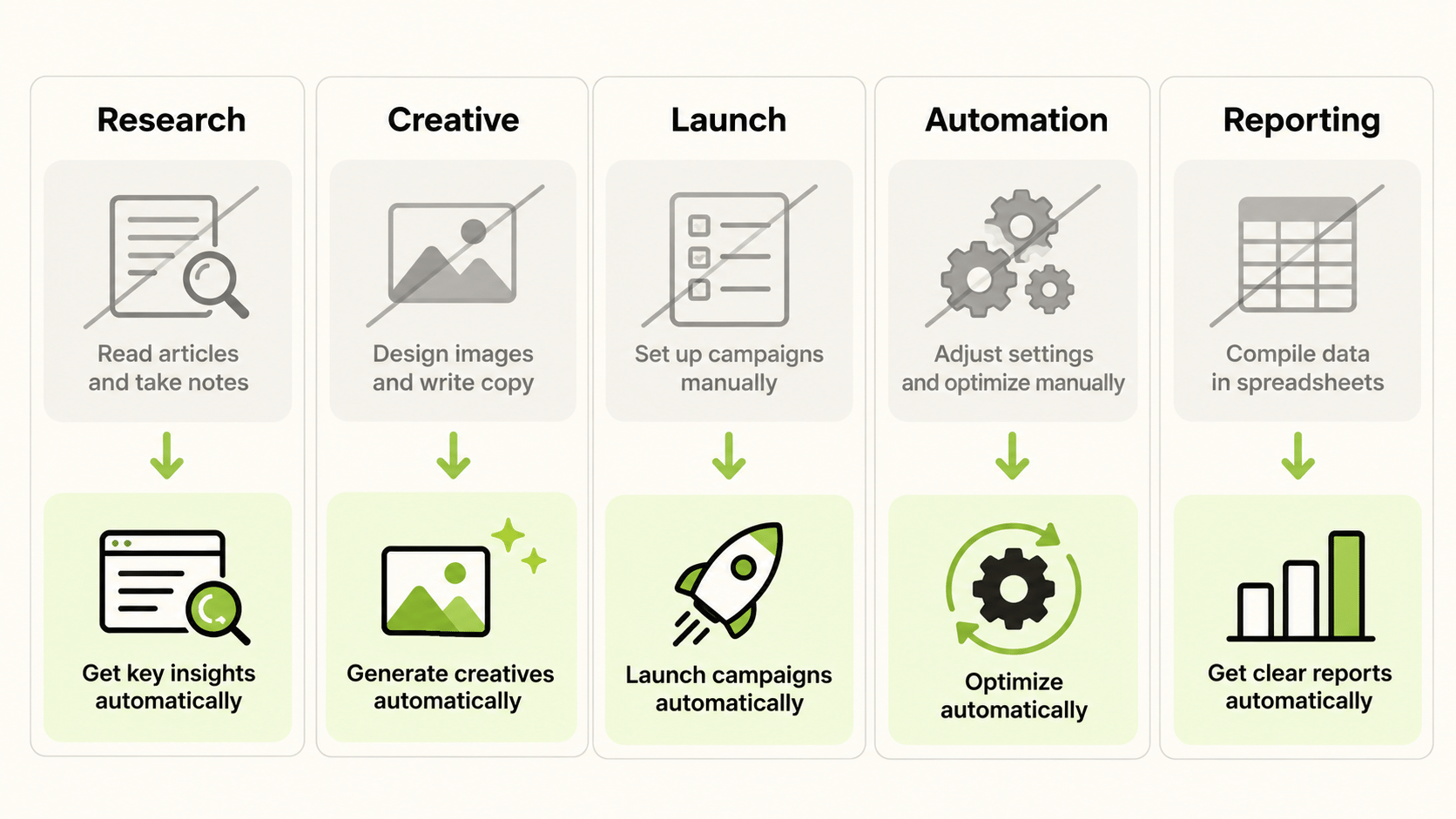
AI tools for marketing fall into five jobs: competitor and market research, creative generation, campaign launch and setup, rule-based automation, and reporting. No single tool does all of them well, so choose by the bottleneck in your own workflow. For advertisers, the biggest gains usually come from creative variation and campaign execution, because these are repeated, time-consuming, and easy to check. Keep humans in charge of budget, claims, and brand decisions, and test each tool against a baseline before you commit. Treat vendor claims about speed and performance as unverified until you have measured them in your own accounts.
What Are AI Tools for Marketing?
AI tools for marketing are products that use machine learning, often generative models, to carry out or assist marketing tasks. Some generate content, such as copy, images, and video. Some analyse data, such as competitor ads or account performance. Some act on rules, such as pausing ads that fall below a threshold. Some answer questions in plain language.
The label “AI tools for marketing” covers very different products, so a useful comparison starts with the job, not the technology. Two tools that both say “AI” may share nothing in how they work or what risk they carry.
What Are the Main Jobs for the Best AI Tools for Marketing?
| Job | Manual version | What the tool does |
|---|---|---|
| Research | Browsing competitor ads and pages by hand | Surfaces and organises competitor creative |
| Creative | Briefing designers and editors for every variant | Generates image and video variations from a brief |
| Launch | Building campaigns one at a time | Launches many campaigns from templates and assets |
| Automation | Checking accounts for winners and losers | Applies rules that scale or pause |
| Reporting | Copying numbers into slides | Answers questions and assembles cross-platform views |
When people search for the top AI tools for marketing, the lists mix all five. Treat such lists as a map of options, then pick by job.
How Does AI Help With Competitor Research and Creative Analysis?
Research and analysis tools reduce the time spent scanning what competitors run. FabFunnel’s Industry Insights is built for competitor ad discovery, where you browse and track competitor ads. It is a discovery tool, not a benchmarking tool, so it shows what competitors are running and observed creative activity, not how well their ads perform. From a static ad, you can generate variations in Genie, and from a video ad you can open it in Video Sage for analysis.
Video Sage analyses video ads and is credit-based. It is for analysis, not video generation. Whatever tool you use for competitor research, remember that seeing an ad does not tell you whether it works. Use it for ideas and angles, and test your own versions.
How Does AI Help With Creative Generation?
Creative is the usual bottleneck in paid social, because testing needs variety and variety needs production. Generative tools can produce image and video variants from a brief, which shortens the path from idea to testable asset.
FabFunnel’s Genie is an AI creative studio for image and video, with several modes, and it pulls brand guidelines from the Catalogue so that output follows brand rules. For ecommerce brands, Catalogue syncs automatically from Shopify, while other stores add products manually.
Quality control matters more than speed. Check generated creative for factual errors, off-brand elements, and claims you cannot support, and keep an approval step before anything goes live.
How Does AI Help With Campaign Launch and Automation?
Launching is repetitive: the same structure, repeated across audiences, creatives, and accounts. FabFunnel’s Bulk Launcher launches campaigns on Meta, TikTok, and NewsBreak, and its stated speed claim is 200+ campaigns in under two minutes once setup is complete. It offers five launch flows: New Launch, Relaunch, Clone, Creative Library Folder Launch, and launching from Genie.
Automation then keeps campaigns tidy. FabFunnel’s Automation is rule-based and works at campaign, ad set, and ad level, with the aim of scaling winners and pausing losers around the clock. Because rules act on spend, review them before you switch them on and check them regularly.
Two boundaries apply. Launch and automation are for Meta, TikTok, and NewsBreak. Google and Snapchat are connected for reporting only. And speed claims depend on your setup, so measure them yourself.
How Does AI Help With Reporting Across Platforms?
Reporting tools save time by pulling numbers from several platforms into one view and by answering questions without a trip through multiple dashboards. FabFunnel’s Multi Ad Account Reporting shows Meta, TikTok, and NewsBreak alongside Google and Snapchat, with columns that follow each platform’s own metrics. Copilot answers questions about account performance in natural language and recommends actions; it does not change your account.
The test for any reporting assistant is traceability. You should be able to see where a number came from and confirm that it matches your definitions. Check a sample of answers against source reports before you use the tool for client work.
How Do You Choose Among AI Tools for Marketing?
Work through five questions.
- What is the bottleneck? Pick the job that costs your team the most hours.
- What does the tool actually do? Separate generation, analysis, action, and answers.
- What will it touch? Tools that spend money or publish content need tighter controls.
- How will you measure it? Time saved, error rate, and cost per result against a baseline.
- What happens if it fails? Know your manual fallback.
Run a month-long test on one task before you roll any of these AI tools for marketing out. Ask for a trial on your own data, not a demo.
What Risks Come With AI Tools for Marketing?
Accuracy is the first risk: generated content can be wrong in confident language. Data handling is the second: know what data leaves your systems. Brand and compliance risk is the third: generated claims may breach platform or legal rules. The fourth is over-automation: rules that act on spend can misfire if thresholds are wrong, so start small and monitor.
Counter these with approval steps, written data rules, and a short list of claims your team may never make. Keep a person accountable for every automated process.
How Should Teams Divide Work Between People and AI Tools for Marketing?
A useful rule is to give machines the repeatable parts and keep people on the judgement calls. Let tools gather competitor examples, produce variants, build campaign structures, and assemble reports. Keep people responsible for positioning, offers, budgets, and what the brand will and will not say.
In practice, that means writing a short operating guide. State which tasks the tools may do alone, which need review, and which are off limits. For example, a team might allow generated creative drafts but require approval before launch, allow automation rules but require a named owner who reviews them weekly, and allow assistants to answer questions but not to change accounts.
Review the guide every quarter. Tools change, and so do platform rules. A guide that was sensible in spring may be out of date by autumn, and the people who use the tools every day are best placed to say what has changed.
What Do Marketers Often Get Wrong With AI Tools for Marketing?
Common mistakes include buying several overlapping tools, judging a tool by a demo, skipping the baseline, and trusting generated output without checks. Another is expecting AI to fix a weak offer or weak tracking. Tools amplify the quality of your inputs, so fix the basics first.
FAQs
What are AI tools for marketing?
They are products that use AI to generate content, analyse data, act on rules, or answer questions in marketing work.
What are the best AI tools for marketing?
There is no single best. Choose by job: research, creative, launch, automation, or reporting.
Can AI tools launch ad campaigns?
Some can. FabFunnel’s Bulk Launcher launches on Meta, TikTok, and NewsBreak. Google and Snapchat are reporting only.
Is Industry Insights a benchmarking tool?
No. It is for competitor ad discovery and shows observed activity, not performance benchmarks.
Does Copilot make changes to my account?
No. It answers questions and recommends.
How do I test an AI tool?
Time a real task with and without it, check output quality, and include editing and approval time.
Where to Start
Choose the one job that costs your team the most hours, test one tool against it for a month, and keep a baseline. To see FabFunnel’s approach to launch, creative, and reporting, start at FabFunnel or explore the full toolset at Fab AI. AI for marketing automation works best when approval rules are explicit. Lists of top AI marketing tools matter less than whether a tool fits the campaign workflow.