Quick Answer
Ai sales tools generally fall into a few categories: CRM-adjacent automation (lead scoring, follow-up sequencing), conversation intelligence (call analysis, coaching), and pipeline forecasting. This piece doesn’t name a single winner among the best ai sales tools, because the right tool depends on which part of the sales process (prospecting, qualifying, closing, forecasting) you’re trying to automate. Note upfront: this is a sales-process category, distinct from paid advertising execution tools, which is a different function even though both sit under a broader “AI for revenue teams” umbrella.
Ai sales tools and ai tools for sales cover the sales process specifically — lead management, outreach, forecasting — which is a separate function from paid ad campaign execution, even though both increasingly get grouped under “AI for growth teams” in marketing content.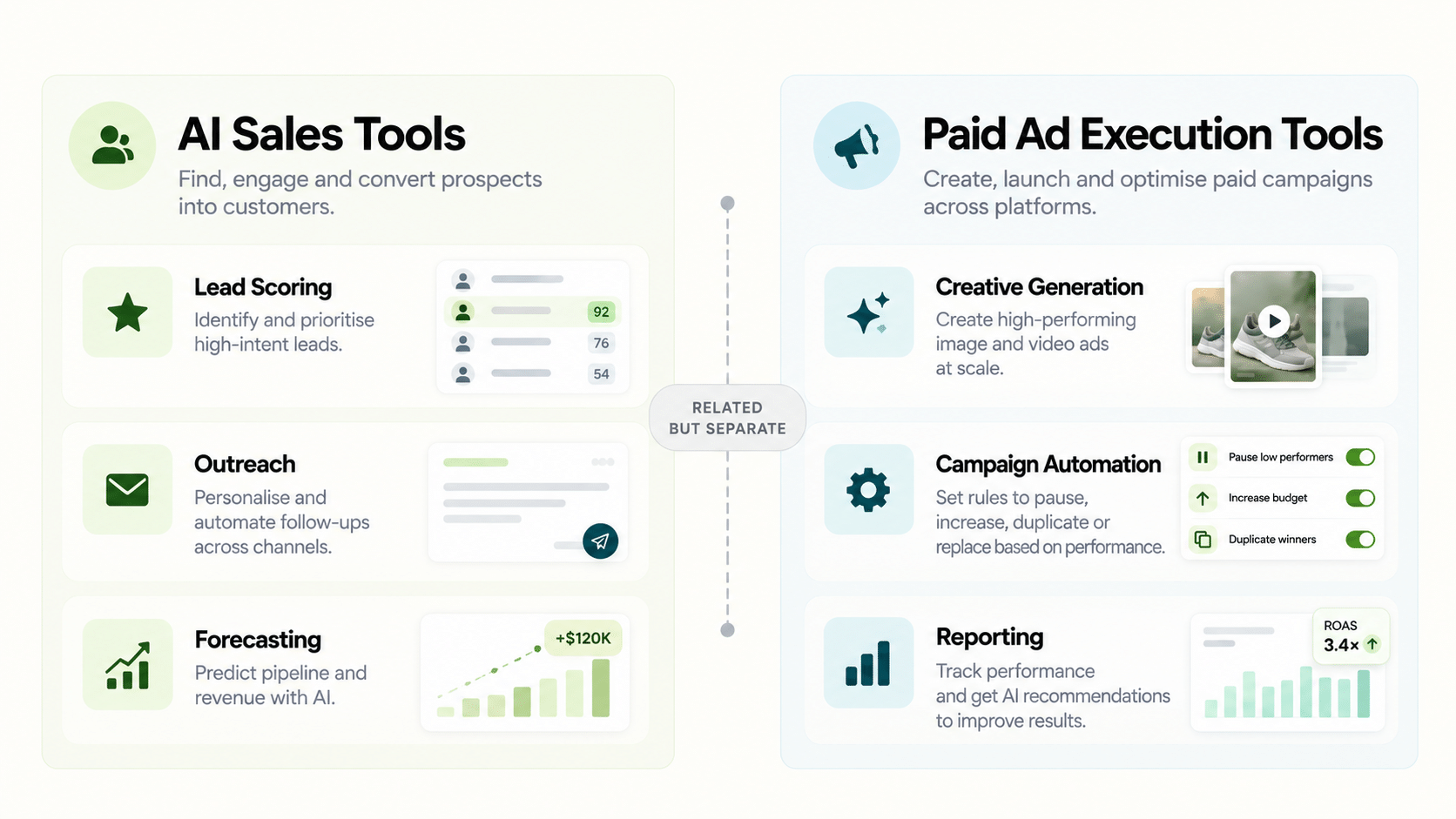
What Do AI Sales Tools Actually Automate?
Primarily the sales process itself: scoring which leads are worth prioritizing, sequencing follow-up outreach, analyzing sales call recordings for coaching insights, and forecasting pipeline based on historical patterns. An ai sales platform focused on these functions is solving a different problem than a paid advertising tool, even when both use similar underlying AI techniques.
It helps to match the tool to the sales stage:
- Prospecting. Finding and prioritizing accounts or contacts worth contacting.
- Qualifying. Scoring leads by fit and intent signals so reps spend time where it counts.
- Closing. Surfacing deal risk, suggesting next steps, and supporting call preparation.
- Forecasting. Predicting which deals will close and when, based on historical patterns.
A team that struggles with lead quality needs different tooling from a team that struggles with rep coaching. Buying a broad ai sales platform to fix one narrow gap often means paying for features nobody uses.
What’s the Difference Between an AI Sales Funnel Tool and a Paid Ad Funnel?
An ai sales funnel tool typically manages the post-lead nurture and conversion process: email sequences, lead scoring, sales rep prioritization. A paid ad campaign, by contrast, is what generates the lead or the initial traffic in the first place. The two connect (ads feed a funnel) but are managed by different tools built for different stages.
The handoff is where teams lose value. If paid campaigns bring in leads that the sales team rates as poor fit, the issue may sit upstream in creative, targeting, or offer. If leads are good but conversion is low, the issue sits downstream. Separating the two tool categories makes it easier to see which stage is failing.
AI Sales Tools: Category Breakdown
| Category | What It Automates | Distinct From |
|---|---|---|
| Lead scoring | Prioritizing which leads to pursue | Ad targeting (which audiences to reach) |
| Conversation intelligence | Call analysis and rep coaching | Ad creative testing and iteration |
| Pipeline forecasting | Predicting deal closure based on patterns | Ad performance forecasting (ROAS, CPA trends) |
| Sales funnel automation | Post-lead nurture sequences | Paid campaign execution that generates the lead |
Does FabFunnel Function as an AI Sales Tool?
No. FabFunnel is positioned as a campaign execution infrastructure platform for paid advertising: creative generation (Genie), competitor ad intelligence (Industry Insights, Video Sage), campaign automation (Automation Rules Engine), bulk launch (Bulk Campaign Launcher), and cross-account reporting (Multi Ad Account Reporting) across Meta, TikTok, and NewsBreak.
It does not manage the sales process itself. Lead scoring, CRM workflows, and sales rep tooling are not part of FabFunnel’s confirmed capabilities. FabFunnel does integrate with Slack, Voluum, RedTrack, and JVZoo, but those connect ad operations and tracking, and shouldn’t be read as sales-tool functionality.
A team running both paid ads and a sales process would use FabFunnel for the ad execution side and a separate ai sales tool for the sales-process side.
Should Paid Advertising and Sales Tooling Be Evaluated Together?
Generally no. They solve different operational problems, even for the same revenue goal. Evaluating “best ai tools for sales” and “best ai tools for paid ads” as separate category questions, rather than one blended list, produces a more accurate comparison, since a tool strong in one category rarely also leads in the other.
A practical approach is to run two short evaluations. For sales tooling, start from the stage where deals stall and ask what data the tool needs, which CRM it connects to, and how reps will actually use it. For ad execution, start from your campaign bottleneck: creative volume, launch speed, or monitoring. Compare each tool only against the others in its own category.
What Should You Check Before Adopting Any AI Sales Tool?
Four questions apply regardless of vendor:
- Data fit. Does it work with the CRM and data you already have, or does it need a migration?
- Adoption. Will reps use it daily, or is it a dashboard nobody opens?
- Evidence. Can the vendor show results from teams similar to yours, not just a generic case study?
- Handoff. If your pipeline starts with paid ads, does lead data pass cleanly from ad platform to sales tool?
The last point is where the two categories meet. Clean lead handoff matters more than any single feature on either side.
How Do You Hand Leads From Paid Ads to a Sales Team Cleanly?
The handoff is where value is most often lost. A few habits make it smoother.
First, agree what counts as a qualified lead and put it in writing. If ads optimise for form fills while sales wants decision-makers, the two sides will argue about quality indefinitely. Second, make sure the source of every lead is captured, including the campaign and ad, so sales can report back on which ads bring good prospects. Third, set a response-time target. Leads contacted within minutes convert far better than leads contacted days later.
Then close the loop. Feed outcomes, such as meetings booked and deals won, back to the people running ads. That information helps them judge which campaigns create real revenue rather than cheap leads.
What Is a Sensible Way to Trial Sales Tooling?
Pick one stage of the process and one measurable goal, for example faster follow-up or better lead prioritisation. Run the tool with a small group for four to six weeks and compare against a control group or the previous period. If the metric doesn’t move, the tool isn’t solving your problem, however good the demo looked.
How Do You Compare AI Sales Tools Fairly Across Vendors?
Use the same scorecard for every vendor, or the demos will decide for you. Pick five criteria that reflect your real process and score each tool from one to five.
Good criteria for ai sales tools include fit with your CRM, quality of the data it needs, time to first useful result, how much rep effort it requires, and the evidence the vendor can show from similar teams. Weight them by what hurts most today. If reps already resist data entry, a tool that depends on manual logging should score low however clever it looks.
Ask each vendor to run your data, not a sample set. Ai sales tools that look sharp on clean demo data can struggle with the messy records most teams actually have.
Insist on references from teams of similar size and sales cycle. Ask those references what changed in the first ninety days and what they would do differently. Real answers are more useful than any feature comparison.
Finally, agree the success measure for any ai sales tools pilot in advance, such as faster follow-up or a higher share of qualified meetings. If ai sales tools cannot move the measure you chose within a quarter, the pilot has answered your question.
FAQs
What’s the difference between ai sales tools and an ai sales platform?
The terms are used interchangeably. The more useful distinction is which specific stage of the sales process (lead scoring, outreach, forecasting) a given tool addresses.
Are ai tools for sales the same as paid advertising automation tools?
No. They address different stages of the revenue process. Sales tools manage leads after they exist; paid advertising tools generate the initial traffic or lead.
Does an ai sales funnel tool include paid ad campaign management?
Not typically. An ai sales funnel tool usually starts after a lead is captured, managing nurture and conversion rather than the ad campaign that generated the lead.
Is FabFunnel an ai sales tool?
No. FabFunnel is a paid ad campaign execution platform (creative, automation, bulk launch, reporting) for Meta, TikTok, and NewsBreak. It doesn’t manage sales-process functions like lead scoring or CRM workflows.
What should I check before choosing between “best ai sales tools” lists?
Whether the list is specifically about sales-process tools (lead scoring, outreach, forecasting) or blends in unrelated marketing and advertising categories under a broad “AI for revenue” label.
Can a team use both an ai sales platform and a paid ad execution platform together?
Yes. They address different parts of the funnel, and using a purpose-built tool for each stage (ad execution feeding leads into a separate sales tool) is a common structure.
Where to Start
Identify the stage where your revenue process loses the most value, then evaluate ai sales tools for that stage only. For paid ad campaign execution (creative, automation, bulk launch, reporting) across Meta, TikTok, and NewsBreak, FabFunnel is built for that function. Start at FabFunnel or explore the full toolset at Fab AI. For sales-process automation, apply the category framework above to whichever ai sales tool fits your team’s needs.