Quick Answer
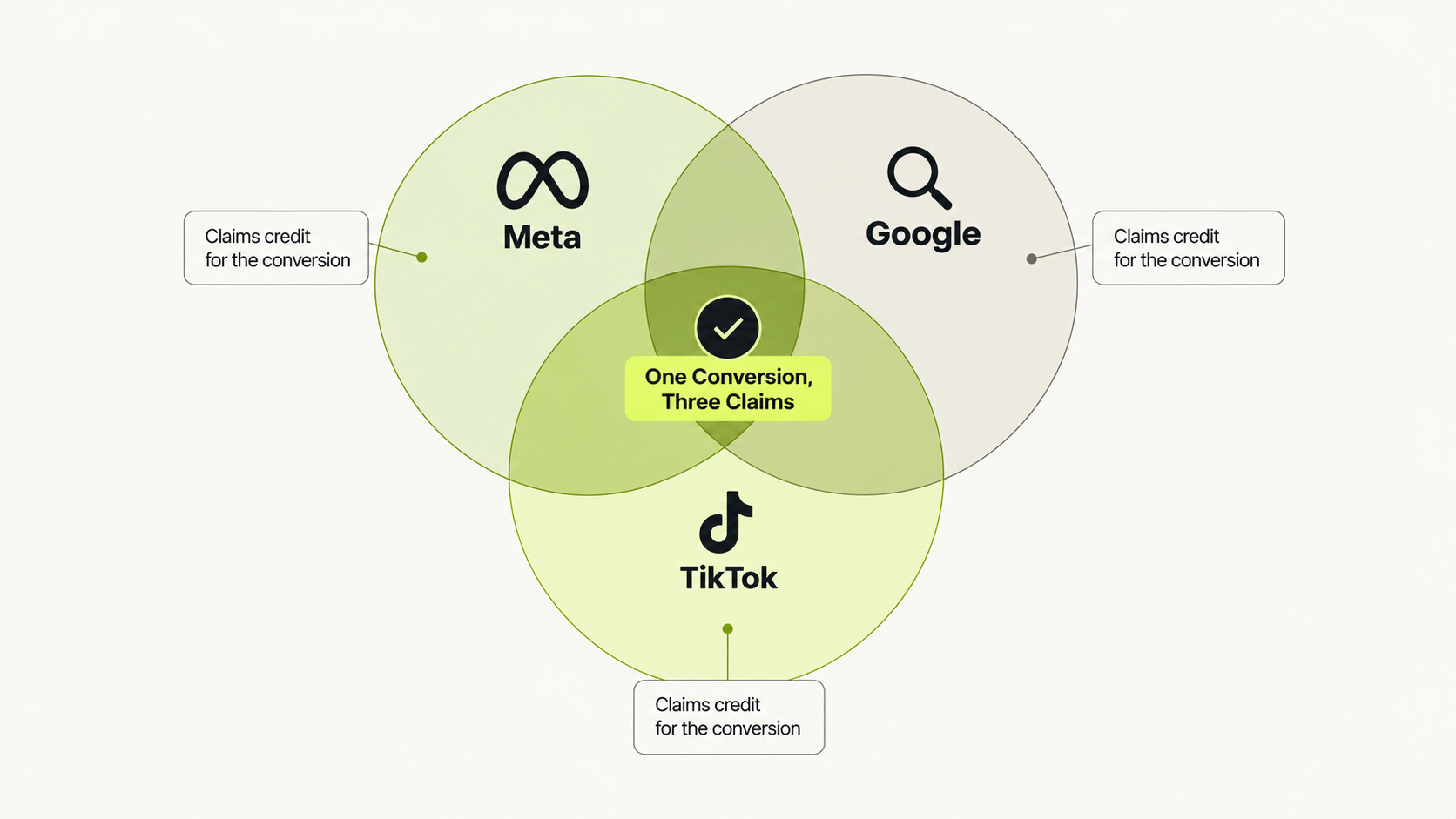
When a brand runs Meta, Google, and TikTok ads simultaneously, each platform’s attribution only sees its own touchpoints clearly, which means all three can independently claim credit for the same conversion — inflating what “total attributed conversions” looks like if you simply add the three platforms’ numbers together. The fix isn’t picking one universal attribution model; it’s being explicit about which model you’re using for which decision, and treating any cross-platform total as directionally useful rather than a precise, additive number.
Ad attribution gets meaningfully harder the moment a brand runs more than one platform, because each platform’s reporting is built to measure its own contribution, not to reconcile with what another platform is also claiming credit for. This is a structural limitation of how platform-level attribution works, not a bug in any single platform’s reporting.
Why Does Each Platform’s Ad Attribution Model Overstate Its Own Contribution?
Because each platform’s attribution is built on its own visibility into user behavior — Meta sees Meta touchpoints, Google sees Google touchpoints, TikTok sees TikTok touchpoints. If a customer saw ads on all three before converting, each platform’s attribution model may credit itself for that conversion, since none of them can see what happened on the others. Adding up “attributed conversions” across all three platforms will typically overcount actual total conversions.
What Is an Ad Attribution Model, Practically?
A defined rule for how credit gets assigned across touchpoints — last-click, first-click, or some form of multi-touch weighting. Different platforms default to different models, and a brand comparing performance across Meta, Google, and TikTok needs to know which model each platform is applying before treating the numbers as comparable.
What Should a Brand Running All Three Platforms Actually Track?
Two things separately: each platform’s own attributed performance (useful for optimizing within that platform) and a platform-agnostic total conversion count from your own source of truth, like actual purchases recorded in your order system. The mismatch between the sum of platform-attributed conversions and your actual total conversions is expected, not a sign that something is broken.
Cross-Platform Attribution: What Each Data Source Actually Tells You
| Data Source | What It Measures | Limitation |
|---|---|---|
| Meta’s own attribution | Conversions Meta believes its ads drove | Can’t see Google or TikTok touchpoints |
| Google’s own attribution | Conversions Google believes its ads drove | Can’t see Meta or TikTok touchpoints |
| TikTok’s own attribution | Conversions TikTok believes its ads drove | Can’t see Meta or Google touchpoints |
| Your own order/conversion system | Actual total conversions | Doesn’t attribute credit to a specific ad or platform on its own |
Is There an Ad Attribution Tracking Platform That Solves This Cleanly?
Some ad attribution software attempts cross-platform reconciliation, typically by connecting to your own conversion data (like a pixel or server-side event) and applying one consistent model across platforms rather than trusting each platform’s self-reported number. This reduces but doesn’t eliminate the overlap problem, since it still depends on what each platform’s tracking can see.
How Does FabFunnel’s Reporting Fit Into This Picture?
Multi Ad Account Reporting syncs spend, ROAS, CPR, CPC, and CTR roughly every 15 minutes across Meta, TikTok, and NewsBreak — it consolidates reporting across those three platforms in one place, but it reflects each platform’s own attributed numbers rather than resolving cross-platform double-counting. FabFunnel’s reporting does not currently include Google Ads, so a brand running Meta, Google, and TikTok together would need to bring in Google’s numbers separately when reconciling a full cross-platform view.
How Do You Build a Simple Cross-Platform View Without Perfect Ad Attribution?
Use blended metrics from your own data as the anchor. Two are enough for most teams:
- Blended CPA: total ad spend across all platforms divided by total orders from your own system.
- MER (marketing efficiency ratio): total revenue divided by total ad spend. It ignores platform credit entirely, so it can’t be double-counted.
Neither tells you which platform deserves credit. They tell you whether the whole programme is healthy. Pair them with each platform’s own attributed numbers, which are still useful for comparing ads, audiences, and creative within a platform.
A weekly routine works well: record spend per platform, record total orders and revenue from your own system, calculate blended CPA and MER, then note the platform-attributed numbers beside them. Over several weeks, patterns emerge. If total spend rises and blended CPA holds steady, scaling is working, regardless of which platform claims the credit.
Which Numbers Should Drive Which Decision?
What Is the Most Reliable Way to Test Platform Contribution?
Controlled tests. Pause or reduce one platform in a defined period and watch total orders and blended CPA. Platform-reported numbers can’t settle the question on their own, because each one only measures its own touchpoints. A well-run test tells you whether total results actually fell. Keep the test short, change one variable, and account for seasonality, since a promotion can mask the effect.
How Do You Explain Attribution Gaps to Clients or Leadership?
Expect the question: “Why do your platform reports show more sales than our store?” A clear explanation prevents a loss of trust.
Say it simply. Each ad platform counts the sales it can see evidence of. A customer who saw ads on two or three platforms may be counted by all of them, so the platform totals add up to more than real sales. That overlap is a known limit of platform reporting, not an error or an attempt to inflate results.
Then show the numbers you do trust: total orders and revenue from your own system, blended cost per order, and efficiency ratio. Present platform-attributed numbers as a guide to which ads and audiences work best within each platform, not as a statement of total sales.
Clients usually accept this once they see it laid out with their own figures. What damages trust is discovering the gap later without an explanation.
What Does a Practical Attribution Setup Look Like for a Small Team?
You don’t need an expensive stack to start. A reasonable minimum is: consistent tracking on every platform, a shared spreadsheet or dashboard with weekly spend and orders from your own system, and a written note of each platform’s attribution settings. Add a post-purchase survey asking how customers found you, since self-reported answers often reveal channels that tracking misses.
Review the setup quarterly. As you add platforms or change windows, the gaps change too, and your notes keep comparisons honest.
How Does Ad Attribution Change Between a Prospecting and a Retargeting Campaign?
Not all campaigns deserve the same reading. Prospecting campaigns reach people who have never heard of you, so ad attribution often shows a delayed payoff: the customer sees the ad, thinks about it, and buys days later through another channel. Short windows will under-credit these campaigns.
Retargeting works the other way. It reaches people who already visited your site, so ad attribution tends to flatter it, because many of those buyers would have returned anyway. A strong ROAS on retargeting alone does not prove it is creating new demand.
Judge each campaign type against its own job. For prospecting, look at new-customer volume and blended cost per order over a longer period. For retargeting, look at incremental lift where you can test it, for example by holding out a small audience.
Using one ad attribution reading for both campaign types leads to a familiar mistake: cutting prospecting because it looks expensive, then watching retargeting performance fade a few weeks later because nobody new is entering the funnel. Treat ad attribution as a guide to each campaign’s role and your budget split stays healthier.
FAQs
Why do my Meta, Google, and TikTok attributed conversions add up to more than my actual total sales?
Each platform independently claims credit for conversions it can see evidence of, and if a customer interacted with more than one platform’s ads before converting, multiple platforms can claim the same conversion. This overlap is expected, not an error.
What’s the most reliable number if I run ads on all three platforms?
Your own conversion source of truth (actual orders or leads recorded in your own system), used alongside each platform’s attributed numbers for within-platform optimization — not the sum of all three platforms’ attributed totals.
Does ad attribution software fix the double-counting problem completely?
It typically reduces it by applying one consistent model across platforms using your own conversion data, but it can’t fully resolve overlaps it doesn’t have visibility into.
How should I compare an ad attribution model across Meta, Google, and TikTok?
Confirm each platform’s default window and model first — differences here explain a meaningful part of why the same campaign can look different across platforms even before considering the overlap problem.
Does an ad attribution tracking platform replace the need to check my own order data?
No — your own order or conversion system remains the most reliable total, since it isn’t subject to any single platform’s attribution assumptions.
Can FabFunnel help reconcile Meta, Google, and TikTok attribution together?
FabFunnel’s Multi Ad Account Reporting consolidates Meta, TikTok, and NewsBreak reporting in one place, but it does not include Google Ads — Google’s numbers would need to be brought in separately for a full three-platform reconciliation.
Where to Start
If you’re running Meta, Google, and TikTok together, treat each platform’s attributed conversions as within-platform optimization signals, and lean on your own order data for the actual total. FabFunnel’s Multi Ad Account Reporting consolidates Meta, TikTok, and NewsBreak performance in one place — start at FabFunnel or explore the full toolset at Fab AI.