Quick Answer
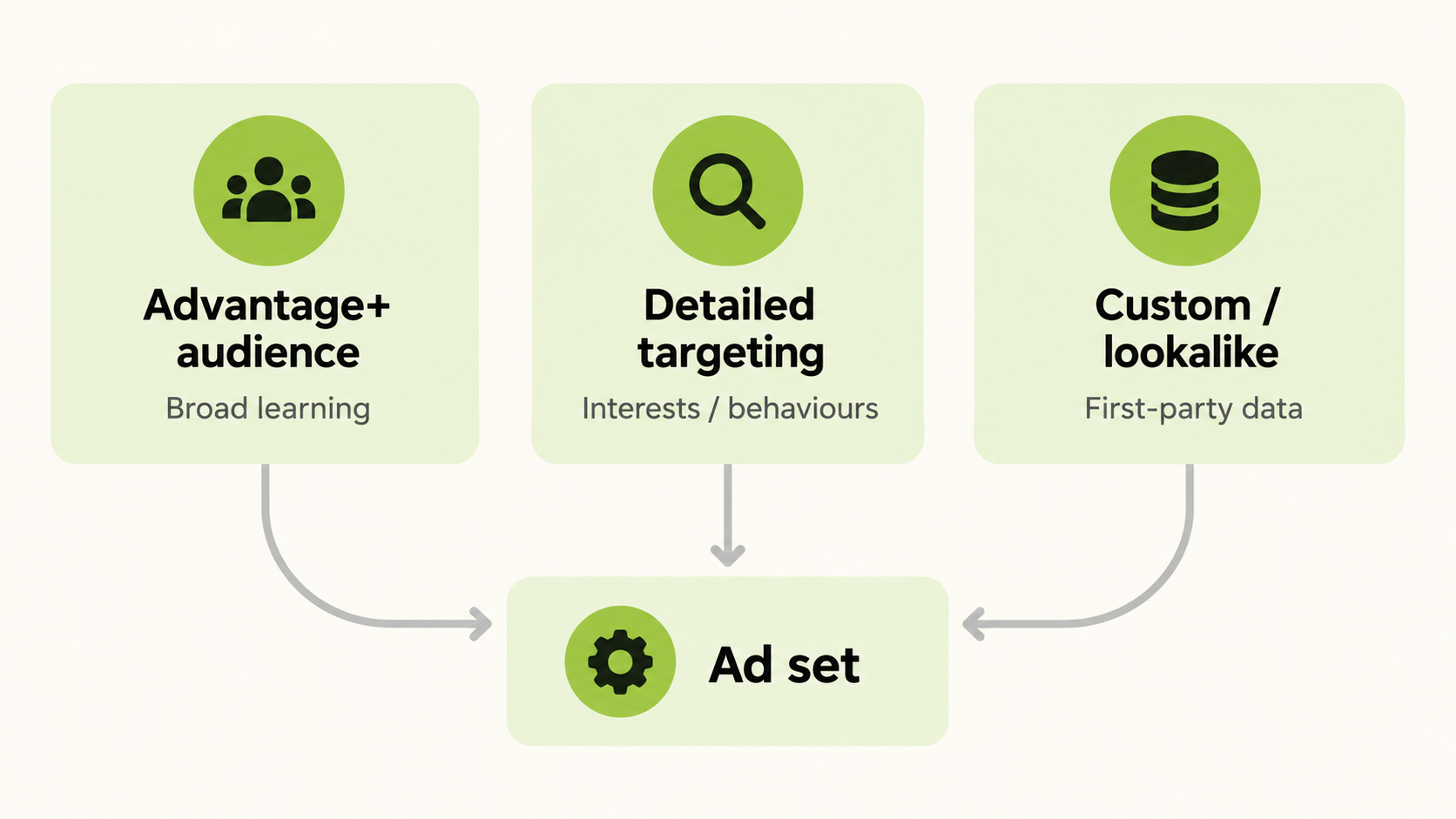
Facebook ads targeting decides who sees your ads. Meta offers three main approaches: Advantage+ audience, where Meta’s system treats your inputs as a starting point and expands beyond them; detailed targeting, where you choose interests, demographics, and behaviors; and custom and lookalike audiences, built from your own data. Broad setups give the delivery system room to find buyers, while narrow setups give you control. Start with a broad or Advantage+ test and a custom-audience retargeting test, hold creative constant, and compare cost per result. Meta’s targeting options and defaults change often, so confirm them in Ads Manager.
What Is Facebook Ads Targeting?
Facebook ads targeting is the set of choices that define who your ads can reach on Meta’s apps. It includes basic fields such as location, age, and gender, plus audience inputs such as interests, behaviors, customer lists, and site visitors.
Targeting works together with creative and bidding. A precise audience cannot rescue a weak ad, and a strong ad can find its audience even with loose targeting. Treat targeting as one of three levers, and test it alongside the other two, not in isolation.
What Facebook Ads Targeting Options Are Available?
| Option | What it is | Best for |
|---|---|---|
| Advantage+ audience | Meta expands beyond your suggestions | Scale and prospecting |
| Detailed targeting | Interests, demographics, behaviors you select | Testing specific segments |
| Custom audiences | Built from your lists, site, app, or engagement | Retargeting and exclusions |
| Lookalike audiences | People similar to a source audience | Finding new buyers like current ones |
| Location, age, gender | Basic filters | Hard limits |
Meta’s help pages note that Advantage+ audience is applied automatically to new campaigns where it is available, with exceptions for certain campaign types, and that you can still set hard limits such as minimum age, location, and exclusions. Availability varies by objective and account, so check your own options.
How Does Facebook Ad Interest Targeting Work?
Facebook ad interest targeting lets you pick topics, pages, and behaviors that your potential customers are likely to engage with. Meta’s detailed targeting tool shows suggestions as you type, along with an estimate of audience size.
Meta’s help pages describe Advantage detailed targeting as widening delivery beyond your chosen detailed targeting selections. It is enabled automatically for some objectives, such as conversion-optimised campaigns, and it is not available for brand awareness or reach objectives. It applies to detailed targeting only, not to location, age, or gender.
In practice, this means your interest list is a hint, not a fence, for many campaigns. If you need a hard boundary, use the fields that Meta treats as limits, and be aware that restricted categories such as credit, employment, and housing have their own rules.
How Do You Use Facebook Ads Targeting Interests Well?
Facebook ads targeting interests work best when they are specific, tested, and grouped by idea.
- Group by theme. Combine related interests in one ad set so you can read the result as one idea.
- Keep audiences big enough. Very small audiences can limit delivery and learning.
- Test one theme at a time. Run a few ad sets with the same creative and different themes.
- Check overlap. Ad sets that target the same people compete in the same auction.
- Review monthly. Interests that worked in spring may not in autumn.
Do not assume that a clever interest beats a broad audience. Many accounts find that broad delivery with strong creative holds its own, but only a test in your account can tell you.
How Do Custom and Lookalike Audiences Fit In?
A custom audience is built from sources you own: customer lists, website or app visitors, and people who engaged with your content. These audiences are the base of retargeting. They also serve as exclusions, so that you do not pay to show acquisition ads to people who already bought.
A lookalike audience is built from a source audience and finds people who resemble it. The quality of the source matters. A list of recent, high-value customers is a better seed than a list of everyone who ever visited your site.
Meta’s help pages note limits, such as a cap on the number of custom audiences per ad account, and rules around data you may upload. Read the current policy before you upload customer data, and make sure you have the right to use it.
What Facebook Ads Targeting Tools Help You Plan and Test?
Native facebook ads targeting tools cover most needs. The audience size estimate shows potential reach, the audience overlap view helps spot competing ad sets, and the Meta Ad Library shows ads that competitors are currently running, which can suggest angles worth testing. Reporting breakdowns by age, gender, and placement show who actually responded.
Third-party tools add value mainly for scale: building many ad sets, duplicating structures, and reporting across accounts. Compare them on the platforms they act on, the controls they provide, and how they handle approvals.
How Does FabFunnel Fit Into Facebook Ads Targeting?
FabFunnel does not replace Meta’s targeting system, and this article does not claim it does. Targeting choices are made with Meta’s own options. FabFunnel helps with the surrounding workflow. Industry Insights lets you discover competitor ads for angle ideas, though it is a discovery tool, not a benchmarking tool. Genie generates image and video creative. Bulk Launcher launches campaigns on Meta, TikTok, and NewsBreak, with a stated speed claim of 200+ campaigns in under two minutes once setup is done, which helps when you want to test many audience and creative combinations. Automation is rule-based and works at campaign, ad set, and ad level.
Speed claims depend on your setup, so measure them in your own accounts. This article does not describe specific targeting controls inside FabFunnel, so confirm those with the product before you plan around them.
What Is a Practical Facebook Ads Targeting Strategy?
A sound facebook ads targeting strategy has three layers.
- Prospecting. Run a broad or Advantage+ audience test, and one or two detailed-targeting tests, with the same creative.
- Retargeting. Use custom audiences for site visitors, cart abandoners, and past buyers, with shorter windows for warmer groups.
- Exclusions. Exclude recent buyers from acquisition campaigns, and exclude prospecting audiences from retargeting so that budgets do not overlap.
- Keep a testing log. Record the audience, the creative, the dates, the spend, and the result. After a month, you will see which audiences repeat and which were luck.
How Do You Match Audiences to Funnel Stages?
Audience choice should follow how close a person is to buying. Cold audiences, such as broad delivery or interest groups, need a clear introduction: who you are, what the product does, and why it matters. Warm audiences, such as site visitors and people who engaged with your content, need a reminder and a reason to act now. Hot audiences, such as cart abandoners, need little more than a direct prompt and any information that removes doubt, such as shipping or returns.
Different stages also tolerate different frequencies. A cold audience tires of the same ad more slowly than a small retargeting pool does, so refresh retargeting creative more often and watch frequency in each group.
How Do You Test Audience Choices Fairly?
A fair test changes one thing. Keep creative, offer, landing page, and bidding the same, and vary only the audience. Give each ad set enough budget and time to leave the learning phase and gather enough conversions to read. Do not stop a test after a day because one ad set looks better, since early results are noisy.
When a result is close, run it again. A repeated result is a pattern, and a single result may be noise.
What Facebook Ads Targeting Mistakes Should You Avoid?
Common mistakes include building audiences so small that delivery stalls, running overlapping ad sets, changing targeting mid-test, ignoring exclusions, and blaming targeting when the creative is the real problem. Another is trusting old advice: Meta’s options and defaults have changed, and guidance written years ago may no longer match your account.
FAQs
What is Facebook ads targeting?
It is the set of choices that determine who can see your ads on Meta’s apps.
What are the Facebook ads targeting options?
Advantage+ audience, detailed targeting, custom audiences, lookalike audiences, and basic filters for location, age, and gender.
Do interests still matter in Facebook ads?
They are inputs, and for many campaigns Meta’s system expands beyond them. Test them against broad delivery in your account.
Can FabFunnel set Facebook audiences?
Targeting is set with Meta’s own options. FabFunnel helps with launching, creative, and automation around them, so confirm any audience controls with the product.
How do I find competitor angles?
Use the Meta Ad Library or a discovery tool such as FabFunnel’s Industry Insights, then test your own versions.
How long should I test an audience?
Long enough to gather meaningful results, which depends on your budget and conversion volume.
Where to Start
Run one broad test, one interest test, and one retargeting test with the same creative, and keep a log. To launch and compare many variations, try FabFunnel or explore the full toolset at Fab AI. FB ads targeting follows the same audience logic, even when teams use the shorter name in reports or briefs.