Quick Answer: “AI advertising tools” is not one category, it’s three, and they solve different problems. Generation tools create creative and copy (image, video, ad text). Automation tools execute repetitive workflow actions (launching campaigns, applying rules, pushing budgets) without manual clicks. Optimization tools analyze performance data and recommend or adjust targeting, budget, and bidding. Buying a generation tool to fix an execution bottleneck, or an optimization tool to solve a creative-output problem, is the single most common reason “AI advertising” purchases underdeliver. Match the tool to the specific bottleneck, not the AI label.
Why does “AI advertising tools” mean three different things?
The phrase got flattened by marketing. Every vendor selling anything adjacent to advertising now calls itself an “AI advertising tool,” which makes the category useless as a buying filter.
In practice, the tools doing work in a paid media stack split into three distinct jobs:
- Generation, producing the creative asset or copy itself. Input: a brief, a product, a brand asset. Output: an image, video, or ad copy variant.
- Automation, executing the mechanical steps of running campaigns. Input: a decision or rule someone already made. Output: campaigns launched, budgets shifted, naming conventions applied, at volume and without a human clicking through each one.
- Optimization, analyzing what’s already running and telling you (or, in rarer cases, adjusting) what to change. Input: live performance data. Output: a recommendation or an automated adjustment tied to a threshold.
These are sequential, not competing. Generation feeds automation (you need creative before you can launch it). Automation feeds optimization (you need live campaigns before you have performance data to analyze). A tool that’s excellent at one layer usually has nothing to say about the other two, and vendors rarely volunteer that limitation.
What’s the actual difference between generation, automation, and optimization tools?
Generation tools solve a production-capacity problem. If your bottleneck is “we don’t have enough creative variants to test” or “our design team can’t turn briefs around fast enough,” this is the layer to fix. These tools use generative models to produce ad images, video, and copy, often from a product catalogue or a set of brand assets. The output is a deliverable: a finished or near-finished creative asset.
Automation tools solve a labor-and-speed problem, not a creative one. If your bottleneck is “we know what to launch, we just can’t launch 300 ad sets by hand without errors,” generation won’t help, you already have the creative. What you need is infrastructure that takes a decision (launch these campaigns, apply this naming convention, split this budget across these audiences) and executes it at scale, consistently, without a human manually repeating the same clicks 300 times.
Optimization tools solve a decision-quality problem. If your bottleneck is “we’re running campaigns but can’t tell fast enough which ones are underperforming, or by how much, or why,” this is the layer to fix. These tools sit on top of live reporting data and either flag what to change or, in a smaller subset of tools, change it automatically against pre-set thresholds.
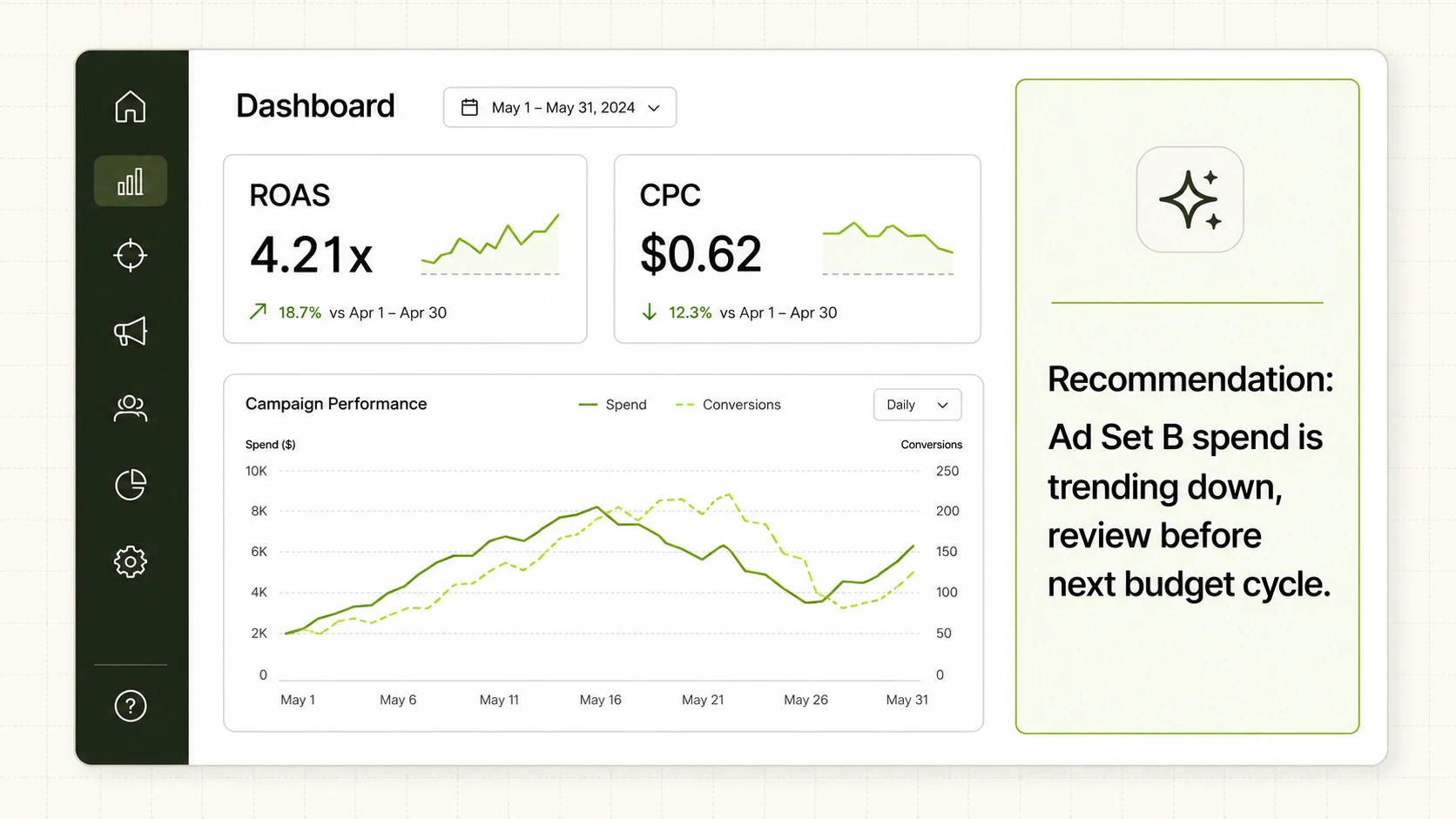
The distinction that matters most for buying: generation tools produce assets, automation tools execute actions, optimization tools produce (or act on) judgments. A tool can’t do all three well by accident.
Why does conflating these categories lead to buying the wrong tool?
Because the failure mode is invisible until after the contract is signed.
A common pattern: a team’s real bottleneck is campaign execution, an agency managing 40 client accounts can’t structure and launch campaigns fast enough, and errors creep in from manual setup. They buy an “AI advertising tool” that turns out to be a generative creative tool. It makes decent images. It does nothing for the 40-account launch bottleneck. Three months later they’re still bottlenecked, just with better-looking ads sitting in a queue they can’t push out fast enough.
The reverse happens too: a team buys an optimization/recommendation tool expecting it to fix a creative fatigue problem. Optimization tools can tell you that a creative is fatiguing (declining CTR, rising CPA), they cannot generate a replacement. Without a generation tool downstream, the recommendation is a dead end.
The fix is diagnostic, not vendor-driven: identify which of the three problems (production capacity, execution speed, decision quality) is actually constraining output right now, then buy against that specific constraint. Ask a vendor “which of the three does this do” before you ask what AI model powers it.
How do generation, automation, and optimization tools fit together in a stack?
They’re layers, and the sequencing matters:
- Generation sits at the top of the funnel, before a campaign exists. Output feeds into a creative library or asset repository.
- Automation sits in the middle, it takes finished creative plus a targeting/budget decision and turns it into live campaigns across ad accounts, at whatever volume is needed.
- Optimization sits downstream of live spend, it needs automation (or manual execution) to have already happened, because there’s no performance data to analyze until campaigns are running.
A mature paid media stack typically has tooling, sometimes from one vendor, sometimes several, covering all three layers, because a gap in any one layer bottlenecks the others. Fast creative generation is wasted if there’s no automation layer to launch it at volume. Automation without optimization means you’re executing consistently but blind to whether the campaigns are working. Optimization without generation or automation gives you a list of recommendations nobody can act on fast enough.
FabFunnel is an example of a platform built to span more than one of these layers rather than a single one: Genie (generation, four creative modes, a Concepts tab with pre-built frameworks, Shopify catalogue sync) sits alongside a Bulk Campaign Launcher (automation, pushing large campaign volumes live and supporting dynamic variables across variations) and an Automation Rules Engine (automation, CPA floors, ROAS thresholds, frequency caps, with every action logged). Co-Pilot, its recommendation layer trained on live reporting data, is a clean example of the optimization category specifically because it’s recommendation-only, it surfaces what to change but does not execute the change itself. That’s a meaningful distinction worth checking for in any tool sold under the optimization label: does it recommend, or does it act, and do you want it to act unsupervised.
Comparison: Generation vs. Automation vs. Optimization Tools
| Generation Tools | Automation Tools | Optimization Tools | |
|---|---|---|---|
| What they do | Produce creative assets and ad copy from a brief, catalogue, or brand input | Execute repetitive campaign actions, launching, structuring, budget/rule enforcement, at volume | Analyze live performance data and surface (or in some cases apply) changes |
| Example use case | Generating ad-generated Facebook ads from a product catalogue instead of briefing a designer per SKU | Launching 200+ campaigns across ad accounts in one run instead of building each manually | Flagging that a campaign is breaching a CPA ceiling or that spend should shift toward a higher-ROAS ad set |
| Solves this bottleneck | Not enough creative volume/variants; slow production turnaround | Manual execution can’t keep pace with campaign volume; error-prone repetitive setup | Can’t tell fast enough what’s underperforming or why; decisions lag the data |
| What to check before buying | Does it integrate with your actual catalogue/asset source? Can it produce the ad formats you run (not just static images)? | Does it support your account structure and volume? Is every automated action logged for audit? Does it work across the platforms you actually spend on? | Does it recommend or auto-execute? If it auto-executes, can you set guardrails and see the audit trail? Is it built on your live account data or generic benchmarks? |
Do I need all three, or can one tool cover everything?
Most single-vendor tools are strong in one layer and thin in the other two, even when the marketing implies full coverage. A pure generation tool with a basic “scheduling” feature is not an automation layer, check whether it handles account structure, budget rules, and audit logging, or just publishes on a timer. A pure optimization dashboard with a “create ad” button bolted on is not a generation layer, check whether the output is production-ready or a rough draft that still needs a designer.
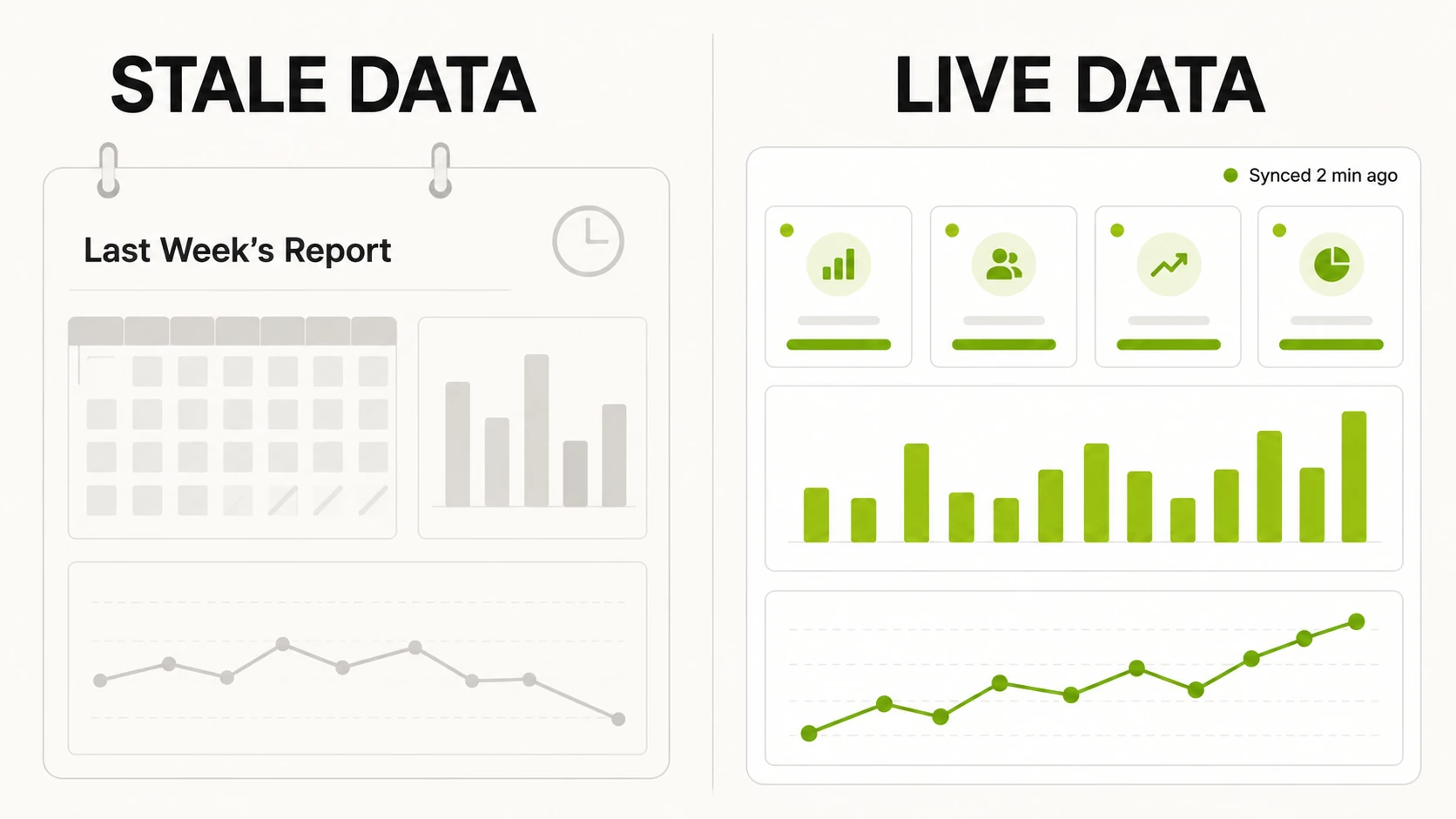
The practical test: ask what happens at the handoff points. Does the generation tool’s output flow into your execution tooling without manual re-upload? Does your automation layer feed clean performance data into whatever you use for optimization? If every handoff between layers involves exporting a file and re-uploading it somewhere else, you don’t have a stack, you have three disconnected tools that happen to touch the same campaigns. Our ad management tool buying checklist covers this handoff test in more depth if you’re evaluating a specific vendor right now.
Is “generative AI advertising” the same as an “AI advertising tool”?
No, generative AI advertising is a subset. It specifically refers to tools using generative models (image, video, text generation) to produce creative and copy. It’s the generation category described above. Automation and optimization tools may use AI/ML techniques internally (pattern detection, anomaly flagging, rule-based decisioning), but they’re not “generative” in the sense of creating new creative assets. If a vendor pitch uses “generative AI advertising” and “AI advertising tool” interchangeably, ask which one they actually mean, the answer tells you which bottleneck they’re built to solve. For more on evaluating the generation layer specifically, see our ad design tool guide.

FAQ
What’s the difference between a Facebook ads AI tool and a general AI advertising tool?
A Facebook ads AI tool is typically scoped to one platform’s ad system, creative formats, campaign structure, and delivery rules specific to Meta. A general AI advertising tool may span multiple platforms (Meta, TikTok, and others) for one or more of the three layers, generation, automation, or optimization. If you run cross-platform, check whether a “Facebook ads AI tool” claim extends to your other channels or is Meta-only with a broader name attached.
Are AI-generated Facebook ads actually ready to publish, or do they need editing?
It depends on the tool and the ad type. Product-catalogue-driven generation (turning SKU data into ad creative) tends to be closer to publish-ready because the inputs are structured. Brand or concept-driven generation usually benefits from a review pass, treat AI-generated output as a strong first draft, not a final asset, until you’ve validated it against your brand guidelines and platform policy requirements.
Can an optimization tool replace a media buyer?
No, not if it’s a recommendation-only tool, and most are, deliberately, because unsupervised auto-execution on live ad spend carries real budget risk. A recommendation-only optimization tool changes the media buyer’s job from manually digging through reports to reviewing and approving flagged changes faster. That’s a workflow improvement, not a headcount replacement, and any vendor claiming otherwise should be asked exactly what it auto-executes and under what guardrails.
How many AI advertising tools does an agency actually need?
There’s no fixed number, it depends on where your bottlenecks are. An agency with strong in-house design but slow campaign launches needs automation more than generation. An agency drowning in manual creative requests needs generation first. Audit your actual constraint before adding tools; stacking three tools that all target the same layer doesn’t fix a gap in a different layer.
Do automation tools work the same way across Meta, TikTok, and other platforms?
Not necessarily, automation logic (rules, thresholds, campaign structures) has to account for each platform’s own campaign architecture and API constraints. A tool that automates well on one platform doesn’t automatically automate well on another; check platform coverage and reporting sync frequency (e.g., near-real-time vs. daily) as part of evaluation, not as an assumption.
What should I check before buying any “AI advertising tool,” regardless of category?
Ask three questions: which of the three layers (generation, automation, optimization) does this actually address; does it integrate cleanly with the layers you already have; and for anything that touches live spend, is there an audit trail for what it changed and when. A tool that can’t answer the audit-trail question clearly is a risk on any account with real budget behind it.
Closing
Buying “AI advertising tools” without naming which layer you’re solving for is how teams end up with overlapping subscriptions and an unsolved bottleneck. Diagnose the constraint first, production, execution, or decision-making, then buy against it. FabFunnel covers generation (Genie), automation (Bulk Campaign Launcher, Automation Rules Engine), and recommendation-based optimization (Co-Pilot) as connected layers rather than a single bolted-together feature list; if you’re mapping your own stack against these three categories, that’s a reasonable structure to evaluate any vendor against, including us.