Most people who start exploring AI for sales and marketing run into the same problem. There’s no shortage of tools – there are hundreds of them. What’s missing is a clear picture of what AI actually does in a sales and marketing context versus what it gets credit for.
This guide is for teams that are newer to this space: what artificial intelligence in sales and marketing actually covers, where it delivers real value, where it doesn’t, and how to start without overbuilding a stack you don’t need.
What AI For Sales and Marketing Actually Means
The short version: AI for sales and marketing means using machine learning and automation to handle decisions and tasks that previously required manual effort – at a speed and scale that a human team can’t match alone.
That breaks down into a few distinct areas. On the marketing side: audience segmentation, ad creative generation, campaign optimization, content production, and performance analysis. On the sales side: lead scoring, outreach personalization, pipeline forecasting, and follow-up sequencing.
The reason these get grouped together is that the handoff between marketing and sales is where most revenue leaks. Marketing generates leads that sales doesn’t follow up on fast enough. Sales complains about lead quality. AI for sales and marketing addresses both sides of that gap – it helps marketing send better-qualified leads and helps sales act on them faster.
That said, the tools that handle marketing functions and the tools that handle sales functions are usually different products. “AI for sales and marketing” is a category description, not a single platform.
Where AI Delivers Real Value in Sales and Marketing
1. Lead Scoring and Prioritization
Not every lead in your CRM deserves the same amount of attention right now. The problem is figuring out which ones do – and doing it fast enough that by the time your rep reaches out, the lead is still warm.
AI lead scoring looks at behavioral signals – pages visited, emails opened, content downloaded, time on site – and assigns a score that predicts conversion likelihood. Instead of reps working through a list in order of when the lead came in, they work it in order of who’s most likely to buy. Response times drop. Conversion rates go up.
The caveat: AI lead scoring is only as good as your CRM data. If your data is messy – inconsistent contact records, missing company fields, poor activity tracking – the model has nothing reliable to learn from.
2. Personalized Outreach at Scale
Writing a genuinely personalized email to a hundred prospects takes hours. Sales AI tools now handle the first draft: pulling company-specific context, inserting relevant pain points based on industry, and generating a message that doesn’t read like a template – at volume.
The best use here is the same as with any AI writing tool: AI draft, human review, human send. The AI handles the volume problem. The human handles the judgment problem – whether the message actually makes sense for this specific person.
What breaks this: over-relying on the AI draft without review. Outreach that’s personalized to the wrong pain point is worse than generic outreach. It signals that you didn’t do your homework.
3. Ad Campaign Creation and Optimization
For the marketing side, this is where AI for sales and marketing tends to deliver the most immediate, measurable ROI.
AI-powered ad platforms let teams generate multiple creative variants – copy, visuals, hooks – test them in parallel, and automatically shift budget toward what’s working. What used to take a designer, a copywriter, and a campaign manager working across multiple tools now happens in a single workflow.
Platforms like FabFunnel take this further for teams running high-volume paid campaigns: bulk campaign launch across Meta, TikTok, and NewsBreak, with automated rules that pause underperformers and scale winners around the clock. For performance marketers, this compresses the time between “creative concept” and “campaign live” from days to minutes.
4. Pipeline Forecasting
Sales forecasting is traditionally a combination of rep judgment, deal stage weighting, and managerial intuition. It’s also notoriously inaccurate. Deals that look close slip. Deals that weren’t on the radar close fast.
AI tools look at past deals – how fast they moved, how engaged buyers were, what won or lost – to tell you how healthy your pipeline looks. It’s still a prediction, not a promise. But it’s more accurate than gut feel, and it surfaces risk earlier.
This is more relevant for teams with enough pipeline history for the model to learn from. If you’ve closed fewer than a few hundred deals, you may not have enough data to make the model useful.
5. Content and SEO at Scale
Marketing teams are constantly behind on content. Blog posts, landing pages, email sequences, social posts – the demand outpaces what a small team can produce manually.
AI for marketing and sales content handles the volume layer: generating first drafts, repurposing long-form content into shorter formats, producing variations for different audience segments. The editorial layer – voice, accuracy, brand judgment – still needs a human.
The compounding benefit here is SEO. More content, published consistently, on topics your audience is searching for, builds organic traffic over time. AI doesn’t write great content on its own. But it helps teams publish more of the decent-to-good content that compounds.
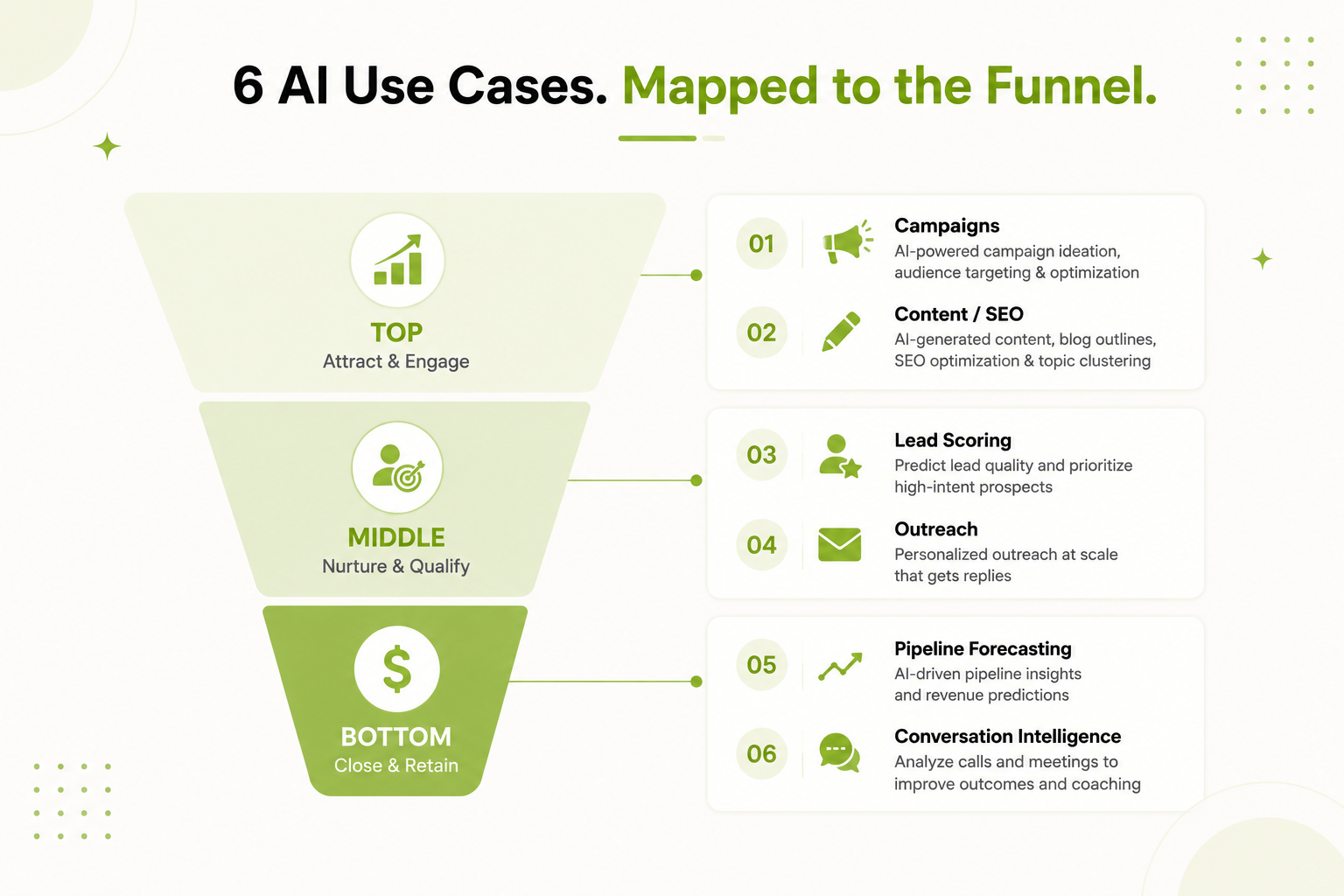
6. Customer Conversation Intelligence
Sales calls contain a lot of signal that most teams never capture. Who talked more – the rep or the prospect? Which objections came up? What questions did the prospect ask that the rep couldn’t answer?
Conversation intelligence tools – Gong, Chorus, and similar – record and analyze sales calls, flag patterns across the team, and surface coaching opportunities. A rep who consistently loses deals at the pricing conversation gets flagged. The team finds out before the next quarter’s numbers come in.
This is one of the more underutilized applications of artificial intelligence in sales and marketing. The data is already there – every call, every demo, every discovery – and most teams don’t use it for anything beyond notes.
Where AI For Sales and Marketing Doesn’t Work
A few honest caveats before you start building a stack:
AI doesn’t fix a broken sales process. If your reps don’t follow up consistently, if your ICP isn’t defined, if your messaging doesn’t resonate – AI amplifies those problems. It doesn’t solve them. Fix the process first, then automate it.
AI doesn’t replace relationship-building. The parts of sales that actually close enterprise deals – trust, negotiation, understanding a prospect’s internal politics – are not automated. Sales AI handles the top of the funnel and the operational layer. The human element is still what converts at the bottom.
Most tools require clean data to work well. CRM hygiene isn’t exciting. It’s also not optional if you want lead scoring, forecasting, or personalization to function properly. Bad inputs produce bad outputs regardless of how sophisticated the AI layer is.
How to Start: A Simple Framework
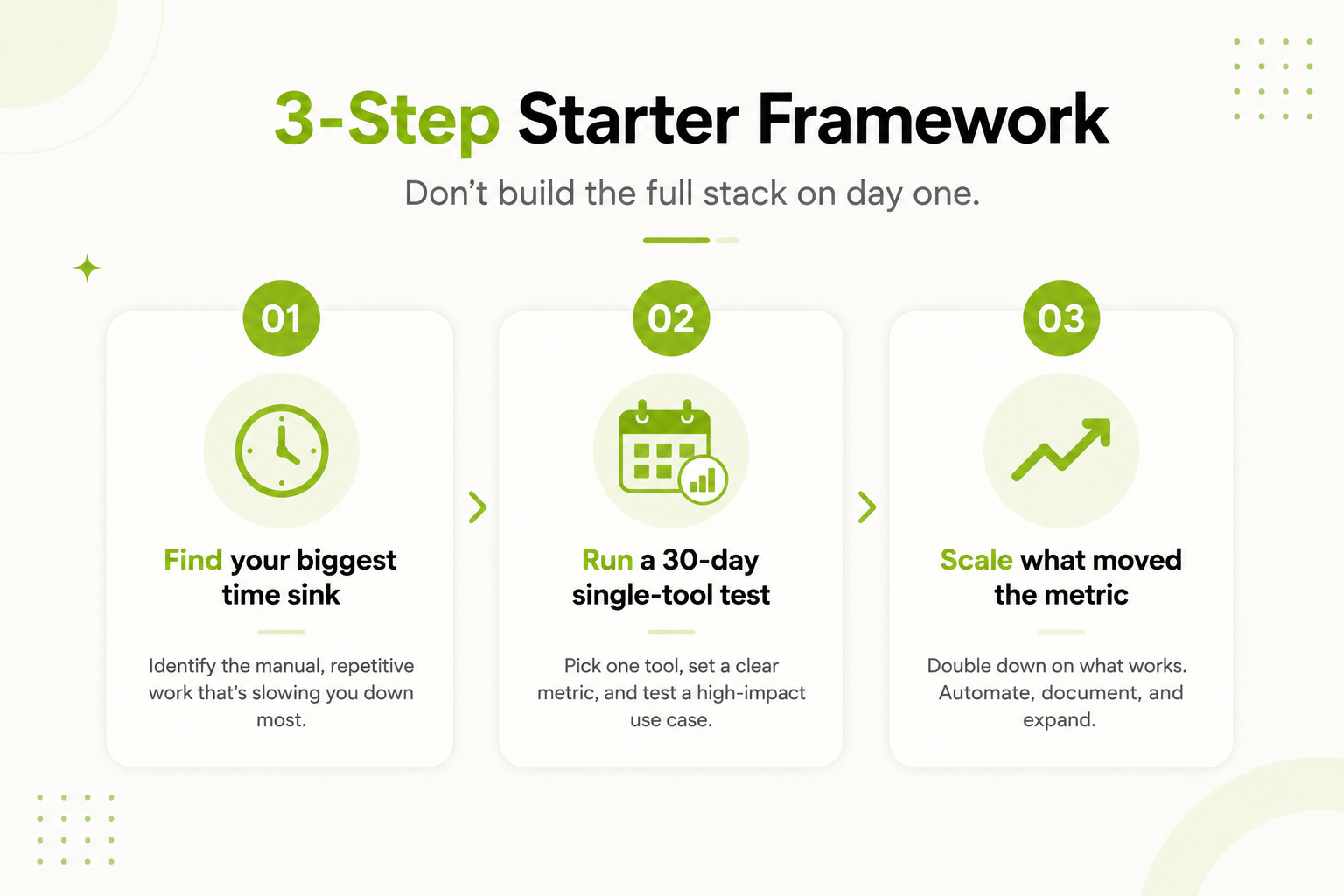
If you’re new to AI for sales and marketing, don’t try to implement everything at once. Pick one problem, solve it, measure it, then expand.
Start with your biggest time sink. Is it campaign creation and monitoring? Lead follow-up? Content production? The tool that removes the most wasted hours has the highest return. Everything else is optimization.
Run a 30-day test on one tool. Pick a single metric to move – response time, cost per lead, campaign launch time – and measure it before and after. If it moves, expand. If it doesn’t, cut it.
Don’t automate what doesn’t work manually. A broken email sequence, automated, sends broken emails faster. A weak ad creative, bulk-launched, wastes budget at scale. The fundamentals have to work before automation adds value.
The Takeaway: Start Small, Measure Honestly, Scale What Works
AI for sales and marketing is not a single purchase or a one-time implementation. It’s a set of capabilities you add to your existing process over time, in the places where they remove the most friction.
The teams getting the most out of AI for sales and marketing in 2026 aren’t the ones who bought the most tools. They’re the ones who implemented fewer tools more carefully, measured what changed, and scaled from there.
Start with one problem. Solve it. Then move to the next one.
Read Also – AI + Email Marketing: Trends You Can’t Ignore In 2026
Frequently Asked Questions
What is AI for sales and marketing?
AI for sales and marketing is simply software that uses machine learning to do the math behind lead scoring, campaign tweaks, outreach timing, revenue predictions, and content assembly.
How is artificial intelligence used in sales and marketing?
Common applications include: AI lead scoring to prioritize prospects by conversion likelihood, personalized outreach generation at volume, automated ad campaign creation and optimization, predictive pipeline forecasting, conversation intelligence on sales calls, and AI-assisted content and SEO production.
What’s the difference between AI for sales vs. AI for marketing?
Marketing AI typically handles top-of-funnel: campaign creation, audience targeting, content generation, ad optimization. Sales AI handles mid-to-bottom funnel: lead scoring, outreach sequencing, pipeline forecasting, and call analysis. The two overlap at the lead handoff point, which is where most revenue is lost if the integration is weak.
Do small teams benefit from AI for sales and marketing?
Yes, often more than large teams. A small marketing team running on AI doesn’t just keep up with the giants; it outperforms them. Campaigns at scale, budgets that punch harder, and results that speak volumes.
What’s the biggest mistake teams make when adopting sales and marketing AI?
Buying too many tools before validating one. Most teams overestimate how quickly they’ll adopt new tools and underestimate how much process change is required. Start with one tool, one problem, one metric. Prove value before expanding the stack.
How much does AI for sales and marketing cost?
It varies widely. Pricing varies by platform and use case. Mid-market platforms with full automation and reporting typically run from a few hundred to a few thousand per month. Enterprise solutions are custom-priced. The ROI question is whether the time or cost saved exceeds the subscription cost.