Email has been declared dead more times than any other marketing channel. It never actually dies. What changes is what separates the campaigns that perform from the ones that get ignored – and right now, that line runs through AI.
Not AI as a buzzword. AI as a set of specific capabilities that email tools have quietly baked in over the last two years: better send-time prediction, smarter segmentation, copy generation that goes beyond subject line templates. These aren’t the same as having a chatbot write your newsletter. They’re structural changes to how campaigns get built and optimized.
This article covers the AI in email marketing trends worth paying attention to in 2026 – and more importantly, how to tell which ones are actually moving the needle versus which ones just look good on a product landing page.
Why AI in Email Marketing Is Actually Different Now
For a long time, AI in email marketing meant one of two things: send-time optimization (which tool sends at the hour a recipient historically opens) or subject line A/B testing. Both are useful. Neither transformative.
What’s changed is depth. AI in email marketing now operates across more of the campaign lifecycle – from audience segmentation to content generation to post-send analysis. The difference between 2022 and 2026 isn’t a single capability. It’s how many separate decisions that used to require human judgment now have a reasonable automated default.
That said, “AI-powered” still gets slapped on features that are just rule-based logic with a nicer UI. The useful distinction is whether the tool adapts to new data or just executes a fixed set of conditions. The former is worth paying attention to. The latter is just automation with better branding.
The AI Email Marketing Trends That Actually Matter in 2026
1. Predictive Segmentation That Updates Itself
Traditional segmentation is static. You define a segment – subscribers who purchased in the last 90 days, leads from a specific campaign – and it stays that way until someone updates it.
Predictive segmentation uses behavioral data to move subscribers between groups continuously. Someone who opened every email for six months and then went quiet for three weeks doesn’t stay in the “active” bucket. They get flagged and routed differently – maybe a re-engagement sequence, maybe a sunset campaign – without a human reviewing the list.
The practical value: list hygiene and targeting accuracy improve passively. You’re not doing quarterly audits to clean up stale segments. The model does it as behavior changes.
Where this breaks: if your data inputs are bad – inconsistent UTM tracking, gaps in purchase data, email opens masked by Apple Mail Privacy Protection – the predictions suffer. AI in email marketing is only as good as the signal it’s working from.
2. Hyper-Personalization Beyond First-Name Fields
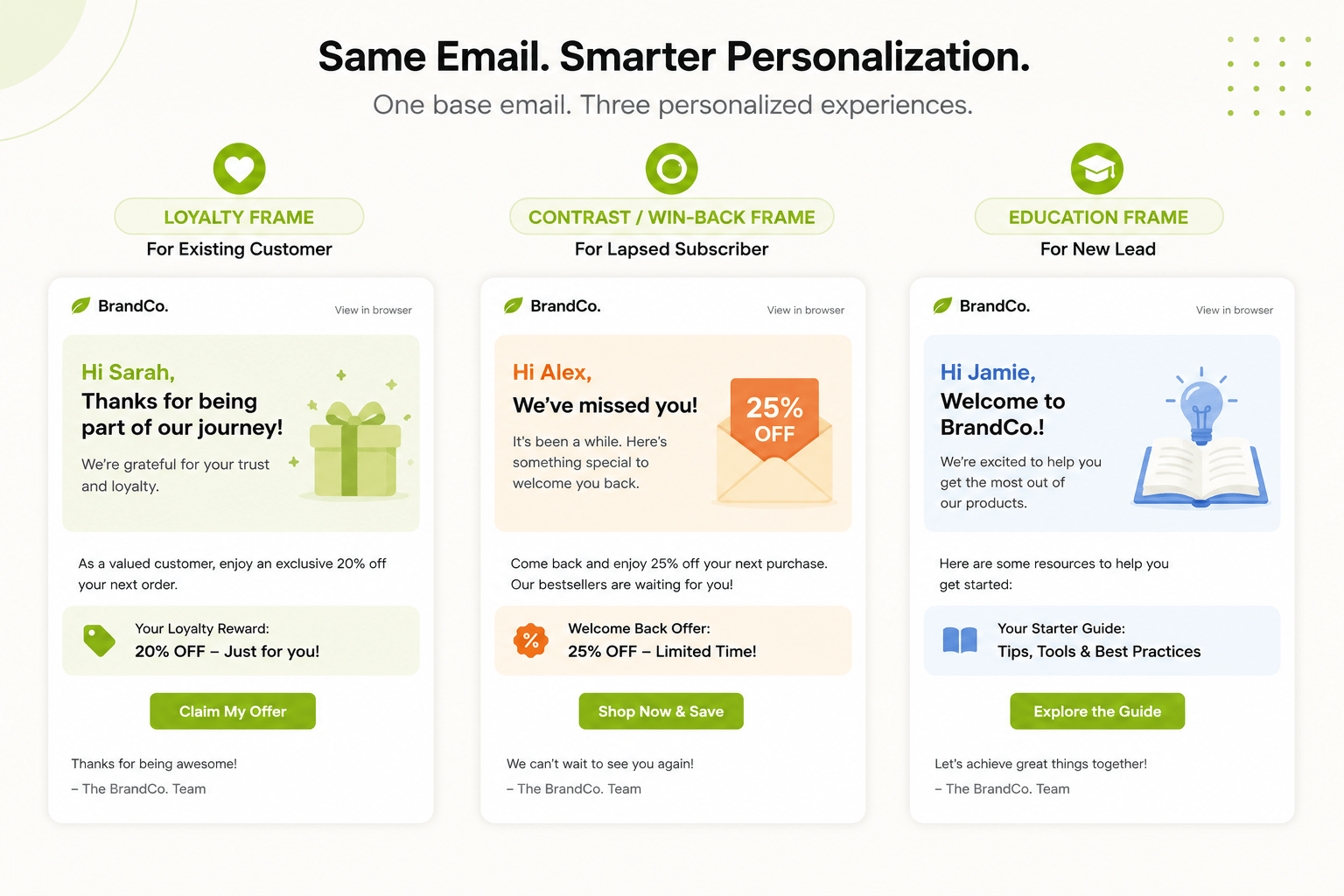
Personalization used to mean “Hi [First Name]” and maybe a product recommendation block. In 2026, AI in email marketing is doing a lot more: adapting the body copy tone based on engagement history, swapping out entire content blocks based on funnel stage, and adjusting offer framing based on what a subscriber has and hasn’t responded to before.
Some platforms now generate fully individualized email variants – not just the subject line, but the structure and angle of the message – based on subscriber profile data. A long-time customer gets a loyalty frame. A lapsed subscriber gets a contrast frame. A new lead gets an education frame.
The ceiling here is still content quality. Personalization at scale only works if the underlying content is worth personalizing. A well-personalized version of a weak email is still a weak email.
3. AI-Generated Email Copy (Used Correctly)
AI email automation tools now generate copy natively – subject lines, preview text, body content. The question isn’t whether the technology works. It’s whether it’s being used in a way that produces better results.
The honest answer: AI-generated copy works best as a starting point, not a final output. A human writer reviewing and editing an AI draft moves faster than writing from scratch. The AI draft gets you 60-70% there. The human edit gets the voice, specificity, and judgment that makes the difference between something that reads well and something that converts.
What doesn’t work: using AI to generate full emails, not reviewing them, and sending at volume. The output tends toward generic. “Generic” in email marketing means low engagement, high unsubscribes, and domain reputation damage if you’re sending it at scale.
4. Behavioral Trigger Sequences That Actually Respond to Behavior
Most trigger sequences are still built on time-based logic: email 1 at day 0, email 2 at day 3, email 3 at day 7. Some have conditional branches – if they clicked, send this; if they didn’t, send that. But most branches stop at one or two levels deep because building more gets complicated fast.
AI-driven email sequences adapt based on the full behavior pattern, not just the last action. A subscriber who opens three emails but never clicks gets a different path than one who clicks but never buys. The sequence responds to what’s actually happening rather than following a fixed decision tree that was accurate when it was built and increasingly wrong as subscriber behavior shifts.
For ecom specifically, this matters a lot in abandoned cart and post-purchase flows. The timing and framing that converts one segment can actively suppress another. AI email automation that adapts to those differences without requiring manual rebuild delivers compounding gains over time.
5. Deliverability Intelligence
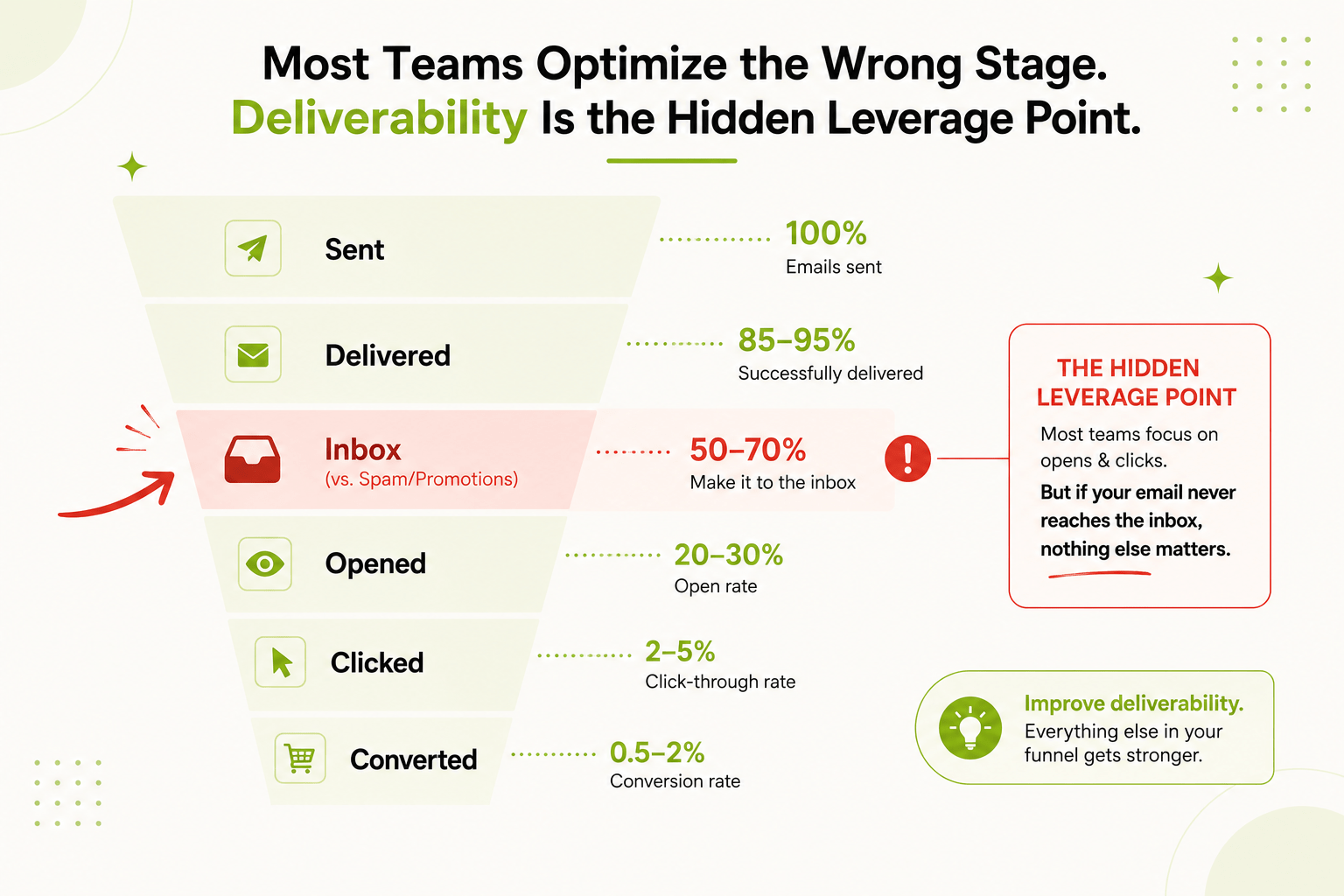
This one gets less attention than it deserves. Getting into the inbox isn’t purely a sending reputation issue. It’s increasingly a content and engagement signal issue. Gmail and Outlook use engagement data – opens, replies, moves-to-inbox – to determine whether future emails from a sender belong in primary, promotions, or spam.
AI in email marketing is now building deliverability intelligence into the sending layer: suppressing sends to disengaged segments before they hurt your reputation, flagging content patterns that correlate with promotions tab placement, and adjusting sending cadence based on individual recipient engagement windows.
This is one of the more consequential applications of AI in email marketing because deliverability problems compound. A sender who lands in spam 20% of the time doesn’t see 20% worse results – they see dramatically worse results because the engaged portion of their list starts missing emails too.
6. Smarter A/B Testing and Multivariate Optimization
Traditional A/B testing splits a list, waits for statistical significance, picks a winner, and sends the rest. That works. It’s also slow, and the winning variant is usually optimized for the aggregate, not for specific segments within your list.
AI-driven multivariate testing runs more variations simultaneously, reaches significance faster by routing traffic dynamically, and identifies which variants perform best for which audience segments – not just overall. A subject line that wins for new subscribers might underperform for long-term customers.
The compound benefit: every campaign produces learning that improves the next one, rather than a binary win/lose that gets applied uniformly and forgotten.
What to Actually Do With This in 2026
A few practical filters before adding AI in email marketing capabilities to your stack:
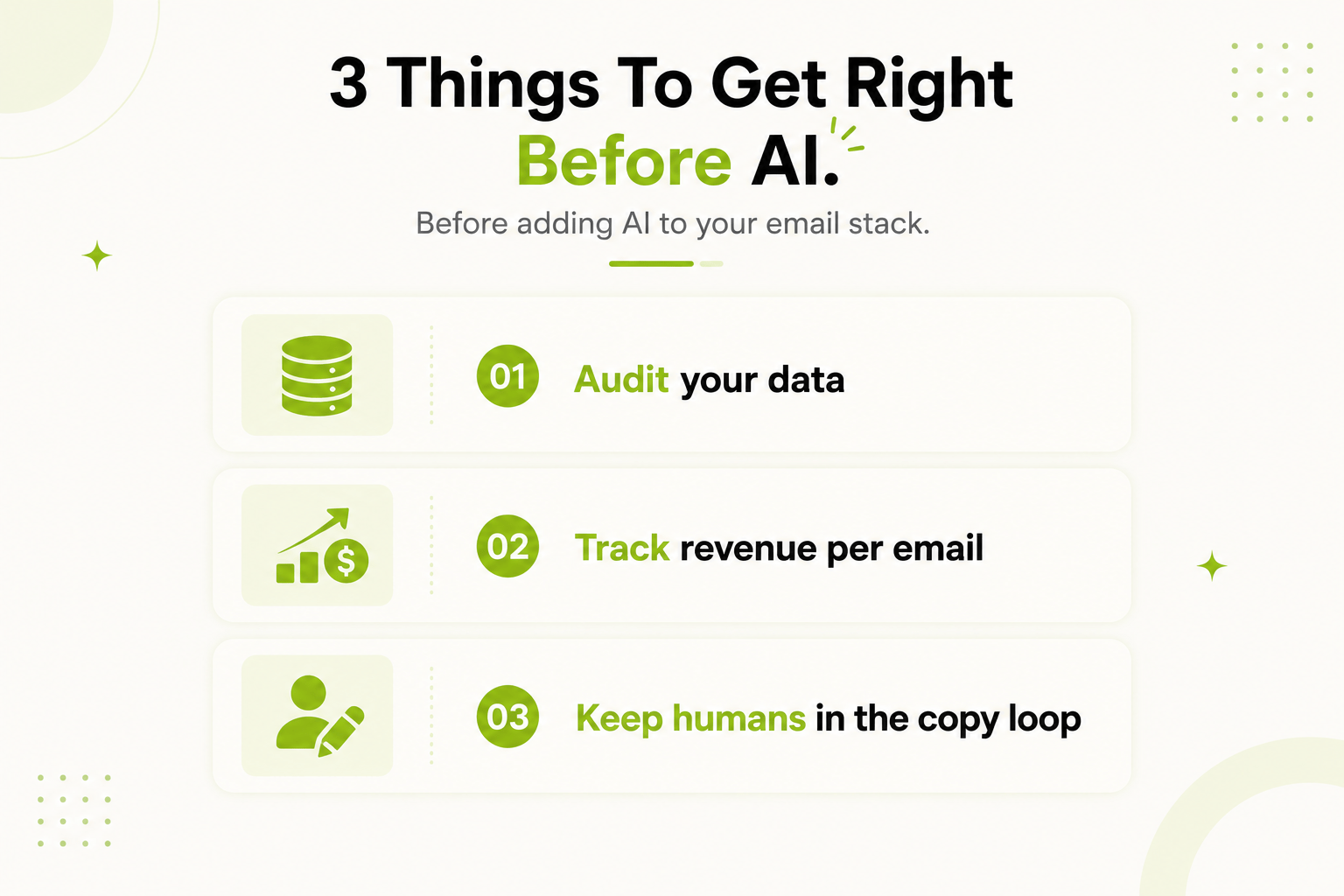
Audit your data first. Predictive segmentation and behavioral personalization are only as good as your subscriber data. If your CRM is inconsistent, your purchase data has gaps, or you’ve never cleaned your list, fix that before investing in AI features that depend on clean inputs.
Revenue per email is the metric. Open rates are increasingly unreliable post-MPP. Click rates tell you about content relevance but not conversion. The metric that matters is revenue per email sent – and if an AI email marketing tool isn’t moving that, it’s not working regardless of what the engagement dashboard shows.
Keep a human in the copy loop. AI email automation handles sequencing, timing, and optimization well. It handles voice and brand-specific nuance poorly. The teams getting the most from AI in email marketing are using it to handle the operational layer while keeping editorial judgment on the content itself.
The Takeaway: Email Is Still the Highest-ROI Channel. AI Is Widening That Gap.
Email marketing still returns more per dollar spent than most other channels. The gap between teams using AI in email marketing well and those still running manual sends is widening – not because AI is magic, but because the operational leverage compounds. Better segmentation means more relevant sends. More relevant sends mean better engagement. Better engagement means better deliverability. And better deliverability means more of your sends actually land.
The teams ignoring AI in email marketing in 2026 aren’t just missing a feature. They’re ceding the compounding advantage to the ones who aren’t.
Frequently Asked Questions
What is AI in email marketing?
AI in email marketing refers to tools and capabilities that use machine learning to automate and optimize campaign decisions – segmentation, send timing, content personalization, deliverability management, and performance analysis – without requiring manual intervention per decision.
How is AI email automation different from regular email automation?
Regular automation is simple: if a subscriber does X, you send Y. No changes. AI automation is different: it studies behavior, then changes timing, content, and routing to fit each person – no fixed sequence required.
Which AI email marketing tools are worth using in 2026?
Your best AI email tool depends on what you need. Ecommerce? Klaviyo. B2B sequences? ActiveCampaign. Cold outreach at scale? Instantly.ai. Deep personalization? Iterable or Braze. Figure out your biggest problem – creation, segmentation, or optimization – and pick the tool that solves it.
Does AI-generated email copy actually work?
As a starting point, yes. As a finished product sent without review, usually no. The best use is AI draft, human edit – it speeds up production without sacrificing the quality that drives engagement.
How does AI improve email deliverability?
By suppressing sends to disengaged subscribers before they hurt sender reputation, identifying content patterns that correlate with spam placement, and optimizing send cadence to individual engagement windows. All of this reduces the signals that inbox providers use to route you away from primary.
What metrics should I track to measure AI email marketing performance?
Revenue per email sent is the most honest signal. Click-to-open rate tells you about content relevance. List growth rate and unsubscribe rate tell you about list health. Open rate is unreliable post-MPP for accurate measurement but still useful as a directional indicator.