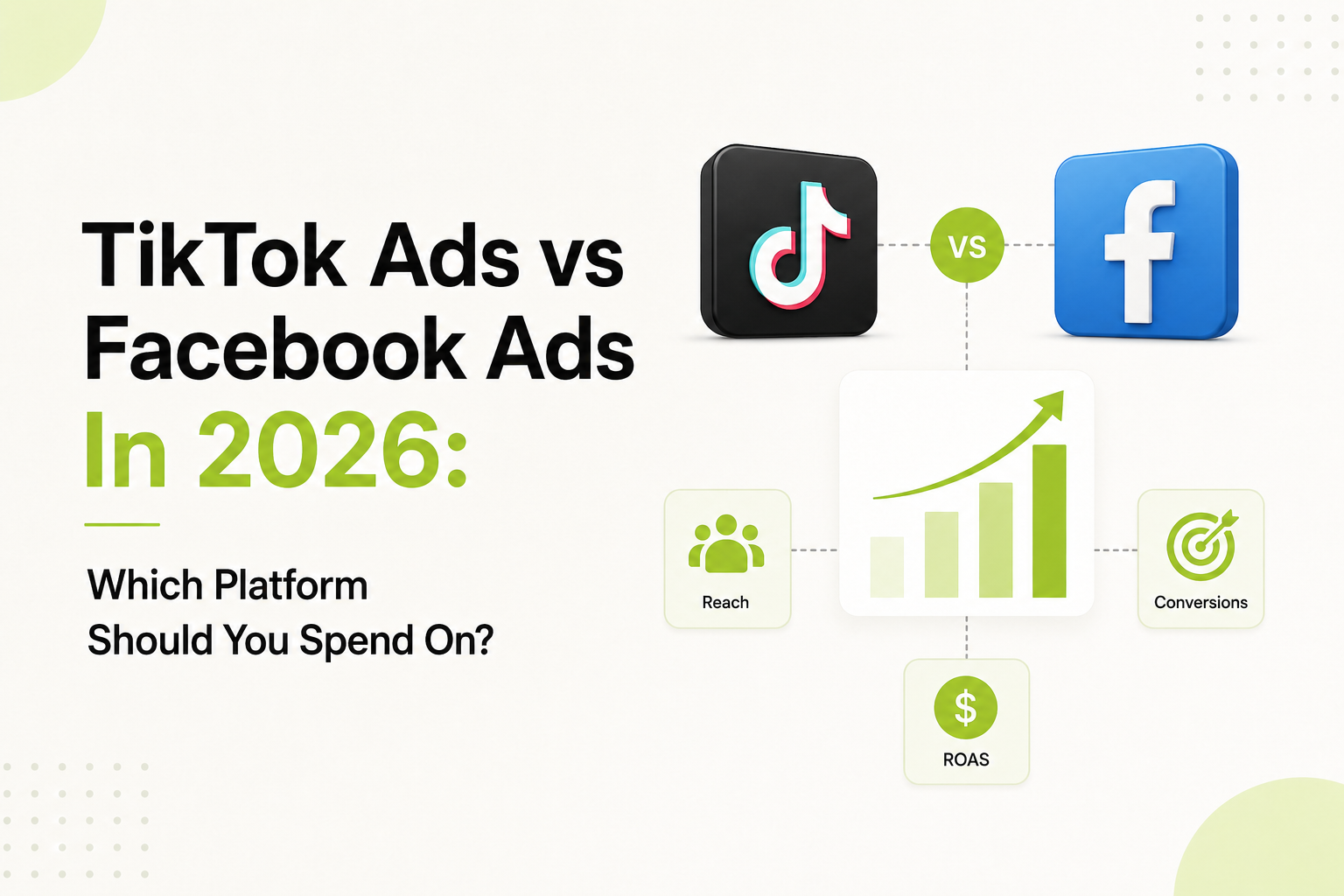
The TikTok Ads vs Facebook Ads debate misses the real question.
It’s not which platform is better. It’s which platform is better for your objective – and whether your team can actually execute on both without accumulating what performance teams increasingly call operational ad debt: the backlog of campaign builds, creative briefs, and budget adjustments that pile up when you’re managing two distinct ad ecosystems simultaneously.
A creative team producing static placements for Meta and native UGC for TikTok simultaneously is effectively running two separate ad operations. Different brief formats, different aspect ratios, different hooks, different performance benchmarks. That’s before the campaign management overhead even starts.
In 2026, most performance advertisers aren’t choosing between the two platforms. They’re running both and trying to solve the TikTok Ads vs Facebook Ads execution problem – not the strategy problem.
This article breaks down the TikTok Ads vs Facebook Ads decision – costs, audience reach, creative requirements, performance by objective – and addresses the operational question most comparison articles skip entirely.
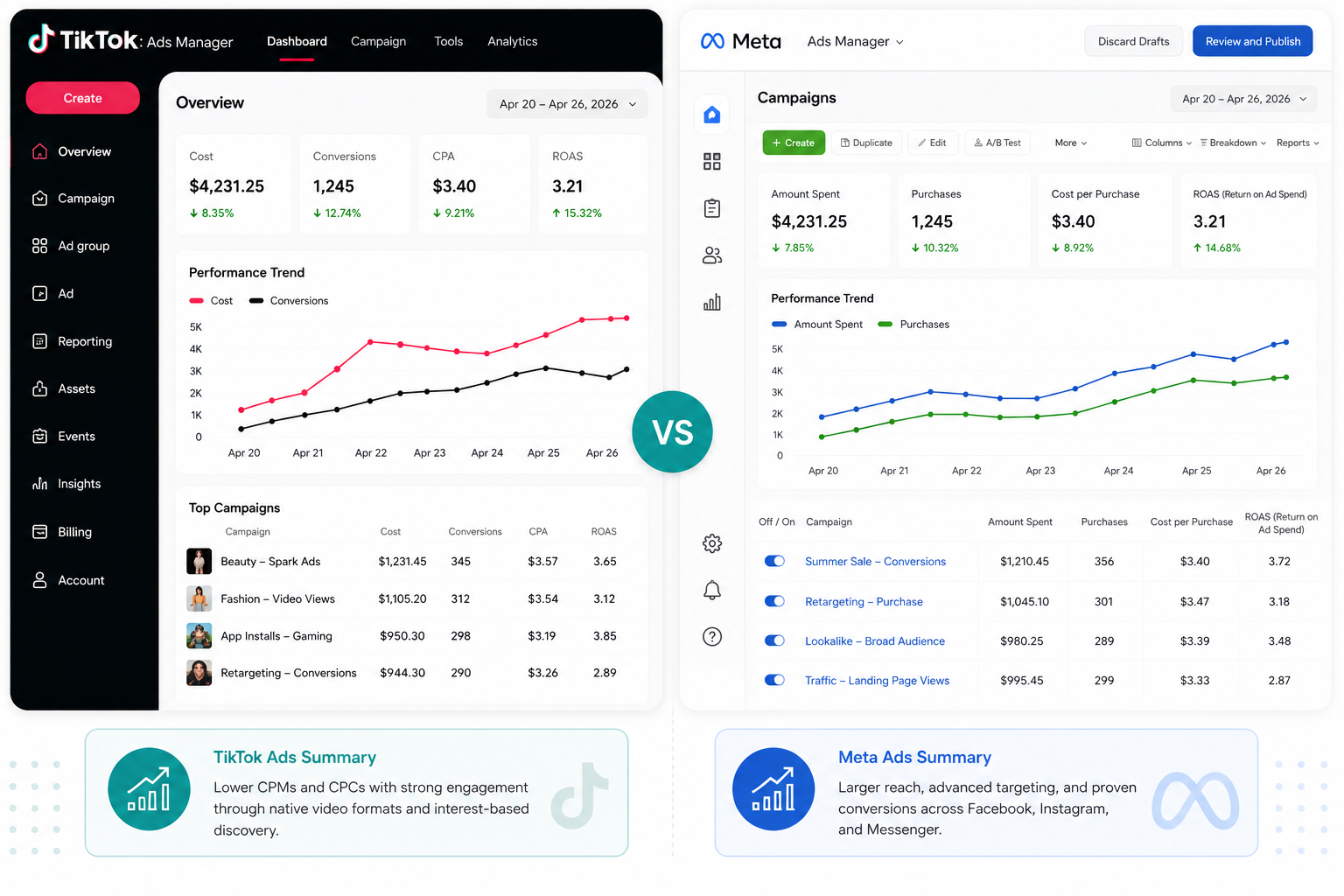
TikTok Ads vs Facebook Ads: Platform Snapshot In 2026
Before the TikTok Ads vs Facebook Ads head-to-head breakdown, here’s where each platform stands.
Facebook / Meta Ads remains the largest paid social advertising ecosystem. Meta’s targeting infrastructure is built on over a decade of behavioral and interest data across Facebook, Instagram, and Messenger. Audience size, demographic breadth, and targeting precision are unmatched. The conversion data pipeline – especially with the Conversions API – is the most mature in the industry.
TikTok Ads has crossed from “emerging platform” into a mainstream performance channel. Its strength is attention: native video format, high engagement rates, and an algorithm that surfaces content based on interest rather than social graph. TikTok’s audience has broadened significantly since 2022 – the platform is no longer exclusively Gen Z.
Both platforms offer full-funnel campaign types: awareness, traffic, engagement, lead generation, and conversion. The differences that matter are in cost structure, creative requirements, and where each platform tends to outperform.
Is TikTok Ads Cheaper Than Facebook?
This is the most common comparison question – and the answer requires nuance.
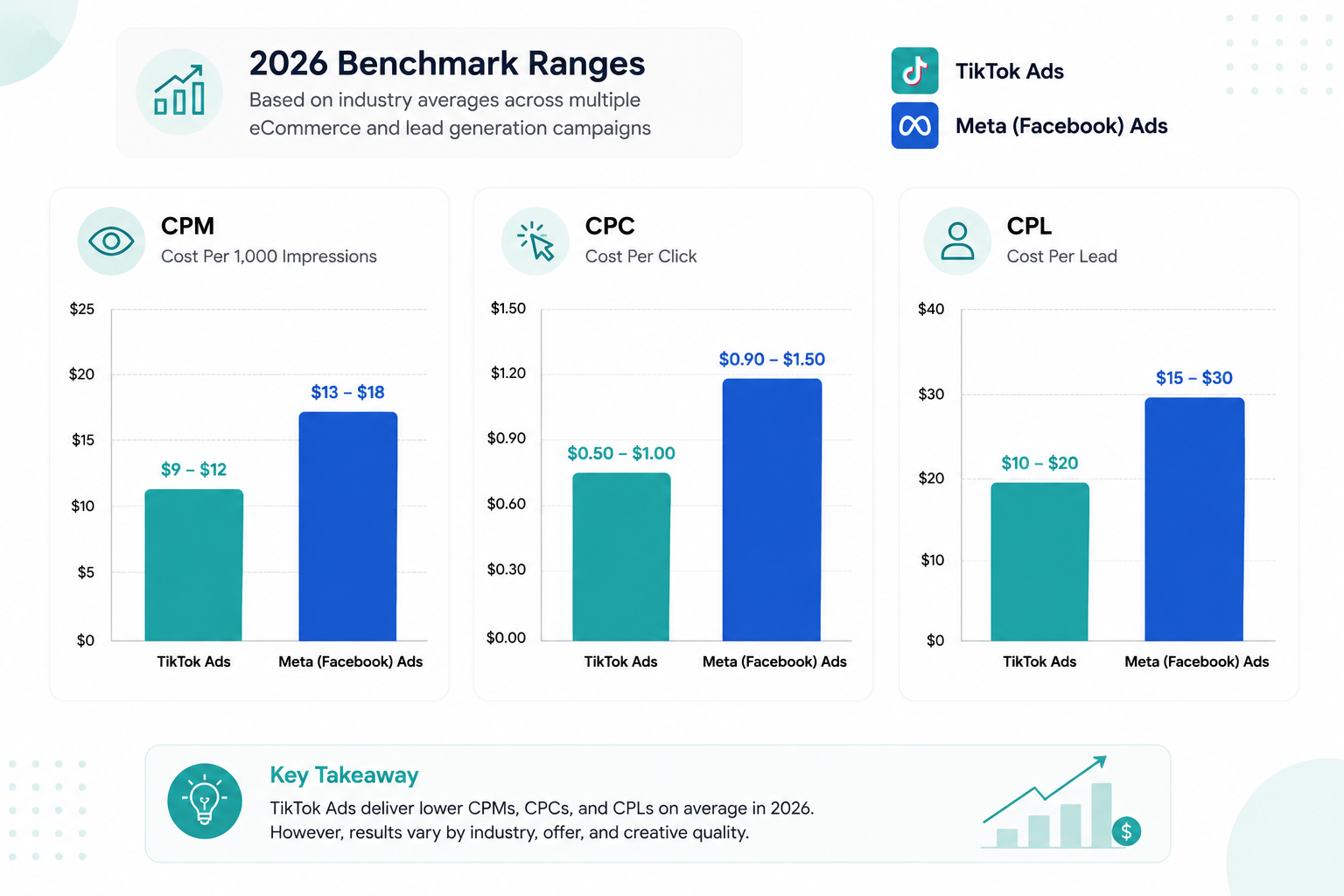
CPM Comparison (2026 averages)
| Metric | TikTok Ads | Facebook Ads |
| Average CPM | $9–$12 | $13–$18 |
| Average CPC | $0.50–$1.00 | $0.90–$1.50 |
| Average CPL (lead gen) | $10–$20 | $15–$30 |
| Learning phase minimum | ~$50/day/ad group | ~$50/day/ad set |
On raw CPM, TikTok Ads is generally cheaper than Facebook. But cheaper impressions don’t automatically translate to cheaper conversions.
TikTok’s lower CPM comes with a trade-off: the creative has to work harder. TikTok’s algorithm is less forgiving of weak creative – a poorly executed video gets deprioritized quickly. On Meta, strong targeting can compensate for average creative to a degree. On TikTok, creative is the primary lever.
The more accurate framing: TikTok Ads or Facebook Ads isn’t a cost question – it’s a cost-per-outcome question. And cost-per-outcome depends heavily on creative quality, product category, and audience fit.
Audience Reach: Where Each Platform Wins
Facebook Ads advantages
- Broader age demographic reach – strong 35–65+ coverage that TikTok hasn’t replicated
- More granular interest and behavioral targeting built on longer data history
- Better for B2B adjacent audiences through interest stacking and lookalikes
- Instagram placement adds visual-first inventory without a separate campaign build
TikTok Ads advantages
- Higher organic engagement rates – content from ads surfaces more naturally in-feed
- Stronger 18–34 density, particularly for lifestyle, fashion, beauty, and consumer products
- Interest-based discovery algorithm surfaces ads to users who haven’t engaged with your brand
- Sound-on environment creates stronger creative recall than silent-scroll Meta placements
Neither platform “wins” on audience. They reach overlapping but meaningfully different user behaviors – even when the demographic is the same person. Someone on TikTok at 8pm and on Instagram at noon is in a different intent state.
Creative Requirements: The Biggest Operational Difference
This is where the TikTok Ads vs Facebook Ads comparison stops being a budget question and becomes an execution question.
Meta creative formats
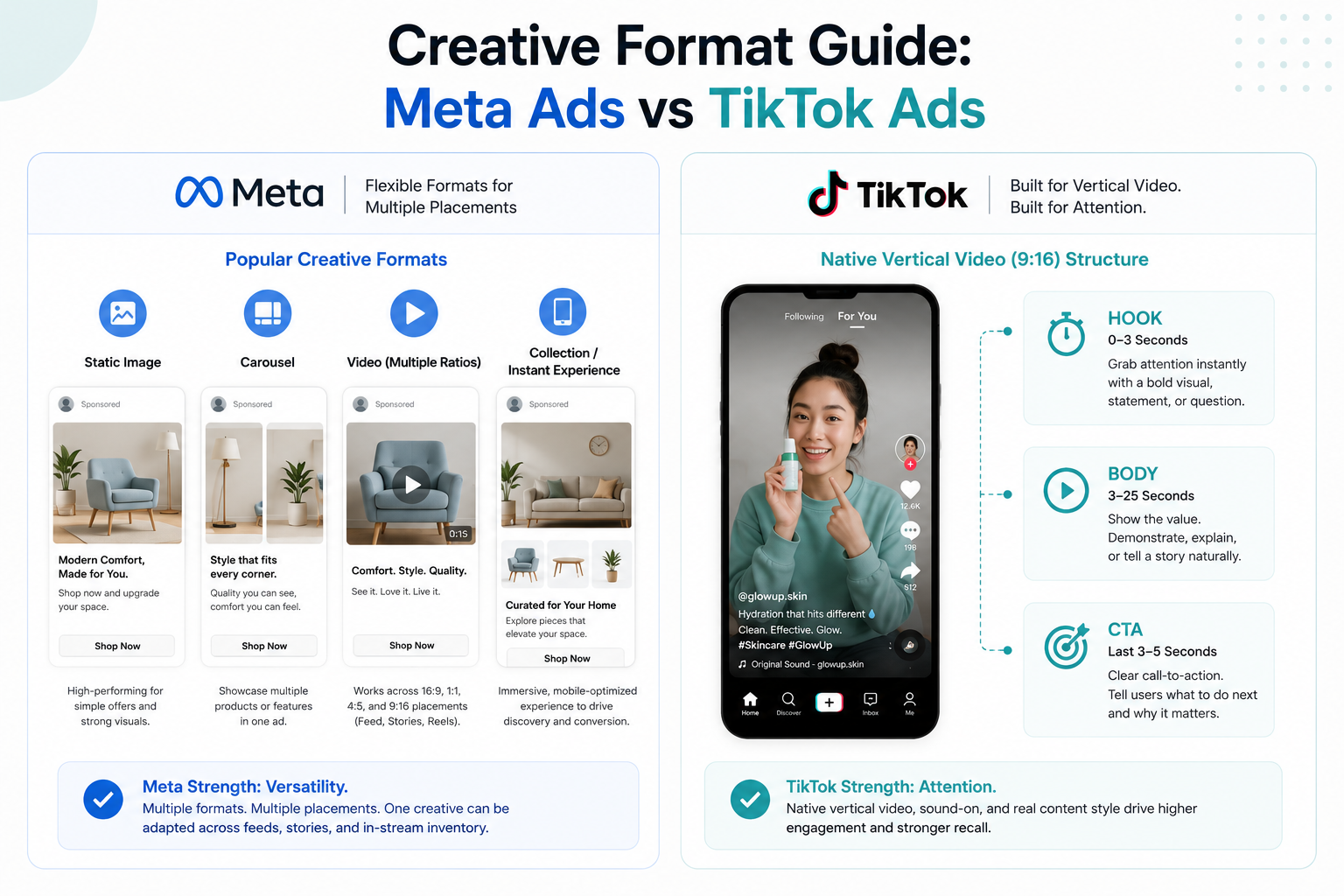
Static image, carousel, video (16:9, 1:1, 4:5, 9:16), collection, instant experience. Static images and carousels still perform strongly across Facebook and Instagram placements. A single video can be reformatted across multiple placements.
TikTok creative requirements
Native vertical video (9:16), sound-on, first 3 seconds must hook, UGC-style or creator-style content performs significantly better than polished brand video. What works on Meta often fails on TikTok because it reads as an ad rather than content.
This is the real overhead in running both platforms simultaneously: you can’t repurpose Meta creative directly to TikTok and expect equivalent performance. TikTok requires creative that feels native to the feed.
Performance by Objective: TikTok vs FB Ads
| Objective | Facebook Ads | TikTok Ads |
| E-commerce / direct purchase | Strong – mature pixel, robust conversion tracking | Growing – best for impulse/lifestyle products |
| Lead generation | Very strong – lead forms + conversion campaigns | Solid – better for younger audiences |
| Brand awareness / reach | Strong – broad demographic reach | Strong – high engagement, sound-on recall |
| App installs | Competitive | Competitive – strong for gaming, consumer apps |
| B2B / high-consideration | Best option – interest stacking, longer consideration | Weaker – shorter content format, younger skew |
| Retargeting | Best option – deepest behavioral data | Limited – smaller retargeting pool for most accounts |
Here’s the strategic framework worth internalizing: TikTok creates demand. Meta monetizes intent.
TikTok surfaces products to people who weren’t looking for them. Its algorithm is a discovery engine – strong for creative discovery, impulse categories, and top-of-funnel reach where the audience doesn’t know your brand yet. Meta’s infrastructure is built around harvesting conversion intent – retargeting warm audiences, closing considered purchases, and optimizing against events that take days or weeks to occur.
Running both in sequence is more effective than either alone. TikTok builds the audience. Meta converts it. The TikTok Ads vs Facebook Ads comparison isn’t really about competition – it’s about funnel position.
The Case For Running Both
The TikTok Ads vs Facebook Ads framing assumes a choice. For most performance advertisers running budgets above $5,000/month, the better question is how to run both without creating a second full workload.
The argument for dual-platform is straightforward: Facebook and TikTok reach the same customer at different points in their day, in different intent states, with different creative that builds brand salience from multiple angles. Sequenced exposure across both platforms consistently outperforms single-platform spend when creative is adapted correctly.
The blocker isn’t strategic. It’s operational. Building, launching, and managing campaigns across two ad managers at any meaningful scale doubles the execution overhead – unless the campaign infrastructure is built to handle it.
The Hidden Cost: Creative Mismatch Tax and Cross-Platform Fatigue
Creative Mismatch Tax
The performance penalty paid when creative built for one platform gets repurposed on another without native adaptation. A polished Meta video running on TikTok doesn’t just underperform – it signals “advertisement” in an environment where native content wins. The CPM may be low, but the conversion rate tanks, and the effective cost-per-acquisition climbs above what a platform-native creative would have delivered. Every repurposed asset carries this tax.
Cross-Platform Fatigue
What happens to teams managing two ad ecosystems without dedicated infrastructure for each. Briefs get written for the wrong format. Campaign structures from Meta get copied to TikTok without adapting to TikTok’s ad group logic. Budget decisions get delayed because the team is stretched across two dashboards. The creative iteration cadence slows. Performance degradation follows – not from bad strategy, but from execution strain.
Platform-native execution is the standard worth targeting: campaigns built from the brief stage for the specific platform’s format, audience behavior, and optimization logic. Not adapted. Not repurposed. Built natively – and launched at speed.
The teams closing the gap between TikTok Ads vs Facebook Ads performance aren’t just better at media buying. They’ve built the operational infrastructure to execute natively on both platforms simultaneously.
How FabFunnel Solves The Dual-Platform Execution Problem
FabFunnel’s Bulk Campaign Launcher is built specifically for this: launching campaigns across Meta and TikTok at scale without proportional operational overhead.
The core capability: 100+ campaigns launched in under 5 minutes. Not through templates that still require individual edits – through a structured launch workflow that applies campaign parameters, audience configurations, and creative assignments in bulk across both platforms simultaneously.
For advertisers running TikTok Ads vs Facebook Ads across multiple accounts, this changes the operational math. What typically takes an ads team hours – duplicating campaign structures, assigning creatives, setting budgets, pushing live – becomes a single workflow that fires across platforms in parallel.
The use case where this matters most: when you’re testing creative across both platforms, you need matching campaign structures and equivalent spend exposure per variant. Manual duplication at that volume is where execution consistency breaks down. Bulk campaign launch maintains structure parity across platforms without manual reconciliation.
TikTok Ads vs Facebook Ads: Decision Framework
Start with Facebook Ads if:
- Your primary conversion event has a long consideration cycle (7+ days to purchase)
- You’re targeting 35+ demographics with high purchase power
- Your creative library is primarily static/carousel format
- You rely heavily on retargeting for conversion volume
- You’re in B2B or high-ticket categories
Start with TikTok Ads if:
- Your product has strong visual appeal and short purchase consideration
- Your audience skews 18–34 and is active on short-form video
- You have (or can produce) native UGC-style video creative
- Your category is lifestyle, fashion, beauty, consumer tech, or food
- CPM efficiency matters more than conversion infrastructure maturity
Run both if:
- Monthly budget exceeds $5,000 and allows meaningful spend on each platform
- You can produce platform-native creative for each (not just repurpose)
- You have infrastructure to manage two campaign environments without diluting execution quality
Common Mistakes In The Facebook Ads vs TikTok Ads Decision
Choosing based on CPM alone
The most common mistake in the TikTok Ads vs Facebook Ads decision: TikTok’s lower CPM matters only if your creative converts. A $10 CPM with a 0.5% conversion rate is more expensive than a $15 CPM with a 1.2% conversion rate.
Repurposing Meta creative directly to TikTok
Polished brand video built for Instagram Feed will underperform on TikTok. The platform rewards native-feeling content. Cross-platform creative strategy requires format adaptation, not just resizing.
Running both platforms at a budget that can’t fund either properly
Splitting $2,000/month between Facebook and TikTok gives you $1,000 on each – often below the threshold required to exit the learning phase and generate statistically meaningful data on either. Concentrate budget until you have a proven structure, then expand.
Measuring TikTok Ads vs Facebook Ads on the same attribution window
TikTok’s purchase intent cycle is typically shorter – users see and buy the same day. Meta often has longer attribution windows. Comparing platform ROAS on identical windows misrepresents actual performance.
Conclusion
In 2026, the bottleneck isn’t media buying knowledge. It’s operational capacity.
TikTok creates demand. Meta monetizes intent. The teams scaling fastest aren’t picking one – they’re executing platform-native campaigns across both without doubling workload or accumulating operational ad debt.
The TikTok Ads vs Facebook Ads question has a clear answer: run both, build natively for each, and solve the execution infrastructure problem before it becomes a performance problem.
If campaign launch speed and cross-platform execution are the constraint – FabFunnel’s Bulk Campaign Launcher is built for exactly this.
Frequently Asked Questions
Q1: Which is better for small budgets – TikTok Ads vs Facebook Ads?
For budgets under $3,000/month, focus on one platform first. Don’t split. Don’t chase CPMs. Your product and audience decide whether TikTok or Facebook wins. Splitting a tiny budget starves both – no data, no optimization. Commit to your audience’s primary platform. Build a structure that works. Then consider the other.
Q2: Is TikTok ads cheaper than Facebook?
On average CPM, yes – TikTok Ads typically runs $9–$12 CPM versus $13–$18 on Facebook in 2026. But cheaper impressions don’t guarantee cheaper conversions. TikTok requires strong native video creative to convert. If your creative isn’t adapted for TikTok’s format, the lower CPM won’t translate to lower cost-per-acquisition.
Q3: Which platform has better targeting – TikTok Ads vs Facebook Ads?
Facebook Ads brings a decade of behavioral and interest data to the table – plus deeper lookalikes and super granular retargeting. TikTok? Solid interest and behavior targeting, but with a much shorter data history. So if you need pinpoint accuracy for conversion campaigns, Meta still takes the crown.
Q4: Can I run the same creative on TikTok and Facebook?
Technically yes, practically no. Facebook supports a wide range of formats – static, carousel, video at multiple aspect ratios. TikTok requires vertical video (9:16) in a native, sound-on, UGC-style format. Creative built for Instagram Feed typically underperforms on TikTok because it reads as an advertisement rather than content. Platform-native creative adaptation is required for both to perform.
Q5: How do I manage TikTok and Facebook campaigns simultaneously without doubling workload?
Use campaign structure parity and bulk launch workflows. FabFunnel’s Bulk Campaign Launcher launches 1000+ campaigns across Meta and TikTok in under 5 minutes. Add automation rules to manage spend – dual-platform management scales easily.
Q6: What’s the best split between TikTok Ads and Facebook Ads budget?
There’s no universal split. Start with 70/30 toward the platform with your proven conversion data, use 30% to build TikTok or Facebook infrastructure with platform-native creative, and let performance.