Most Facebook ad scaling failures follow the same pattern: a campaign is performing, so the budget gets doubled. Performance tanks. The account is now in the learning phase again, and the window is gone.
Facebook ad scaling requires a more deliberate approach – not just more budget, but the right kind of budget movement, at the right time, in the right campaign structure. This guide covers the complete framework: when to scale, how to scale, and how to automate the decisions so you’re not missing windows or reacting late.
Why Most Facebook Ad Scaling Attempts Fail
The core mistake is treating scaling as a budget decision when it’s actually a structural decision.
Facebook’s algorithm needs data to optimize. When you increase a campaign budget dramatically – 50%, 100% at once – the system re-enters a learning phase because it now needs to spend significantly more per day. The audience delivery changes, CPMs shift, and what was a well-optimized ad set is now essentially starting over.
The second mistake is scaling campaigns that aren’t structurally ready. An ad set converting on a small budget with 3–5 conversions per day isn’t statistically proven – it’s a promising signal. Scaling it aggressively before it has enough conversion history compounds variance, not performance.
The third mistake is scaling everything rather than isolating what’s actually driving results. Budget going to ten ad sets where two are carrying the others isn’t scaling – it’s waste.
Understanding these failure modes is the starting point for a Facebook ads scaling strategy that actually holds.
Vertical Scaling vs Horizontal Scaling
The two approaches to scaling Facebook ads are vertical and horizontal. Most teams default to vertical. Most high-performing agencies use both deliberately.
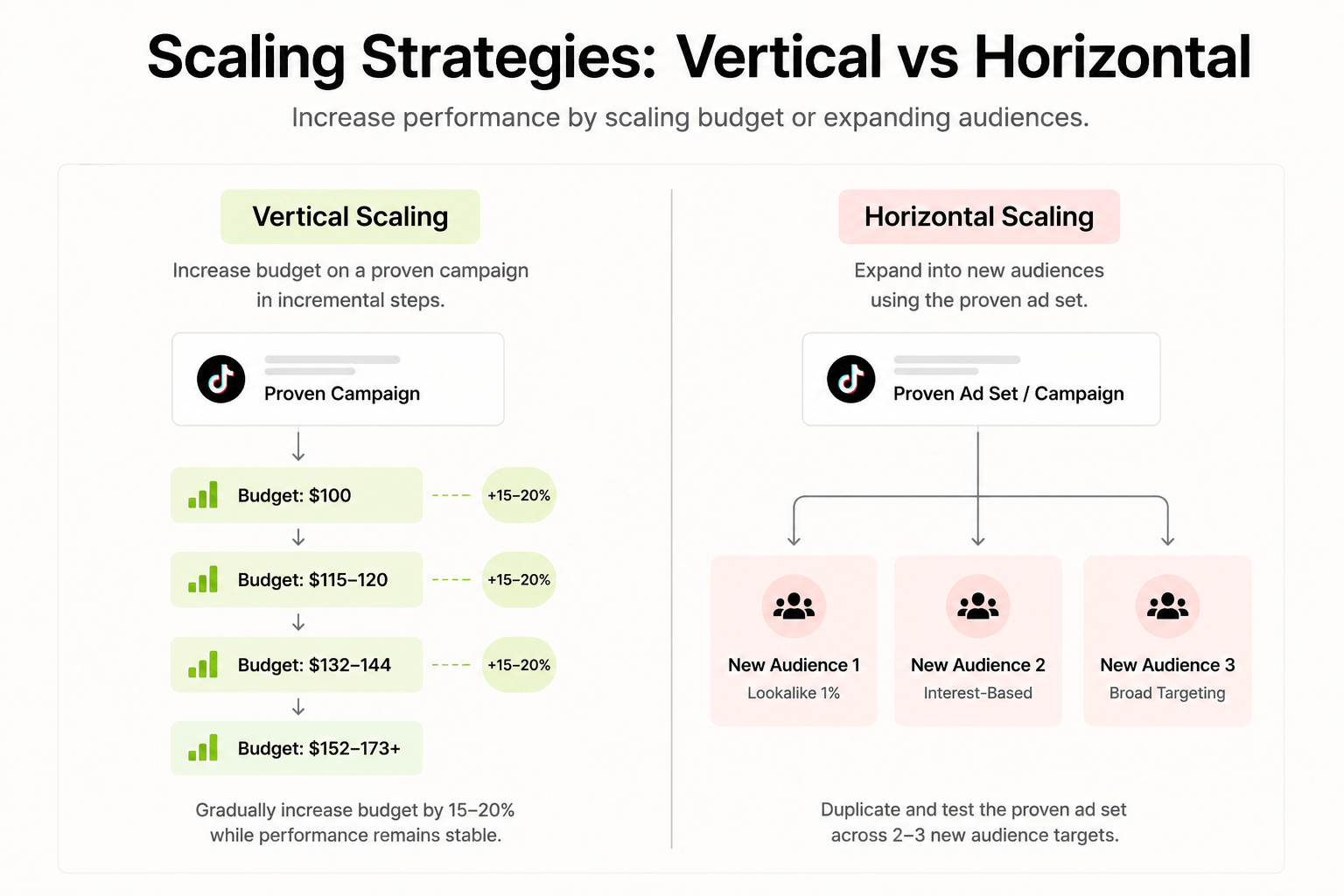
Vertical scaling means increasing the budget on campaigns that are already working. Done right, this looks like incremental increases – 15–20% every 3–5 days on ad sets with consistent conversion data, enough time for the algorithm to absorb the change without resetting optimization.
Done wrong, it’s doubling budget on a winner because it’s working, watching performance drop, then pausing to investigate.
Horizontal scaling means expanding the surface area of what’s working – duplicating proven ad sets into new audiences, new placements, or additional accounts – rather than putting more budget into the same structure.
The logic: if an ad set is converting at target in one audience, the same creative and offer may perform similarly in adjacent audiences. Duplicating the structure tests that hypothesis without disrupting the original ad set’s learning. If the duplicate fails, the original is untouched.
The best approach for agencies is usually a combination: vertical scaling on proven performers within a defined increment ceiling, horizontal scaling to expand reach without disrupting existing optimization.
The Role of Automated Rules in Facebook Ad Scaling
Manual scaling requires someone to check performance, decide it’s scaling-ready, calculate the right increment, and make the change – repeatedly, across every campaign in the account.
At agency scale, this becomes the constraint. An account manager running twelve client accounts can’t make real-time scaling decisions on every performing ad set across every account. They’ll catch some. They’ll miss more.
Automated rules close the coverage gap. Define the conditions for scaling: ROAS above target for X days with Y minimum conversions, then increase budget by 20%. The rule runs continuously – not at weekly review intervals, but whenever the condition is met.
This matters because Facebook ad scaling windows are time-sensitive. An ad set hitting a performance peak on a Thursday afternoon isn’t waiting for Monday’s review. Automated rules capture the window; manual review processes don’t.
The same logic applies to pulling back. Auto-pause rules that trigger when CPA exceeds your floor prevent budget from continuing to flow into ad sets that have already shown they won’t hit target. This is the downside protection that makes aggressive scaling viable – you can push harder on winners because you know losers are being cut automatically.
Tools like FabFunnel run these rules 24/7 across all connected Meta accounts, logging every automated action with the condition that triggered it – giving agencies consistent execution without per-account manual oversight.
How to Structure a Facebook Ads Scaling Strategy
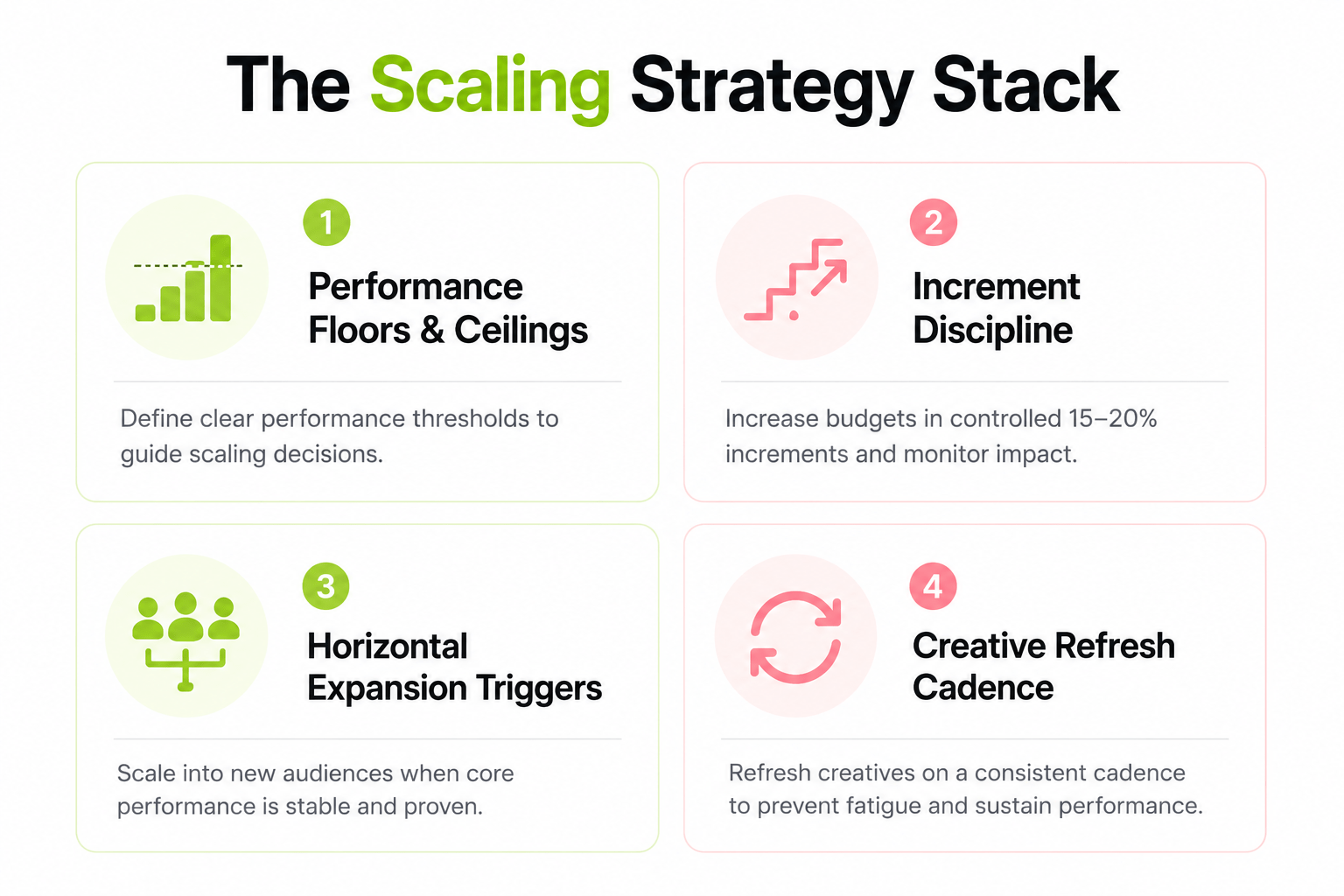
A Facebook ads scaling strategy that holds over time has four components:
Performance floors and ceilings. Before scaling anything, define what “working” means: minimum ROAS, maximum CPA, minimum conversion volume. These aren’t aesthetic preferences – they’re the thresholds that determine when a rule fires and when it doesn’t.
Increment discipline. Vertical scaling increments of 15–20% every 3–5 days are the standard that avoids learning phase resets. Larger increments require longer stabilization periods. Define your increment policy and apply it consistently.
Horizontal expansion triggers. Specify the conditions that warrant duplicating an ad set rather than scaling it: sustained performance above target for a defined window, audience saturation signals (frequency creeping above 2.5), or campaign structure that’s been proven across enough conversion volume to replicate with confidence.
Creative refresh cadence. Scaled campaigns burn creative faster than lower-budget ones. A Facebook ad scaling strategy without a creative refresh plan eventually hits a frequency wall and stalls. Build the creative pipeline alongside the scaling plan.
Conclusion
Facebook ad scaling fails when it’s treated as a budget lever rather than a structural discipline. The mechanics – incremental vertical scaling, deliberate horizontal expansion, automated rules for both directions – are what separate accounts that compound performance from accounts that blow budget on resets.
The execution layer matters too. Manual scaling decisions made at weekly review intervals miss windows. Automated rules that run continuously catch them. Getting both right – the strategic framework and the execution infrastructure – is what makes scaling repeatable at agency scale.
Frequently Asked Questions
Q1: What is Facebook ad scaling?
Facebook ad scaling is simple: you take campaigns that are already hitting targets and increase their reach and spend – without breaking optimization. Two proven methods exist: vertical scaling (incremental budget bumps) and horizontal scaling (duplicating winners into new audiences). Here’s the truth: both demand structural discipline, not just more budget.
Q2: What is the best way to scale Facebook ads without resetting the learning phase?
The proven method: increase by 15–20% every 3–5 days. Any larger, and Meta forces a relearning period that disrupts delivery and wastes spend. Stick to smaller, consistent increases – your algorithm stays stable, your performance keeps improving, and you never lose optimization momentum.
Q3: What’s the difference between vertical and horizontal scaling?
Vertical scaling increases budget on an existing campaign. Horizontal scaling duplicates a proven structure into new audiences, placements, or accounts. Most effective strategies use both – vertical scaling within defined increment ceilings, horizontal expansion once the structure has enough conversion history to replicate.
Q4: How do automated rules support Facebook ad scaling?
ROAS above target? Scale budget immediately. CPA hits the floor? Pause instantly. Real-time scaling. Real-time protection. No delays. No inconsistency. Manual reviews can’t compete.
Q5: When should you duplicate an ad set instead of scaling its budget?
When: frequency > 2.5 (saturated audience); you need to test the same structure on adjacent audiences without touching the original; or another vertical bump will reset learning. Horizontal scaling keeps the original optimized. Reach grows. Original stays intact.
Q6: How does FabFunnel support Facebook ad scaling for agencies?
FabFunnel covers both scaling layers. The Bulk Campaign Launcher handles horizontal scaling – deploying structures across Meta accounts in bulk without manual rebuilds. The automation rules engine handles vertical scaling and pausing continuously across all client accounts, with every action logged. Consistent execution across accounts without per-account manual oversight.