Introduction — The Creative Bottleneck Killing Your Facebook Ad Results
Let’s be honest. When was the last time you actually completed a rigorous A/B test on your Facebook Ads Creatives? Most advertisers run 1–2 versions, pick the one with the lower CPA, and call it “optimized.”
In 2026, that approach is a fast track to wasted spend.
Here’s the reality: creative quality now accounts for up to 70% of campaign results. With Meta fully automating targeting and bidding through Advantage+ and generative AI, the playing field has leveled on audience reach. The only real differentiator left is your creative. Yet most brands treat Creative Ads on Facebook like an afterthought.Meanwhile, creative fatigue is hitting harder and faster than ever.
Meta’s own research found a 45% drop in ad performance after just four exposures to the same FB Ad Creative. Worse, over 19% of Meta ad impressions are already being shown to the same user more than five times. When frequency exceeds 3.0, CPA jumps 10–25%; at frequency 5.0+, click-through rates crater by 40–60%.
The problem isn’t a lack of strategy. It’s a lack of volume. Generating enough creatives for Facebook ads to test systematically requires time, money, and a design team that most brands simply don’t have. Manual production is the bottleneck – not ideas, not budget, not audience analysis.
This post walks you through a repeatable, data-driven framework for A/B testing Creative Ads on Facebook at scale and shows how FabFunnel’s creative generation and campaign management features remove the production bottleneck entirely, letting any team test like an agency.
Why “Scale” is the Hard Part of Creative Testing
Most advertisers intuitively understand that testing more variations leads to better results. Yet they still run 2–3 creatives per campaign and call it a day. Why? Because production isn’t free.
Let’s do the math.
To test properly, you need 3–5 Creatives for Facebook Ads per ad set, across multiple audiences or ad sets. That’s 15–25+ individual assets per campaign cycle. For a brand running three active campaigns simultaneously, you’re looking at 45–75 fresh creatives per month.
Traditional production (in-house designers or agencies) simply cannot keep up with that velocity. Each asset takes hours, if not days to concept, design, copywrite, and approve. By the time your fifth variation is ready, your first is already showing signs of fatigue.
And when you don’t have enough volume, what happens?
- You recycle tired creatives → frequency spikes → CPMs rise → ROAS tanks.
- You make gut-feel decisions instead of data-driven ones.
- Winners get scaled too late; losers run too long, burning the budget unnecessarily.
Adopt a weekly creative refresh cycle. Always have new creatives in test while winners are scaling. This isn’t a “nice to have”, it’s the only way to stay ahead of algorithm-driven fatigue. Meta’s own data shows that creative fatigue onset has accelerated from 14 days in 2024 to just 9.2 days for video ads in 2026.
FabFunnel Takeaway: The bottleneck has never been your strategy. It’s your production speed.
The A/B Testing Framework: What to Test and in What Order
Once you commit to testing at scale, you need a structured approach, not a random spray of variations. Here’s the hierarchy.
The Creative Pyramid (Top to Bottom)
- Tier 1 — Concept: The core angle (Benefit vs fear vs social proof vs curiosity).
- Tier 2 — Format: Creative Delivery (Static image vs video vs carousel).
- Tier 3 — Element: Individual components (Hook, headline, CTA, color, callout).
Start at the top of the pyramid. A brilliant static image will never outperform a mediocre video if video is the better format for your audience. Likewise, testing button colors before settling on a concept is like rearranging deck chairs on the Titanic.
The One-Variable Rule
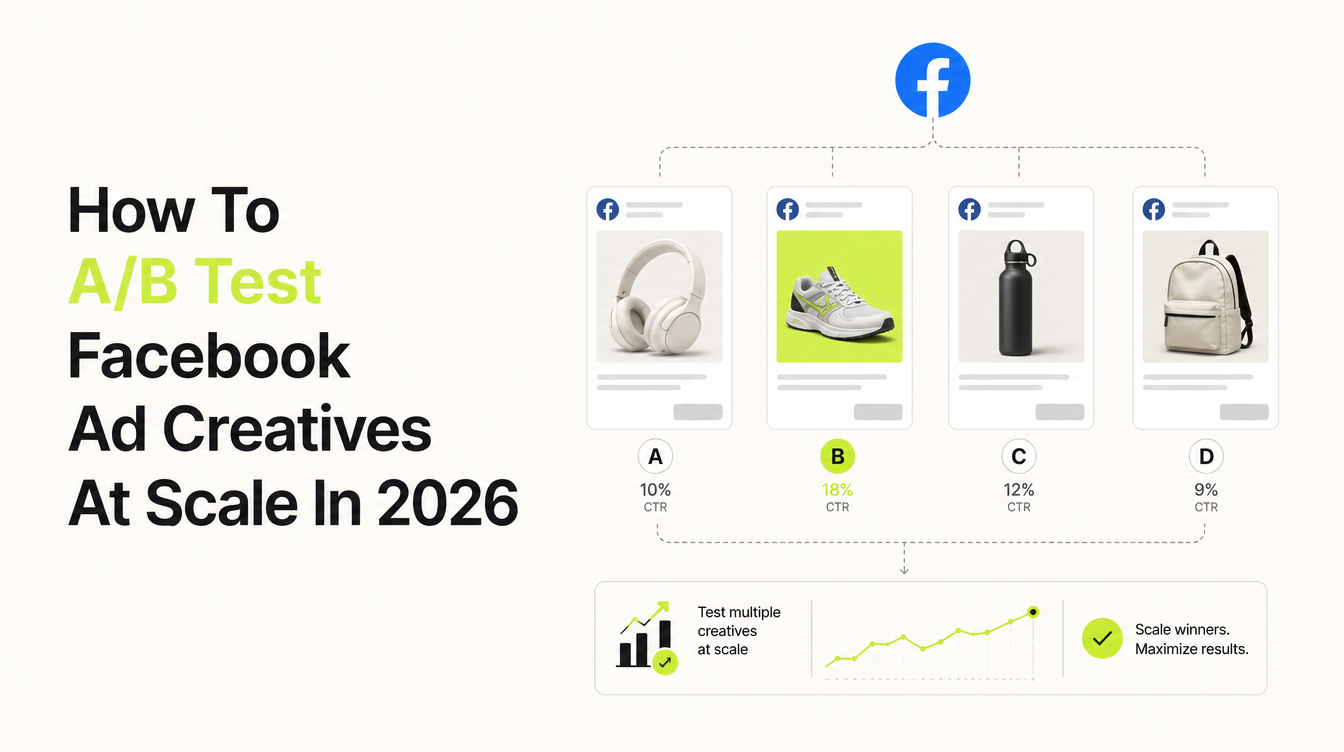
Change one thing per test. Mixing variables makes winners unattributable. If you test a new headline and a new image at the same time, and the ad wins, you have no idea which change drove the result. This is the single biggest mistake in testing.
Pro tip: Use Meta’s “Creative Testing Feature” (rolled out in late 2025), which prevents the platform from optimizing delivery unevenly across ads during the test.
Aim for a weekly creative refresh cycle. Always have fresh variations in testing while current winners are still scaling.
How FabFunnel Generates Test-Ready Facebook Ads Creatives in Minutes
This is where most testing frameworks break down. Even with the perfect hypothesis and the best variable-isolation strategy, you still need to actually produce the assets.
Traditional workflow:
- Write a brief (2 hours)
- Designer creates mockups (4–8 hours)
- Copywriter drafts headlines and primary text (2–4 hours)
- Approvals and revisions (1–3 days)
- Export and upload to Meta (30 minutes)
Total: 3–5 business days for 3–5 creatives. In 2026’s 9-day fatigue window, you’re already behind before you even launch the test.
FabFunnel eliminates this bottleneck entirely.
What FabFunnel’s Creative Generation Feature Does
From a single brief, FabFunnel automatically generates multiple FB Ad Creative variations that are test-ready:
- Static images
- Carousel assets
- Copy variations – headlines, primary text, descriptions, and CTAs mapped directly to your testing framework.
Every asset is brand-safe. Fonts, color palettes, logo placement, and visual guidelines remain consistent across all variants. You’re not getting generic, off-brand garbage. You’re getting predictable, on-brand output that reflects your style guide.
FabFunnel’s outputs are plug-and-play with Meta’s FB Dynamic Creative feature. Upload multiple FabFunnel variants into a single FB Dynamic Creative ad, and Meta’s algorithm will automatically mix and match assets to find the winning combinations.
- Before FabFunnel: 5 test creatives = 3 days + designer + copywriter + approvals
- After FabFunnel: 5 test creatives = 15 minutes
Try FabFunnel Free or Book a Demo
Deploying Your Tests Directly from FabFunnel
Forget manual exports or toggling back and forth between tabs. FabFunnel is an all-in-one ad engine designed to keep your workflow inside a single platform. You integrate your Facebook accounts once, and FabFunnel handles the rest.
The Automated Workflow
- Direct Integration: Connect Meta Ads to FabFunnel. No CSV imports or manual Ads Manager uploads.
- Build Your Template: Pick your goal, budget rules, and bid type. Save it to use again.
- Define Your Matrix: Add your images, videos, and audience lists. FabFunnel’s tool shows you how many campaigns you’ll run and checks everything before you go live.
- Preview and Launch: View a full preview of every campaign generation before it hits your live account. Catch errors, review naming conventions, and launch thousands of campaigns in seconds with a single click.
- Automated Monitoring: Post-launch, you don’t need to live in Ads Manager. FabFunnel monitors your performance against the rules you set. Pause underperformers, scale winners, and shift budgets automatically.
By keeping your execution inside FabFunnel, you avoid the time-suck of manual creation and the human errors that plague high-volume testing.
CBO vs ABO for Creative Tests
- ABO (Ad Set Budget Optimization) = Recommended for clean creative tests. Each variant gets equal budget, giving you a direct apples-to-apples comparison.
- CBO (Campaign Budget Optimization) obscures creative performance because Meta automatically shifts budget toward what it thinks is winning, which may not align with your actual statistical winner.
Reading the Results: Metrics That Matter for Creative Testing
You’ve run the test for 7–14 days. Now, which metrics actually tell you which are the Best Facebook Ad Creatives, and what’s not?
Primary Metrics
- CPA / Cost per result: Your north star.
- ROAS: For e-commerce and direct response.
Creative-Specific Diagnostic Metrics
- Hook rate (3-sec video views ÷ impressions): Is the opening frame/headline stopping the scroll?
- Hold rate (ThruPlays ÷ 3-sec views): Are people staying engaged after the hook?
- CTR (click-through rate): Is your CTA and landing page’s intent compelling?
- Frequency: When this exceeds 3–4×, it’s a kill signal. Fresh creatives are needed.
When to Call a Winner
- Minimum 50 conversions per variant before declaring significance.
- Frequency creep: If a creative’s CPA looks good but frequency is climbing above 4.0, it’s a ticking time bomb.
- Pro tip: Hook rate often predicts performance 3–7 days before conversion metrics show a decline. If your hook rate drops below 35%, refresh immediately.
Scaling Winners: Iterate Fast With FabFunnel’s Creative Variations
Finding a winner is exciting. But that’s where most advertisers stop. Use FabFunnel to spin out variations of the winner:
- Same hook + new CTA
- Same visual concept + new offer messaging
- Same format + new audience angle
The Perpetual Testing Pipeline
- Always keep 3–5 new FabFunnel creatives in test while winners scale.
- Weekly creative refresh cadence.
- Build a creative log to develop pattern recognition.
Stop Guessing, Start Testing With FabFunnel
Here’s what we’ve covered:
- Creative quality determines 70%+ of campaign results in 2026.
- Testing at scale requires 15–25+ creatives per campaign cycle.
- A structured Creative Pyramid ensures your tests are actionable.
- FabFunnel acts as your one-stop ad engine: generate, launch, and monitor within one platform.
- Read the right metrics (hook rate, hold rate, CPA, frequency) and iterate quickly with AI-driven insights.
The brands that win on Facebook in 2026 are the ones that build systems for sustained creative testing. FabFunnel gives you that system.
Start Generating Facebook Ads Creatives in Minutes
Frequently Asked Questions
1. How many creative variations should I test per ad set for statistically significant results?
Test at least 3–5 creatives per ad set to compare different concepts or formats. Get about 50 conversions per variant. Then pick a winner. That ensures reliable results. FabFunnel makes generating multiple variants quick and scalable.
2. Does FabFunnel generate video creatives, or only static images?
Both. FabFunnel creates static images, and video previews as per your prompts.
3. Can I use FabFunnel if I already have a dedicated design team?
Yes. FabFunnel does the boring, repetitive work of making many ad versions and testing them. That way, your designers can spend their time on big-picture, important tasks.
4. How does FabFunnel ensure brand safety?
You give FabFunnel your brand’s style: your fonts, colors, logo, and rules. Then it makes ads that all look like they belong to your brand.
5. Does FabFunnel work with Meta’s latest Advantage+ campaigns?
Yes. Outputs are fully compatible with Advantage+, FB Dynamic Creative, and other Meta features, making it easy to upload and optimize multiple variants in one campaign.