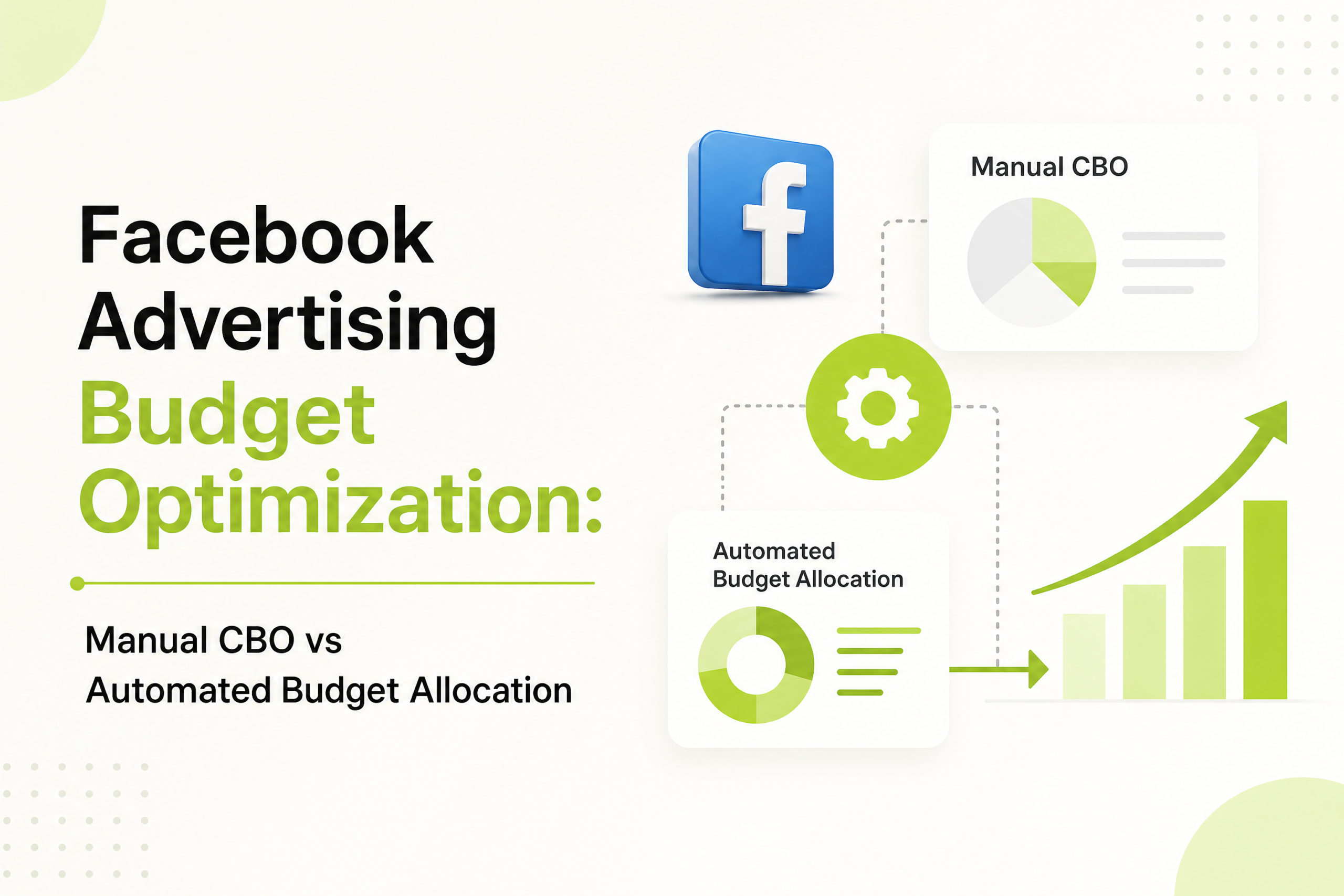
Your Facebook advertising budget doesn’t go where you tell it. Not with CBO running. Campaign Budget Optimization hands Meta’s algorithm control over how spend flows between ad sets. The intention: smart allocation. The reality: budget consolidates into one or two ad sets, creative tests get starved, and distribution decisions happen in a black box you can’t directly adjust. Manual control solves the visibility problem but creates an execution one. Every budget adjustment depends on someone reviewing a dashboard first – and that review window is rarely the same day. This article breaks down when CBO works, when it fails, and how automated budget allocation outperforms both approaches at scale.
What Is Campaign Budget Optimization (CBO)?
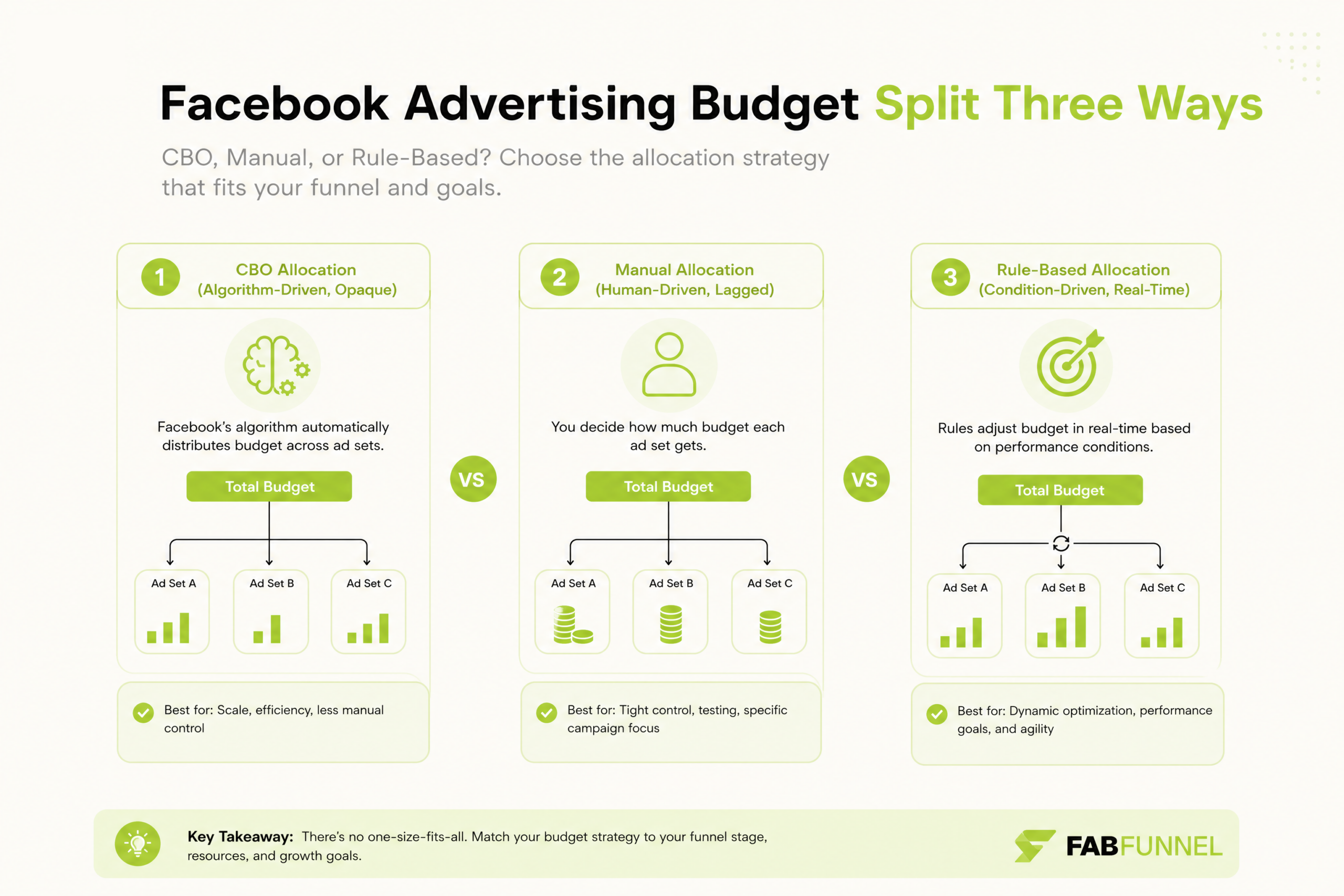
Facebook campaign budget optimization moves your Facebook ads budget decisions from ad set level to campaign level. Instead of setting individual budgets per ad set, you set one campaign-level budget and Meta’s algorithm distributes it based on real-time performance signals – auction dynamics, audience overlap, predicted conversion rates, delivery data. Reallocation happens continuously, not once per day.
- When CBO works: Only if you have proven ad sets, stable audiences, and enough conversion data for the algorithm to make half-decent decisions. At scale, dynamic allocation often outperforms manual splitting.
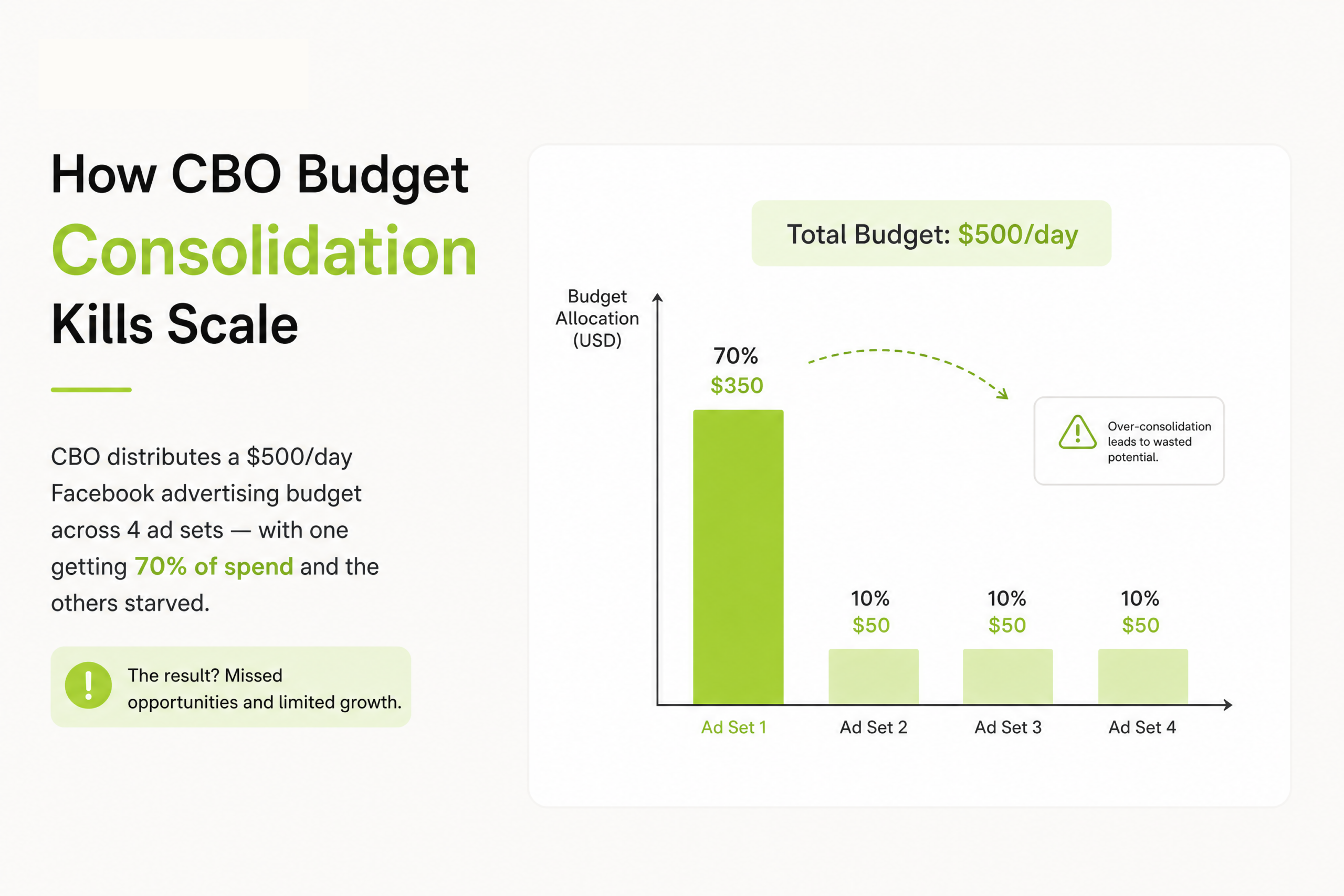
- When CBO fails: new campaigns with untested ad sets, creative testing environments where you need equal spend exposure per variant, and any scenario requiring budget floors per ad set to guarantee minimum test coverage.
The Problem With Manual Facebook Ads Budget Control
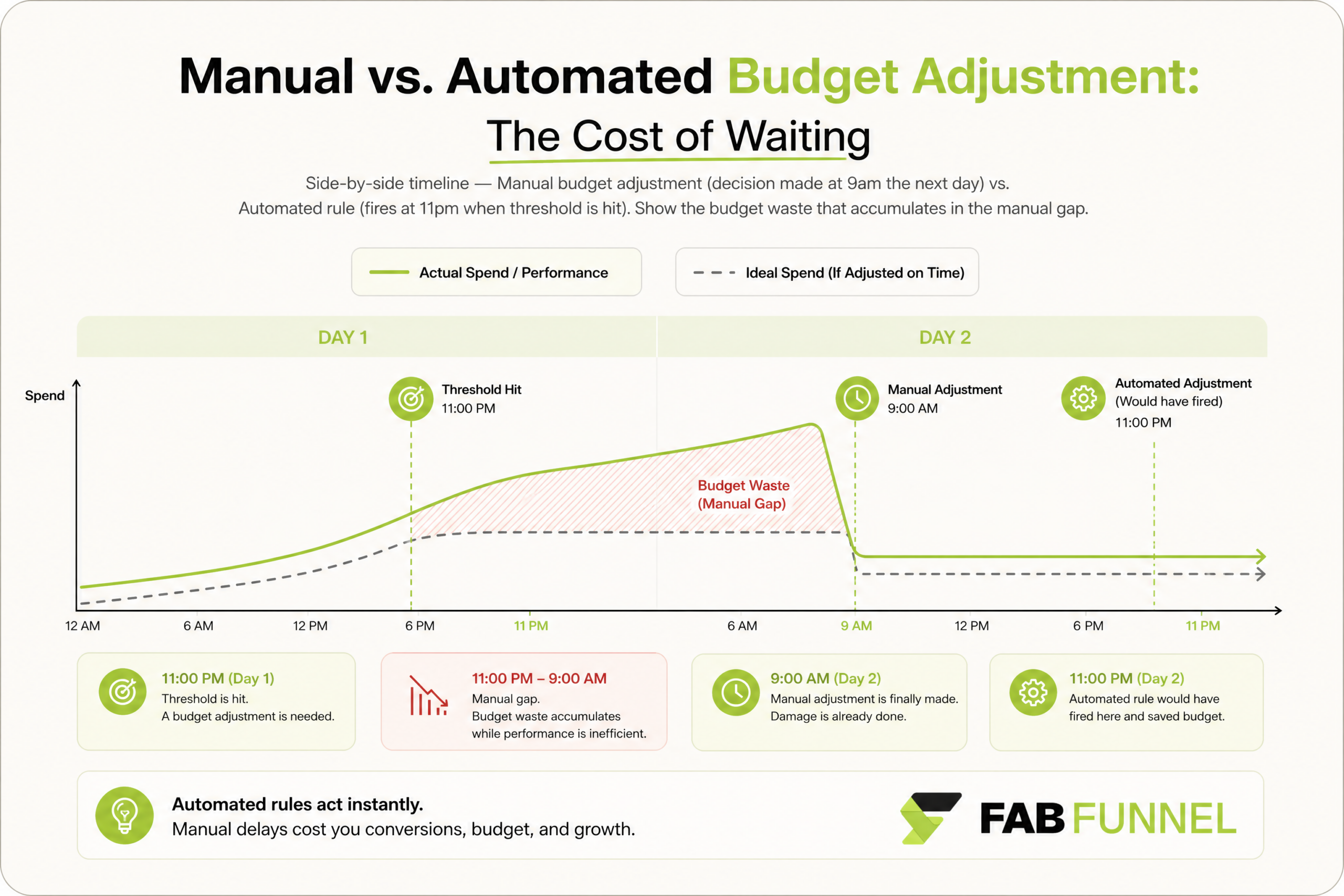
Manual control gives you precision: you set specific ad set budgets, watch performance, and move spend between what’s working and what isn’t. No algorithm consolidation. No starvation on creative tests. The problem is the execution window. Manual Facebook ads budget strategy requires someone to check performance, make a call, open Ads Manager, and push the change. One account with five ad sets – manageable. Three accounts with twenty ad sets each – daily precision becomes operationally impossible.
What this costs in practice:- A low-ROAS ad set burns overnight because it wasn’t flagged until the morning review.
- A high-performing ad set sits at its original budget for three days while the team aligns on scaling it.
- Creative tests collect unequal spend because manual budget splits don’t account for live auction dynamics.
Manual Facebook ads budget optimization is precise but slow. CBO is responsive but opaque. Neither solves the core issue: budget decisions that should fire at 6pm on Thursday get made at 9am on Friday.
Automated Budget Allocation: Rule-Based Control
Automated budget allocation replaces both problems with a third approach: predefined conditions that trigger budget actions the moment thresholds are crossed. No dashboard dependency. No algorithmic opacity. The structure is simple:
IF [performance condition], THEN [budget action]. This provides CBO’s speed without CBO’s lack of control, and manual precision without the execution gap.
FabFunnel’s automation layer runs Facebook ads budget rules 24/7 – pausing spend on underperformers, increasing daily budget behind winners when ROAS thresholds are hit, and applying pacing rules to prevent early budget exhaustion. FabFunnel’s Co-Pilot adds the intelligence layer on top: analyzing campaign and account data to surface budget recommendations before problems develop. It flags which ad sets are trending toward a threshold, where ad spend is accelerating without matching conversion lift, and exactly where your Facebook advertising budget is generating returns worth scaling. Automated execution plus forward-looking recommendations – running without anyone monitoring dashboards between reviews.
CBO vs Manual vs Automated: When To Use Each
| Approach | Best For | Weakness |
| CBO | Proven ad sets, stable audiences, scaled campaigns | Budget consolidation, no creative test control |
| Manual | New campaigns, creative testing, strict allocation needs | Timing gap, breaks down past a few accounts |
| Automated rules | Any campaign with defined performance thresholds | Requires correct threshold setup upfront |
The practical hybrid: run CBO at campaign level for delivery efficiency, layer automated rules on top as guardrails. Pause rules override CBO if an ad set runs beyond your CPA threshold. Scale signals surface when it’s time to manually bump campaign-level budget.
Budget Allocation Audit: 4 Questions Before You Touch Spend
Before building a rule stack, diagnose where your current Facebook advertising budget is actually leaking. Four checks – each one points to a specific fix.
1. Is CBO consolidating into a single ad set?
Pull 7-day spend by ad set. If the top 1–2 ad sets are absorbing 70%+ of campaign budget, CBO is effectively running one ad set with the rest as backup. Your creative tests aren’t getting the exposure needed to evaluate them fairly.
Fix: set minimum ad set spend limits, or shift to manual budgets during testing phases.
2. Is daily budget exhausting before peak conversion hours?
Pull hourly spend for the last 7 days. If your campaign burns through 60%+ of the budget before 2pm, you’re probably running out of money before the good traffic comes in at night.
Fix: Add a pacing rule to limit early-day spend.
3. Is frequency rising while CPM climbs?
Frequency above 3.0 and CPM trending up week-over-week? Creative fatigue inflates CPC before ROAS shows damage. Facebook budget hits diminishing returns.
Fix: rotate creative or add frequency-triggered pause rule.
4. Are high-ROAS ad sets sitting at flat budgets?
Pull ad sets: ROAS above target 7+ days, budget unchanged. That gap between performance signal and spend action is recoverable revenue.
Fix: build a scale rule so the increase fires automatically within the first 48 hours of sustained performance. This audit takes 20 minutes in Ads Manager. The answers tell you whether your budget problem is algorithmic (CBO consolidation), operational (timing gap), creative (fatigue), or structural (no scale automation).
Facebook Ads Budget Strategy: Building The Rule Framework
A complete Facebook ads budget strategy covers five rule types:
- Kill rules: pause ad sets where ROAS drops below break-even after a minimum spend floor. Stops your Facebook advertising budget from continuing to flow to proven underperformers.
- Scale rules: increase budget by 15–20% when ROAS exceeds target for two consecutive days. Captures upside without waiting for a manual review cycle.
- Pacing rules: reduce daily budget if 65%+ of daily spend exhausted before 2pm. Protects conversion rate during high‑intent hours.
- Frequency rules: flag any ad set where audience frequency surpasses 3.5 within a 7‑day period. Creative fatigue degrades budget efficiency predictably; catching it early prevents ROAS erosion.
- Threshold floors: minimum spend before any rule can fire. Prevents kill or scale decisions on campaigns that haven’t collected enough data.
Facebook Ads Budget Optimization Rule Stack
| Rule Type | Trigger | Budget Action | Minimum Spend |
| Kill rule | ROAS < break-even x 0.7 for 3 days | Pause ad set | 2x avg CPA |
| Scale rule | ROAS > target x 1.3 for 2 days | +20% budget | $150 spend |
| Pacing rule | 65%+ budget spent before 2pm | -20% for remainder of day | – |
| Frequency rule | Frequency > 3.5 in 7 days | Pause + notify | – |
How FabFunnel’s Co-Pilot Improves Budget Decisions
Rules handle reactive execution. Co-Pilot handles the forward-looking layer. FabFunnel’s Co-Pilot analyses campaign data and account performance history to surface budget recommendations before thresholds are crossed. It identifies where your Facebook advertising budget is generating efficient returns, where ad spend is accelerating without matching conversion improvement, and which ad sets are approaching the conditions where a rule should fire – giving you a window to act proactively, or to adjust the rule if account conditions have shifted. For Facebook ads budget strategy at scale, this is what replaces the daily manual sweep: rules handle reactive budget actions, Co-Pilot surfaces what to do next.
Common Facebook Advertising Budget Mistakes
- Spreading budget too thin to exit learning. Meta needs 50+ optimization events per week per ad set to deliver efficiently. A Facebook advertising budget split across too many campaigns keeps multiple ad sets in learning indefinitely – none accumulating enough data to perform.
- Scaling too aggressively. Budget increases above 30% in a single step push campaigns back into the learning phase. Keep ad spend increases to 15–20%, spaced 48–72 hours apart.
- Running CBO on untested creative. CBO consolidates behind the first marginally-better performer. New creative variants need equal exposure to be fairly evaluated. Use manual ad set budgets or spend limits during creative testing phases.
- Rules without spend floors. A pause rule that fires after $20 in spend is acting on noise. Every kill or scale rule needs a minimum data threshold before it can activate.
- Static weekly budget reviews. Campaign performance shifts daily. Treating Facebook advertising budget as a fixed weekly decision leaves money in the wrong places for days at a time.
Conclusion
CBO allocates fast but opaquely. Manual control is precise but slow. Automated rules close the gap – executing budget decisions on conditions you’ve already defined, in real time, without a dashboard check in between. Run the audit first. Build the kill rules. Add the scale logic. Co-Pilot surfaces what the rules miss. If you’re managing Facebook advertising budget across multiple accounts and losing ground to execution delays – FabFunnel’s automation layer is built for exactly this.
Frequently Asked Questions
Q1: What is Facebook campaign budget optimization (CBO)?
Facebook campaign budget optimization moves your Facebook ads budget control from ad set level to campaign level. Meta’s algorithm distributes the total campaign budget across ad sets in real time based on performance signals. It improves delivery efficiency on proven campaigns but loses precision on creative testing and new audiences.
Q2: Should I use CBO or manual budgets for Facebook ads?
It all depends on how mature your campaign is. CBO thrives on stable, proven ad sets with solid conversion data – it can distribute spend smartly. But manual control? That’s your go-to for creative testing, brand‑new audiences, or anytime you need to guarantee each ad set gets a minimum spend. Choose wisely.
Q3: What is Facebook ads budget optimization?
Facebook ads budget optimization is the practice of allocating and adjusting campaign spend to maximize returns – through CBO, manual ad set budgets, or automated rules. The goal: your Facebook advertising budget flows to what’s converting, and away from what isn’t, as quickly as the data supports that call.
Q4: How much should I spend on Facebook ads?
Start with enough budget to hit 50+ optimization events per week per ad set – typically 10–15x your target CPA in weekly spend per campaign. Below that threshold, Meta’s delivery system won’t exit the learning phase, and Facebook ads budget optimization rules won’t have reliable data to act on.
Q5: How do automated rules improve Facebook advertising budget efficiency?
Automated rules pause underperforming ad sets instantly at CPA/ROAS threshold – no daily review. They scale winning ad sets within hours of hitting your target, not days. The result is your Facebook advertising budget shifts to what’s working faster than any human workflow can match.
Q6: What does Co-Pilot do for Facebook ads budget strategy?
FabFunnel’s Co-Pilot analyses campaign and account performance data to surface budget recommendations – identifying where your Facebook advertising budget is working efficiently, where ad spend is accelerating without matching returns, and where adjustments should be made before performance degrades. It’s the strategic layer that complements automation rule execution.