Today’s marketing teams have more data than ever before. Every campaign, every click, impression, lead, sale, email, landing page visit, and customer interaction generates valuable data. But more data doesn’t always lead to better decisions. The teams in many cases are unable to connect the dots between reports, platforms and real campaign profitability.
That’s where the power of AI for marketing analytics comes in.
AI doesn’t just tell us what happened, it helps marketers understand why performance changed, what’s next, and what we can do to improve the results. AI helps many teams to register profitable audiences, to find where the budget is leaking, and improve targeting.
In this blog we will be exploring how AI can make raw marketing data into useful insights and also how it helps teams build more profit.
In this blog, we’ll look at how AI can transform raw marketing data into clear insights, and help teams build more profitable campaigns.
What’s AI Marketing Analytics?
So AI marketing analytics is basically using artificial intelligence, machine learning, predictive modeling, and automation to dig into your marketing data and make smarter decisions about campaigns. It helps you get past those basic reports and actually find patterns, trends, and opportunities hiding in all that data.
Traditional analytics? That tells you what happened. How much you spent, how many clicks, how many leads, what the conversion rate was. Helpful, sure. But it doesn’t tell you why.
AI marketing analytics takes it up a level. It explains why performance changed and what to do next. For example, AI can show me which audience segment is most likely to convert, which campaign is wasting my budget, which creative is losing performance, or which channel is bringing in my highest-value customers. That lets me optimize campaigns based on profit, not just the easy-to-see numbers.
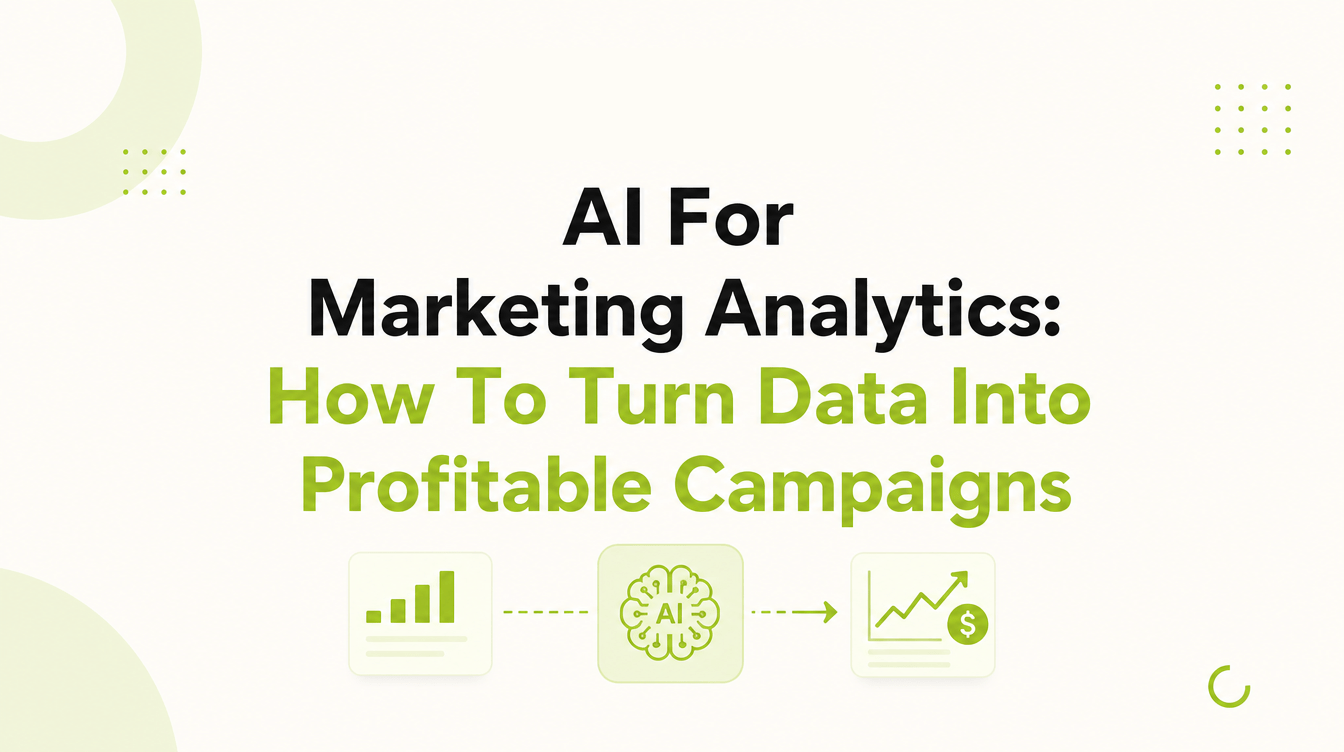
Put simply, AI for marketing analytics enables teams to turn raw data into actionable decisions, leading to higher ROAS, lower CPA, more conversions, and better campaign growth.
How Marketing Teams Fail to Make Money from Data
Most marketing teams don’t have a data shortage. They have data from ad platforms, analytics tools, CRM systems, email platforms, landing pages, ecommerce stores, call tracking tools, and sales dashboards. The hard part is taking all of that information and turning it into clear, profitable action.
Ever dealt with data fragmentation? Campaign performance looks great inside the ad platform itself. But then you check your backend revenue, lead quality, refunds, or sales data, and it’s a whole different story. So what happens when your data is spread across different tools? It becomes incredibly difficult to understand your true profitability.
Another problem is delayed reporting. By the time teams review performance after a few days, they may be missing early warning signs such as increasing CPA, decreasing ROAS, poor quality leads, or wasted spend. Also manual analysis becomes harder with increasing campaign volume. Marketers can’t look at every campaign, audience, creative, keyword and funnel path in detail on a daily basis.
That’s why AI marketing analytics tools are becoming more important. They help teams analyze large data sets faster, identify patterns earlier and focus on the insights that can actually improve campaign profitability.
The Role of AI in Marketing Analytics

AI for marketing analytics should help teams move from standard reporting to smarter decision-making. AI can look at your campaign data, spot the trends, identify the issues and make recommendations for actions that will improve performance, not just display numbers.
AI can quickly comb through the data across spend, clicks, impressions, conversions, revenue, CPA, ROAS, customer behavior and retention. It helps marketers know which campaigns are profitable, which audiences are valuable and where budget is being wasted.
AI can tell you which campaigns are likely to succeed before you spend too much money on them. It can tell you which leads are most likely to convert so you don’t waste time on the tire-kickers. And it can tell you which customer segments may deliver the most lifetime value so you know where to double down. That means your team can make decisions early—before small performance issues turn into expensive problems.
Anomaly Detection
Now think of anomaly detection as a smoke alarm. If your CPA suddenly spikes, ROAS drops, conversion volume falls, or your tracking data seems off, AI alerts you immediately. You don’t wait for the house to burn down while you’re pulling manual reports.
The Bottom Line
AI helps marketing teams make faster, more accurate, and more profitable decisions. It takes all that complex, messy data and hands you clear, actionable recommendations. No smoke. No guesswork.
How Marketing Analytics Uses Machine Learning
Machine learning in marketing analytics
Think of machine learning as a student who actually pays attention. It looks at both past homework (historical data) and current classwork (real-time data) to find patterns that can help you do better on future campaigns
The whole thing starts with collecting data. Marketing teams pull from ad platforms, websites, CRMs, email tools, ecommerce platforms, customer behavior reports, and revenue systems. That data includes impressions, clicks, conversions, spend, revenue, lead quality, purchase history, and whatever customers are doing.
Next, the data has to be cleaned and organized. This is an important step, since machine learning works with accurate data. Campaign names, conversion events, attribution windows, customer records and revenue fields must be consistent.
Machine learning models can find relationships between different variables when the data is ready. For example, the model might discover that a specific audience responds better to a specific creative or that the leads from one channel have more lifetime value than the leads from another.
Finally, machine learning can produce predictions and suggestions. It can help marketers score leads, forecast ROAS, predict churn, detect weak campaigns and suggest where to shift budget for better profitability,” he said.
AI Marketing Analytics Tools for Marketers
So there are a bunch of AI marketing analytics tools out there. They help teams collect data, analyze it, visualize it, and actually do something with it. Which one is best? Depends. How much do you want to do? Where’s your data coming from? What’s your budget? How technical is your team?
Google Analytics 4
Look, GA4 is genuinely good at helping you understand website behavior, conversion paths, predictive audiences, and user engagement. When it works, it works well.
Looker Studio
Looker Studio with AI connectors? You can build centralized dashboards that pull from multiple marketing data sources. That’s powerful when you set it up right. Lots of power at your fingertips if you do the integration work.
Sales & CRM Platforms
HubSpot AI and Salesforce Einstein are solid for lead scoring, customer journey analysis, sales forecasting, and revenue intelligence. You can also use them for BI and reporting. Tableau AI and Power BI with Copilot let teams explore data, uncover trends, and generate automated reports. Are they perfect? No. But they get the job done.
Next, business intelligence and reporting.
Tableau AI and Power BI with Copilot let your team explore data, uncover trends you’d probably miss, and generate automated reports without spending hours pulling numbers. They’re your data explorers.
How to Select the Best AI for Marketing Analytics
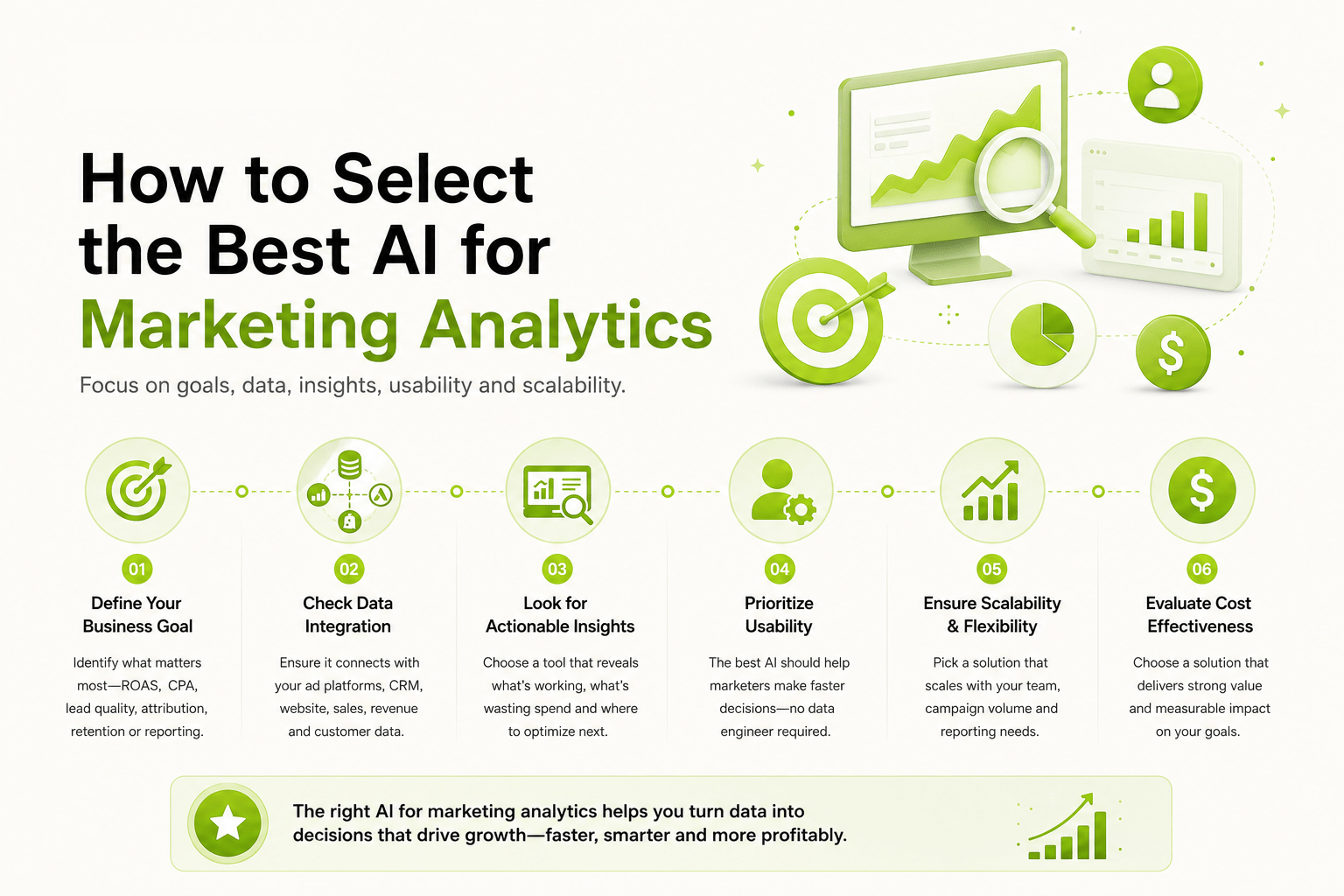
The first step in selecting the best AI for marketing analytics is to determine your primary business goal. Some teams need better ROAS, some need lower CPA, some need stronger lead quality, some need better attribution, some need improved retention, some need clearer cross-channel reporting.
The next item to examine is the ability to integrate data. A good analytics tool should talk to your ad platforms, CRM, website analytics, sales systems, revenue data, and customer behavior data. If the tool can’t access the right data, its insights will be limited.
Marketers should not just be looking for dashboards, but for actionable insights. The tool should help answer questions like what campaigns are wasting spend, what audiences are most profitable, what leads are highest quality, where should the budget move next.
Usability is equally important. The best AI for marketing analytics should empower marketing teams to make faster decisions without depending entirely on data engineers. The system needs to be scalable, cost effective and flexible to grow with the team’s volume of campaigns and reporting needs.
Conclusion
AI for marketing analytics helps teams evolve from simple reporting to making profitable campaign decisions from data. AI enables marketers to not just measure clicks, impressions, conversions and spend, but to understand what’s working, why it’s working and where the next growth opportunity is.
So AI marketing analytics helps teams find budget leaks, spot profitable audiences, predict campaign performance, improve attribution, and optimize spend across channels. It also cuts down on manual analysis so you can move faster when performance starts changing.
But here’s the thing. A microscope is only as good as the sample you put under it. AI needs clean data, clear KPIs, and human judgment to really shine. It’s not here to replace you—it’s here to give you better vision. Use it right, and AI helps you improve ROAS, lower CPA, and build campaigns that actually work. With confidence.
Also Read – AI In Performance Marketing: How Smart Automation Improves Conversions
Frequently asked questions
1. What is AI marketing analytics?
When there is a use of machine learning and Artificial Intelligence to analyze marketing data and improve campaign decisions then it refers to AI marketing analytics. It also helps marketers to find the pattern that could help them and also recommends actions that can improve performance.
2. How does AI for marketing analytics enhance campaign profitability?
AI increases profitability by helping companies to find high performance audiences, eliminate wasted spend, etc. Also helps to find weak spots in the funnel. It enables marketers to make things faster and more effective.
3. Best AI Marketing Analytics Tools ?
Popular AI marketing analytics tools are Google Analytics 4, Looker Studio with AI connectors, HubSpot AI, Salesforce Einstein, Tableau AI, Power BI with Copilot, Semrush and Mixpanel. The best tool depends on your goals, data sources, budget and reporting needs.
4. How does machine learning fit into marketing analytics?
ML is behind a lot of the key stuff. Customer segmentation, predictive lead scoring, churn prediction, campaign forecasting, anomaly detection, attribution modeling, budget optimization. It helps marketers find patterns they wouldn’t see otherwise and predict how things are going to perform.
5. What should you consider before picking an AI marketing analytics tool?
A few things are worth your attention. Data integration, ease of use, reporting features, quality of recommendations, scalability, privacy controls, and cost. The tool needs to play nice with your existing platforms and give you insights your team can actually act on. Get those things right, and you’re in good shape.