Quick Answer
Ecommerce advertising is paid promotion built around a product catalog: shoppers see specific products in ads, click through, and buy. The two workhorse channels are Facebook and Instagram ads, which create demand through audiences and creative, and Google Shopping, which captures demand from people already searching for a product. Both depend on a clean product feed and accurate conversion tracking. For a Shopify store, start by syncing the catalog, set up purchase tracking, run one prospecting campaign and one retargeting campaign, and judge results against your margin, not only against reported return on ad spend.
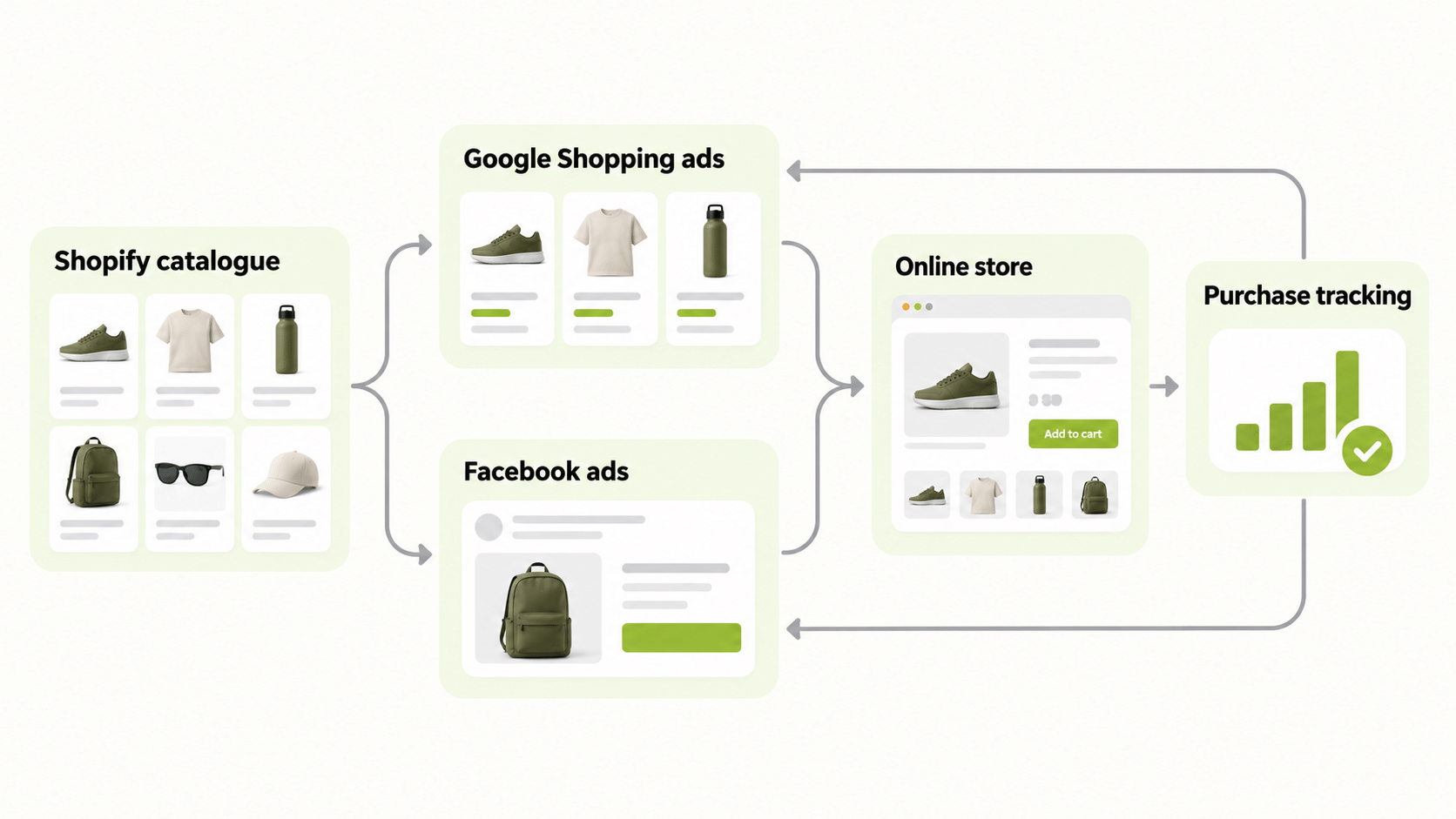
What Is Ecommerce Advertising?
Ecommerce advertising covers paid ads whose job is to sell products online. Unlike brand advertising, success is measured in orders and revenue, and the ads are usually tied to a catalog, so the product image, price, and link come from your store data.
The main formats are search ads, shopping ads that show product images with prices, social ads built from creative, and dynamic ads that show a person products they have already viewed. A store rarely needs all of them at once. Pick the formats that match how your customers find products.
Which Channels Work for Ecommerce Advertising?
| Channel | Role | Best for |
|---|---|---|
| Google Shopping | Captures existing search demand | Products people search by name or type |
| Google Search | Captures high-intent queries | Branded and category terms |
| Facebook and Instagram | Creates demand and retargets | Visual products and impulse purchases |
| TikTok | Creates demand through video | Products that demonstrate well on video |
| Email and SMS | Converts existing contacts | Repeat purchases |
A common starting split is one demand-capture channel, such as Google Shopping, and one demand-creation channel, such as Meta. Expand only when the first two have stable tracking and a clear cost per order.
How Do Facebook Ads Work for Ecommerce?
Facebook ads for ecommerce let you show products to audiences built from interests, customer lists, site visitors, and lookalikes, or to a broad audience that Meta’s delivery system narrows for you. Meta’s help pages describe Advantage+ audience as treating your selections as a starting point and expanding beyond them, with hard limits you can still set for age, location, and exclusions.
A workable structure has two layers. A prospecting campaign introduces products to new people, usually with several creatives so the system can find what works. A retargeting campaign reaches people who viewed a product, added to cart, or bought before, with a shorter message and an offer where it makes sense.
Creative does most of the work. Test different hooks, formats, and product angles, and keep the product and the benefit clear in the first seconds. The same product can sell on a problem-led angle, a social-proof angle, or a demonstration, and you will not know which until you test.
How Does Google Shopping Work for Ecommerce Advertising?
Google Shopping ads show a product image, title, and price in search results. They are built from a product feed submitted through Google Merchant Center, not from keywords you write. Google can also show products in free listings across surfaces such as Search, the Shopping tab, and Images, and merchants with paid Shopping ads can use free listings alongside them.
Because the feed is the ad, feed quality decides performance. Clear titles that include the product type and key attributes, accurate prices and availability, and good images all affect whether your products show and get clicked. If your feed is wrong, no bidding strategy will repair it.
How Do You Promote a Shopify Store With Ads?
For Shopify stores, the path is short.
- Sync the catalog. Use Shopify’s channel apps to send products to Google and Meta, and confirm the products are approved.
- Install tracking. Make sure purchases, add-to-cart, and checkout events are recorded in each platform.
- Start with one product group. Launch with your best-selling products before you scale the full catalog.
- Run prospecting and retargeting separately. Keep budgets and reporting apart so you can see each.
- Review weekly. Pause what wastes spend and give winners more budget in steps.
The best way to promote a Shopify store depends on your margins and audience, so there is no single correct answer. A store with a low average order value needs cheaper acquisition than one selling high-ticket items.
What Should Ecommerce Advertising Measure?
Track orders, revenue, cost per purchase, return on ad spend, average order value, and new versus returning customers. Reported return on ad spend is a platform figure and uses each platform’s attribution rules, so compare it with your store’s actual revenue and your margin.
Break-even return on ad spend is the number to know. It is the point where ad revenue just covers product cost, shipping, and fees. If your break-even is far above what the platform shows, scaling will lose money no matter how good the dashboard looks.
What Does Ecommerce Advertising Cost?
Costs depend on competition, category, season, and creative quality, so any figure quoted without context is unreliable. Set a test budget you can afford to lose, run it long enough to gather meaningful data, and calculate your cost per purchase. Then compare it with the gross profit on an average order. If you earn more than you spend per order, you can scale carefully. If not, fix the offer, the page, or the creative before you add spend.
Where Does Ecommerce Advertising Break Down?
Most failures come from the same few places: poor product feeds, missing or double-counted conversion tracking, weak landing pages, creative that never changes, and budgets scaled before a campaign is stable. A store with a slow, confusing checkout will waste ad spend however good the targeting is.
Fix the page first. Ads send traffic, but the store converts it. Check mobile speed, product page clarity, shipping information, and returns policy before you raise budgets.
How Does FabFunnel Fit Into Ecommerce Advertising?
FabFunnel positions itself as campaign execution infrastructure, and several parts apply to ecommerce teams. Its Catalogue syncs automatically from Shopify, while other stores add products manually. Genie, its AI creative studio, generates image and video creative and uses brand guidelines from the Catalogue. Bulk Launcher launches campaigns on Meta, TikTok, and NewsBreak, with a stated speed claim of 200+ campaigns in under two minutes once setup is done. Industry Insights helps you discover competitor ads for ideas, but it is a discovery tool, not a benchmarking tool.
Two boundaries matter. FabFunnel launches on Meta, TikTok, and NewsBreak only, so Google Shopping campaigns are built in Google’s own tools, and Google is connected for reporting only. Speed claims depend on your setup, so measure them in your own accounts.
How Should a Small Store Plan Its First Ecommerce Advertising Budget?
A small store should plan its first ecommerce advertising budget as an experiment with a fixed end date. Choose a number you can lose, split it across no more than two channels, and decide in advance what result would justify a second round. Write down your gross profit per order before you start, since that figure is the ceiling on what you can pay to acquire a customer.
During the test, resist changing everything at once. Change one variable at a time, such as the creative, the audience, or the offer, and record the date of each change. At the end, compare cost per purchase with gross profit per order. Good ecommerce advertising results come from repeating small, well-recorded tests, not from a single clever campaign.
How Do You Scale Ecommerce Advertising Without Losing Control?
Scale in steps. Raise budgets gradually, and wait for results to settle before the next increase. Add new creative before old creative tires, since frequency tends to climb as budgets rise. Keep a log of each change so that you can tell what moved the numbers.
As the account grows, repeated work piles up: building campaigns for each product group, duplicating structures, and refreshing creative. That is where templates and bulk launching help, as long as someone still reviews what goes live.
FAQs
What is ecommerce advertising?
It is paid promotion designed to sell products online, usually built from a product catalog.
Are Facebook ads good for ecommerce?
They can be, especially for visual products. Results depend on creative, offer, and tracking.
How do Google Shopping ads work?
They are built from a product feed in Google Merchant Center and show product images with prices.
What is the best way to promote a Shopify store?
Sync the catalog, set up tracking, and test one demand-capture channel and one demand-creation channel.
Can FabFunnel launch Google Shopping campaigns?
No. FabFunnel launches on Meta, TikTok, and NewsBreak. Google is connected for reporting only.
Does FabFunnel sync with Shopify?
Yes. The Catalogue syncs automatically from Shopify.
Where to Start
Sync your catalog, confirm purchase tracking, and run one prospecting and one retargeting test. To launch and report across channels, try FabFunnel or explore the full toolset at Fab AI. Searches for “fb ads for ecommerce” and “facebook advertising for ecommerce” usually point to the same catalogue-led workflow. The comparison often includes “google shopping ads for ecommerce” and “facebook ads for shopify store” campaigns. The best way to advertise Shopify store products, or the best way to promote Shopify store launches, depends on margin, demand, and tracking quality.