Quick Answer
Advertising attribution is the method that assigns credit for a conversion to the ads, channels, or touchpoints that came before it. Different models split credit differently: last click gives everything to the final touch, first click to the first, and multi-touch models share it across the path. Each ad platform applies its own rules, so totals rarely match. In Meta’s Ads Manager, the attribution setting is chosen at the ad set level, and Meta’s help pages list click-only and click-plus-view options. Programmatic buying adds view-through and cross-device gaps. Pick one source of truth, state the window, and use platform figures as directional checks.
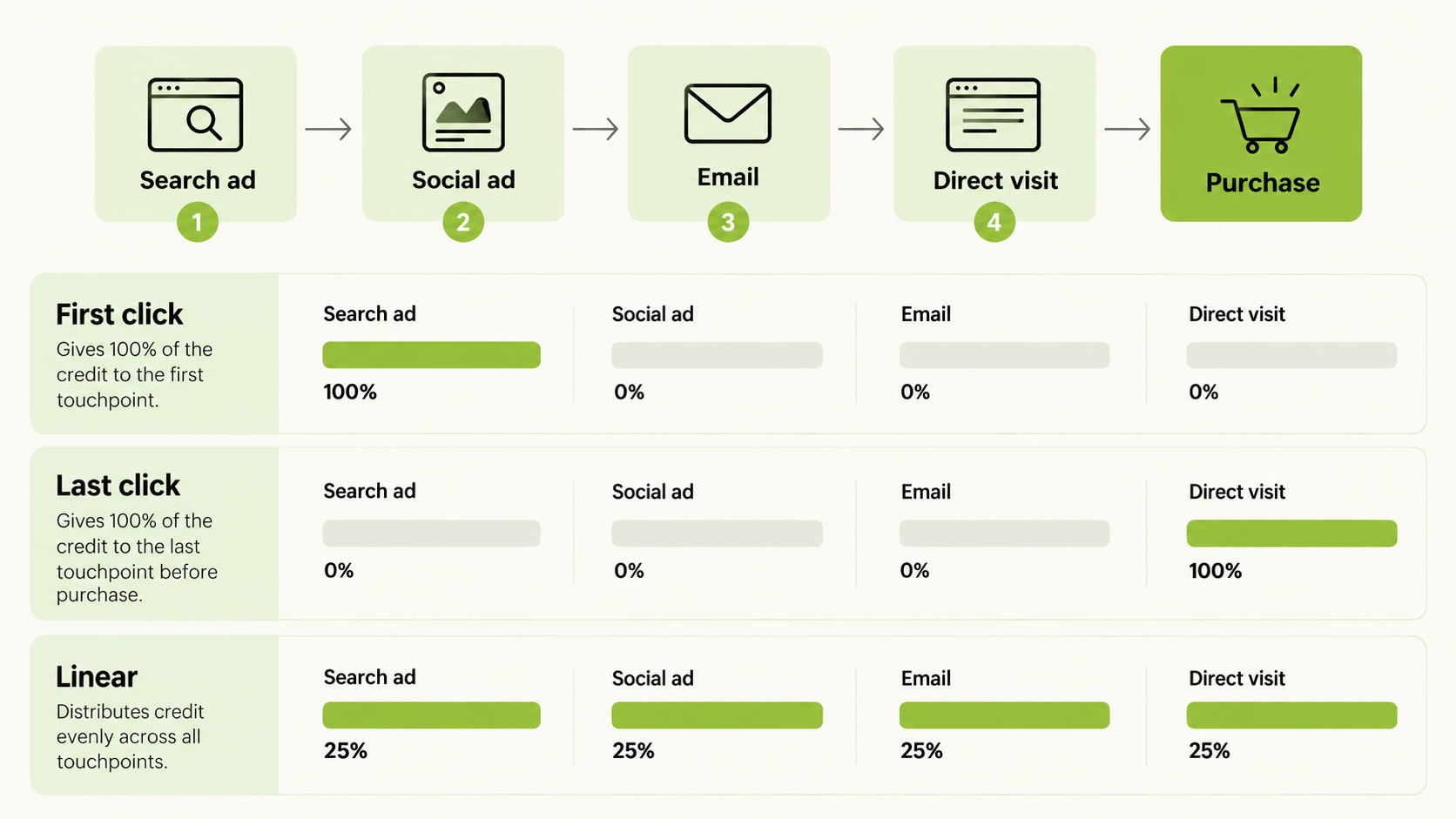
What Is Advertising Attribution?
Advertising attribution answers one question: which ads deserve credit for this sale or signup? A customer might see a video ad, click a search ad a week later, and buy after an email. Attribution is the rule set that decides how much each of those touches receives.
It matters because budget follows credit. If a model over-credits the last click, you will underfund the channels that start demand. If it over-credits views, you may pay for exposure that would have converted anyway. No model is neutral, so the useful habit is to know which assumptions your numbers rest on.
Which Attribution Models Are Common in Advertising?
| Model | How credit is assigned | Typical weakness |
|---|---|---|
| Last click | All credit to the final click | Ignores earlier touches |
| First click | All credit to the first touch | Ignores what closed the sale |
| Linear | Equal credit across touches | Treats weak and strong touches alike |
| Time decay | More credit to touches nearer the conversion | Undervalues early awareness |
| Position-based | Extra credit to first and last touches | The split is a judgement call |
| Data-driven | Credit estimated from observed paths | Needs volume and is hard to audit |
Vendors differ in which of these they offer and how they implement them, so check the documentation for each tool before you compare outputs. A model is a lens. The same campaign can look strong under last click and weak under first click without anything having changed.
How Does Attribution Work in Facebook Ads?
Meta describes its attribution as a window-based setting. According to Meta’s Business Help Center, you choose the attribution setting at the ad set level, and the options listed include 1-day click, 7-day click, 1-day click or view, and 7-day click or 1-day view. The pages note that some campaign types offer fewer options, for example those optimising for value or app events.
Two cautions apply. First, Meta’s help pages describe changes to defaults over time, so the default for a new ad set may not match older guidance. Check what your account shows. Second, the setting applies to ad sets, and existing ad sets keep the setting they were created with, so a single account can contain different windows. Before you compare results across campaigns, confirm that they use the same setting.
Meta has also offered a comparing-windows view under column customisation, though its help pages suggest availability has changed. Treat any window comparison as a diagnostic, not a verdict.
What Is Attribution in Facebook Ads Missing?
Attribution in Facebook ads reflects what Meta can observe. It can miss purchases that happen in-store, on another device, or after a long delay. It may count a conversion that your analytics tool credits to a different channel, because both platforms claim their own touches.
That overlap is the main reason platform totals add up to more than your actual sales. Treat the platform number as a measure of Meta’s contribution under Meta’s rules, and treat your backend sales as the ceiling.
How Does Programmatic Advertising Attribution Differ?
Programmatic advertising attribution has extra problems because buying happens across many sites and apps through exchanges. Three issues recur.
- View-through conversions. Many programmatic impressions are never clicked. Crediting a conversion to an impression that was served but not clicked is a judgement call, and a short view window is safer than a long one.
- Cross-device gaps. A person may see an ad on a phone and buy on a laptop. Without a login or shared identifier, the link is lost.
- Identifier loss. Browser and device privacy controls reduce how much user-level tracking is available, so modelled or aggregated measurement fills in more of the picture.
Because of these limits, programmatic advertising attribution leans on tests. Holdout groups and geographic experiments estimate what would have happened without the ads, which tells you incremental effect rather than credited conversions.
How Do Attribution Windows Change Advertising Attribution Results?
A window is the period after an interaction during which a conversion can be credited. A longer window credits more conversions, especially for considered purchases. A shorter window is stricter and favours quick-converting audiences.
When you change a window, past and future periods stop being comparable. Write down the window in every report, and avoid changing it mid-test. If you must change it, restart your comparison baseline.
How Do You Choose an Attribution Approach?
Match the approach to your decision.
- Day-to-day optimisation. Use the platform’s own numbers inside each platform, with a consistent window.
- Budget between channels. Use a neutral source, such as your analytics tool or backend sales, and compare channels under one model.
- Big spend decisions. Use an experiment, such as a holdout test, to measure lift.
- Executive reporting. Show one model, state its limits, and keep it stable.
Mixing these purposes is the common error. Platform numbers are good for steering within a platform and poor for ranking platforms against each other.
How Do You Reconcile Platform Numbers?
Start from backend orders. Add each platform’s reported conversions and compare the total with actual sales. The ratio is your over-claim factor. Track it over time, because a sudden change usually means a tracking or setting change, not a performance change.
Then write a reconciliation rule: which number is the source of truth, which window each platform uses, and the expected lag. When a stakeholder asks why the numbers differ, the answer should take one sentence.
How Does FabFunnel Fit Into Advertising Attribution?
FabFunnel does not present itself as an attribution modelling tool, and this article does not claim it is. Its Multi Ad Account Reporting shows Meta, TikTok, and NewsBreak alongside Google and Snapchat in one dashboard, with columns that follow each platform’s own metrics. That means the conversion numbers you see carry each platform’s own attribution rules, so apply the reconciliation steps above before you compare platforms.
FabFunnel launches campaigns on Meta, TikTok, and NewsBreak, while Google and Snapchat are connected for reporting only. If you need a neutral cross-channel attribution model, confirm with your analytics tool, not with a platform dashboard.
What Should You Ask Before Trusting an Advertising Attribution Report?
Before you act on any advertising attribution report, ask five questions. Which model produced the numbers? What window was used, and does it match the other platforms in the report? Are view-through conversions included, and how are they weighted? How recent is the data, and could late conversions still arrive? And what would the result look like under a stricter model?
If the person who built the report cannot answer these, treat the figures as directional. A good advertising attribution report states its model and window at the top, notes known gaps, and keeps the same settings from month to month so that trends mean something.
Teams that run several channels often keep a short attribution policy document. It lists the source of truth, the default window per platform, the model used for executive reporting, and the schedule for review. This policy takes an hour to write and saves many arguments later.
What Advertising Attribution Mistakes Should You Avoid?
Common errors include comparing platforms with different windows, treating view-through credit as proven impact, changing settings mid-test, and trusting a single model for every decision. Another is ignoring lag: recent days often change as late conversions arrive, so judge a campaign after the window has closed.
FAQs
What is advertising attribution?
It is the method for assigning credit for conversions to ads and channels.
What is the best attribution model?
None is best in every case. Choose by the decision you are making and be consistent.
Where do I set attribution in Facebook ads?
At the ad set level in Ads Manager. Check the options in your account, because Meta’s defaults and options have changed.
Why does Facebook report more conversions than my analytics tool?
Each tool counts its own touches under its own rules, so credit overlaps.
What is programmatic advertising attribution?
It is attribution for ads bought across many sites and apps, where view-through credit and cross-device gaps are common.
Does FabFunnel model attribution?
No. Its reporting shows each platform’s own metrics side by side.
Where to Start
Write down your source of truth and one attribution window per platform, then compare platform totals with backend sales for a month. To see Meta, TikTok, NewsBreak, Google, and Snapchat numbers side by side, try FabFunnel or explore the full toolset at Fab AI. Different advertising attribution models answer different questions, and attribution on Facebook can still differ from the figures in an analytics platform.