Quick Answer
OpenAI ads are sponsored placements shown inside ChatGPT. According to third-party reports, they began in the United States in February 2026 for users on the free and Go tiers, appear as a labelled card below ChatGPT’s answer, and are matched to the context of the conversation instead of to keywords. OpenAI says advertisers cannot shape or alter ChatGPT’s responses. OpenAI’s own announcement describes broader access through partners and a beta of self-serve tools. Reported pricing has moved quickly, from high-CPM, high-minimum deals at launch to lower CPMs, click-based bidding, and no minimum, but figures come from secondary sources and change often. Confirm everything in OpenAI’s advertiser documentation before you plan a budget.
What Are OpenAI Ads?
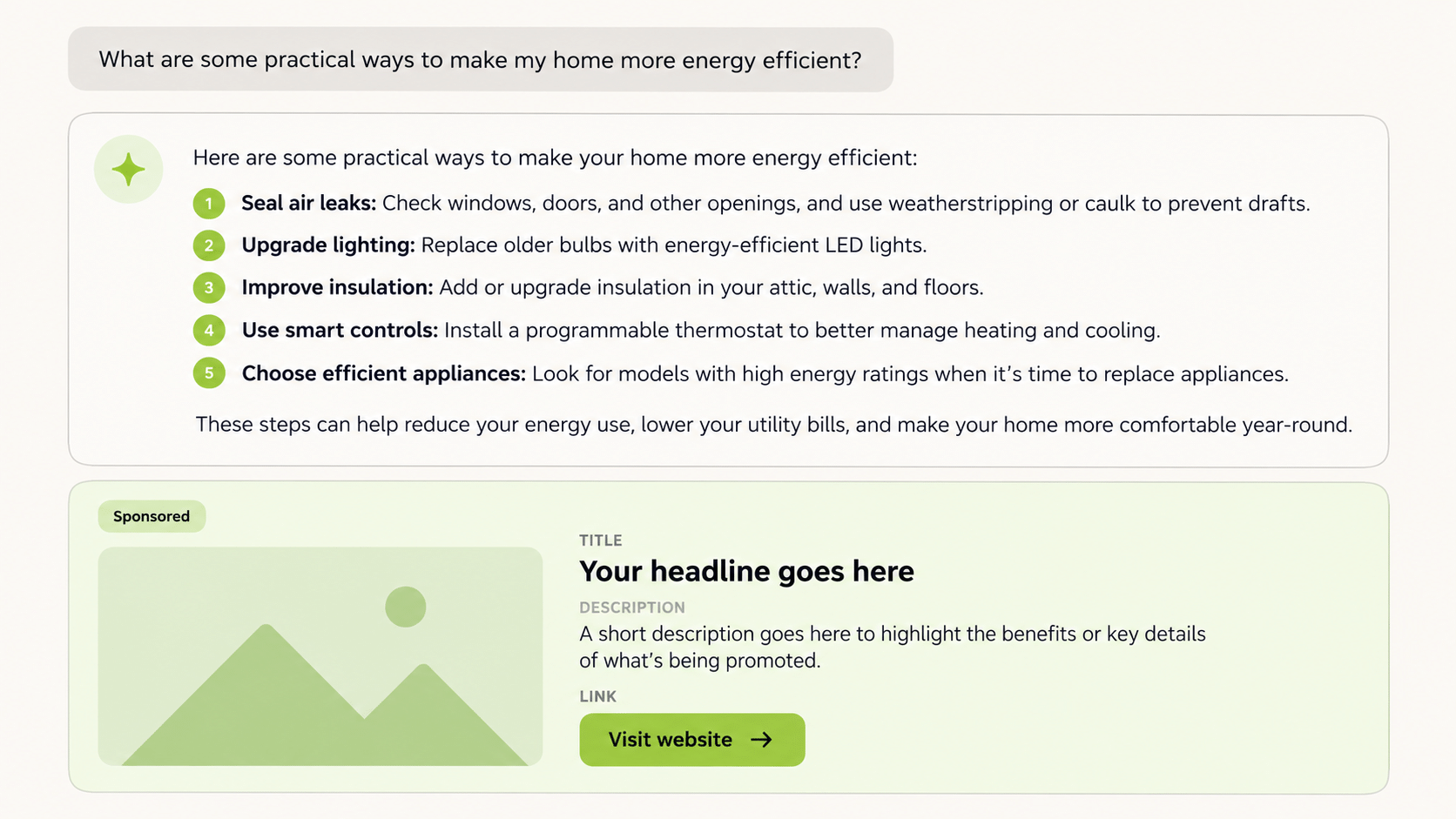
OpenAI ads are paid placements inside ChatGPT, the conversational assistant. Instead of appearing in a feed or beside search results, an ad appears after the assistant has answered a question, in a card marked as sponsored. The card typically carries a title, a short description, an image, and a destination link.
The format matters for two reasons. First, the surrounding content is a conversation, which gives advertisers a different kind of context from a page or a feed. Second, the assistant’s answer is the product, so OpenAI has been explicit that ads are separate from it: it says advertisers cannot rank, shape, or alter ChatGPT’s responses.
This guide separates three kinds of statement. What OpenAI says itself is attributed to OpenAI. What secondary sources report is labelled as reported. Anything unconfirmed is flagged as such.
When Did OpenAI Ads Launch and Who Sees Them?
Secondary guides report that OpenAI ads began in the United States on 9 February 2026 and were shown to logged-in adult users on the free and Go tiers, with paid tiers kept ad-free. They also report expansion to dozens of countries since then. OpenAI’s own page on buying options says it has broadened access through partners and is introducing beta self-serve tools for advertisers.
Availability varies by country and changes quickly. If you plan a campaign, check the current market list in OpenAI’s advertiser documentation instead of relying on a guide’s snapshot.
How Do OpenAI Ads Work?
The reported mechanics are consistent across sources.
- Placement. A sponsored card below the assistant’s response.
- Matching. Ads are matched to the topic of the active conversation. One guide describes advertisers writing plain-language context hints that are matched to live conversations, rather than choosing keywords or user profiles.
- Auction. Reported as a relevance-weighted auction in which several eligible ads compete, though the exact rules are not something this article can confirm.
- Restrictions. Reported exclusions include political advertising and conversations touching health, mental health, or politics.
Because the system is new, treat any claim about targeting depth or ranking as provisional.
How Much Do OpenAI Ads Cost?
Reported pricing has changed several times since launch, which is itself the main finding.
| Period | What secondary sources report |
|---|---|
| Launch (early 2026) | High CPMs (one source says about $60) and large minimum commitments |
| Spring 2026 | Click-based bidding added; minimum commitment reportedly removed; CPMs reported near $25 |
| Now | OpenAI says it is introducing beta self-serve tools; one source reports conversion bidding in testing with select advertisers |
These figures come from blogs and agency guides, they disagree on some details, and they may be out of date by the time you read this. Use them to understand the direction of travel, not to build a budget. The OpenAI ads cost that matters is the one quoted inside your own account or by your partner.
A sensible approach is to treat OpenAI ads as a test line with a capped budget, a clear goal, and a fixed review date, and to compare its cost per result with your existing channels.
What About OpenAI Ads Revenue?
The phrase “OpenAI ads revenue” usually means two different things: what OpenAI earns from advertising, and what advertisers earn from it. On the first, OpenAI has not published a detailed breakdown that this article can cite, and secondary projections should be treated as speculation. On the second, there is no reliable public benchmark for advertiser return yet, because the format is new and early results are mostly vendor claims.
For advertisers, that means the honest position is uncertainty. Measure your own results, and avoid copying a return figure from a blog.
What Do Early Advertiser Reviews Say?
OpenAI ads reviews from early advertisers and agencies tend to be cautious. Common themes in secondary coverage are interest in the high-intent context of a conversation, concern about measurement being less mature than in established ad platforms, and questions about how far targeting can go within OpenAI’s privacy and sensitivity rules. These are themes, not verdicts, and individual experiences will differ.
If you read reviews, check the date, check whether the author sells ad services, and check whether the figures refer to the current pricing model.
Where Do You Find Support?
Start with OpenAI’s own advertiser help documentation and its published announcements, since details such as eligibility, formats, policies, and billing are set there. If you work through an agency or partner, ask them what access they have and what reporting they can offer. Ask for the current policy on restricted categories before you build creative, because rejected ads cost time.
For support questions about billing or account access, use the channels named in OpenAI’s documentation and keep a record of your account details and campaign identifiers when you ask.
Should You Test This Format?
Consider a test if your product benefits from being shown at the moment someone is researching a decision, and you can tolerate an early, changing platform. Be cautious if your category falls under the reported exclusions, if you need mature conversion tracking from day one, or if you cannot afford a test that returns little information.
A simple test plan keeps it low risk.
- Set a capped budget you are comfortable losing.
- Choose one goal, such as visits to a specific page or leads.
- Write a few clear context descriptions and two or three creatives.
- Agree how you will measure before launch, including the attribution rule.
- Set a review date and a rule for continuing or stopping.
How Do These Ads Differ From Search and Social Ads?
Compared with established ad platforms, the format changes three things. In search, the trigger is a short query, while in a conversation the trigger can be a long, detailed description of a problem, which may reveal intent in more depth. In social feeds, ads interrupt browsing, while here the ad follows an answer the person asked for. And in both older channels, advertisers have years of measurement tooling, third-party integrations, and benchmarks, while this channel is new and those pieces are still forming.
That combination suggests who might benefit first. Products that people research with detailed questions, such as software, financial products, or travel, may find the context useful, provided the category is allowed. Impulse products that depend on visual discovery may find social feeds a better fit. Neither statement is proven, and both are reasons to test, not reasons to commit a large budget.
Teams also need to plan creative differently. A card with a title, a short description, and one image leaves little room, so the message has to be specific. Write for the person who just read an answer: what does your product add to what they now know? A generic slogan is likely to be ignored, while a clear, relevant next step has a chance.
What Should You Verify Before Spending?
Before you commit budget, check these points in OpenAI’s own documentation or with your partner.
| Question | Why it matters |
|---|---|
| Is your country supported? | Availability changes often |
| Is your category allowed? | Restricted topics are excluded |
| What bidding and billing options exist today? | Reported pricing has moved |
| What measurement is available? | Determines whether you can judge results |
| What are the formats and asset specifications? | Decides creative workload |
| What disclosure and labelling rules apply? | Required for compliance |
FAQs
What are OpenAI ads?
They are labelled sponsored placements shown inside ChatGPT, below the assistant’s answer.
Who sees these ads?
Secondary reports say users on the free and Go tiers, with paid tiers kept ad-free. Confirm current rules with OpenAI.
Can advertisers change ChatGPT’s answers?
OpenAI says advertisers cannot shape, rank, or alter ChatGPT’s responses.
How much do OpenAI ads cost?
Reported pricing has changed several times, and sources disagree. Check current terms with OpenAI or your partner.
Where can I get support for these ads?
Start with OpenAI’s advertiser help documentation and announcements, or your agency or partner.
Is it worth testing?
It depends on your category, goal, and tolerance for an early platform. A capped, measured test is the lowest-risk way to find out.
Where to Start
Read OpenAI’s current advertiser documentation, confirm that your country and category are eligible, and plan a small capped test with one goal and a fixed review date. Record what you learn so that the next budget decision rests on your own results. There is no separate OpenAI ads support route for campaign buyers unless OpenAI publishes one through its official channels.