Quick Answer
Online advertising platforms fall into a handful of types: search, social, display and native networks, marketplace and retail ads, and video. The right one depends on five things: your goal, where your buyers already spend time, the kind of creative you can produce, your budget, and how well you can measure results. Search tends to capture people who already want something, while social tends to create demand and awareness. Most advertisers should prove one platform against a clear goal before adding a second, and compare results in one place so the numbers can be read side by side.
What Are Online Advertising Platforms?
Online advertising platforms are the systems where advertisers buy ad space, set targeting and budgets, upload creative, and read results. Some are owned by a single publisher, such as a search engine or a social network. Others are networks that sell space across many third-party sites and apps.
The distinction matters because it shapes what you control. On a publisher’s own platform, you usually get detailed first-party targeting and reporting for that platform. On a network, you get reach across many sites, but less certainty about where each ad appeared. Neither is better in general. They answer different questions.
What Types of Online Advertising Platforms Exist?
| Type | How it works | Best for | Main trade-off |
|---|---|---|---|
| Search | Ads match what people type | Capturing existing demand | Costs rise in competitive categories |
| Social | Ads appear in feeds and short video | Awareness, discovery, retargeting | Needs a steady supply of creative |
| Display and native | Ads appear across many third-party sites | Broad reach, retargeting | Placement quality varies |
| Marketplace and retail | Ads inside shopping sites | Product sales | Tied to one marketplace |
| Video | Ads in streaming and video platforms | Brand awareness | Higher production effort |
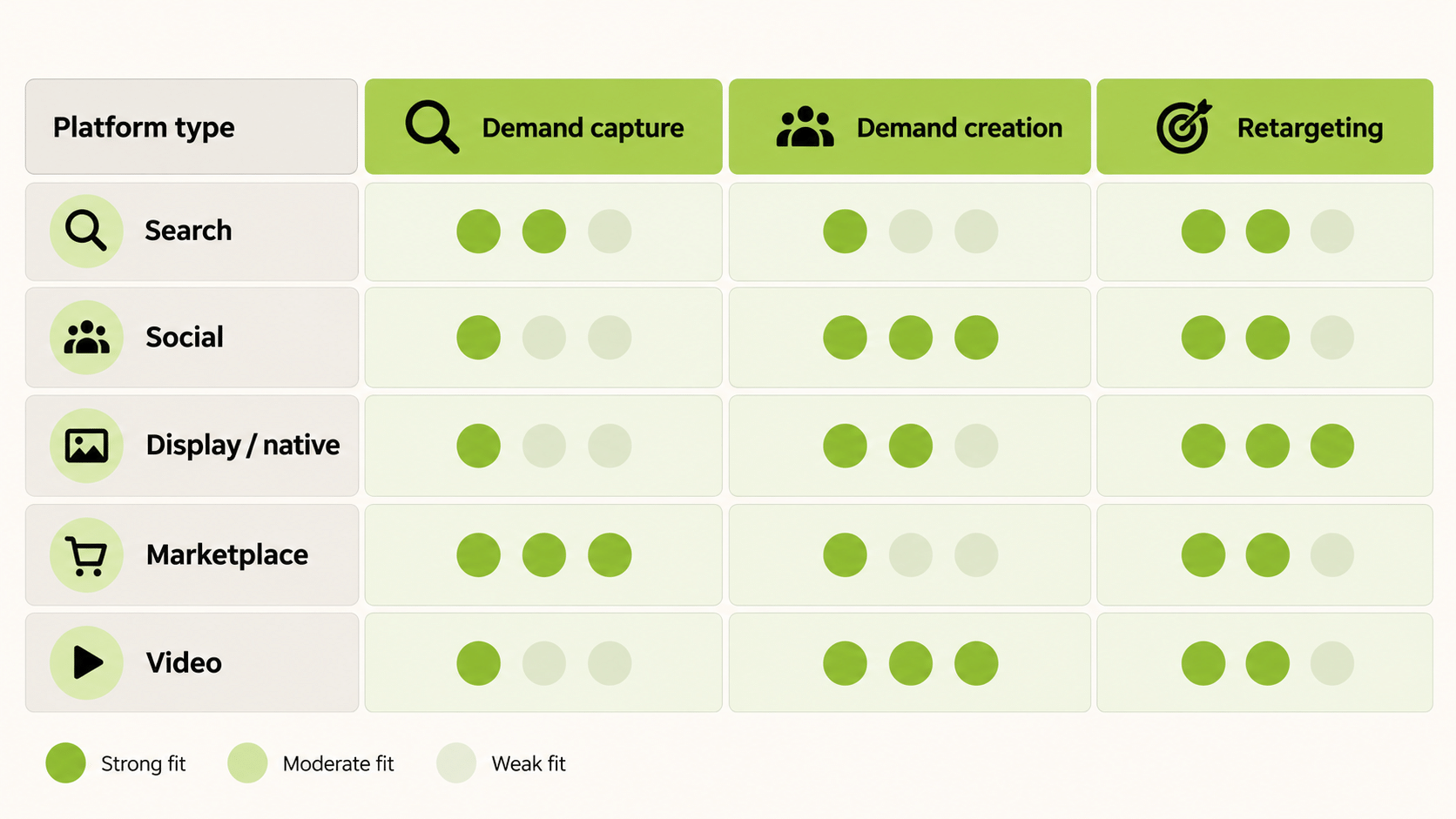
Search tends to reach people who are already looking for something specific. Social tends to reach people before they know they want it, which is why many brands pair the two. Sources comparing these options broadly agree on this split, and describe social as better for engagement and awareness and search as better for immediate orders.
How Do You Choose Between Online Advertising Platforms?
Use five questions, in this order.
- What is the goal? If you need orders this month, start where intent is highest. If you are launching a new product, start where discovery happens.
- Where is your audience? Younger audiences are commonly reached through short-video apps and visual social platforms, while professionals are commonly reached through business networks. Check your own customer data before relying on a generalisation.
- What creative can you produce? Search is driven by copy and a landing page. Social needs a stream of visual assets, hooks, and variations. A platform you cannot feed with creative will underperform.
- What is the budget? Small budgets do better concentrated on one platform than spread across four.
- Can you measure it? If you cannot track conversions on a platform, you cannot judge it. Install tracking before you spend.
If two platforms look equally good on paper, pick the one you can measure more easily and test it first.
What Should You Compare Across Online Advertising Platforms?
When you shortlist online advertising platforms, compare them on the same checklist rather than on features alone.
| Question | Why it matters |
|---|---|
| What targeting is available? | Affects how precisely you reach your audience |
| What formats does it support? | Decides how much creative work you need |
| What are the minimums and cost structure? | Sets your realistic test budget |
| What conversion tracking does it offer? | Determines whether you can judge results |
| How do reports export? | Matters when you compare against other channels |
| How much control do you get over placement? | Affects brand safety |
Ask for a live look at your own account where possible, and read the platform’s current help pages. Published benchmarks differ by source, season, and country, so use them only as a sanity check.
How Should You Run a First Test?
A simple test plan keeps the comparison fair.
- Pick one goal and one metric, such as cost per purchase or cost per lead.
- Choose one platform to start, or two at most.
- Set a budget high enough to produce enough results to read, not just enough to be live.
- Use similar creative and the same offer wherever the formats allow, so differences come from the platform.
- Run long enough for each platform’s learning or optimisation period to finish before you judge.
- Record the date, spend, and result for each test. After a month or two you will have your own benchmarks, which are worth more than any blog’s average.
How Do You Compare Results When You Use Several Platforms?
Once you run more than one of the online advertising platforms, the practical problem is reading the results together. Each platform names metrics differently, counts conversions with its own attribution window, and reports in its own interface. Moving numbers into a spreadsheet by hand each week is slow and error-prone.
FabFunnel’s Multi Ad Account Reporting shows Meta, TikTok, and NewsBreak alongside Google and Snapchat in one dashboard, so spend and performance can be read side by side. The boundary matters: FabFunnel launches campaigns on Meta, TikTok, and NewsBreak, while Google and Snapchat are connected for reporting only. The columns follow each platform’s own metrics, so check them before you use the dashboard for client reporting.
Whatever tool you use, write down your reconciliation rule: which number is the source of truth, which attribution window you apply, and how you handle platform-reported figures that disagree with your backend sales.
How Do Budget and Creative Capacity Change the Answer?
Two practical limits decide more choices than strategy does. The first is budget. Every platform needs enough spend to leave its learning period and produce readable results, and that minimum is higher for conversion goals than for awareness. If your monthly budget is small, one platform with a real test beats three platforms with token spend.
The second is creative capacity. A search campaign can run for months on a handful of ads and a good landing page. A social campaign can burn through a set of creatives in weeks, because frequency builds fast. Before you commit, count how many fresh videos or images your team can produce each month, and choose accordingly. A realistic plan with fewer assets beats an ambitious plan that stalls after the first batch.
Finally, think about who will manage the account. Some platforms reward daily attention, while others can run on a weekly review. Match the workload to the people you actually have.
What Mistakes Do Advertisers Make When Choosing?
The common mistakes are choosing a platform because a competitor uses it, spreading a small budget across too many platforms, launching without conversion tracking, judging a test before the learning period has ended, and expecting one platform to do every job. Search will not build awareness for an unknown brand, and social will not always close a sale on its own.
Another mistake is treating a platform’s reputation as a plan. A platform that works for a consumer brand may not suit a business-to-business product, and the reverse is also true. Let a short, well-measured test decide.
How Often Should You Reassess Your Platform Mix?
Review the mix of online advertising platforms on a fixed rhythm. Check delivery and spend weekly, compare cost per result across platforms monthly, and reconsider the whole mix quarterly. Platforms change formats, costs, and rules, so a choice that was right six months ago may not be right now.
When you add a platform, do it with a clear question, such as “can this reach customers our current platform cannot?” When you remove one, do it because the numbers say so, not because a single week went badly.
FAQs
What are online advertising platforms?
They are the systems where advertisers buy ad space, set targeting and budgets, and measure results. Examples include search, social, display, marketplace, and video platforms.
What are the best online advertising platforms for a small business?
There is no single best option. Search suits people already looking for your product, and social suits discovery. Choose by goal, audience, creative, and budget.
How do I choose between search and social advertising?
Use search to capture existing demand and social to create new demand. Many advertisers use both once one has been proven.
How many online advertising platforms should I start with?
One or two. A small budget spread over many platforms produces too little data on any of them.
What should I measure first?
Pick one result, such as cost per purchase or cost per lead, and track it the same way on every platform.
Can FabFunnel launch campaigns on every platform?
No. FabFunnel launches campaigns on Meta, TikTok, and NewsBreak. Google and Snapchat are connected for reporting only.
Where to Start
Write down your goal, shortlist two platforms with the five questions above, and run a measured test with a fixed budget. To read your results from several online advertising platforms in one place, try the reporting at FabFunnel or explore the full toolset at Fab AI. An online ads platform can look like one of the best online ad platforms in a demo, but the best platform to advertise your business is the one that matches how your customers discover and buy.