Quick Answer
Paid advertising platforms let you pay to put ads in front of a defined audience, and they differ mainly in three ways: how they charge (per click, per thousand impressions, or per action), how people find your ad (they search for it, or they scroll past it), and how much control you get over targeting, creative, and measurement. Search-based pay per click platforms such as Google Ads and Microsoft Advertising capture existing intent. Social platforms such as Meta and TikTok create discovery. Cost figures in published guides conflict, so compare platforms on cost per result in your own account, not on blog averages.
What Are Paid Advertising Platforms?
Paid advertising platforms are the systems where advertisers bid for ad placements, set targeting, upload creative, and read results. You fund a budget, the platform runs an auction each time an ad slot opens, and you pay according to the model you chose.
Some paid ad platforms are search engines, some are social networks, and some are networks that distribute ads across many third-party sites. The differences matter because the same budget behaves differently in each. A dollar on a search ad buys a visit from someone who typed a query. A dollar on a social ad buys attention from someone who was doing something else.
How Do Paid Advertising Platforms Charge?
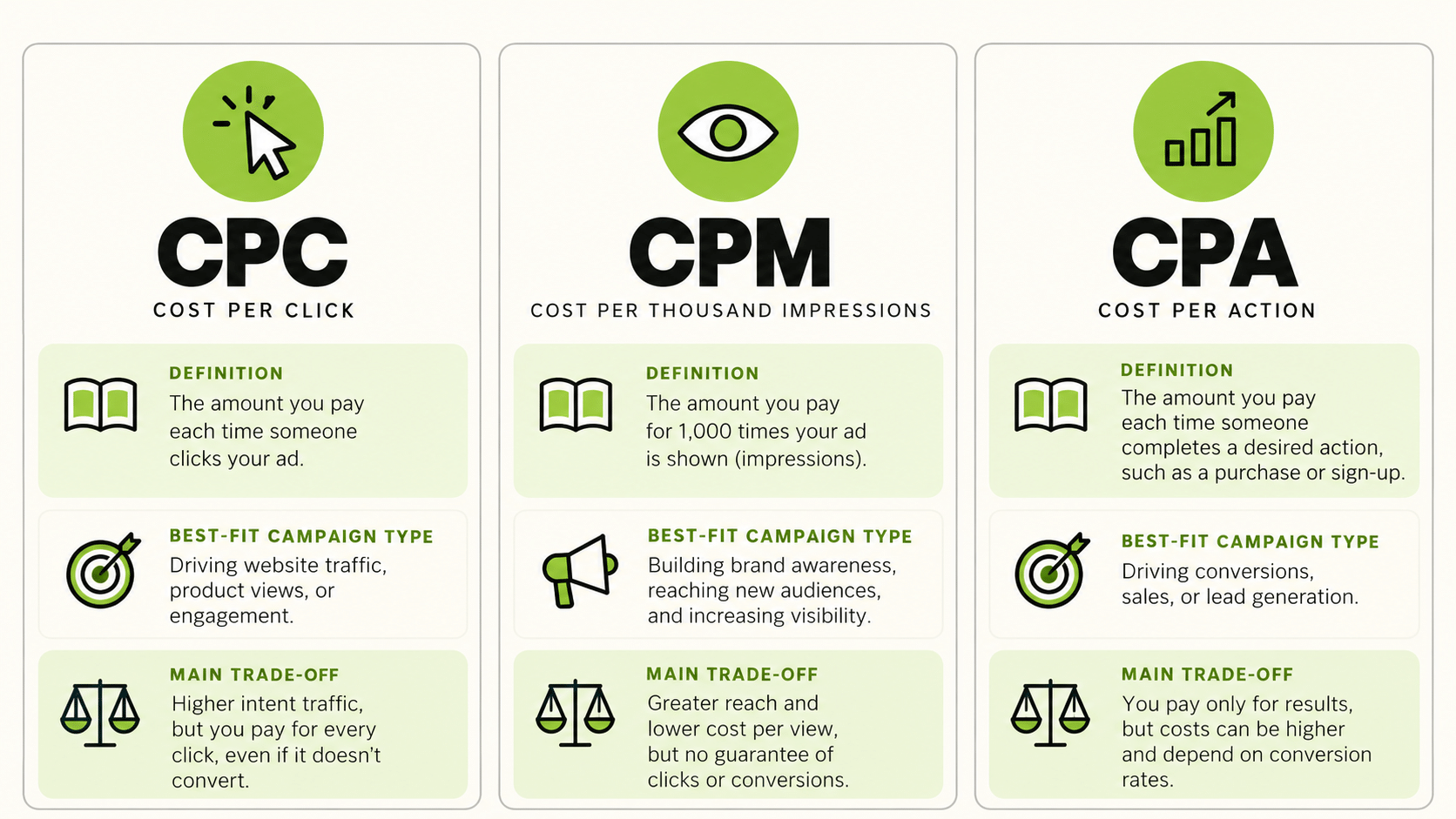
Most paid advertising platforms offer a choice of pricing models, and the model you pick changes your risk.
| Model | You pay for | Best for | Watch out for |
|---|---|---|---|
| CPC (cost per click) | Each click on your ad | Traffic, lead generation | Clicks that do not convert |
| CPM (cost per thousand impressions) | Every thousand times the ad is shown | Awareness, reach | Paying for views no one acts on |
| CPA or optimised conversion | A result such as a purchase or lead | Performance goals | Needs reliable conversion tracking |
In most auctions, the price you pay is shaped by your bid, the quality or relevance of your ad, and the competition for the same audience. Platforms that reward relevant ads can charge less for strong creative, which is why the same bid can win cheaply for one advertiser and fail for another.
Automated bidding is now common across paid advertising platforms. It lets the platform adjust bids towards a goal such as a target cost per acquisition. It works best when conversion tracking is accurate and there is enough data to learn from.
How Do Pay Per Click Platforms Differ From Social Platforms?
Pay per click platforms and social platforms are built on different signals.
Search-based PPC. On Google Ads and Microsoft Advertising, your ad is matched to what a person types. Intent is high, but so is competition, and costs vary widely by industry. Published averages range from a dollar or two in lower-competition categories to far more in expensive ones such as legal or finance.
Social. On Meta and TikTok, ads are matched to interests, behaviours, and audience data, not to a search. Reported click costs are often lower than search, but people are not actively looking for you, so conversion rates can be lower and creative matters more.
Neither is better by default. Many advertisers use search to capture demand that already exists and social to create new demand, then compare the two on cost per result.
What Features Matter When You Compare Paid Advertising Platforms?
Compare platforms on the same checklist, not on feature lists.
| Feature | Why it matters |
|---|---|
| Targeting depth | Controls how precisely you reach your audience |
| Formats | Decides the creative work you need |
| Bidding options | Affects how much control you keep |
| Conversion tracking | Decides whether you can judge results at all |
| Reporting and exports | Matters when you compare against other channels |
| Minimum spend | Sets the realistic size of a first test |
Ask to see your own account data inside any tool before you commit, and read the platform’s current help pages for the exact options available to you.
What Do the Best Paid Advertising Platforms Have in Common?
Lists of the best paid advertising platforms usually name the same few: Google Ads, Microsoft Advertising, Meta, TikTok, and LinkedIn. They earn that place by reach, targeting depth, and measurement, not because any one of them wins for every business. The best pay per click advertising platforms for you are the ones that reach your buyers at a cost your margin can support.
Be sceptical of rankings that give a single winner. A platform that is best for a software company selling to professionals may be wrong for a consumer brand selling a low-cost product. Pick two candidates on the strength of your audience and goal, then let a measured test decide.
How Do You Judge Costs Fairly?
Cost per click is the most quoted number and the least useful on its own. A cheap click that never converts is more expensive than a costly click that does. Use cost per result, measured the same way on every platform, and compare it with your margin.
Published benchmarks conflict because they count different things: all clicks versus link clicks, different industries, different countries, different years. Treat them as a rough range and replace them with your own numbers after a test. Keep a simple log with the platform, date range, spend, and result. After two or three tests, you will have benchmarks that fit your business.
What Mistakes Waste Budget on Paid Platforms?
The most common error is judging a platform by clicks instead of results. A campaign with a low cost per click and no conversions is losing money quietly. The second is launching without tracking, which leaves automated bidding with nothing to learn from. The third is changing budget, audience, and creative together, which makes any result impossible to explain.
Others are quieter. Teams copy a competitor’s platform mix without checking whether the audience is the same. They split a small budget across four platforms, so none produces enough data. They ignore the landing page, then blame the platform for poor conversion. And they stop a test early because one bad week looked alarming.
A short written plan prevents most of these: the goal, the metric, the budget, the review date, and the rule for deciding. Put it in a shared document so that anyone reviewing the account can see what was supposed to happen.
How Do You Run a Fair Test Across Paid Advertising Platforms?
A fair test needs a few controls.
- One goal and one metric, such as cost per lead.
- Comparable budgets, large enough for each platform to leave its learning phase.
- The same offer and a similar message, adapted to each format.
- The same attribution rule, so that numbers are comparable.
- A fixed review date, so you do not judge a platform on day two.
If one platform needs a creative stream that your team cannot supply, include that effort in your cost comparison. A platform that looks cheap but needs ten new videos a month may cost more than one that runs on a few good ads.
How Do You Read Results From Several Platforms Together?
Once you use more than one of the paid advertising platforms, reading them side by side becomes the hard part. Each platform has its own interface, its own metric names, and its own attribution window.
FabFunnel’s Multi Ad Account Reporting shows Meta, TikTok, and NewsBreak alongside Google and Snapchat in one dashboard. FabFunnel launches campaigns on Meta, TikTok, and NewsBreak, while Google and Snapchat are connected for reporting only. The columns follow each platform’s own metrics, so check them before you use the dashboard for client reporting. Whatever tool you use, write down which number is your source of truth and how you treat platform figures that disagree with your backend sales.
FAQs
What are paid advertising platforms?
They are the systems where advertisers bid for ad placements, set targeting and budgets, and measure results. Search engines, social networks, and ad networks are the main types.
What are the best pay per click advertising platforms?
Google Ads and Microsoft Advertising are the best-known search platforms, and Meta and TikTok are the best-known social platforms. The best choice depends on your audience and goal.
What is the difference between CPC and CPM?
CPC charges per click. CPM charges per thousand impressions, whether or not anyone clicks.
How much do paid ad platforms cost?
There is no fixed price. Costs depend on the auction, your industry, your audience, and your creative. Compare cost per result in your own account.
How many platforms should I start with?
One or two. A small budget spread across many platforms produces too little data on any of them.
Can FabFunnel launch campaigns on every platform?
No. FabFunnel launches on Meta, TikTok, and NewsBreak. Google and Snapchat are connected for reporting only.
Where to Start
Choose one goal, shortlist two platforms, and run a measured test with a fixed budget and one attribution rule. To read your results from several paid advertising platforms in one place, try the reporting at FabFunnel or explore the full toolset at Fab AI.