Quick Answer
To advertise with Instagram, you create a campaign in Meta Ads Manager, choose an objective that supports Instagram placements, pick Instagram Feed, Stories, Reels, or Explore (or let Meta’s Advantage+ placements choose), and upload creative that fits each format. Instagram ads cost whatever the auction sets. Published 2026 benchmarks cluster around $7 to $12 per thousand impressions and $0.70 to $1.30 per link click for mainstream consumer categories, but figures vary widely by source, industry, and season, so use them only for first-pass planning. Start with a modest daily budget, one objective, and two or three vertical creatives, then judge results against your own cost per result.
How Do You Advertise with Instagram?
You need an Instagram account to be the face of your ads, images or videos that meet the format requirements, and an objective that can use Instagram as a placement. Instagram ads are bought through Meta’s system, so you build them in Meta Ads Manager rather than inside the Instagram app, although you can also boost an existing post or reel from your profile.
The main route looks like this.
- Connect your accounts. Link your Instagram account and your Facebook Page in Meta’s business settings.
- Choose an objective. Awareness, traffic, leads, sales, and app promotion are the common ones. Meta says all major objectives support Explore, and most support the other Instagram placements.
- Set audience, placements, budget, and schedule at the ad set level.
- Build the ad with your creative, text, and call to action.
- Review and publish, then leave the campaign alone through its learning period.
Boosting is the fast way to advertise with Instagram. Per Meta’s help pages, a boosted reel must be 90 seconds or less in full-screen 9:16 vertical format, and it can then appear in the Reels tab, Explore, Feed, and Stories. Boosting gives you fewer controls than Ads Manager, so most businesses move to Ads Manager once they want to test audiences and formats.
Which Placements Can You Use When You Advertise with Instagram?
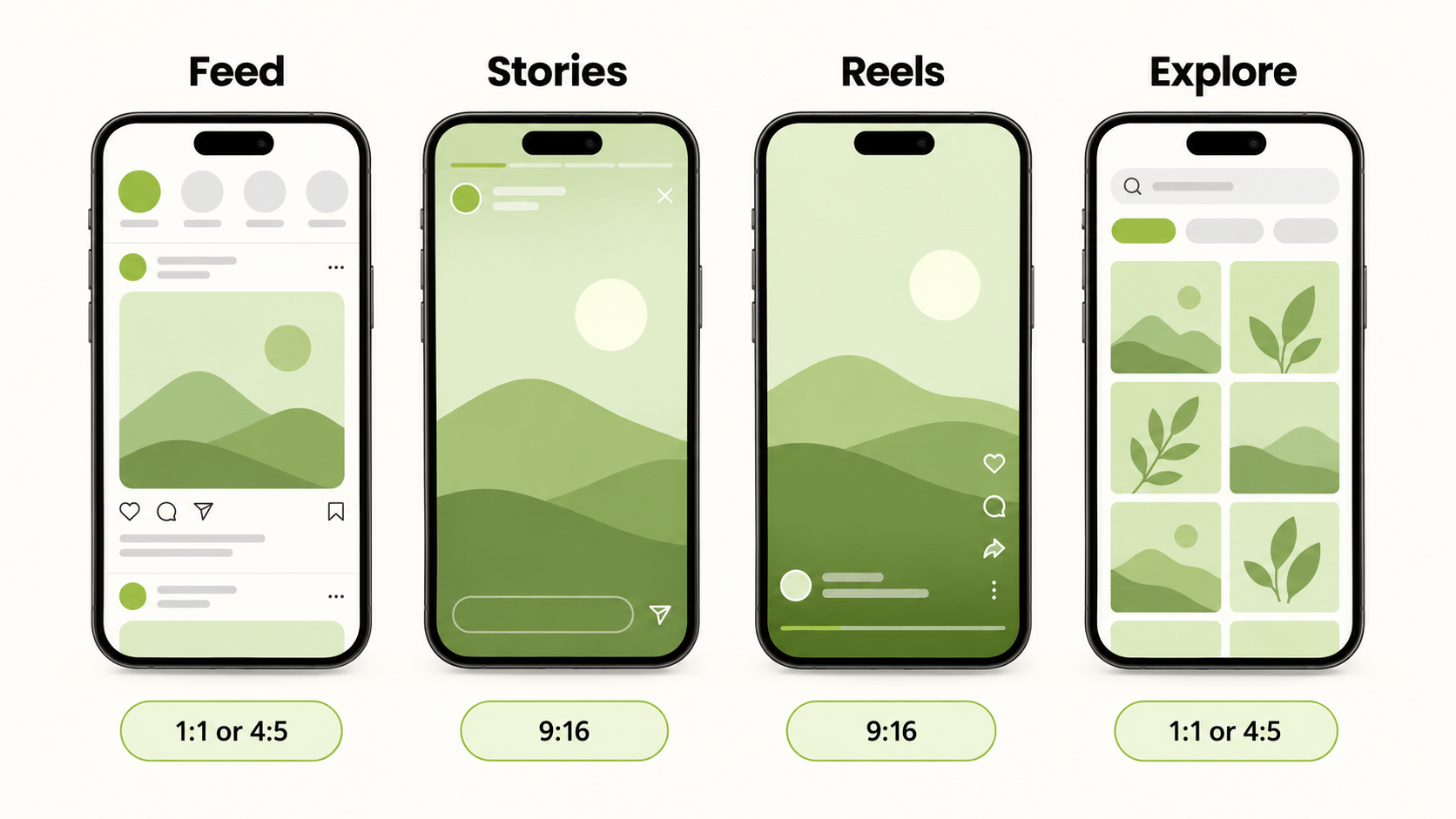
Meta groups Instagram inventory into placements. Each one suits different creative.
| Placement | Where it appears | Creative notes |
|---|---|---|
| Feed | The main scrolling feed in the mobile app | Image, video, or carousel |
| Stories | Full-screen vertical ads between people’s Stories | 9:16 vertical is recommended |
| Reels | The immersive Reels viewer | Short vertical video |
| Explore | The browsing view that opens when someone taps a photo or video | Meta says Explore is not a standalone placement, so ads must also run in Feed |
| Shop | Shopping surfaces in the app | Needs product setup |
Meta has retired In-Stream video ads, so you will not see that option now. Because placements change, check the list in Ads Manager when you build your ad set.
Business ads on Instagram usually take one of a few shapes: a single image, a single video, a carousel with several cards, or a collection that links to a catalogue. For a first campaign, a short vertical video and a single image are enough to learn from.
Should You Use Automatic or Manual Placements to Advertise with Instagram?
Meta’s Advantage+ placements spread your ads across Facebook, Instagram Feed, Stories and Reels, Messenger, and Audience Network. Meta reports an average cost-per-result improvement of 11.7% for ad sets that use them, which is a vendor figure, so treat it as directional.
Manual placements give you control. If you pick them yourself, Meta advises selecting at least six, and says adding more placements does not raise the cost of your ad. A practical approach: start with automatic placements to learn where delivery lands, then check the breakdown by placement and move to manual only if one placement is clearly dragging results.
If your brand needs strict control, for example when one creative only works in a vertical full-screen format, build separate ad sets for each format instead of one set that tries to serve all of them.
How Much Do Ads on Instagram Cost?
There is no fixed price. Ads on Instagram are sold through an auction, and the price depends on your audience, your objective, your creative quality, the season, and the competition. Three numbers matter most: CPM (cost per thousand impressions), CPC (cost per click), and cost per result.
Before you advertise with Instagram, it helps to see what others report. Published 2026 benchmark roundups from marketing agencies give a rough picture, and they disagree with each other.
| Metric | Range cited by third-party sources |
|---|---|
| CPM | About $6 to $12 for typical consumer categories; higher in Q4 and competitive niches |
| CPC (link clicks) | About $0.50 to $1.30 depending on source and definition |
| CPC (all clicks) | About $0.40 to $0.70 |
Treat these as directional. They come from agency blogs rather than Meta, they count clicks differently, and some mix in older data. Seasonal peaks such as Black Friday push prices up, and costs run far higher in expensive verticals than in cheap ones. The cost of advertising on Instagram for your business is the number in your own account after a proper test.
For the ads on Instagram cost question at the budget level, Meta’s older pricing guidance suggests starting with at least $5 and running longer than six days. That is a practice suggestion, not a platform minimum, and the page is several years old. Check the minimum shown in Ads Manager for your currency and objective.
How Do You Set a Budget to Advertise with Instagram?
Before you advertise with Instagram at scale, work backwards from the result you need. Decide the outcome (for example, 50 purchases or 200 leads), estimate an acceptable cost per result from your margin, and multiply to get a test budget. Then divide by the number of days you plan to run.
A few rules keep the maths honest.
- Give each ad set enough volume to learn. Meta’s guidance for app campaigns is to aim for about 50 events over a 7-day period, and the same logic applies to other objectives: a budget too small to produce results gives you no signal.
- Choose daily or lifetime budgets on purpose. Daily budgets suit steady always-on spend. Lifetime budgets suit a fixed promotion window.
- Do not split a small budget across many ad sets. Two or three ad sets with real spend beat ten that each get pennies.
If the maths gives you a daily number your business cannot afford, narrow the goal rather than cut the budget. Aim for add-to-cart or landing page views first, and move to purchases once the account has data.
What Creative Works When You Advertise with Instagram?
To advertise with Instagram well, build creative for the app. Shoot vertical, put the point in the first second or two, and add short on-screen text for people watching without sound. Faces, hands, and product in use tend to look more native than polished studio footage, though your own tests should settle that.
Keep one message and one call to action per ad. Match the landing page to the ad, with the same offer and a mobile-first layout. Plan to refresh creative: frequency builds quickly on smaller audiences, and the same ad shown for weeks usually fades.
How Do You Track Instagram Results Next to Other Channels?
Instagram ads run through Meta, so the numbers sit in your Meta account. The harder part is comparing them with TikTok, NewsBreak, Google, or Snapchat, where metrics and naming differ.
FabFunnel’s Multi Ad Account Reporting shows Meta alongside TikTok and NewsBreak, plus Google and Snapchat as reporting-only connections, so you can read spend and performance in one dashboard. FabFunnel launches campaigns on Meta, TikTok, and NewsBreak. Whether a specific Instagram placement option is available in a FabFunnel launch flow is not something this article can confirm, so check the product before you plan around it. The columns shown follow each platform’s own metrics, so confirm them before you use the dashboard for client reporting.
What Mistakes Waste Budget When You Advertise with Instagram?
The common errors are a weak first second, so the ad is scrolled past; sending clicks to a slow or mismatched page; splitting a small budget over too many ad sets; changing several variables at once, so nothing can be learned; and judging results on day one. Another is copying a benchmark from a blog as if it were a target. Use benchmarks to sense-check, not to set goals.
Review rhythm helps. Check delivery daily, creative weekly, and audience and objective only after a full test cycle.
FAQs
How do I advertise with Instagram?
Link your Instagram account in Meta, create a campaign in Meta Ads Manager with an objective that supports Instagram placements, choose placements, set a budget, and publish your creative.
How much do ads on Instagram cost?
There is no fixed price. Third-party 2026 benchmarks put CPMs around $6 to $12 and link clicks around $0.50 to $1.30, but your results depend on audience, objective, creative, and season.
What is the cost of advertising on Instagram for a small business?
It depends on the goal. Meta’s older guidance suggests starting from at least $5 a day for over six days, though that is a practice tip and not a rule.
Do I need a Facebook Page to run paid ads on Instagram?
Meta’s setup connects your Instagram account to your Facebook Page and business settings, so plan to link them.
Why advertise with Instagram instead of another network?
Its audience spends time in a visual, mobile-first app, and the formats suit product demonstrations. Awareness, traffic, leads, and sales are all available objectives. Whether it beats another channel for you is a question for a test.
Can I use FabFunnel for Instagram ads?
FabFunnel launches campaigns on Meta and reports across Meta, TikTok, NewsBreak, Google, and Snapchat. Confirm the specific Instagram placement options in the product before you rely on them.
Where to Start
To advertise with Instagram, link your accounts, pick one objective, and test two vertical creatives on automatic placements with a budget big enough to produce results. When your campaigns are live, you can follow Instagram and your other channels together at FabFunnel or explore the full toolset at Fab AI. When people compare cost advertising on Instagram, they should separate auction costs from creative and management costs. The Instagram ad platform does not publish a universal rate card.