Quick Answer
“AI marketing agent” is a newer, less standardized term than most people assume — it generally implies a system that can take multi-step actions toward a goal with less explicit configuration than a traditional rules engine, but the actual capability varies enormously by vendor. Before treating any specific product as an ai marketing agent in the fuller sense of the term, verify concretely what it decides on its own versus what it executes from a pre-set rule. The label alone doesn’t tell you which one you’re getting.
Vendors across marketing and advertising software have adopted “agent” language quickly, often applied to products that functioned as standard automation tools a year earlier. That doesn’t mean the underlying capability changed — sometimes it did, sometimes it’s the same rule-based system with new terminology. This piece is about how to tell the difference.
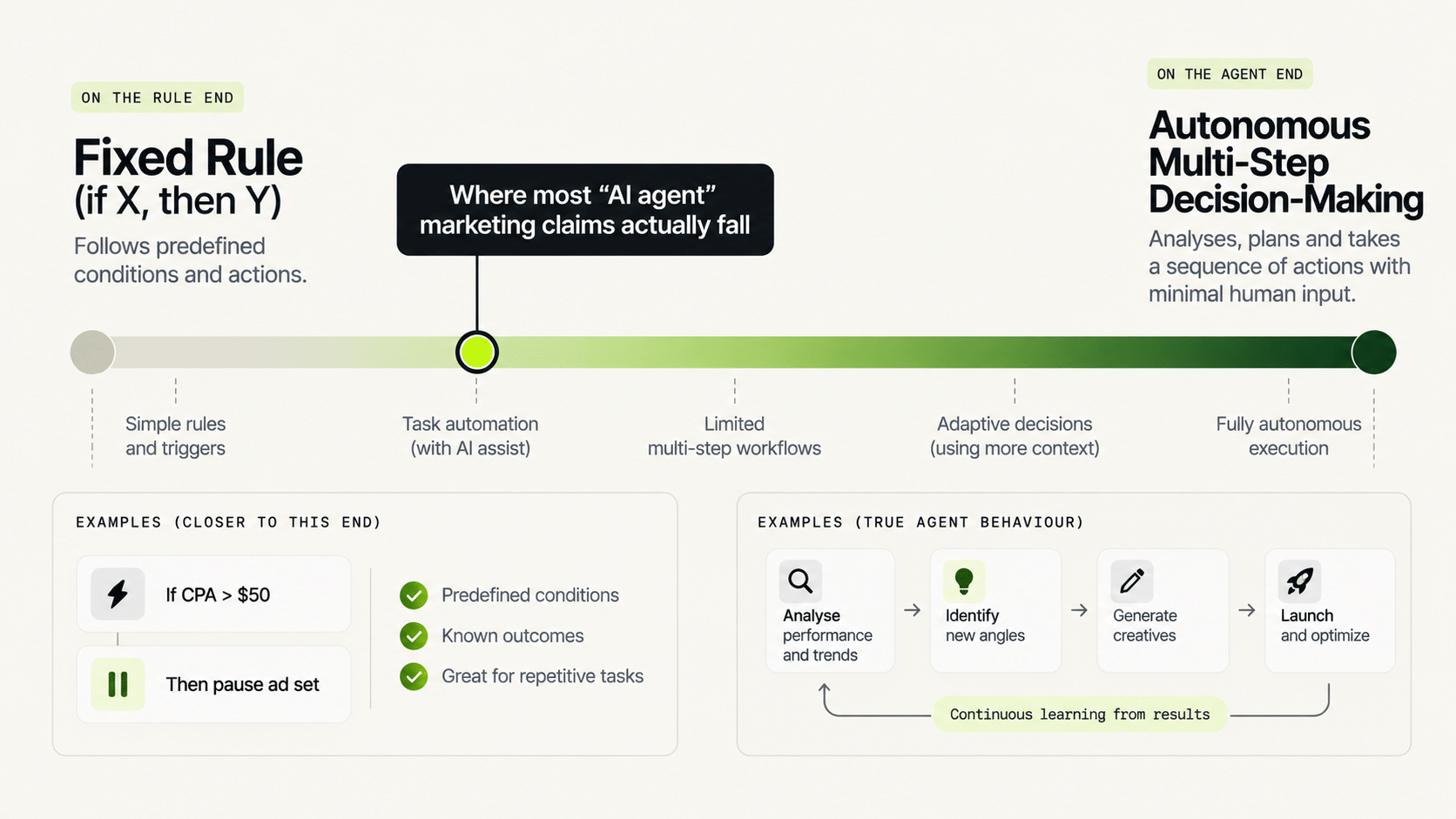
What Does “AI Marketing Agent” Actually Claim to Do?
In the fullest version of the claim, an agent takes a goal (increase ROAS, reduce CPA) and figures out a sequence of actions to get there, adjusting as it goes, with less person-specified logic than a traditional rule. That’s a substantially bigger claim than “if X, then Y” automation, and it’s worth treating as a claim to verify rather than a description to accept.
Why Is There a Gap Between “Agent” Marketing Language and Actual Capability?
Because “agent” has become a popular term across software broadly, and applying it to a product is often a positioning decision more than a technical one. Best ai agents for marketing claims should be evaluated the same way any technical claim should be: ask for a specific example of a decision the product made that wasn’t from a pre-configured rule, and what happens in a situation the system wasn’t explicitly set up to handle.
How Does This Differ From Sales and Marketing AI Agents More Broadly?
Sales and marketing ai agents often get described in similar terms across adjacent categories — lead qualification, email sequencing, ad management. The verification approach is the same regardless of category: does the “agent” decide, or does it execute a configuration a person set? A lead-qualification tool claiming agent status and an ad management tool claiming agent status should both be held to the same specific question.
What Should AI Agents for Marketing Teams Actually Be Evaluated On?
Not on the label, but on: what specific decision it makes without explicit configuration, what happens when it encounters something outside its expected scenarios, and whether its actions are logged in a way that lets you audit what happened and why. A tool that can answer all three concretely is demonstrating agent-like capability rather than just claiming it.
Verifying “Agent” Claims: Questions to Ask
| Question | What a Strong Answer Looks Like | Red Flag |
|---|---|---|
| What decision does it make without a pre-set rule? | A specific, concrete example | Vague description of “optimizing automatically” |
| What happens outside expected conditions? | A defined fallback or escalation to a person | No clear answer, or “it just handles it” |
| Is every action logged and auditable? | Yes, with the triggering condition and timestamp | No consistent audit trail |
| Does a person review or approve significant actions? | Clearly defined review points | Everything executes with no review step |
Does FabFunnel Market Itself as Having an AI Marketing Agent?
No — this is a deliberate distinction. FabFunnel’s Automation Rules Engine executes pre-configured conditions (CPA floors, ROAS thresholds, frequency caps) with every action logged, and Co-Pilot is a recommendation layer that surfaces patterns from live reporting data without executing changes automatically. Both are accurately described as rule-based automation and a recommendation system, not as an autonomous agent, because that’s what they actually do.
What Does an AI Marketing Agent Look Like in a Paid Ads Workflow?
For paid advertising, the useful version of the idea is narrower than the headline. Think of three jobs an agent-like system might take on: generating creative from a brief, executing launch and budget changes, and analysing performance to suggest what to do next.
In FabFunnel, those jobs map to separate, verifiable tools rather than one autonomous agent:
- Creative: Genie generates image and video ads from your Catalogue after you choose an ad mode, format, and approach.
- Execution: the Automation Rules Engine runs conditions you configure (CPA floors, ROAS thresholds, frequency caps) at campaign, ad set, and ad level, and logs every action.
- Analysis: Copilot answers performance questions in natural language, generates visual reports, and surfaces insights. It does not execute changes.
A person sits at each decision point. That’s less dramatic than the “agent” pitch, and easier to trust.
What Can a Marketing Team Realistically Delegate Today?
Delegate the mechanical, bounded work and keep the judgement calls:
- Variation production. Producing many versions of an approved concept across products.
- Threshold monitoring. Watching CPA, ROAS, and frequency around the clock.
- Report assembly. Pulling consolidated numbers across accounts instead of exporting by hand.
- First-pass diagnosis. Surfacing which campaigns look unusual, so you can look first where it matters.
Keep with a person: positioning, offer design, budget allocation between channels, and any decision where the cost of a wrong call is high. Whatever the product is called, ai agents for marketing teams are most useful when their scope is clear and their actions are visible.
How Should You Pilot an AI Marketing Agent Safely?
Treat any AI marketing agent like a new hire on probation. Give it a narrow job, a small budget, and a reviewer.
Start by writing the job in one sentence, for example: “pause ads that exceed the cost ceiling and report what was paused.” If the AI marketing agent cannot be held to a sentence like that, its scope is too vague to trust with live spend.
Next, cap the exposure. Run the pilot on one account, or a single campaign, with a daily spend limit you are comfortable losing. Decide beforehand what counts as a failure, such as an action nobody can explain, and agree to stop if it happens.
Then review the record every day for the first week. For each action the AI marketing agent took, ask three questions: what triggered it, was the trigger correct, and could I have predicted it from the settings? Actions that fail the third question are the ones that need the closest look, because they suggest decisions made outside your configuration.
Expand only after two clean weeks. Add accounts one at a time, and keep a person responsible for the outcome. Responsibility for results does not transfer to software, however the product is described.
FAQs
How long should I test an AI marketing agent before trusting it?
Two clean weeks on a single account is a sensible minimum. Judge it on whether every action can be traced to a condition you set or a decision you can inspect.
Is an AI marketing agent the same thing as a chatbot with marketing knowledge?
No — a conversational interface is a separate feature from autonomous decision-making. A tool can have a chat interface and still be executing standard rule-based logic underneath, or vice versa.
What’s the risk of trusting an “AI marketing agent” claim without verifying it?
If the system genuinely acts with less oversight than you assumed, it may take actions in situations you didn’t anticipate, on live budget or live campaigns, without the audit trail a rules engine provides.
Are ai agents for marketing teams ready to run campaigns unsupervised?
This varies significantly by product and by how narrowly the “campaign running” task is defined. Verify what specific actions happen without human review before relying on any tool this way.
How is a sales and marketing ai agent different from a standard CRM automation workflow?
The distinguishing claim is autonomous, less-explicitly-configured decision-making. A standard CRM workflow executes defined triggers; whether a specific “agent” product genuinely goes beyond that requires the same verification approach regardless of category.
Does calling something an “agent” mean it’s more advanced than rule-based automation?
Not necessarily. The term is applied inconsistently across the industry — verifying actual behavior matters more than the label a vendor chooses.
What should I ask a vendor pitching “the best AI agents for marketing”?
The three questions above: what it decides without a pre-set rule, what happens outside expected scenarios, and whether actions are logged and auditable. A vendor confident in their agent claim should answer concretely.
Where to Start
Before adopting a tool marketed as an AI marketing agent, verify what it actually decides versus what it executes from a pre-configured rule — the label alone won’t tell you. FabFunnel is transparent about this split: the Automation Rules Engine executes configured conditions with a full audit log, and Co-Pilot recommends without executing — start at FabFunnel or explore the full toolset at Fab AI.