Marketing automation existed before AI. The version most teams have been running – email sequences triggered by form fills, ad rules that pause when a budget cap is hit, reports that send on a schedule – works on fixed logic. Define the condition, define the action, done.
AI marketing automation is different in one important way: it adapts. Instead of executing the rules you wrote, it learns from data and adjusts decisions based on patterns that fixed rules can’t capture.
For businesses that have been running traditional automation and wondering whether AI changes anything meaningful – this guide covers what’s actually different, where the practical value is, and how to start.
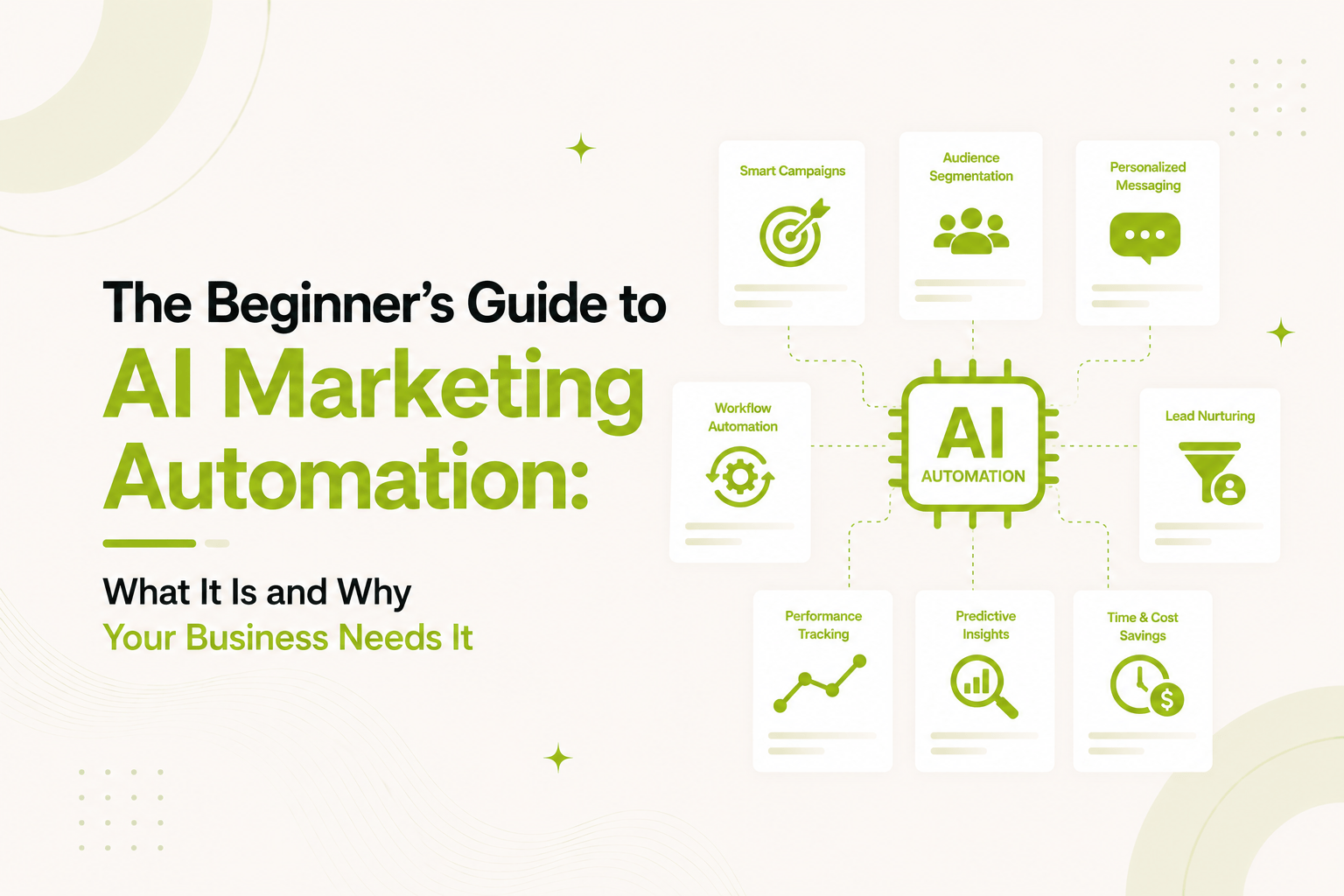
In short, AI marketing automation tools use machine learning to adjust decisions in paid ads, email, and social as new data comes in, instead of running the same fixed rules every time. AI for marketing automation works best when you start with one high-value process, and AI powered marketing automation (also called AI based marketing automation) still needs your strategy and your review.
What AI Marketing Automation Actually Is
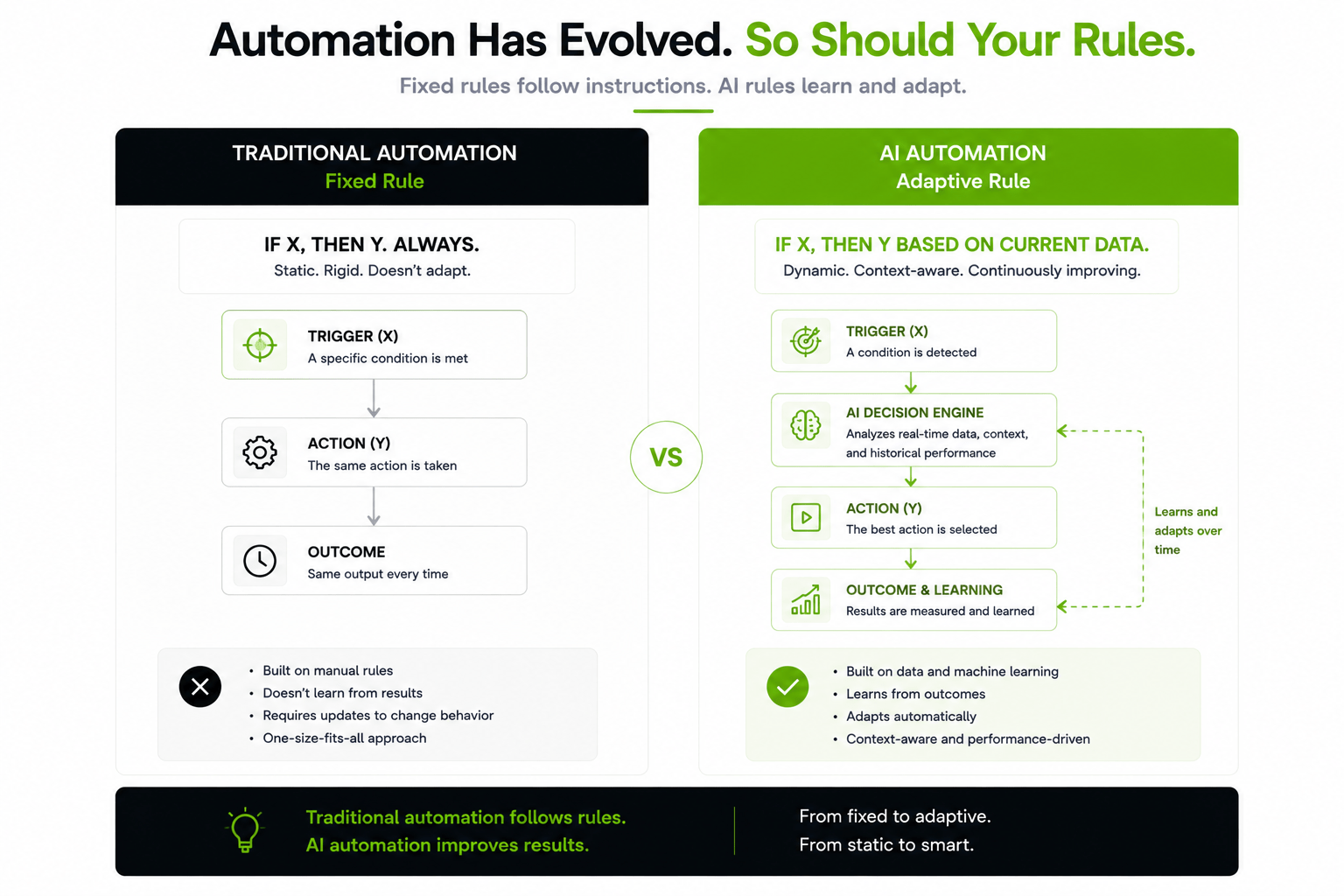
Traditional marketing automation is rule-based. If someone fills out a form, send this email. If an ad set’s CPA exceeds $50, pause it. If a customer hasn’t purchased in 90 days, trigger a re-engagement sequence. The rules are explicit, fixed, and execute exactly as written.
AI marketing automation uses machine learning to make decisions that adapt based on data rather than executing fixed conditions. The system learns which email send time produces the best open rate for each individual subscriber. It identifies which ad sets are trending toward underperformance before they cross a fixed threshold. It segments audiences based on behavioral patterns that weren’t defined upfront.
The practical difference: rule-based automation executes what you designed. AI powered marketing automation adjusts based on what it’s learning. Both are useful. They solve different problems.
| Area | Rule-based automation | AI marketing automation |
|---|---|---|
| How decisions are made | Fixed rules you define in advance | Machine learning that adapts to data |
| Ad pausing | Pauses when a set threshold is crossed, such as CPA above $50 | Spots ad sets trending toward underperformance before the threshold |
| Email send time | One fixed time for the whole list | Learned for each subscriber to improve open rates |
| Segmentation | Lists updated manually | Adapts to behavior patterns that weren’t defined upfront |
| Strength | Executes exactly as written | Adjusts to patterns fixed rules can’t capture |
Where AI Marketing Automation Creates Real Value
Paid Advertising
This is where the impact is most direct and most measurable.
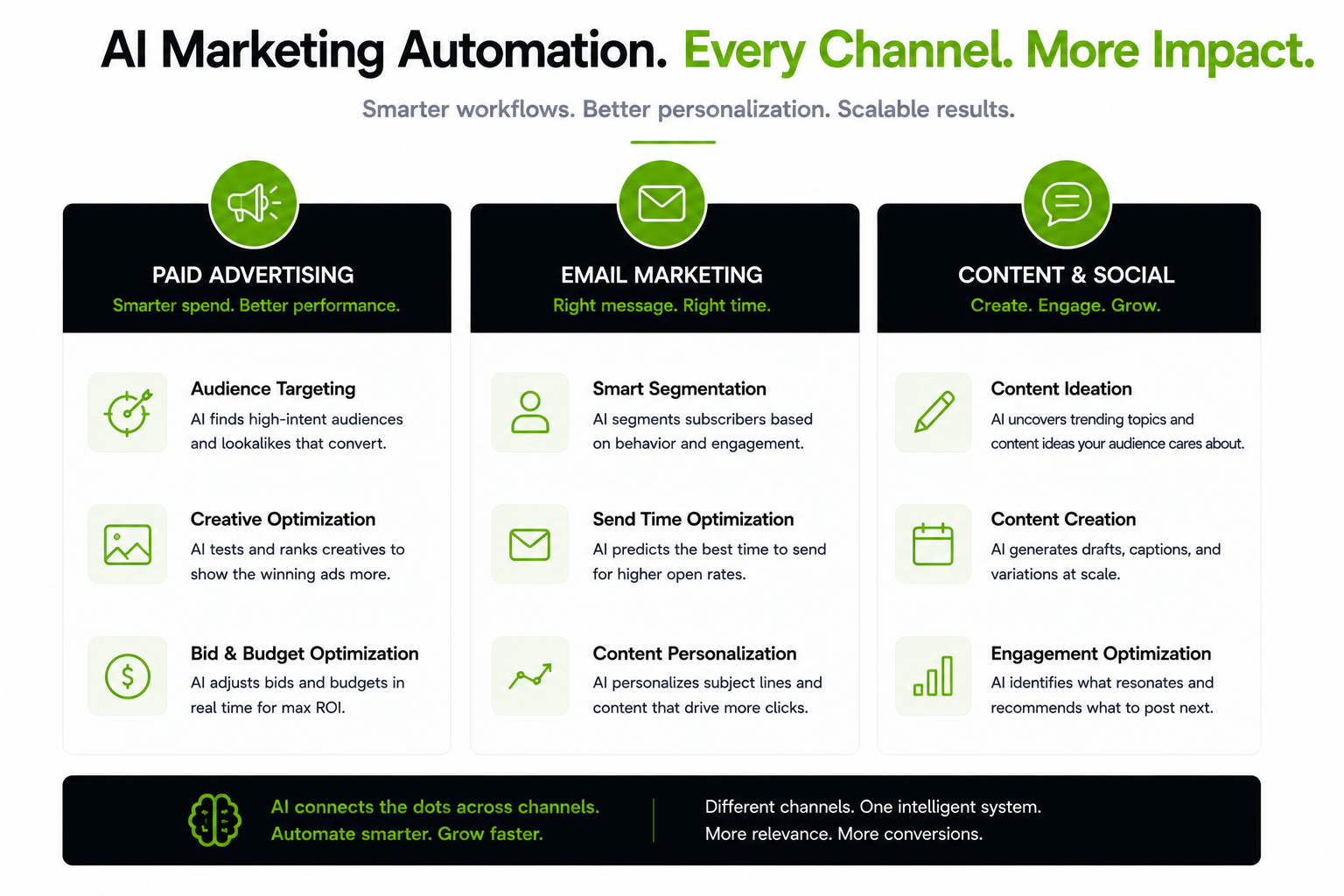
AI marketing automation in paid advertising handles three decisions that used to require constant manual attention: when to pause underperforming campaigns, when to scale campaigns that are exceeding targets, and how to reallocate budget across the account when performance shifts.
Rule-based versions of these exist – most media buyers have some form of auto-pause and auto-scale rules running. What AI adds is context-sensitivity. A fixed rule that pauses an ad set when CPA exceeds $40 doesn’t know whether that spike is a data anomaly, a day-of-week effect, or genuine underperformance. An AI system that’s learning from the account’s historical patterns makes that distinction better over time.
The second difference is speed. Manual review operates on daily or weekly cycles. Automated rules typically run once or twice daily. AI automation running continuously can catch a bad ad set at $50 of wasted spend rather than $500.
Among AI marketing automation tools built for paid social, FabFunnel’s automation layer runs 24/7 at campaign, ad set, and ad level across Meta, TikTok, and NewsBreak – covering auto-pause, auto-scale, and budget reallocation with full audit logging of every automated action.
Email Marketing
AI marketing automation in email handles segmentation, send timing, and sequence adaptation in ways that fixed logic can’t.
Send time optimization is the simplest application – AI learns when each individual subscriber is most likely to open, rather than sending the whole list at a fixed time. The lift from this alone is measurable for many email programs.
More significant is adaptive segmentation – moving subscribers between engagement tiers based on real behavior rather than manually updating lists. Someone who was active three months ago and has gone quiet doesn’t stay in the “active” segment. They get routed to a re-engagement sequence automatically, before they’re formally classified as a dormant subscriber.
Sequence adaptation – adjusting the path through an email flow based on how a subscriber is behaving, not just whether they clicked a single link – is where AI automation produces the most compounding value. Subscribers who don’t respond to promotional framing get educational content. Subscribers showing high intent get accelerated toward a conversion offer.
Content and Social
AI automation in content and social is less mature than in paid advertising and email, but useful for specific applications.
Content scheduling and republishing – find what’s already got strong engagement history and push it back out automatically. Keeps organic channels alive without churning out new content every day.
Audience monitoring – catch trending topics and signals relevant to your audience as they happen, so teams can jump on a moment fast instead of babysitting every channel by hand.
What AI Marketing Automation Doesn’t Do
A clear-eyed view of the limitations:
It doesn’t replace creative strategy. AI automation manages and optimizes what’s already in market. Deciding what to test, what angle to run, and what the offer should be are still strategic decisions that require human judgment.
It doesn’t fix bad fundamentals. An AI automation system running on a weak offer, a poorly structured campaign, or an uncompetitive product doesn’t produce good results – it optimizes bad inputs slightly better. Automation amplifies what’s already there.
It doesn’t eliminate the need for human review. AI automation reduces the frequency and urgency of manual reviews, not the need for them entirely. Audit logs, performance trend reviews, and strategy adjustments still require human oversight.
It doesn’t manage brand judgment. What content is appropriate, what audiences should be targeted, and what claims are accurate are not automation decisions.
How to Start With AI Marketing Automation
Identify Your Highest-Value Manual Process
With AI for marketing automation, the first thing to automate is the manual process that takes the most time and has the most room for improvement – usually campaign management for performance marketers, email segmentation for ecom brands, or reporting for agencies.
Don’t start with everything. Start with the one process where automation has the clearest value and build from there.
Define What Success Looks Like Before You Start
Before enabling any AI automation, define the baseline. What is your current average CPA? How long does your team spend on campaign management per week? What’s your email open rate by segment?
These numbers tell you whether the automation is working six weeks later. Without a baseline, you’re measuring nothing.
Start With Guardrails
AI based marketing automation running without constraints can make decisions you don’t want. Start with conservative guardrails – auto-pause rules that require sustained underperformance over multiple days rather than reacting to single-day spikes, scale rules that require minimum conversion volume before firing, and budget caps that prevent runaway spend.
Loosen constraints as you build confidence in the system’s behavior. Don’t start open-ended.
Review the Audit Log
Every automated action should be logged. Review the audit log weekly in the first month of any AI automation deployment. You’re checking whether the system is making decisions you would have made, catching any configurations that need adjustment, and building institutional understanding of how the automation behaves.
The audit log is also your defense if something goes wrong – you can see exactly what the system did, when, and why.
The Takeaway: AI Marketing Automation Reduces the Tax on Manual Work, Not the Need for Strategic Thinking
The practical value of AI marketing automation for most businesses isn’t transformation – it’s leverage. The same team, operating the same strategy, executes more consistently, responds faster, and spends less time on repetitive operational tasks.
For a media buyer managing 10 client accounts, that leverage is significant. For an ecom brand running continuous paid campaigns, the ability to act on performance signals in hours rather than days is meaningful at any spend level.
The ceiling is set by the strategy and the inputs. AI powered marketing automation runs on what you give it – good data, clear objectives, and strong creative inputs. With those in place, the operational layer largely takes care of itself.
Ready to put it to work? Start your free trial or try Fab AI to run automation rules, campaign launch, and reporting across Meta, TikTok, and NewsBreak from one place.
Frequently Asked Questions
What Is AI Marketing Automation?
AI marketing automation is the use of machine learning to make marketing decisions that adapt based on data – adjusting campaign management, email segmentation, audience targeting, and budget allocation in response to real-time signals, rather than executing fixed pre-set rules.
How Is AI Marketing Automation Different From Regular Marketing Automation?
Regular automation is fixed rules – X happens, do Y, same way every time. AI automation actually adapts, picking up on patterns and context from past performance instead of running the same logic blind.
What Are the Best Use Cases for AI Marketing Automation?
Biggest impact shows up in paid advertising management (auto-pause, auto-scale, budget reallocation), email segmentation and send-time optimization, and cross-account reporting if you’re managing multiple clients or campaigns at once.
Why Use AI for Marketing Automation Instead of Fixed Rules Alone?
Fixed rules handle predictable conditions well, but they can’t tell a data anomaly from real underperformance. AI for marketing automation adds that context-sensitivity by learning from your account’s history, so decisions improve over time. In practice, you will probably want both: rules for what is clear-cut and AI for what shifts.
Is AI Powered Marketing Automation the Same as AI Based Marketing Automation?
Yes. The two terms are used interchangeably. Both describe marketing automation that uses machine learning to adapt its decisions from data instead of following fixed, pre-set rules.
How Much Do AI Marketing Automation Tools Cost?
It varies significantly by tool and application. Platform-native AI automation (like Meta’s Advantage+ features) is included in the cost of advertising. Third-party AI marketing automation tools like FabFunnel are priced as platform subscriptions – FabFunnel’s Growth Plan starts at $349 per month and includes automation rules alongside campaign launch, creative tools, and reporting.
Can Small Businesses Use AI Marketing Automation?
Yes. The leverage is often higher for smaller teams because each person is covering more ground. A single marketer using AI automation for campaign management and email can get closer to the output of a larger team. The key is starting with the highest-value use case rather than trying to automate everything at once.
What Should I Automate First With AI Marketing Automation?
Whatever eats the most manual time and has a clear metric attached to it. For most performance marketers that’s campaign management – auto-pause and auto-scale rules that react to performance without someone checking in daily. Ecom email programs are different: start with segmentation and send-time optimization.