Quick Answer: The right ad design tool for performance marketers is the one that produces many on-brand variants quickly and connects that output straight to a live campaign. Speed, brand consistency at volume, and native ad-format support matter more than raw design flexibility. Tools that stop at export force a manual handoff that slows down testing cycles.
Why This Category Matters for Performance Marketers
Performance marketers rarely design one ad. A single launch usually needs ten, twenty, or fifty versions of the same idea, tested across audiences and placements, which is why the ad design tool a team picks shapes how fast that testing can happen. The right one holds a brand kit steady across every variant, outputs the dimensions each platform expects, and gets creative into an ad account without a detour through a downloads folder.
A general design background is not the bar here. The bar is campaign cadence: how many variants a launch needs, how fast a new hook has to go live, and how much rework happens between “design finished” and “ad running.” Most ad design software was never built for this job, and most tools in the space only solve part of it.
What to Evaluate in an Ad Design Tool
Speed to Produce Multiple Variants
Every performance campaign runs on iteration. A single concept usually needs several sized and cropped versions, plus copy swaps for different audiences. A tool that requires rebuilding each variant by hand adds hours to a launch, while one built for this use case treats the variant as the default unit of work.
Brand Consistency at Volume
The faster a team produces creative, the easier it is for logos, colors, fonts, and product imagery to drift. Manual review catches this at low volume but does not scale past a handful of assets a week. A tool that pulls directly from a connected brand or product source, rather than relying on someone remembering the current palette, holds consistency without slowing the team down.
Native Ad-Format Support and Launch Connection
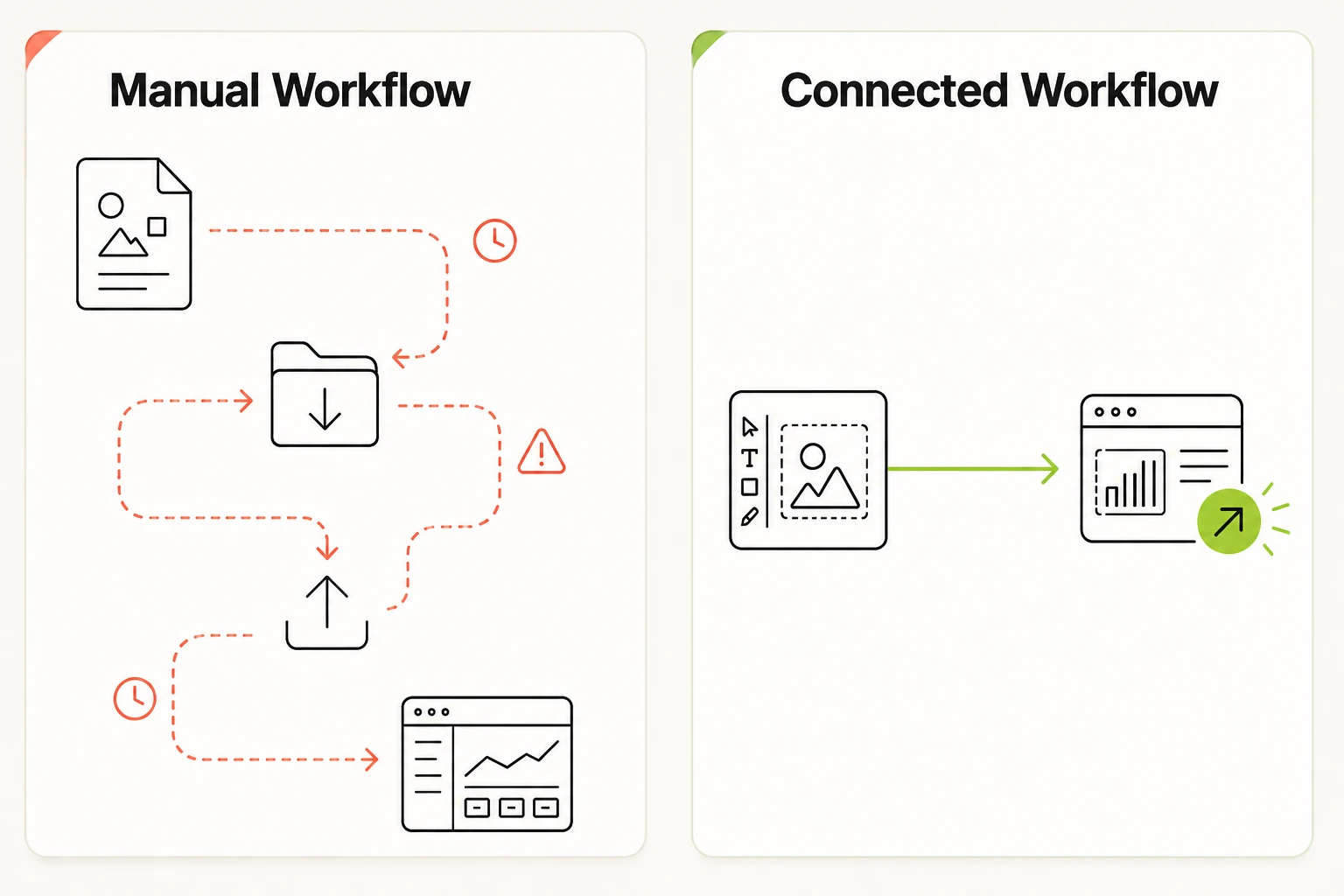
Generic image editors export flat files, while ad platforms expect specific aspect ratios, safe zones, and in some cases native creative structures for feed, story, and reel placements. A tool built around ad formats removes a layer of manual resizing. The bigger cost usually hides at the next step: a finished creative that still has to be downloaded, renamed, uploaded, and matched to the right campaign is not finished, it is halfway done. A tool that hands off directly into campaign creation removes that manual step for every variant, every launch.
Categories Worth Knowing
Traditional Design Software
Tools like Canva, Adobe Express, and Figma remain common starting points for ad creative, offering flexible canvases, template libraries, and brand kit features for fonts and colors, making them common entry points for online ad design work even outside dedicated ad platforms. Their strength is general-purpose design control across many kinds of output, not just ads. Their limitation is that ad-specific structure and platform launch are not the core design of the product, so producing dozens of on-brand variants and getting them live still runs through manual export and upload.
AI-Assisted Generation Tools
A newer category uses AI models to generate ad imagery or full concepts from a prompt, a product photo, or a brief, cutting the time to a usable first draft and in some cases supporting batch generation. Where this category varies most is brand control at scale: generation from a general prompt does not automatically know a company’s exact product catalogue, logo rules, or approved colors unless the tool pulls from that data directly. Most also stop at the generated image, leaving launch to happen elsewhere.
Generation-to-Launch Platforms
The third category combines creative generation with the infrastructure to launch it, closing the gap between a finished asset and a running ad. FabFunnel sits here. Its Genie tool generates static and video ads tied to a connected product Catalogue, across four modes (Product Ad, Brand Ad, Product Shoot, Performance Ad), built from scratch or from one of 200 pre-built frameworks. Output feeds directly into the Bulk Campaign Launcher through a “From Genie” flow, with no export or re-upload step.
Comparison Table
A comparison table is useful here because performance marketers are typically choosing between categories, not individual products, and the tradeoffs are structural rather than cosmetic. Speed, consistency, format support, and launch connection do not move together, so a table makes the tradeoff visible at a glance.
| Tool Category | Speed to Produce Multiple Variants | Native Ad-Format Support | Launch Connection |
|---|---|---|---|
| Traditional design software | Moderate, manual duplication per variant | Limited, general canvas sizes rather than platform-native formats | None, requires manual export and upload |
| AI-assisted generation tools | Fast for a first draft, variable for full variant sets | Varies by tool, often image-only | Typically none, output still needs manual upload |
| Generation-to-launch platforms (e.g. FabFunnel) | Fast, built around producing multiple variants from connected brand data | Built for native formats across supported platforms | Direct, output can launch without a separate export step |
How FabFunnel Fits This Workflow
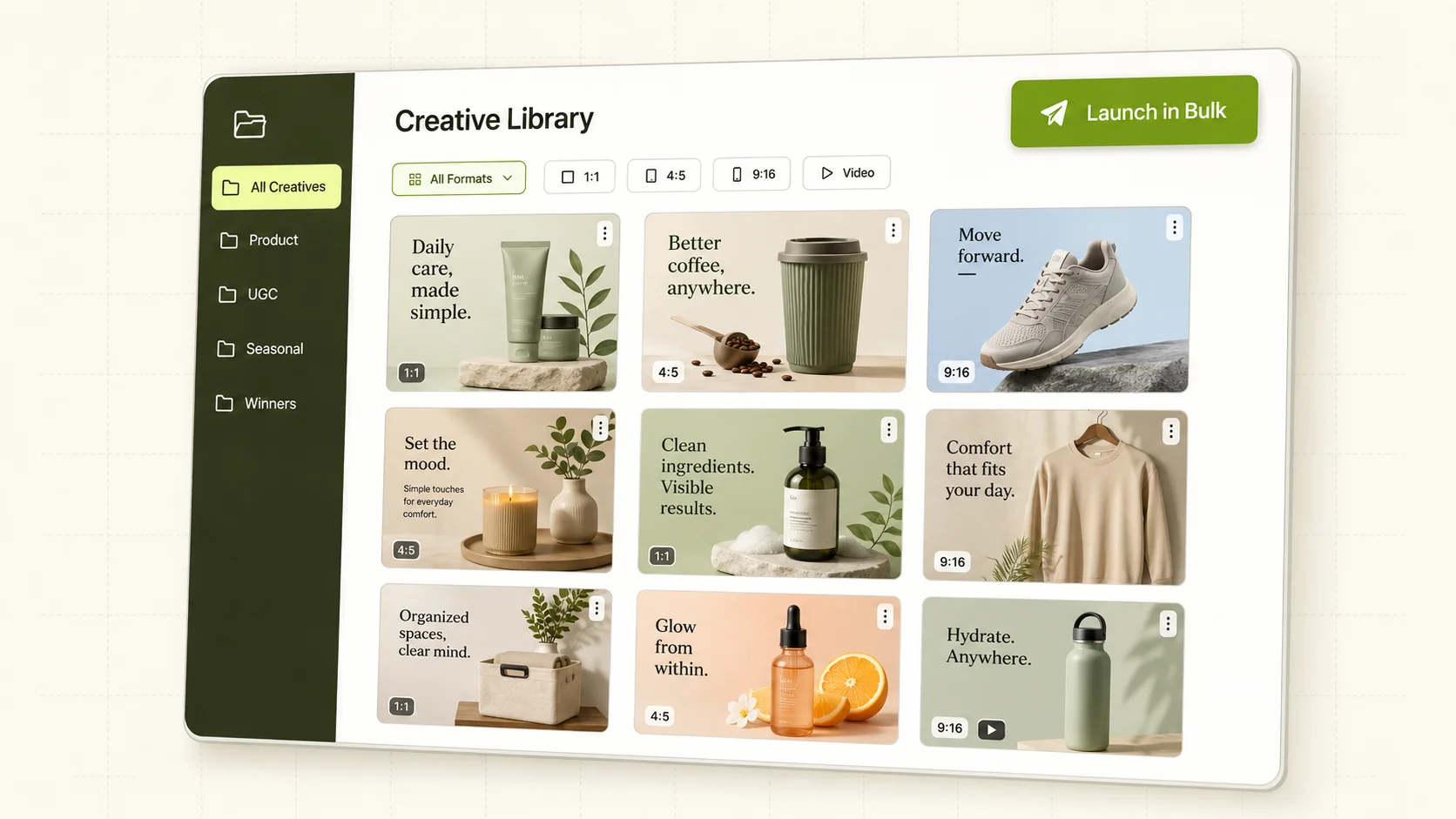
FabFunnel is built as campaign execution infrastructure rather than a standalone editor, positioning it as an ad design automation platform more than a traditional canvas tool, and its features reflect that. Genie generates creative directly from a connected Catalogue, so a product’s actual images, pricing, and details inform the output instead of a generic template. The Creative Library organizes finished assets by folder and category, and top performers can be pulled straight from the library into a new campaign and launched in bulk, keeping the loop between “this creative worked” and “this creative is running again” short.
FabFunnel currently supports Meta, TikTok, and NewsBreak. It does not support Google Ads. Advertisers on the platform report managing more than $2 billion in ad spend, launching over 8 million ads on Meta, an average ROAS of 3.8x, and 40% less time spent in Ads Manager.
Choosing for Your Team
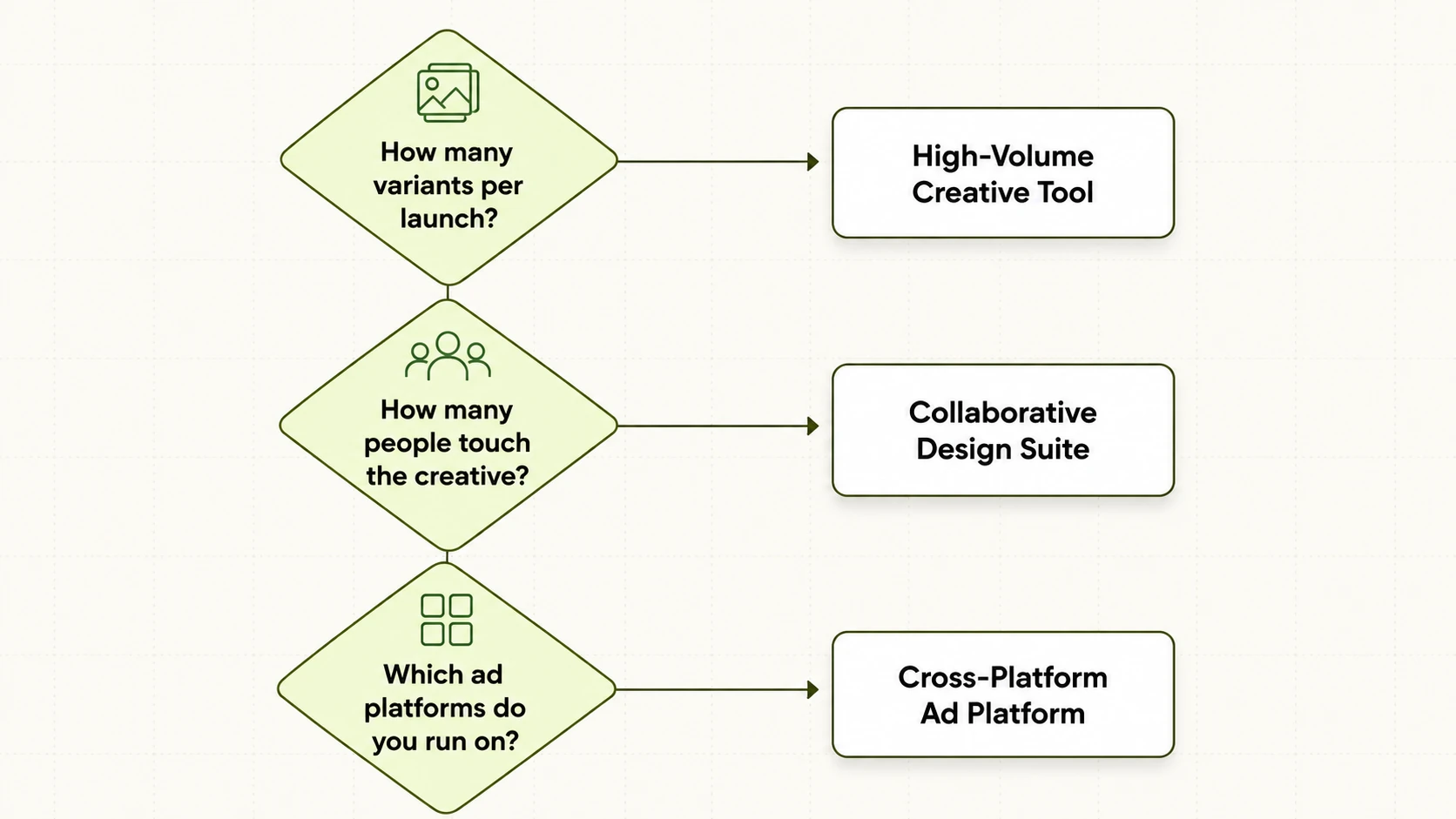
The right choice depends on where the bottleneck sits. A team with strong internal design resources and a low volume of launches may get by with traditional design software, since manual export is a smaller cost when there are only a few campaigns a month. A team producing a steady stream of variants for constant testing feels that same step multiplied across every launch, and that is where a connected tool’s time savings compound. Brand consistency follows a similar pattern: a small, senior team can hold a brand line manually, but as more variants get produced, by more people, on tighter timelines, consistency starts depending on the tool rather than institutional memory.
Format support is worth checking against the platforms a team actually runs on. Broad design capability is not useful if it cannot produce the native formats a specific platform expects, and confirming coverage before adopting a tool avoids finding out mid-launch that a format needs rebuilding elsewhere.
FAQs
1. What makes an ad design tool different from a general graphic design tool?
An ad design tool is built around the specific constraints of running paid campaigns: native platform formats, brand consistency across many variants, and often a direct path into launching the creative. General graphic design tools are built for flexible visual work, capable but not structured around campaign speed.
2. Can an ad design tool generate video ads, not just static images?
Some can. FabFunnel’s Genie, for example, generates both static and video formats across its four ad modes. This matters because video and static creative often need to be tested side by side, and switching tools between the two adds friction to that comparison.
3. How do teams keep brand consistency when producing ads at high volume?
The most reliable approach is generating creative from a connected source of brand and product data rather than relying on a designer to manually apply guidelines to every variant. Tools that pull logos, colors, and imagery directly from a catalogue reduce drift as output volume increases.
4. Does an ad design tool need to connect directly to ad platforms, or is export enough?
It depends on launch volume. A team running a handful of campaigns a month can absorb manual export and upload without much cost. A team launching frequent variant tests feels that step add up quickly, since it repeats for every asset, so a direct launch connection saves real time at scale.
5. Which ad platforms does FabFunnel support?
FabFunnel supports Meta, TikTok, and NewsBreak. It does not currently support Google Ads, so teams whose primary spend runs through Google should evaluate other tools for that channel specifically.
6. What is a pre-built creative framework, and how does it speed up production?
A pre-built framework is a ready-made ad structure a team can populate with their own product and brand data instead of building a layout from a blank canvas. FabFunnel’s Genie includes 200 such frameworks, alongside the option to generate from scratch when a fully custom idea is needed.
7. Is traditional design software like Canva or Figma still useful for performance marketing teams?
Yes, particularly for teams with lower launch volume, strong in-house design skill, or highly custom one-off creative needs. The tradeoff is that producing many on-brand variants and getting them into an ad account still runs through manual steps, which becomes a bigger cost as launch frequency increases.
8. How does a creative library help over time?
A creative library organizes past assets by folder or category so a team can find and reuse what already worked instead of rebuilding it. FabFunnel’s Creative Library allows top performers to be pulled directly into a new campaign and launched in bulk, keeping proven creative in active rotation without extra manual work.
Get Started
Genie itself works as an AI ad creative generator, producing on-brand static and video variants from your connected product catalogue. FabFunnel combines Genie’s ad generation with direct campaign launch on Meta, TikTok, and NewsBreak. Explore Fab AI or create an account.