Startups don’t lose on strategy. They lose on execution capacity.
The idea is usually solid. The market is real. The product works. What breaks early-stage companies is the gap between what the marketing team knows it should be doing and what it actually has the bandwidth to execute. A team of two or three can’t produce the content, run the campaigns, analyze the performance, and iterate fast enough to compete with companies that have ten times the headcount.
An AI marketing platform doesn’t give you ten times the headcount. But it compresses the execution gap – and for a startup, that’s often the difference between gaining traction and burning out before you find it.
What an AI Marketing Platform Actually Does
Before getting into why it matters for startups specifically, it’s worth being precise about what AI marketing software actually covers.
A true AI marketing platform handles multiple parts of the marketing workflow in a unified system – not just one task. That typically includes some combination of:
- Campaign creation and launch – generating ad creative, copy variants, and deploying campaigns across channels
- Performance optimization – automatically adjusting spend, pausing underperformers, scaling what’s working
- Audience segmentation – identifying which segments respond to which messages and routing accordingly
- Content generation – producing blog posts, email sequences, social copy, and landing page variants
- Analytics and reporting – surfacing what’s working without requiring hours of manual data analysis
The distinction between an AI marketing platform and a collection of AI marketing tools is integration. Individual tools handle individual tasks. A platform connects them – so the insight from your campaign performance informs your next creative brief, and your audience data shapes your content strategy, all without switching between five different dashboards.
Why This Matters More for Startups Than Anyone Else
Large companies have dedicated teams for each of these functions. A startup typically has one or two people trying to cover all of them simultaneously.
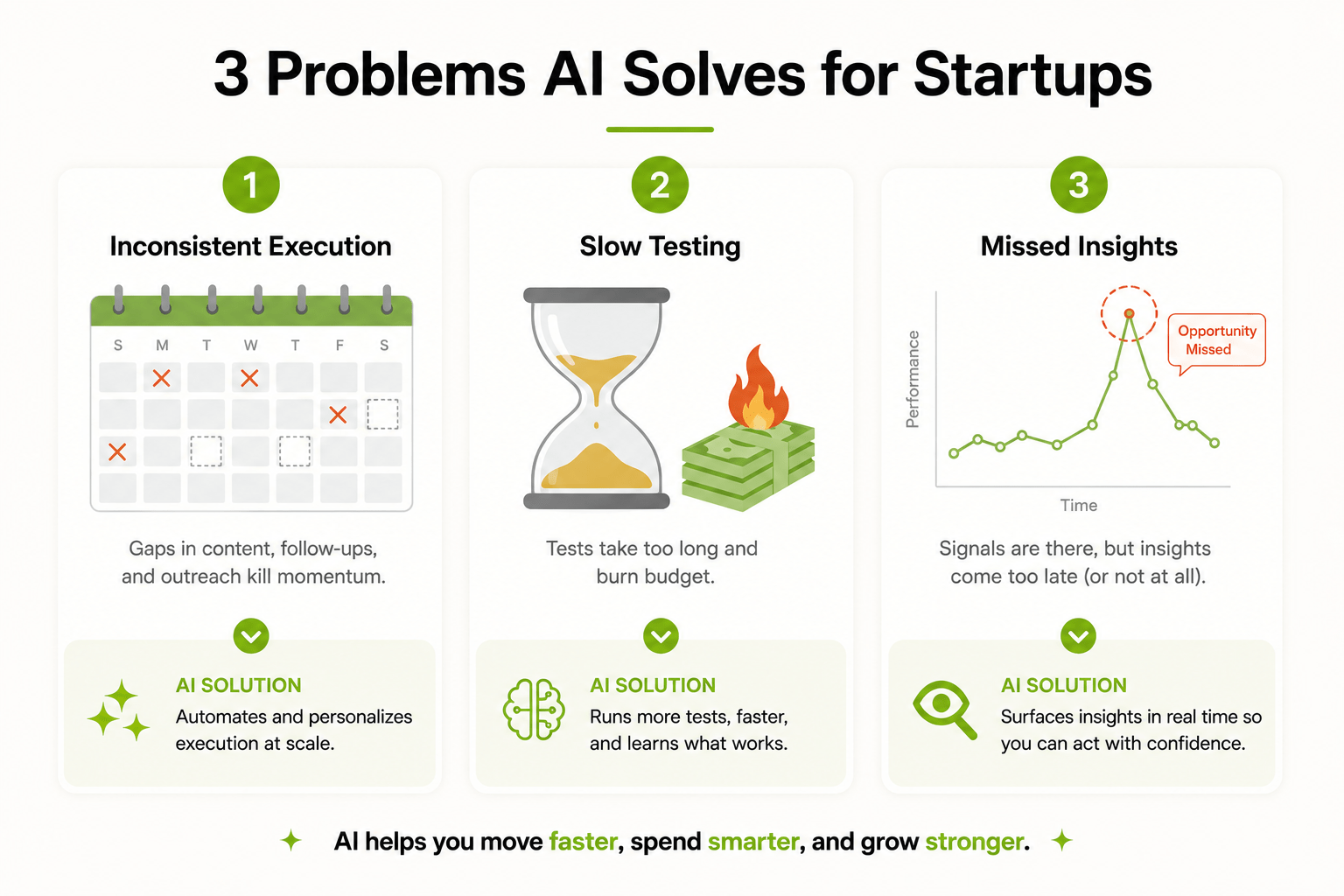
That gap has three practical consequences:
Execution is inconsistent. A two-person marketing team can’t publish content consistently, run campaigns continuously, and respond to performance data in real time. Something always gets deprioritized. Usually it’s the thing that compounds – content, SEO, email nurture.
Testing is too slow. Finding what works in paid acquisition requires running a lot of variations fast. Manual campaign setup, creative production, and performance review cycles slow that iteration down to a pace where you’re burning budget before you find a winner.
Insights get missed. A founder-marketer looking at ad dashboards between product calls and investor meetings isn’t going to catch a high-performing creative variant on a Tuesday afternoon. By the time the weekly review happens, the performance window has closed.
An AI marketing platform addresses all three – not by adding headcount, but by handling the operational layer that headcount would otherwise cover.
The Specific Ways AI Marketing Tools Give Startups an Edge
Speed to Market
A startup’s advantage over incumbents is speed. You can test an idea, validate it, and ship it faster than a large company’s approval process allows. An AI marketing platform extends that advantage to campaign execution – creative generation, audience setup, and launch happen in hours, not days. The window between “we have a hypothesis” and “it’s live and being tested” collapses.
Budget Efficiency
For startups with limited operating capital, allocating budget to non-performing campaigns presents an unacceptable financial risk. AI marketing software helps by using automatic rules. If an ad campaign costs too much per customer, the AI pauses it right away. If a campaign is making good returns, the AI spends more on it. It does this all the time – not just when someone checks once a week. Every dollar that doesn’t go to a losing campaign is a dollar that can go to finding a winning one.
Platforms like FabFunnel are built for exactly this: high-volume campaign execution with automation rules that run around the clock, so a lean team isn’t manually babysitting ad spend at all hours. For a startup that needs to stretch every dollar, that kind of built-in efficiency matters.
Creative Testing at Scale
Most startups undertest. They launch one or two creative variants, pick a winner, and run it until it fatigues. The teams finding product-market fit through paid acquisition faster are running ten, twenty, fifty variants simultaneously – different hooks, different angles, different formats – and letting performance data surface the winner.
AI marketing tools that generate creative variants at scale make that kind of testing accessible to teams that don’t have a full creative studio. You’re not limited by how many ads your designer can produce in a week.
Content That Compounds
Paid acquisition gets expensive fast. The startups that survive long enough to build a brand are typically the ones that invested early in content – blog posts that rank, email lists that grow, social presence that builds trust before someone is ready to buy.
AI marketing software handles the volume layer of content production: drafting posts, generating email sequences, repurposing long-form content into social formats. A two-person team publishing three times per week consistently beats a five-person team publishing sporadically. AI makes the consistency achievable.
Reporting Without a Data Analyst
Most early-stage startups don’t have a dedicated analyst. Performance data lives across multiple platforms – Meta Ads Manager, Google Analytics, an email tool, a CRM – and pulling it together into something actionable takes hours someone doesn’t have.
The best AI marketing platforms centralize reporting and surface insights automatically: which campaigns are driving the lowest CAC, which content is converting, where the funnel is leaking. The marketer sees the signal without building the spreadsheet.
What to Look For in an AI Marketing Platform as a Startup
Not every AI marketing tool is built for startup needs. A few things worth evaluating:
Cross-channel capability. Your audience isn’t on one platform. Look for a platform that handles Meta, TikTok, and other channels from a single interface – not a tool that requires a separate workflow per channel.
Automation depth. A tool that generates creative but requires manual campaign management isn’t saving you much. The leverage is in platforms where generation, launch, and ongoing optimization all happen in one connected workflow.
Speed of setup. You don’t have months to implement a new platform. The best AI marketing software for startups is operational within days, not a quarter-long onboarding project.
Transparent reporting. If you can’t clearly see what’s working and why, you can’t make good decisions with the output. Prioritize platforms where the performance data is surfaced clearly and actionably.
The Mistake Startups Make With AI Marketing Tools
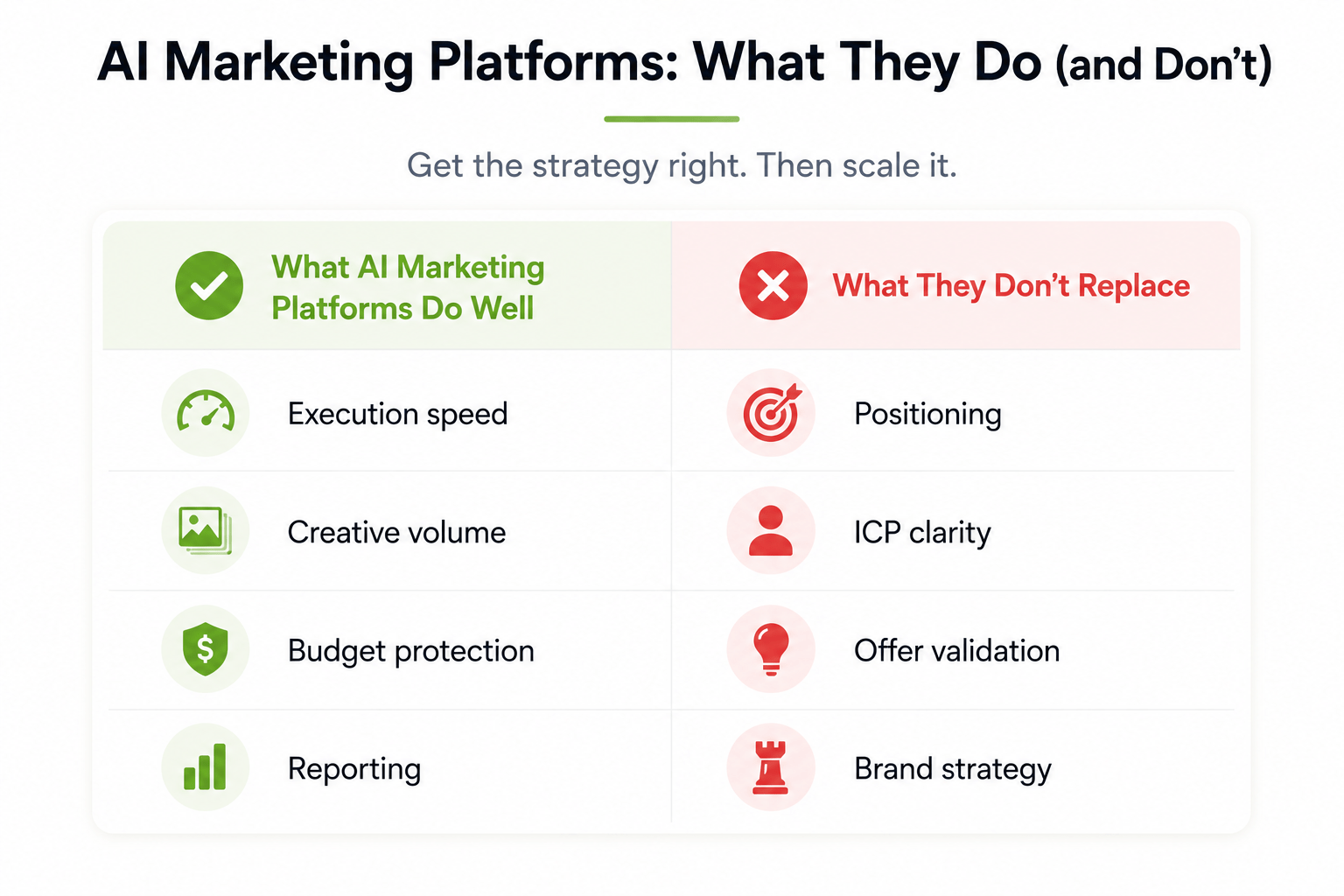
The most common failure pattern: buying an AI marketing platform and expecting it to solve a positioning problem.
If you don’t know who you’re selling to, what pain you’re solving, and why your product is the right solution – no amount of campaign automation will fix that. AI marketing software amplifies execution. It doesn’t replace the strategic clarity that makes execution mean something.
Get the positioning right first. Then use an Artificial Intelligence Marketing Platform to execute it at a scale and speed your headcount alone couldn’t sustain.
The Takeaway: Execution Capacity Is a Competitive Advantage
In 2026, the startups winning on marketing aren’t necessarily the ones with the biggest budgets or the largest teams. They’re the ones executing the fastest – testing more, learning faster, publishing consistently, and responding to performance signals in hours rather than days.
An Artificial Intelligence Marketing Platform is what makes that execution rate possible for a small team. Not as a shortcut to skip the strategic work. As infrastructure that lets you do more of it.
Frequently Asked Questions
What is an AI marketing platform?
An AI marketing platform is a unified system that uses machine learning to automate and optimize multiple parts of the marketing workflow – campaign creation, ad optimization, audience segmentation, content generation, and performance reporting – within a single interface rather than across disconnected tools.
Why do startups need AI marketing software specifically?
Startups lack the people for all the marketing work they need. AI handles the operational tasks – campaign setup, creative production, performance monitoring – so a small team can scale beyond what manual work would allow.
What’s the difference between AI marketing tools and an AI marketing platform?
AI marketing tools handle individual tasks – a writing tool, an image generator, a scheduling tool. An AI marketing platform integrates multiple functions into a connected workflow. The platform advantage is that performance data from campaigns informs creative decisions, and audience insights shape content strategy, without manually connecting separate tools.
How much does an AI marketing platform cost?
It varies by platform and scale. Platforms vary by feature depth and scale. FabFunnel’s Growth Plan starts at $349/month with a 14-day free trial and no contract. Platforms with full campaign management, automation, and reporting typically run from several hundred to a few thousand per month.
When should a startup invest in an AI marketing platform?
Once you have a defined ICP, a validated offer, and you’re running paid campaigns or producing content consistently. Before that point, the bottleneck is usually strategy and positioning, not execution capacity. Once you’re executing consistently and the volume is the problem, that’s when an AI marketing platform delivers the highest return.
Can a solo founder use an AI marketing platform effectively?
Yes – in fact, solo founders are one of the highest-leverage use cases. A founder managing product, sales, and marketing simultaneously can use an AI marketing platform to handle the execution layer of marketing without hiring before the business justifies it. The key is starting with one channel, learning the platform, and expanding from there.