People throw around the phrase “AI ad campaign” pretty loosely. Sometimes it means a campaign built on AI-generated creative. Sometimes it means one an AI platform is actively managing. Sometimes it just means “AI” shows up somewhere in the tech stack. That loose usage is exactly why so many teams are confused about what’s actually possible and what it takes to build one properly.
This guide breaks down the real definition, the build process, and the optimization framework, so you can build an artificial intelligence advertising campaign that actually delivers instead of one that just wears the label.
What Is an AI Ad Campaign?
An AI ad campaign is a paid advertising campaign in which artificial intelligence handles one or more of the following functions: creative generation, audience targeting, bid management, performance monitoring, and campaign optimization decisions.
Handles is the operative word here. Not assists with, not informs, but actually executes. In a real AI ad campaign, defined AI-driven systems are making or carrying out decisions inside the workflow, which is what cuts down the manual oversight needed to keep performance on track.
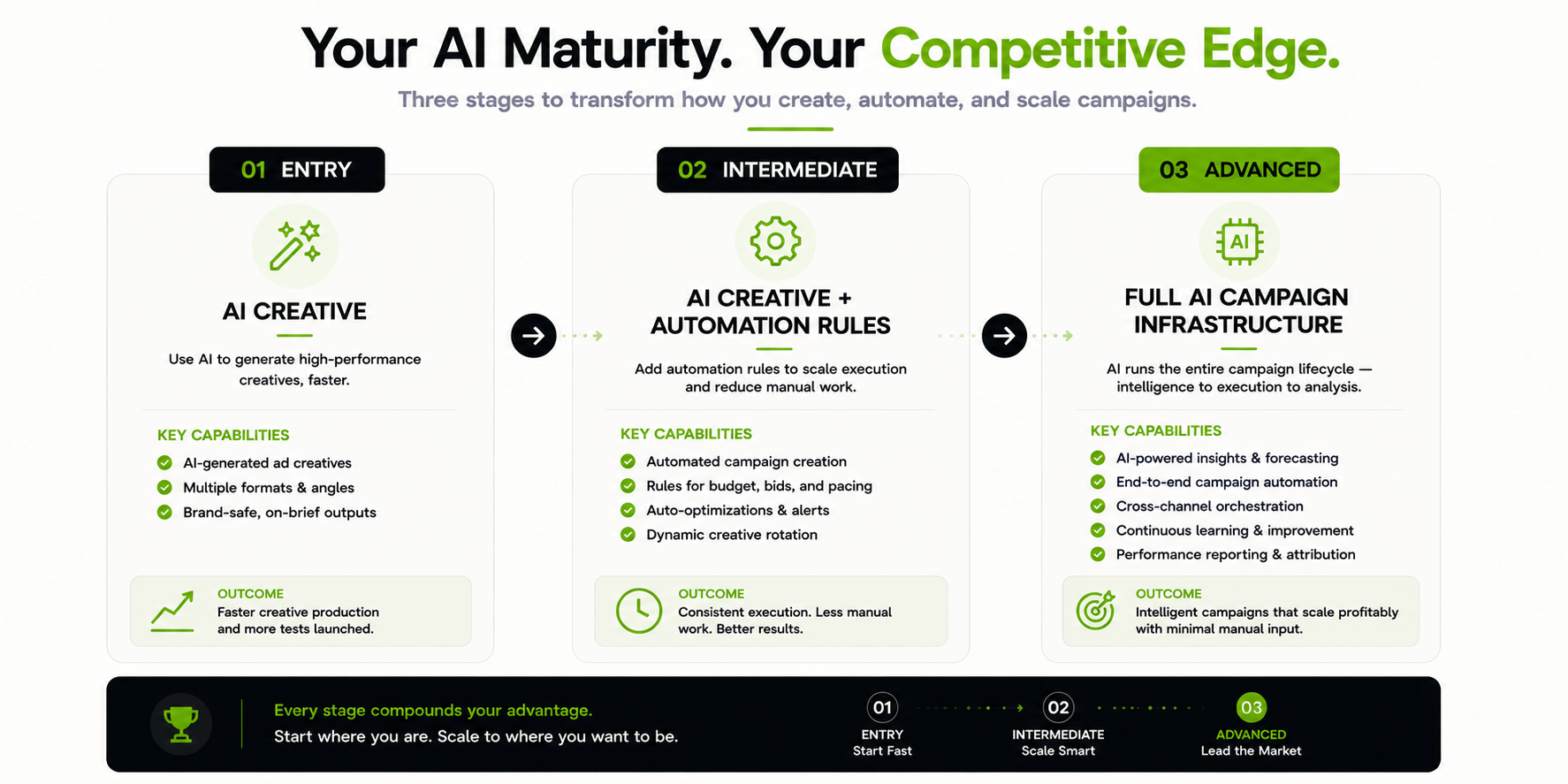
What this looks like in practice depends on how mature the setup is:
- Entry-level: AI-generated creative assets running in a manually managed campaign structure. The AI contributed to production; everything else is manual.
- Intermediate: AI-generated creative combined with automated rules that execute scaling and pausing decisions based on performance thresholds. The campaign structure is manual; optimization decisions are automated.
- Advanced: AI handles creative generation, campaign structure deployment through bulk launch, bid and budget optimization through automation rules, and performance reporting, with human oversight reserved for strategy, budget allocation, and creative direction.
Most teams building their first ai ad campaign are working at the intermediate level and moving toward advanced. The build process below covers that range.\
Step 1: Define the Campaign Parameters
Before any AI tool touches your campaign, the strategic inputs need to be clear:
Objective and KPI. What does this campaign actually need to do: drive conversions, generate leads, build awareness? And what’s the specific number that defines success: a CPA target, a ROAS floor, a CPL cap? AI optimization only works within the parameters you set. Skip that step and the AI has nothing to optimize toward.
Audience. Who are you targeting, and do you already have audience data to seed from (pixel audiences, customer lists, engagement audiences)? AI ad campaign tools can optimize delivery well, but cold targeting with no signal takes a lot longer to find performance than a campaign that starts with real audience data.
Budget and timeline. What’s the daily spend? How long does the campaign need to run before you have enough data to make optimization decisions? Under-budgeted campaigns don’t generate enough conversion signals for AI optimization to work properly.
Platform. Meta, TikTok, or both? The campaign architecture, creative formats, and optimization mechanics are platform-specific.
Step 2: Build the Creative
AI campaign builders work best when they have multiple creative options to deploy and test. Before launching, use an ai ad creative generator to produce the variant set your campaign will test.
For a standard AI ad campaign launch, aim for 3 to 5 distinct creative concepts (different hooks, different value propositions), each adapted to the required placements: Feed, Stories, and Reels for Meta; In-Feed and TopView for TikTok. That gives you a 15 to 30 asset set from a 3 to 5 concept brief, which is a volume that would take days to produce manually and just hours with AI creative tools.
Each concept should test a different angle: one feature-focused, one benefit-focused, one built around social proof, one framed as problem and solution. The point is to generate a real performance signal across different creative approaches, not just cosmetic variation.
Step 3: Structure the Campaign
The campaign structure determines how your AI optimization tools can operate. Specifically:
Ad set structure. Each ad set should contain one defined audience and one creative test set. Don’t mix audiences in the same ad set: it wrecks clean performance attribution. Each ad set also needs enough budget to generate statistically meaningful data, typically 50-plus conversions before you draw any conclusions about what’s working.
Naming conventions. Once AI tools are managing multiple accounts and ad sets at the same time, naming conventions stop being optional: they become the infrastructure that makes your performance data readable. Use a systematic format: Campaign_[Objective]_[Date] / AdSet_[Audience]_[Placement] / Ad_[Creative Concept]_[Variant].
Budget allocation. Give each ad set enough daily spend to exit the learning phase in a reasonable window, typically 7 to 10 days at Meta’s algorithm thresholds. Spread the budget too thin across too many ad sets and you delay both learning and optimization.
Step 4: Deploy at Scale
For teams running multiple accounts or campaigns, manually building each one is the real operational bottleneck. This is where an ai campaign builder earns its keep: it deploys the campaign structure across accounts in bulk instead of making you rebuild it by hand every time.
FabFunnel’s Bulk Campaign Launcher handles this: take a proven campaign structure, apply it across Meta or TikTok accounts in bulk, with the creative set pre-loaded and ready. What would take hours of manual setup per account runs in minutes across the full account portfolio.
For single-account campaigns, manual build is still viable. For agencies or in-house teams managing multiple accounts, bulk deployment is the step that makes the whole AI campaign model operationally sustainable.
Step 5: Set Up Automation Rules
Automation rules are what let an artificial intelligence advertising campaign run continuously instead of needing a daily manual check-in.
The core rule set for any AI ad campaign:
Scale winners. When ROAS clears the target for 3-plus consecutive days with a minimum conversion volume, bump the budget by 15 to 20 percent. That way you catch the performance peak without needing a manual review to line up with the exact window.
Pause underperformers. When CPA goes above your floor for a defined stretch, typically 3 to 5 days, pause the ad set. That keeps budget from continuing to flow into ad sets that have already shown they won’t hit target.
Pause low-CTR creative. When a creative’s CTR drops below a set threshold after a minimum impression count, pause it. That keeps delivery focused on creative that’s actually engaging people.
Alert on anomalies. Set notifications for when spend goes over daily budget by more than 20 percent, or when CPA spikes suddenly. Those are edge cases that need a human look, not an automated response.
These rules run around the clock across every ad set. Nobody’s checking performance and making the call manually; the system is already executing those decisions.
Step 6: Optimise Based on Data
Once the campaign is live and generating data, optimization decisions fall into two categories: what the automation handles, and what requires human judgment.
Automation handles: scaling and pausing decisions based on the rules you defined, bid adjustments (if using platform-native bid strategies), and delivery optimization within audience parameters.
Human judgment handles the calls that need actual thinking: creative strategy, like deciding what the next concept should test once a full creative set is fatiguing; audience expansion, spotting new segments worth testing based on what’s already performing; offer or landing page changes, since a conversion problem after the click isn’t a campaign problem; and budget reallocation across campaigns as the portfolio-level picture builds up.
The best ai ad campaign tool setups save human attention for the decisions that actually need strategic judgment. Routine execution work, budget adjustments, pausing underperformers, gets handled by the automation layer instead.
What the Best AI Advertising Campaigns Have in Common
Looking at the best ai advertising campaigns across direct response categories, the consistent patterns are:
Strong briefs produce strong creative. Teams that invest in systematic creative briefs, specific audience insight, precise offer mechanics, a defined emotional angle, consistently get better output from their AI tools.
Systematic testing beats random creative. The campaigns that learn fastest are the ones testing clearly different creative concepts, not five slight variations of the same ad.
Automation rules go in before launch, not after. The teams getting the most out of automation built their rules before the campaign went live, instead of bolting them on once something broke.
Creative refresh happens on a cadence, not a whim. AI makes new creative faster to produce, and the highest-performing campaigns use that speed to refresh on a regular cycle, so they get ahead of creative fatigue instead of reacting to it once it shows up.
Conclusion
Building an AI ad campaign isn’t about plugging in a tool and walking away. It’s about designing infrastructure where AI handles execution (creative generation, performance-triggered scaling, continuous rule-based optimization) and people focus on strategy, creative direction, and the decisions that actually need judgment.
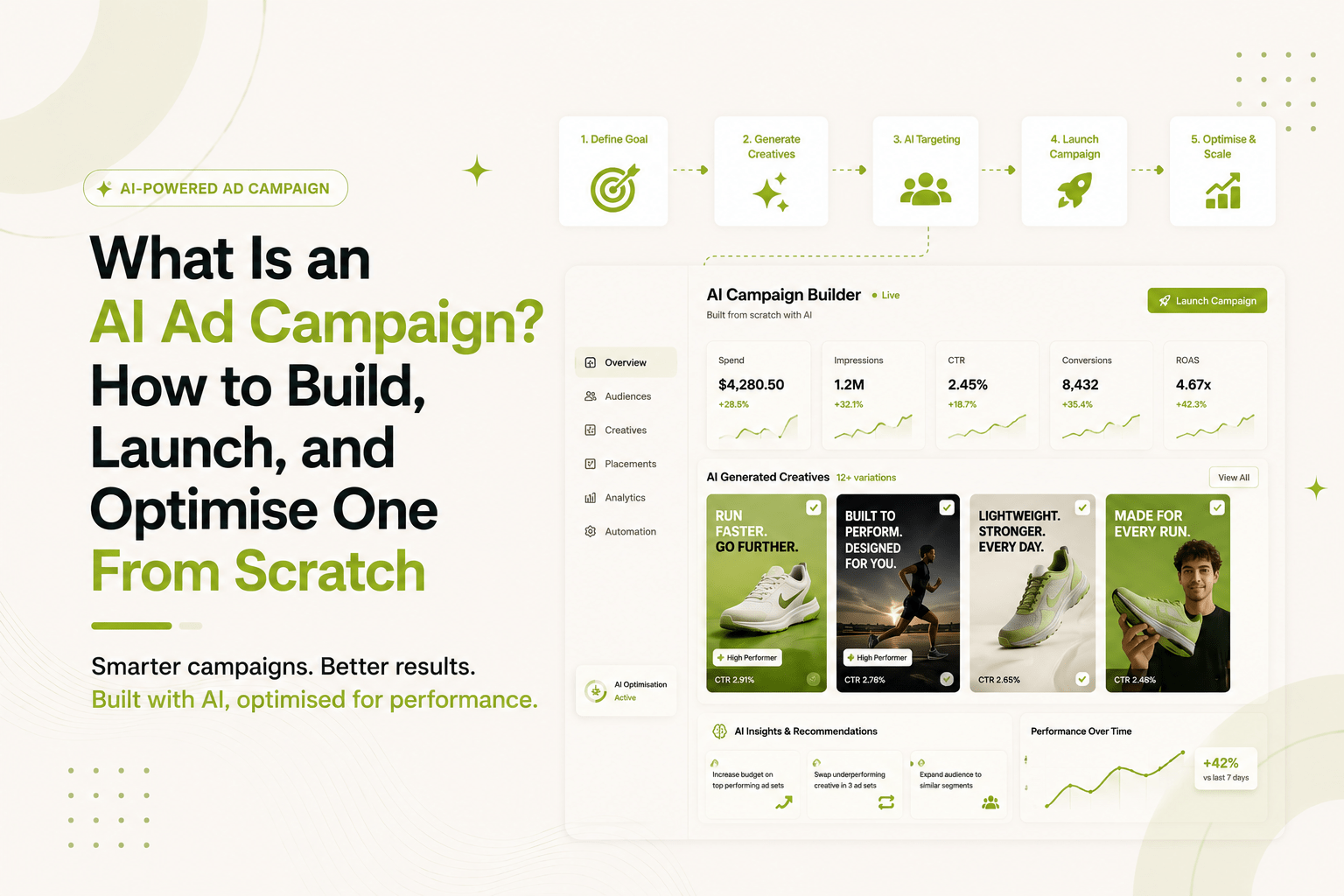
The build is: define parameters → generate creative → structure campaigns → deploy → set automation rules → optimize based on the output. Done right, it’s a system that runs continuously, responds to performance data in real time, and scales what works without waiting for manual review cycles.
Frequently Asked Questions
What is an AI ad campaign?
An AI ad campaign is a paid advertising campaign where artificial intelligence tools handle one or more functions: creative generation, bid management, performance monitoring, or optimization decisions, cutting down the manual work needed to maintain and improve performance.
How do you build an AI ad campaign from scratch?
The build comes down to six steps: define your parameters (objective, KPI, audience, budget), generate a creative variant set with AI tools, structure the campaign with clear ad set organization and naming conventions, deploy at scale using bulk launch tools if you’re running multiple accounts, set up automation rules for scaling and pausing, and optimize based on what the data shows. AI handles execution; you handle strategy.
What are artificial intelligence advertising campaigns used for?
Mostly direct response: performance marketing where the goal is a measurable outcome like conversions, leads, or app installs. Teams running multiple accounts or doing heavy creative testing get the most out of it, since that’s exactly where manual campaign management turns into a bottleneck.
What makes a good AI campaign builder?
One that can deploy structured campaigns at scale across multiple accounts or ad sets, plug into AI creative generation, and connect to automation rules for ongoing optimization. The real test: does it shrink the time between “ready to launch” and “live in market” without cutting corners on structure?
How do automation rules work in AI ad campaigns?
They’re just conditions and responses. If ROAS clears a target for a set number of days, increase budget by a set percentage. If CPA goes over the floor for three days, pause the ad set. These rules run continuously across every active ad set, catching scaling opportunities and cutting underperformers in real time instead of waiting for the next manual review.
What’s the difference between an AI ad campaign tool and the platform’s native AI?
Meta Advantage+ and TikTok Smart Performance are platform-native AI, so they optimize delivery inside their own algorithm. Third-party AI ad campaign tools do more: cross-account rule execution, bulk campaign deployment, creative generation outside the platform, and portfolio-level automation with consistent rules across every client account, no matter which platform you’re on.