AI in B2B marketing. That’s what.
It replaces guesswork with actual data. Marketers can analyze buying intent, predict conversion potential, and personalize outreach at scale—without working 80-hour weeks. Sales and marketing teams finally focus on the prospects that actually matter. You get higher quality leads. Your ROI stops bleeding.
Companies everywhere are using AI tools in B2B marketing right now. Automating lead qualification. Making ABM actually effective. Optimizing content. Finding hidden opportunities buried in data.
Predictive lead scoring. Campaign optimization. AI helps you make faster, smarter decisions. Bottom line? You generate better leads.
What Is AI in B2B Marketing?
Machine learning. Predictive analytics. NLP. Automation. All working together to help you market better and get better results.
Instead of you manually looking through tons of customer and campaign data? AI processes stuff in real time. Find patterns. Tell you what to do. Efficiency up. Results up.
B2B companies generate insane amounts of data. Websites. CRMs. Ads. Email campaigns. Sales stuff. Customer chats everywhere. AI helps marketers turn that into actual insights. So you make smarter decisions. Faster.
Common stuff people use AI for:
- Predictive lead scoring
- Audience segmentation
- Personalized content recs
- ABM
- Campaign optimization
- Marketing analytics
- Automated customer engagement
Why invest in it? Helps you find high-intent prospects faster. Less manual work. Better ROI.
And no—AI isn’t replacing marketers. It’s more like a smart assistant. Handles the heavy lifting so your team focuses on what actually drives revenue.
As AI gets better? Companies that use it well get a real advantage. Better targeting. Stronger personalization. More efficient lead gen.
How to Use AI in B2B Marketing to Generate High-Quality Leads
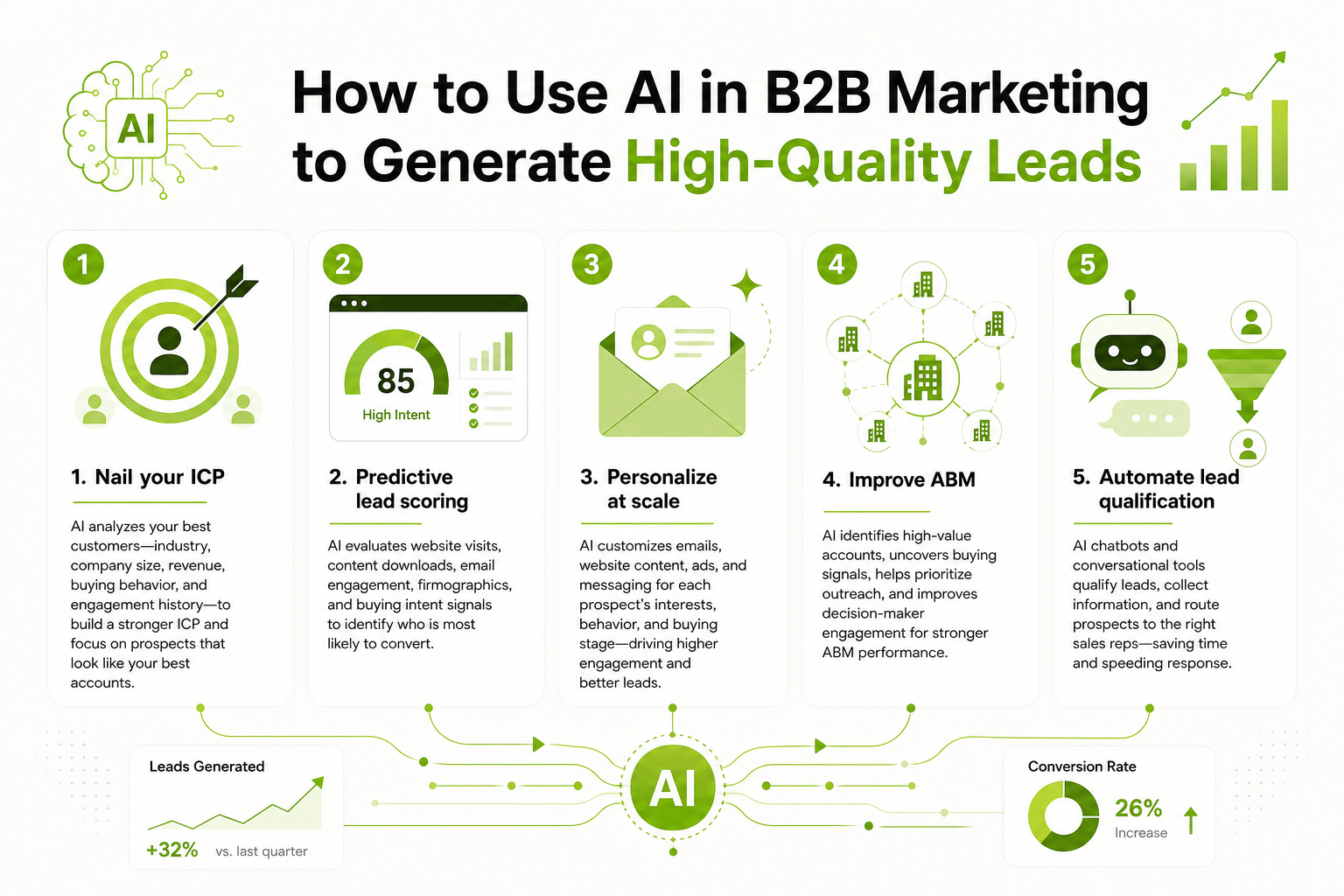
1. Nail your ICP
AI looks at your best customers. Industry, company size, revenue, buying behavior, engagement history. Builds a way better ICP. Then you focus on prospects that look like your best accounts.
2. Predictive lead scoring
AI looks at thousands of data points. Website visits. Content downloads. Email engagement. Firmographics. Buying intent signals. Tells you who’s likely to convert. Stop manual scoring. Prioritize based on real probability.
3. Personalize at scale
Buyers want personalization. AI does it for you. Emails, website content, ads, messaging—all customized to each prospect’s interests, behavior, and buying stage. Higher engagement. Better leads.
4. Improve ABM
AI finds high-value accounts. Spots hidden buying signals. Prioritize outreach. Personalize campaigns. Engage decision-makers. Better account selection. Better performance.
5. Automate lead qualification
AI chatbots and conversational tools qualify leads automatically. Ask questions. Collect info. Route to the right sales rep. Faster response. Sales teams spend less time filtering. More time selling.
Best AI Tools for B2B Marketing
There’s no shortage of AI platforms for B2B marketing these days. Everyone’s jumping on the bandwagon. And yeah, a lot of them can help with lead generation, targeting, automation, and analytics. But picking the right one? That’s the tricky part. It really comes down to what you’re trying to do, how much you want to spend, and what tech you’re already working with.
AI Tools for Lead Generation
- Apollo.io – Prospect discovery, lead enrichment, AI outreach.
- ZoomInfo – Intent data, company insights, buyer ID.
- Cognism – B2B prospecting, AI data enrichment.
- Clay – Automated prospect research, personalized outreach workflows.
What do they do? Find decision-makers. Spot buying signals. Prioritize good prospects.
AI Tools for Content and Personalization
Content attracts and nurtures leads. AI can help create it. But you still need human editing.
Popular options (use with caution):
- ChatGPT – Good for ideation and drafts. Don’t publish raw output.
- Jasper – Better for blogs and email campaigns. Still needs a human touch.
- Copy.ai – Fine for short-form. Not great for complex stuff.
- Writer – Useful for maintaining brand voice across personalized content.
AI Tools for Marketing Analytics
You need to understand campaign performance. These tools help. Some are actually useful.
Common ones:
- HubSpot AI – Fine if you’re already in HubSpot.
- Salesforce Einstein – Powerful but lock-in is real.
- Adobe Marketo AI – Enterprise only. Not for most teams.
- Google Analytics Intelligence – Free and surprisingly capable. Underrated.
How to Choose Without Getting Burned
When evaluating the best AI for B2B marketing, ignore the hype. Look at:
- Data integration capabilities – Will it actually work with your stack?
- Lead scoring accuracy – Have they proven it or just claimed it?
- Personalization features – How deep? Or is it surface-level?
- Analytics and reporting – Can you get actionable insights or just pretty charts?
- Ease of use – Will your team adopt it or ignore it?
- Scalability – Does it grow with you or break?
AI-Powered Lead Scoring: Finding Buyers Before Competitors
Not every lead will buy. Traditional scoring? Fixed rules. Manual guesses. Misses good leads. Chases bad ones.
AI scoring is smarter. Look at historical data, behavioral signals, firmographics, engagement patterns. Predicts who’s likely to convert.
Old way vs AI way:
- Traditional gives points for:
- Email opens
- Form submissions
- Website visits
- Fine but basic. Misses the complicated stuff.
AI learns from past outcomes. Adjusts automatically. Gets more accurate over time.
What AI looks at:
- Website engagement
- Content consumption
- Email interactions
- CRM activity
- Sales conversations
- Company characteristics
- Third-party intent data
Combine all that? You get a clear picture of who’s ready to buy. Find them before your competitors do.
AI in B2B Marketing Analytics
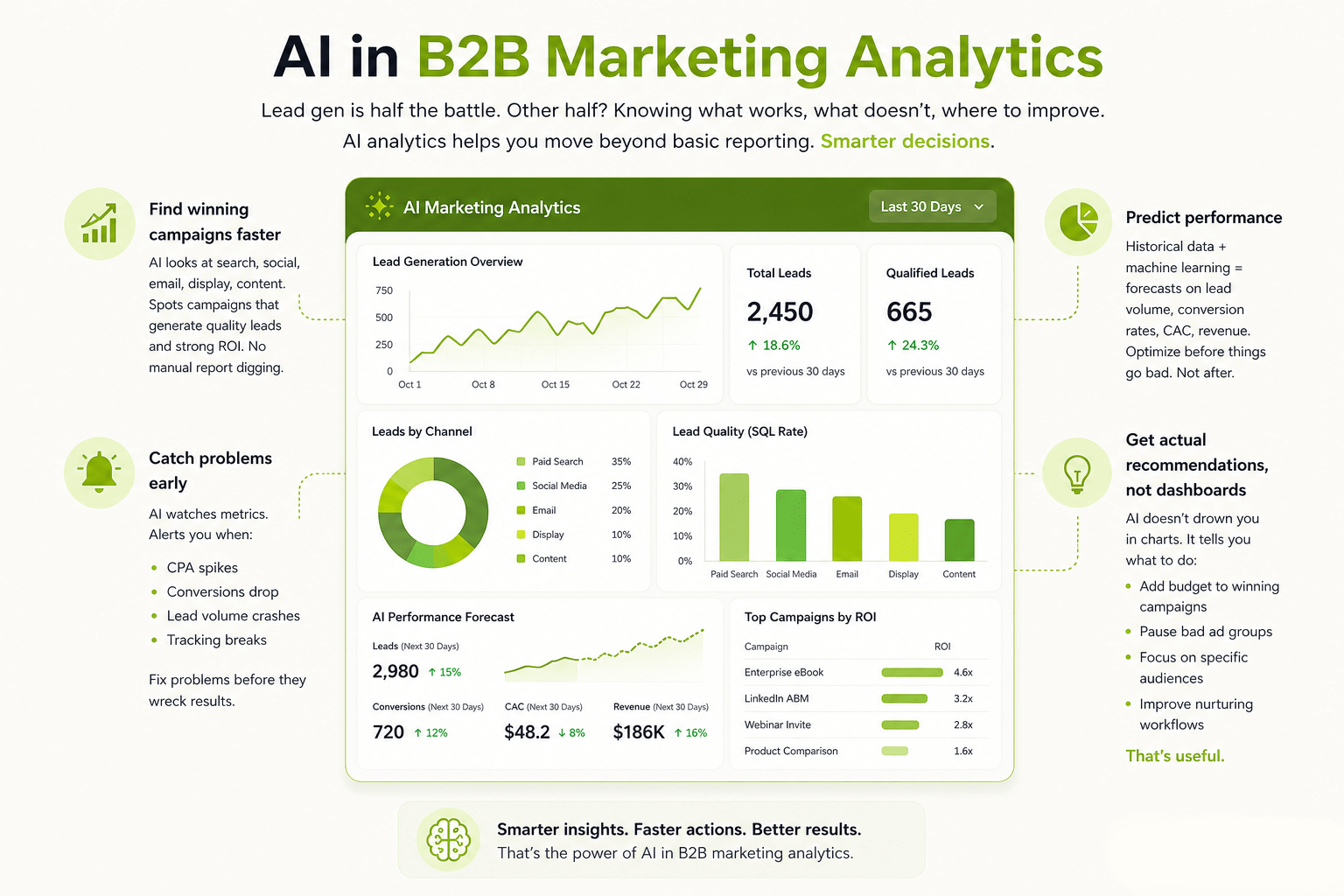
Lead gen is half the battle. The other half? Knowing what works, what doesn’t, where to improve.
AI analytics helps you move beyond basic reporting. Smarter decisions.
Find winning campaigns faster
AI looks at search, social, email, display, content. Spots campaigns that generate quality leads and strong ROI. No manual report digging.
Predict performance
Historical data + machine learning = forecasts on lead volume, conversion rates, CAC, revenue. Optimize before things go bad. Not after.
Catch problems early
AI watches metrics. Alerts you when:
- CPA zspikes
- Conversions drop
- Lead volume crashes
- Tracking breaks
- Fix problems before they wreck results.
Get actual recommendations, not dashboards
AI doesn’t drown you in charts. It tells you what to do:
- Add budget to winning campaigns
- Pause bad ad groups
- Focus on specific audiences
- Improve nurturing workflows
- That’s useful.
Common Mistakes Companies Make When Using AI for B2B Marketing
AI promises a lot. But many businesses fail to see results. Why? Implementation mistakes.
Here’s what to watch for.
1. Replacing humans with AI
Bad idea. AI supports marketers. Doesn’t replace them. Strategy, creativity, relationships, decisions—that’s human work.
Best results? AI insights + human expertise.
2. Using bad data
AI is only as good as your data. Incomplete, inaccurate, outdated info = bad recommendations, bad targeting.
Fix your data quality first. Then deploy AI.
3. Automating just for automation’s sake
Automation creates efficiency. Fine. But the real value? Predictive insights. Smarter targeting. Better decisions.
4. Ignoring privacy and compliance
GDPR. CCPA. Industry rules. Ignore them at your own risk.
Make compliance part of your AI strategy from the start.
Conclusion
So Here’s Where We Land on AI in B2B Marketing
Let me sum this up. Artificial intelligence isn’t waiting for some future release date. It’s already changing how B2B companies find leads and turn them into customers. Right now. Today.
Remember how we used to do things? Manual analysis. Blasting messages to broad audiences. Fixing problems only after they’d already messed up our numbers. That old playbook? It’s not cutting it anymore.
Now, businesses can use AI to spot prospects who are actually ready to buy. Personalize every interaction. Optimize campaigns while they’re running. And predict what’s coming with a level of accuracy that feels like cheating. From predictive lead scoring to account-based marketing. From content personalization to advanced analytics.
And the outcome? Better leads. More of them are turning into customers. Spending less to acquire each one. And a marketing ROI that finally makes your finance team smile.
That’s the real story here.
Also Read – How to Use AI in Marketing to Scale Campaigns Faster
FAQs:
1. So, how does AI actually help get better B2B leads?
Here’s the deal. AI looks at how people act, what their company looks like (firmographics, fancy word I know), how they engage with your stuff, and signals that show they might be shopping around. Then it points at the ones who are actually likely to buy. No more guessing.
2. What’s predictive lead scoring?
AI ranks leads by who’s most likely to buy. Sales focuses on the good ones. No more manually checking every lead. Saves so much time.
3. Can AI help with ABM? Or is that overhyped?
Yeah, actually it can. AI helps you find high-value accounts, spot buying signals you’d probably miss, personalize your outreach, and figure out who the decision-makers are. Makes ABM way less of a headache.
4. How does AI personalize B2B campaigns?
AI customizes emails, ads, website content, messaging. Based on industry, interests, behavior, buying stage. People get stuff that actually feels relevant.
5. Best AI tools for B2B lead gen?
Depends. But look for predictive analytics, CRM AI, chatbots, marketing automation, intent data platforms, AI email personalization. Probably need a few.