Most creative testing is blind.
A team generates a few ad variations, launches them, waits 7-10 days, and then looks at the results. One creative “won.” They scale it. Three weeks later it fatigues. They go back to the beginning.
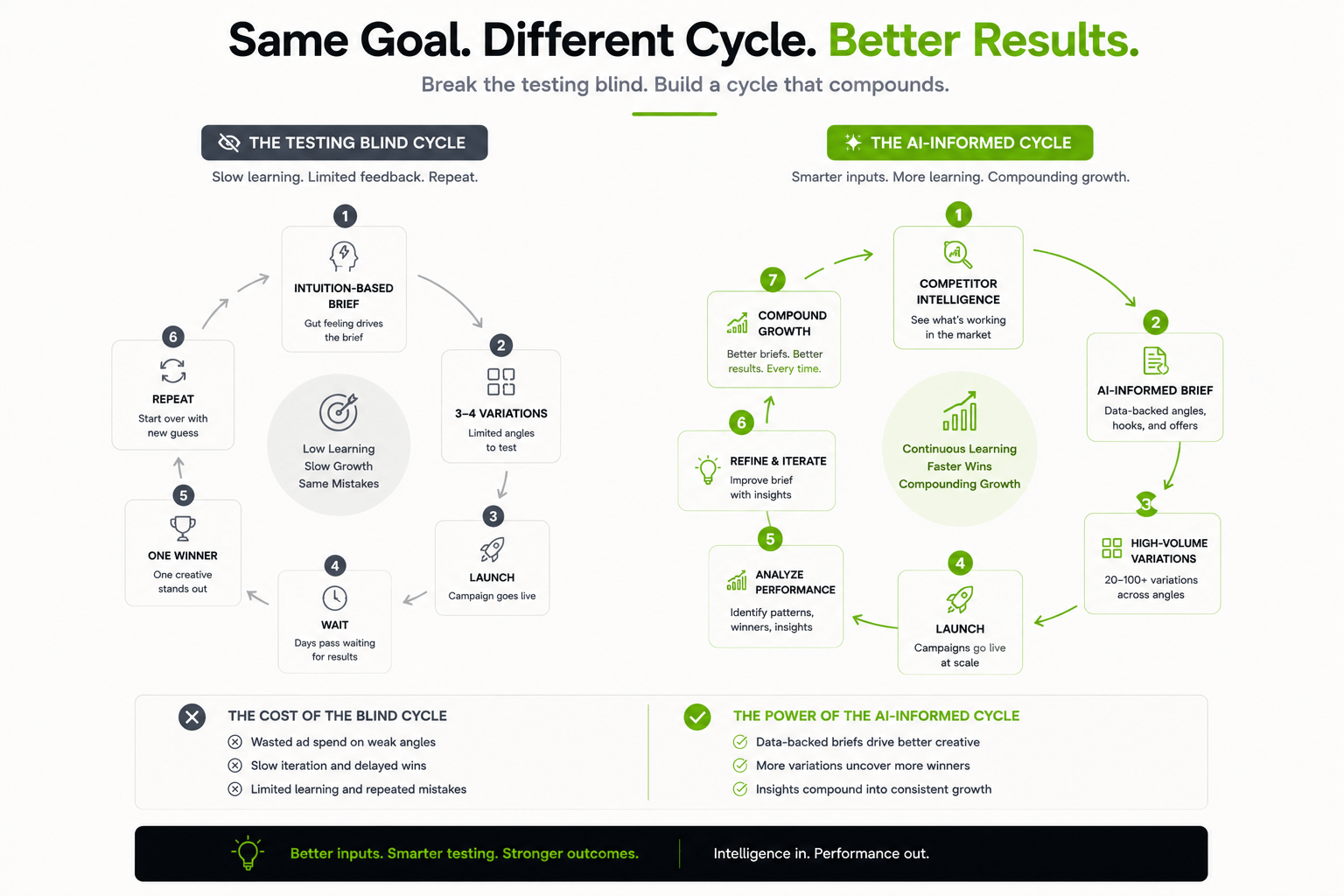
The problem isn’t the testing. It’s the lack of information going into it. The creative brief is based on intuition. The variation set is small. And the analysis that follows tells you what won but not why – which means the next brief is only marginally better than the last one.
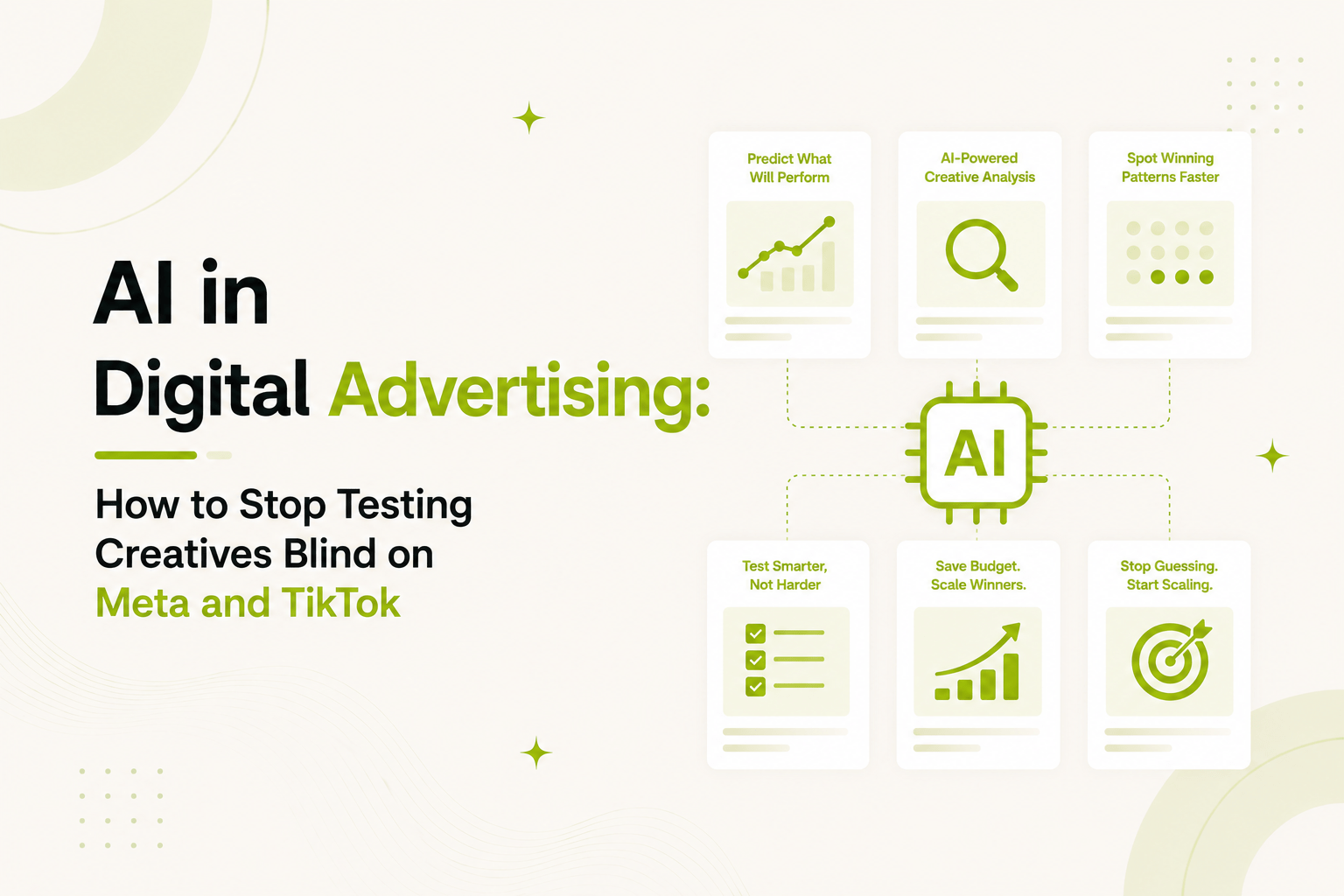
AI in digital advertising changes this by operating at the analysis layer before and after the test – informing the brief with competitor intelligence and creative performance data, and extracting learnings after the test that actually improve the next round.
What “Testing Blind” Means in Practice
Testing blind means making creative decisions without data to support them. Understanding what testing blind looks like is the first step toward using AI in digital advertising effectively.
It looks like this: a media buyer has a new offer to run on Meta. They brief a designer based on what they think will work – a pain point hook, a specific visual treatment, a direct CTA. The designer produces 3-4 variations. The media buyer launches them. The results come back and one creative performs better than the others.
What did they learn? That one specific execution outperformed three others in that specific auction environment over that specific window. That’s a narrow data point. It doesn’t tell them which element drove the win – the hook type, the visual treatment, the CTA, the format. And it doesn’t tell them what’s working for competitors running similar offers.
The next brief is based on the same intuition plus one data point. The cycle repeats. This is exactly the gap that ai for digital advertising is designed to close.
How AI Breaks the Blind Testing Cycle
Competitor Intelligence Before You Brief
Before building a creative brief, the most useful input is knowing what’s already working in your market – what angles competitors are running, what formats they’re investing in, and how long specific creatives have been in rotation (longevity being a proxy for performance).
AI-powered competitor ad intelligence tools aggregate this data across the ad library. These ai digital advertising tools remove the guesswork from competitive research. Instead of manually reviewing competitor Facebook pages or hoping to see their ads in your own feed, you get a structured view of the competitive creative landscape.
What this changes about the brief: instead of starting from intuition about what might work, you’re starting from evidence about what’s already working. Competitor creatives that have been running for 30+ days are likely converting – the advertiser has kept spending on them. The hook types, formats, and offer framings that dominate your competitive landscape are signals worth incorporating into your test set.
FabFunnel’s Industry Insights surfaces competitor ad data for Meta – what’s running, what formats are in use, and how the competitive creative landscape in a given niche looks. This feeds directly into the brief-building stage before any generation happens. This is one of the clearest examples of AI in digital advertising improving decisions before a single ad is even built.
Performance Analysis to Inform the Next Brief
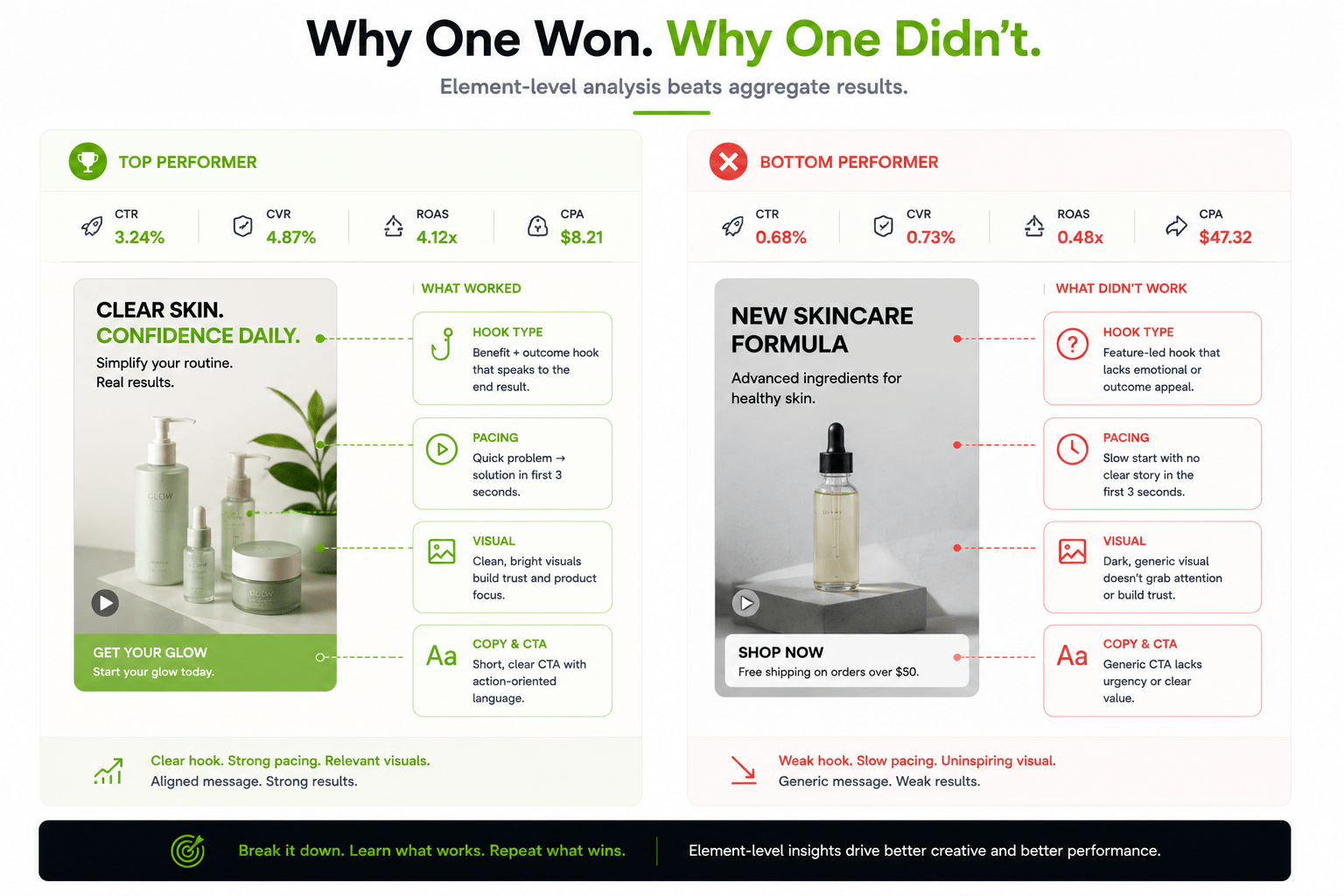
After a test runs, the standard debrief is “creative A won.” The more useful debrief is: which element of creative A drove the win?
AI creative analysis tools break down video performance at the element level – hook structure, pacing, visual treatment, CTA placement, and delivery style. Comparing these elements across your top performers and bottom performers reveals patterns that aren’t visible from aggregate performance metrics alone. This works because machine learning in online advertising models can process far more variables than manual review ever could.
A pattern like “pain point hooks outperform curiosity hooks across 4 consecutive tests” is a brief input. “UGC-format outperforms polished production at 2x efficiency” is a brief input. These specifics make the next test genuinely more informed than the last one. This element-level breakdown is where AI in digital advertising delivers some of its most actionable insights.
Generating Variations Informed by Analysis
Feed competitor intelligence and performance data into the brief, and AI creative generation stops guessing – it tests actual hypotheses instead of poking around the creative space at random.
Instead of “let’s try a few different hooks,” the brief specifies: test pain point hooks in UGC format (strongest signal from last 4 tests) vs. curiosity hooks in product showcase format (competitor’s longest-running format in this niche). The variation set is smaller and more purposeful. The test produces a cleaner signal.
This is what separates teams using ai in digital advertising well from teams that are just using it to produce more content. More content isn’t the goal. Faster learning is.
Applying This to Meta Specifically
Meta’s ad environment in 2026 runs primarily on Advantage+ and broad targeting. The algorithmic layer handles audience optimization – which means creative is the primary variable you’re actually controlling.
That makes creative testing more important, not less. And it makes the intelligence layer – knowing what’s working before you test and understanding why after – more valuable. This is where AI in digital advertising becomes especially valuable, since creative is the primary lever left to optimize.
A few specifics for Meta:
Hook rate as the primary early signal. The first 3 seconds determine whether someone keeps watching. Hook rate (3-second views divided by impressions) tells you this before conversion data is available. High hook rate with low conversion means the creative is stopping scrolls but the offer or body isn’t converting. Low hook rate means the problem is earlier – the opening isn’t working at all.
Frequency as an early fatigue warning. When frequency climbs above 3-4 and performance starts declining, the creative is saturating. The window to swap it out is before the CPR spike, not after. AI-generated variation sets make proactive swaps practical because you’re not waiting on a production cycle to have fresh creative ready.
Creative-level ROAS as the primary scaling signal. In Advantage+ campaigns, budget concentrates automatically around the highest-performing creatives. Knowing which specific creatives are generating the strongest ROAS at the ad level tells you where to put more budget and what to brief next.
Applying This to TikTok
TikTok’s creative environment moves faster. Content freshness matters more, UGC format dominates, and the platform’s algorithm discovers content differently than Meta’s – more content-signal-driven, less audience-signal-driven. Applying AI in digital advertising here requires a faster cadence than on Meta.
The ai in digital advertising workflow on TikTok emphasizes volume and refresh rate over precision. You need more variations, more frequently. Competitor intelligence is still useful – the TikTok Creative Center and ad spy tools show what formats and hooks are working in your category. But the velocity requirement is higher.
Key TikTok-specific metrics to feed back into creative briefs: completion rate (percentage watching the full video), share rate (a strong engagement signal on TikTok specifically), and hook rate in the first 2 seconds (shorter window than Meta).
The Takeaway: AI in Digital Advertising Is Most Valuable at the Brief Stage, Not the Generation Stage
The common framing of AI in digital advertising is about production – AI generates more creatives faster. That’s real value. But the deeper value is at the intelligence layer – using AI to understand what’s already working before you build the brief, and to extract element-level learnings after the test.
Teams that use AI only for generation are producing more blind tests faster. Teams that close the loop – intelligence before, analysis after, generation in between – are compressing their learning cycles in a way that compounds over time. Ultimately, AI in digital advertising works best as a continuous feedback loop rather than a one-off tool.
Frequently Asked Questions
What is AI in digital advertising?
AI in digital advertising is machine learning applied to ad creation, targeting, bidding, and the optimization work behind them. On the creative side, that means generating variations, breaking down what’s working at the element level, and pulling competitor creative intelligence.
How does AI help with creative testing on Meta?
AI supports three stages of creative testing on Meta: before the test (competitor intelligence informing the brief), during production (generating variation sets from a structured brief), and after the test (element-level analysis identifying what drove the winning performance). Used across all three stages, it compresses the learning cycle significantly.
What’s the best way to analyze why a creative performed well?
Break it down at the element level – hook type, visual format, pacing, CTA placement, delivery style. Compare these elements across your top 3 performers vs. your bottom 3. Patterns that appear consistently in winners and are absent in losers are brief inputs for the next test.
How do competitor ad intelligence tools work?
They aggregate data from publicly accessible ad libraries – primarily Meta’s Ad Library – to show which ads competitors are running, in what formats, and for how long. Longevity in rotation is a proxy for conversion performance – advertisers keep running ads that are working. Most tools also filter by niche, format type, and engagement signals.
Does ai in digital advertising work differently on TikTok vs. Meta?
The workflow is similar but the velocity is different. TikTok requires more frequent creative refreshes (every 7-10 days vs. 14+ on Meta for most budgets), rewards UGC-native formats more strongly, and has a faster content discovery cycle. The intelligence and analysis principles apply to both – the production volume requirement is higher on TikTok.
How many creatives should I be testing at once?
Meta’s guidance points to 10-20 variations per ad set for a meaningful algorithmic signal. TikTok wants even more – it burns through creative faster. AI generation makes hitting those numbers realistic without blowing up production cost or time.