Quick Answer
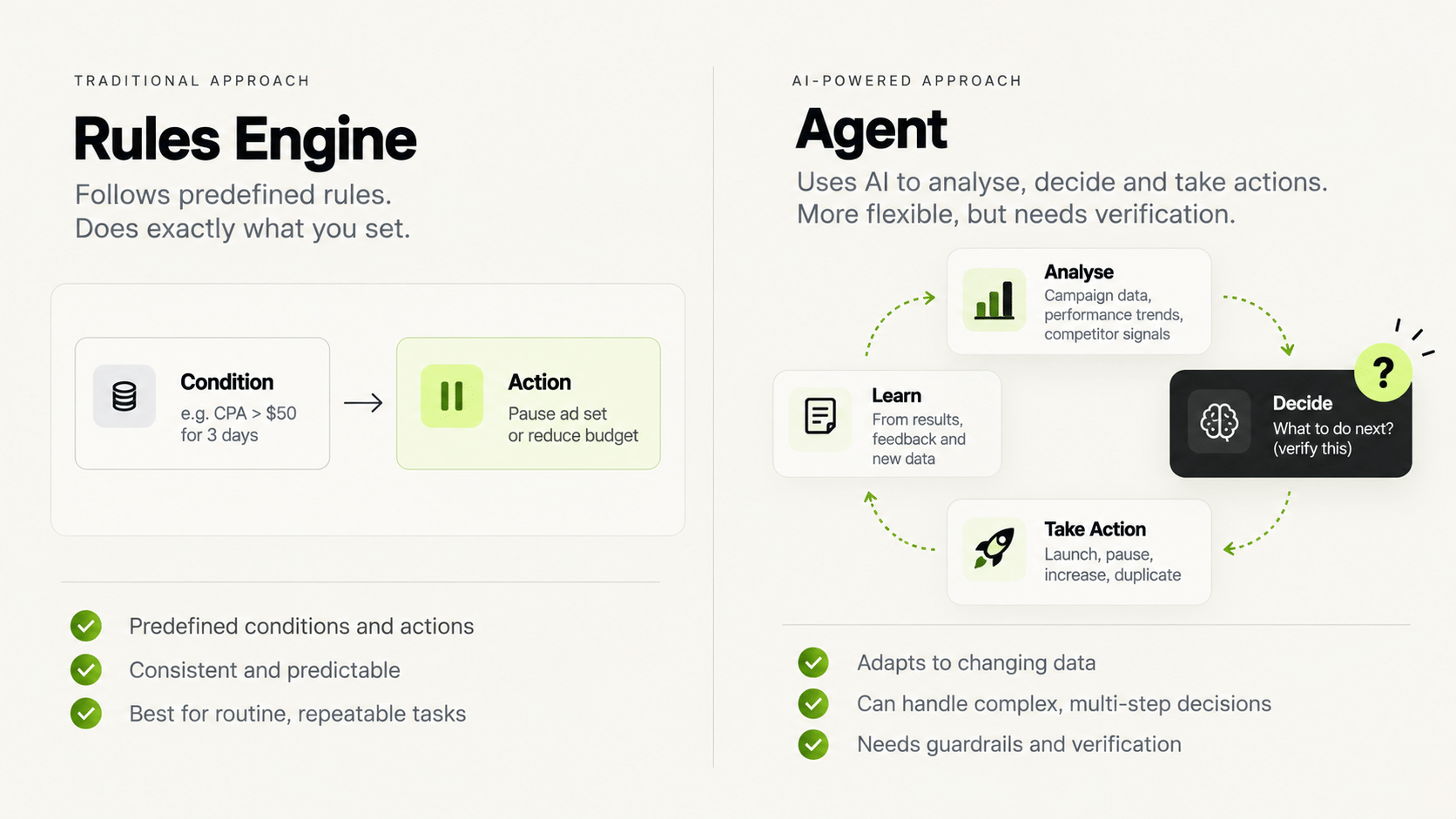
An “AI ads agent,” as the term is generally used in marketing claims, implies something that can take multi-step actions autonomously — deciding what to do, not just executing a pre-set rule. Ad automation software, the more established and verifiable category, executes exactly the conditions a person configures (pause at a CPA ceiling, scale past a ROAS floor) without deciding anything beyond that. Most tools marketed as “agentic” today are closer to rule-based automation with a conversational interface layered on top than to genuinely autonomous decision-making — worth confirming directly with any vendor rather than assuming from the label.
“Agentic marketing tools” is a newer, less standardized term than “automation software,” and the gap between the marketing language and what a given tool actually does can be wide. Before evaluating an ai ads agent claim, it’s worth being precise about what “agent” is actually claimed to do versus what a rules engine has reliably done for years.
What Does “Ad Automation Software” Actually Mean?
A defined condition and a single, pre-set action: if CPA exceeds a threshold, pause the ad set. If ROAS clears a floor with enough conversion volume, scale budget within a set range. FabFunnel’s Automation Rules Engine works this way — CPA floors, ROAS thresholds, and frequency caps applied automatically, with every triggered action logged against the specific condition and timestamp that caused it. Nothing here is a judgment call; the rule either fires or it doesn’t.
What Does “AI Campaign Manager” or “AI Ads Agent” Usually Claim to Do Differently?
The implication, in most marketing around agentic tools, is a system that can weigh multiple signals and decide on a course of action rather than executing one pre-set rule. That’s a meaningfully bigger claim than rule-based automation, and it’s worth asking a vendor directly: does the system decide, or does it execute what a person configured? The answer often turns out to be closer to the latter, with a conversational or “agent” framing added on top of standard rule execution.
Where Does FabFunnel’s Co-Pilot Fit Into This Distinction?
Co-Pilot is a recommendation layer trained on live reporting data — it surfaces what’s underperforming and why, without executing changes automatically. This is deliberately not framed as an autonomous agent: it flags a pattern, and a person decides whether to act on it. That’s a different (and more verifiable) claim than “the system decides for you,” and it’s the accurate description of what this specific tool does.
Rules Engine vs. Recommendation Layer vs. “Autonomous Agent” Claims
| Category | What It Does | Decision Sits With |
|---|---|---|
| Ad automation software (rules engine) | Executes a pre-set condition → action | Person configures the rule in advance |
| Recommendation layer (e.g. Co-Pilot) | Flags patterns worth a closer look from live data | Person decides whether to act |
| “Autonomous ad optimization” / agent claims | Implies deciding and acting without a pre-set rule | Varies widely by vendor — verify directly |
Why Does the Distinction Between These Categories Matter Practically?
Because the risk profile is different. A rules engine does exactly what you configured, so the risk is in the configuration, not the execution. A system claiming genuine autonomous decision-making carries more uncertainty about what it will do in a situation you didn’t explicitly anticipate — which is a reasonable thing to ask a vendor to demonstrate concretely rather than take on faith from the “agent” label.
Is “Agentic Marketing Tools” Just a Rebrand of Existing Automation?
For some vendors, yes — a rules engine with a conversational interface, marketed under newer language. For others, it may reflect a genuinely different underlying approach. This varies by vendor, which is exactly why the label alone shouldn’t be the deciding factor — ask what specifically happens when the system encounters a situation outside its expected conditions.
How Can You Test an AI Ads Agent Claim Before You Trust It With Budget?
Run three short scenarios in a trial, using a low-stakes account or a small budget:
- The expected case. Set a clear condition (for example, CPA above a ceiling) and confirm the system acts exactly as described. This is table stakes for any ai ads agent or rules engine.
- The edge case. Create a situation the rule doesn’t cover, such as a sudden spend spike with no conversions yet. Watch whether the system does nothing, asks you, or acts. Each answer tells you what “agent” means in practice.
- The audit. Ask for the log. Every action should be tied to a reason you can read and reverse.
Any vendor that can’t walk through these scenarios concretely is asking you to trust a label.
Which Approach Fits Which Team: Rules, Recommendations, or an AI Ads Agent?
- Small team, predictable accounts: rules plus periodic review usually covers it. The risk is low and the behaviour is easy to audit.
- Agency with many accounts: rules per account, plus a recommendation layer to surface what needs attention. A person still decides.
- Team with high spend and volatile performance: be most cautious. More autonomy means more potential for expensive surprises, so insist on logs, limits, and approval steps.
In all three cases, the question isn’t whether the system is called an agent. It is how much you can see, limit, and reverse. FabFunnel’s Copilot accepts natural-language questions about account performance and generates visual reports, but it does not execute changes on its own, so the control stays with the person using it.
What Should You Put in Writing Before Buying an AI Ads Agent?
Get the claims in writing, in plain terms. A vendor demo can make any tool look autonomous, so ask for a short document that answers four questions about the AI ads agent you are considering.
First, which decisions does it make without a rule you configured? Second, which actions does it take automatically, and which does it only recommend? Third, where is every action recorded, and can you export the record? Fourth, how do you pause or reverse it if it behaves badly?
If the vendor cannot answer in specifics, treat the AI ads agent as a recommendation tool and budget accordingly. If the answers describe pre-set rules with a log, you are buying automation software, which is perfectly useful but should be priced and trusted as such.
Keep that document with your account records. When a result looks strange three months from now, you will know exactly what the AI ads agent was and was not supposed to do.
FAQs
Is an “AI ads agent” the same thing as ad automation software?
Not necessarily — the term implies more autonomous decision-making than a standard rules engine, though in practice many “agent” tools are closer to rule-based automation with different framing. Confirm directly with the vendor what “agent” specifically means for their product.
What should I ask a vendor claiming “autonomous ad optimization”?
Ask for a concrete example of a decision the system made that wasn’t a pre-configured rule, and what happens when it encounters a situation outside expected conditions. A vague answer is itself informative.
Does FabFunnel offer an “AI ads agent”?
FabFunnel’s automation is a rules engine (Automation Rules Engine) plus a recommendation layer (Co-Pilot) that surfaces insights without executing changes automatically — a deliberately verifiable structure rather than an autonomous decision-making claim.
Is agentic marketing tools just marketing language for existing automation?
Sometimes. It varies significantly by vendor, and the only reliable way to know is asking specifically what decisions the system makes without a pre-configured rule.
What’s the risk of using a genuinely autonomous ai campaign manager versus a rules engine?
A rules engine’s risk lives in the configuration you set. A more autonomous system’s risk is less predictable, since it may act in situations you didn’t explicitly anticipate — which is why verifying the actual decision-making scope matters before trusting it with live budget.
Can rule-based automation and a recommendation layer work together instead of needing a fully autonomous agent?
Yes — this is the practical middle ground: rules handle the mechanical, threshold-based decisions, and a recommendation layer flags what needs human judgment, without either side requiring a fully autonomous system.
Where to Start
Before adopting a tool marketed as an “AI ads agent,” ask what specific decisions it makes without a pre-configured rule — the answer tells you more than the label does. FabFunnel’s Automation Rules Engine and Co-Pilot are built around a clear, verifiable split between rule execution and human-reviewed recommendations — start at FabFunnel or explore the full toolset at Fab AI.