Quick Answer
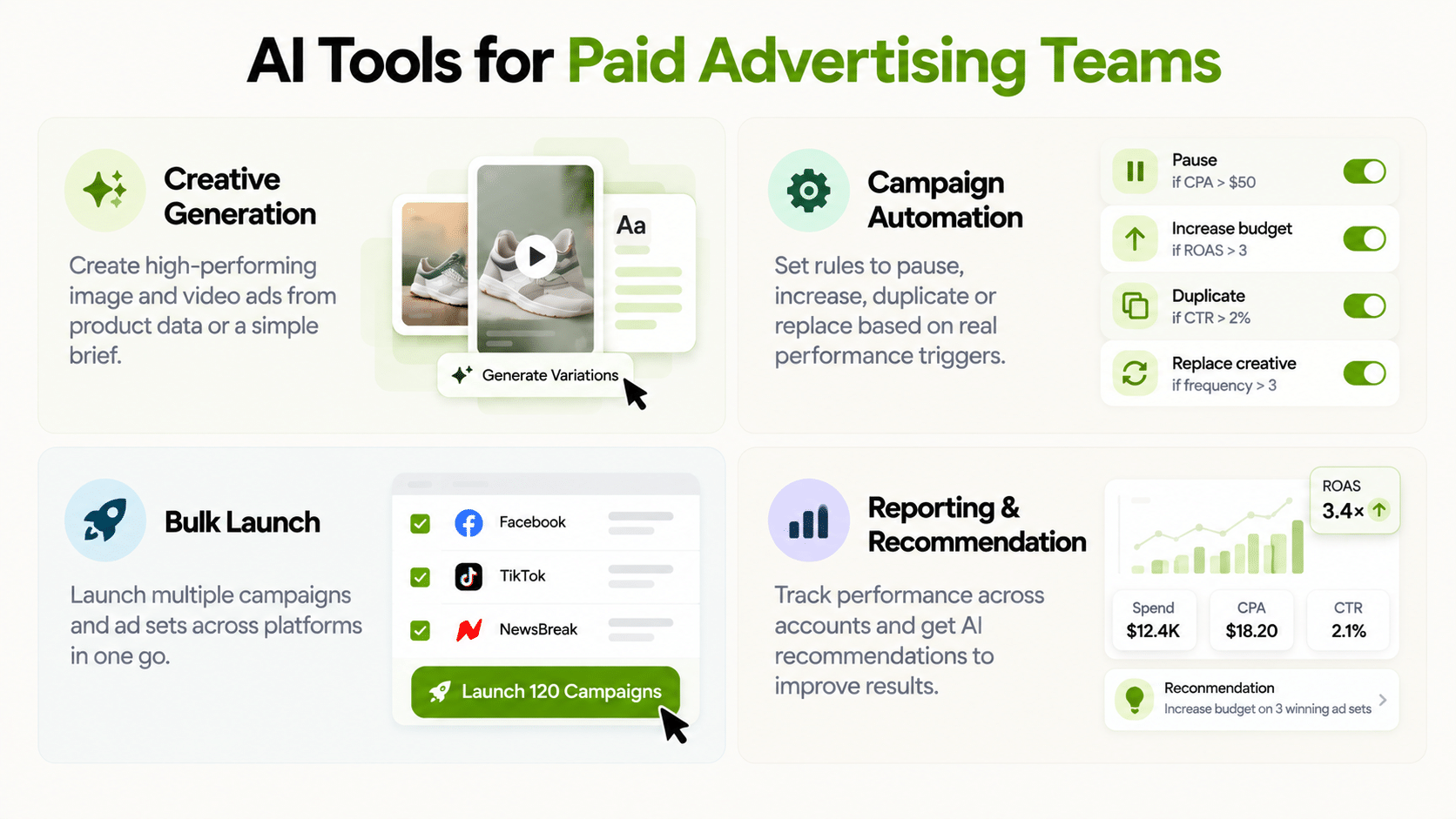
For a paid advertising team, ai tools for marketing break down into five useful categories: competitor and creative intelligence, creative generation (turning product data into ad creative), campaign automation (rule-based budget and performance management), bulk launch (spinning up many campaigns fast), and reporting and recommendation (consolidating performance data and surfacing what to review). Best ai tools for marketing lists often blend these with unrelated categories (content writing, email, SEO) that don’t apply to a paid ads workflow. Filter for the categories that match your team’s function.
“AI tools for marketing” is a broad umbrella covering content generation, email automation, SEO, analytics, and paid advertising tools, among others. This piece narrows to the categories relevant to a paid advertising team and says plainly what is and isn’t covered.
Which Category of Marketing AI Tool Actually Matters for Paid Ads Specifically?
Five: competitor intelligence, creative generation, campaign automation, bulk launch, and reporting. Marketing ai software aimed at content writing, email sequences, or SEO doesn’t address the workflow bottlenecks a paid advertising team faces: repetitive creative production, manual threshold monitoring, slow campaign setup, and scattered performance data.
A useful test for any tool on a list: name the specific task on your team’s weekly calendar that it removes. If you can’t name one, it belongs to a different team’s stack.
What Does Creative Generation Look Like as an AI Marketing Tool Category?
Tools that generate ad creative directly from product data rather than a blank canvas. Genie, FabFunnel’s creative studio, is one example. It generates image and video ads across four modes (Product Ad, Brand Ad, Product Shoot, Performance Ad) from a Catalogue structured as Brand → Categories → Products, with Shopify auto-sync and automatic brand guidelines. A Concepts tab offers 200 fixed frameworks, and Create Variations scales one concept across products.
What to test in any tool in this category: product accuracy, brand consistency across outputs, and whether generated creative can reach a campaign without a manual download-and-upload step.
Where Does Competitor and Creative Intelligence Fit?
Before generating creative, teams need to know what is already running in their market. This category covers competitor ad discovery and analysis.
FabFunnel’s Industry Insights covers competitor ad discovery and tracking. From a static ad, “Generate Variations” sends it into Genie. From a video ad, “Analyse Video” sends it to Video Sage, which evaluates the hook, CTA, and retention patterns. These are analysis aids: they show structure worth testing, not a guarantee of what will perform for your account.
AI Tools for Marketing: Categories Relevant to Paid Advertising Teams
| Category | What It Solves | Example Capability |
|---|---|---|
| Competitor intelligence | Guessing what creative works in your market | Competitor ad discovery; video hook/CTA/retention analysis |
| Creative generation | Repetitive ad creative production | Catalogue-connected image and video ad generation |
| Campaign automation | Manual threshold monitoring | CPA/ROAS/frequency rules at campaign, ad set, and ad level, with logged actions |
| Bulk campaign launch | Slow manual campaign setup | Launching 200+ campaigns in under 2 minutes with dynamic variables |
| Reporting & recommendation | Manual cross-account performance tracking | Consolidated spend/ROAS/CPR/CPC/CTR with ~15-minute sync; AI assistant for questions and reports |
What Does Campaign Automation and Bulk Launch Add?
Automation handles the predictable decisions. FabFunnel’s Automation Rules Engine applies thresholds such as CPA floors, ROAS thresholds, and frequency caps, runs 24/7, and logs every action. Rules apply from the moment they are saved, not retroactively.
Bulk launch handles setup volume. The Bulk Campaign Launcher builds full Meta structures (Account → Campaign → Ad Set → Ads), supports Folder Launch from the Creative Library, and uses dynamic variables so one template can feed many campaigns.
Both sit in the “execution” layer. They don’t decide strategy; they remove the repetitive work around it.
Does Marketing AI Software Replace the Need for a Media Buyer?
No. Copilot, FabFunnel’s AI account assistant, answers performance questions in natural language and generates visual reports, but it does not execute changes automatically. The value of a marketing ai tool in this category is reducing monitoring hours, not replacing strategic decision-making.
Anything labelled “autonomous” deserves scrutiny. Ask what the tool will change without approval, what it logs, and how you reverse a bad action.
How Should a Paid Advertising Team Evaluate a “Top AI Tools for Marketing” List?
By checking whether each entry addresses a paid-ads-specific workflow (intelligence, creative, automation, bulk launch, reporting) versus a broader marketing function (content, email, SEO) that happens to use AI. Top ai tools for marketing lists aggregated across all of marketing often include tools with no direct relevance to a paid advertising team’s day-to-day work.
Also check platform scope. FabFunnel supports Meta, TikTok, and NewsBreak, and integrates with Slack, Voluum, RedTrack, and JVZoo. Google Ads is not supported. A tool that doesn’t cover your channels is the wrong tool regardless of its ranking.
What Are AI Powered Marketing Tools Not Good At?
Be realistic about limits. Most ai powered marketing tools are strong at repetition: producing variations, applying rules, consolidating data, and answering routine questions. They are weaker at positioning, offer design, and deciding what a brand should say in the first place.
For paid teams, that means the strategic work stays human. The best ai tools for marketing remove the mechanical load so that buyers and strategists spend their time on creative direction, testing priorities, and budget decisions. When evaluating ai powered marketing tools, ask which hours they give back and what you plan to do with them.
How Do You Measure Whether an AI Tool Is Worth Keeping?
Judge tools by hours saved and results protected, not by novelty. Before adopting one, write down the task it should improve and how long that task currently takes each week. After a month, measure again.
Also track errors. Count how often you had to correct or redo the tool’s output, and how often it caught something you would have missed. A tool that saves five hours but creates three hours of fixes has saved two.
Finally, ask whether the team actually uses it. Tools that need constant reminders to open tend to be dropped. If adoption is low, the problem may be fit or training rather than the tool itself.
What Should a Paid Team Do About Data and Privacy?
Before connecting any tool to ad accounts or customer data, ask what it can access, where data is stored, and who on your team can see what. Use role-based permissions so people only see the accounts they work on, and review access when someone leaves. Keep a list of every tool connected to your ad accounts. It is easier to manage a short list than to discover forgotten connections later.
How Do You Build a Shortlist of AI Tools for Marketing Without Wasting a Month?
Start from tasks, not tools. Write down the five jobs your paid team repeats most, estimate the weekly hours each one takes, and rank them. The top two are where ai tools for marketing can earn their keep.
Then set a cap: three candidates per job, no more. Search lists, ask peers, and read vendor documentation, but filter hard. Drop anything that does not cover your platforms, and anything that cannot show a real workflow rather than a feature list.
Run each shortlisted tool through the same one-week test on a real account. Use identical tasks so the comparison is fair: generate creative for the same ten products, set up the same rule, pull the same report. Score each tool on time saved, errors, and how easily a colleague could repeat the work.
Share the results with the team before buying. Ai tools for marketing only pay off when people use them, so involve the users early. Pick the tool the team will open on Monday morning, because ai tools for marketing only help when they are used, not the one with the longest feature page, and review the decision after one quarter.
FAQs
What’s the difference between ai tools for marketing and ai powered marketing tools?
No functional difference. Both terms describe the same broad category. The useful filter is which specific marketing function (content, paid ads, email, SEO) a given tool addresses.
Does marketing ai software always include campaign automation?
No. Many marketing ai tools focus on content generation or analytics without touching campaign execution or automation.
What’s the most overlooked category when evaluating ai tools for marketing for a paid ads team?
Bulk campaign launch. Creative and reporting tools get more attention, but the ability to launch large numbers of campaigns quickly is a distinct capability worth checking separately.
Is a marketing ai tool the same as a paid advertising automation tool?
Not necessarily. “Marketing ai tool” is the broader category; paid advertising automation is one specific function within it.
Does FabFunnel cover all five categories relevant to paid advertising teams?
It covers competitor intelligence (Industry Insights, Video Sage), creative generation (Genie), automation (Automation Rules Engine), bulk launch (Bulk Campaign Launcher), and reporting (Multi Ad Account Reporting and Copilot) for Meta, TikTok, and NewsBreak.
What should a paid ads team check before adopting a new AI marketing tool?
Whether it addresses an actual bottleneck in their workflow (creative production, monitoring, launch speed, or reporting) rather than adopting a tool because it’s broadly ranked well.
Where to Start
List your team’s three biggest weekly time sinks, then map each to one of the five categories above and choose ai tools for marketing that cover them. FabFunnel combines competitor intelligence, creative generation, campaign automation, bulk launch, and consolidated reporting in one platform for paid advertising teams running Meta, TikTok, and NewsBreak. Start at FabFunnel or explore the full toolset at Fab AI.