Quick Answer
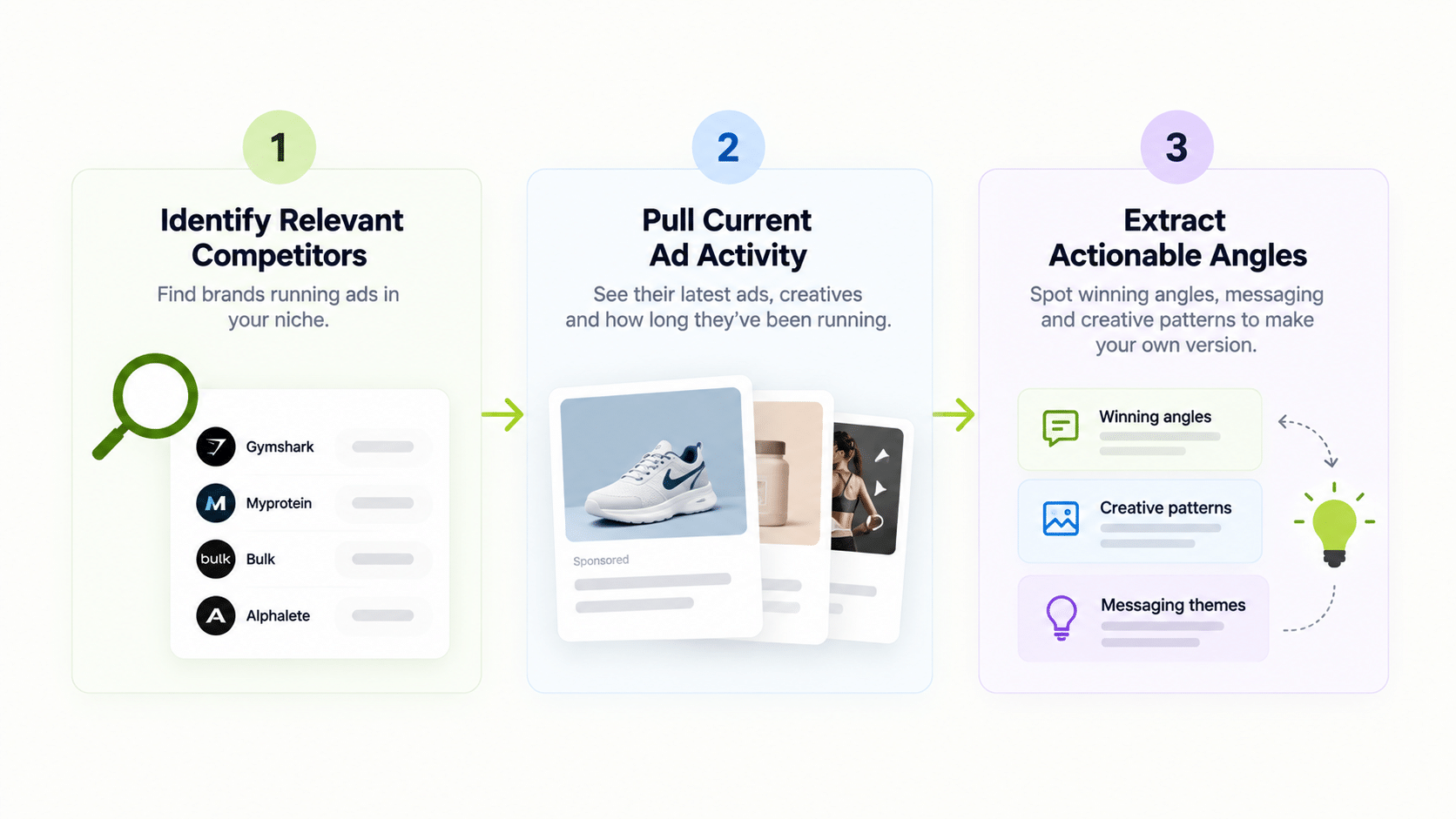
A repeatable competitor ad analysis process for agencies has three steps: identify which competitors actually matter for a given client (not just the biggest names), pull the competitor ads they are currently running, and translate patterns into specific angles the client isn’t using yet. The “repeatable” part comes from doing this the same structured way for every client rather than an ad hoc scroll through a competitor’s page each time a new account onboards.
Competitor ads research often happens once, informally, at the start of a client relationship, then never gets revisited. For an agency running this across multiple clients, that’s a missed opportunity — competitor ad analysis is more useful as a recurring process than a one-time exercise, and it only stays practical at scale if the process is the same every time.
How Do You Identify Which Competitors Actually Matter for a Client?
Not every company selling something similar is a useful comparison. The competitors whose ads are worth analyzing are the ones targeting a similar audience with a similar offer at a similar price point — direct competitors, in other words, not just anyone in the same broad category. FabFunnel’s Industry Insights lets you browse competitor Meta ad activity by vertical, which helps narrow this down to competitors actually relevant to a client’s specific positioning rather than a generic list of “everyone in this industry.”
What Does Pulling Current Competitor Ads Actually Involve?
Once relevant competitors are identified, competitor ad analysis means looking at the competitor ads they’re currently running — not what worked for them last year, since creative and offers rotate. Industry Insights surfaces competitor Meta ad monitoring by vertical, giving a current snapshot rather than a stale screenshot someone saved months ago. For a repeatable process, this step should happen on a schedule (monthly or quarterly, depending on how fast a client’s category moves), not just once at onboarding.
How Do You Turn Competitor Ad Analysis Into Something a Client Can Act On?
Facebook ad competitor analysis is only useful if it ends in a specific recommendation, not a report of what competitors are doing. The translation step asks: what angle, offer structure, or creative format are competitors using that this client isn’t, and is that a gap worth testing? A list of competitor screenshots without this step is research that goes nowhere.
Competitor Ad Analysis Process for Agencies
| Step | What It Covers | Cadence |
|---|---|---|
| Identify relevant competitors | Direct competitors by audience/offer/price, not just category | Once per client, revisited if positioning shifts |
| Pull current ad activity | Live competitor ads by vertical, not historical screenshots | Monthly or quarterly |
| Extract actionable angles | Specific gaps or untested formats the client could test | Each research cycle |
| Document findings consistently | Same format/template across every client | Every cycle, every client |
Why Does Spying on Competitors’ Facebook Ads Need to Be a Recurring Process, Not a One-Time Task?
Because competitor advertising analysis done once at onboarding goes stale the moment a competitor changes creative, offer, or targeting — which happens continuously in most categories. An agency running this as a one-time task at the start of every client relationship is doing the research at exactly the point where it has the least current information to work with.
Can This Process Work the Same Way Across Every Client, Regardless of Industry?
The structure stays the same — identify, pull, translate — but the specific competitors and cadence should flex per client’s category. A fast-moving ecommerce vertical might need monthly competitor ad analysis; a slower B2B category might only need it quarterly. What should be identical across clients is the template used to document findings, so the process stays repeatable rather than reinvented per account.
How Do Competitor Findings Feed Into Creative Production?
Analysis of competitor ads only pays off if it reaches the creative brief. In FabFunnel, the path is short. From a static competitor ad in Industry Insights, “Generate Variations” sends it directly into Genie to create variations. From a competitor’s video ad, “Analyse Video” sends it into Video Sage, which evaluates the hook, the CTA and its placement, and retention patterns.
Video Sage output is useful for briefing: it shows what makes a competitor’s video effective, which hook structures are worth testing, and where CTA placement could improve. For an agency, that turns a research deliverable into a creative brief the client’s team, or Genie, can act on without another round of interpretation.
One caution: treat any competitor ad as a signal, not proof. You can see which competitor ads are running, but not whether it is profitable for them. Test the angle in the client’s own account before building a strategy around it.
What Are the Limits of Competitor Ad Analysis?
Three limits are worth stating to clients up front:
- Visibility isn’t performance. A long-running ad suggests something, but it doesn’t confirm results.
- Platform scope. FabFunnel’s Industry Insights covers Meta ad activity as described here; competitors advertising mainly elsewhere will be under-represented.
- Context gaps. You can’t see the competitor’s targeting, budget, or landing page economics, so copying an ad wholesale rarely transfers.
Naming these limits makes your competitor ads research more credible. Clients tend to trust a research process that says what it can’t tell them.
How Should an Agency Document Competitor Ads for Each Client?
A repeatable process needs a repeatable record. Use one template per client so any strategist can pick up the work, and keep it short enough that people actually update it.
Start each entry with the competitor name, the date you reviewed their ads, and the number of active ads you found. Then capture the patterns, not just screenshots: the main message angles, the offers being pushed, the formats in use (static, video, carousel), and any creative that has stayed live for a long time. Ads that run for weeks are usually worth studying more closely than ones that appear for a few days.
Add a “so what” line to every entry. For example, note that three of five rivals lead with a price offer and none lead with a customer result, so a result-led angle is worth testing for this client. Without that line, a folder of competitor ads is just a gallery.
Finally, link each entry to the brief it influenced. When a client asks whether the research did anything, you can point to the specific ad variations that came from it. That connection is what turns competitor ads research into a deliverable rather than background reading.
FAQs
What’s the difference between competitor ad analysis and facebook ad competitor analysis specifically?
They’re the same activity — “competitor ad analysis” is the general term, “facebook ad competitor analysis” (or competitor analysis facebook ads, as it’s sometimes searched) specifies the platform. The process described here applies to either framing.
How do you find facebook ads of competitors without asking the client for a list?
Industry-level browsing, like FabFunnel’s Industry Insights, lets you search competitor Meta ad activity by vertical, which is useful when a client doesn’t have a clear list of who they consider direct competitors.
How often should an agency spy on competitors’ Facebook ads for an active client?
Monthly is a reasonable default for fast-moving categories; quarterly can work for slower-moving ones. The right cadence depends on how often the client’s actual competitors change creative or offers.
Is competitor advertising analysis more about creative or about strategy?
Both, but strategy first. Creative details (formats, hooks) matter, but the more useful output is the strategic gap — an angle, offer structure, or audience competitors are using that the client isn’t.
Does a repeatable competitor ad analysis template work for every client vertical?
The process structure (identify, pull, translate) transfers across verticals. The specific competitors, relevant ad formats, and how often to refresh the research should adjust to the client’s actual category.
How often should an agency refresh its competitor review?
Monthly for most clients, and weekly during seasonal peaks. Competitor ads change quickly, so an old review loses value fast.
What should an agency actually deliver to a client after competitor ad analysis, not just internally?
A short summary of which competitor ads changed since the last cycle and one or two specific, testable angles — not a raw dump of competitor screenshots, which puts the translation work back on the client.
Where to Start
If competitor research at your agency happens once per client and never gets revisited, that’s the specific gap a repeatable process closes. FabFunnel’s Industry Insights gives you a current, vertical-level view of competitor Meta ad activity to build that process around — start at FabFunnel or explore the full toolset at Fab AI.