Quick Answer
Most tools marketed as “marketing automation software category” are built for email sequences, lead scoring, and CRM workflows — not for launching or managing paid ad campaigns. If you’re comparing marketing automation platforms specifically for paid ads, the features that actually matter are bulk campaign creation, rule-based budget automation, catalogue-driven creative generation, and cross-platform reporting — a different feature set than what dominates most “best marketing automation software” roundups.
Searching “marketing automation platform” mostly surfaces tools built for a different job than the one a paid ads team has. That’s not a flaw in those tools — HubSpot, Marketo, and similar platforms are genuinely built for lead nurture and CRM workflows. It’s a mismatch in what the search term implies versus what a performance marketer actually needs when evaluating automated marketing software for ad execution.
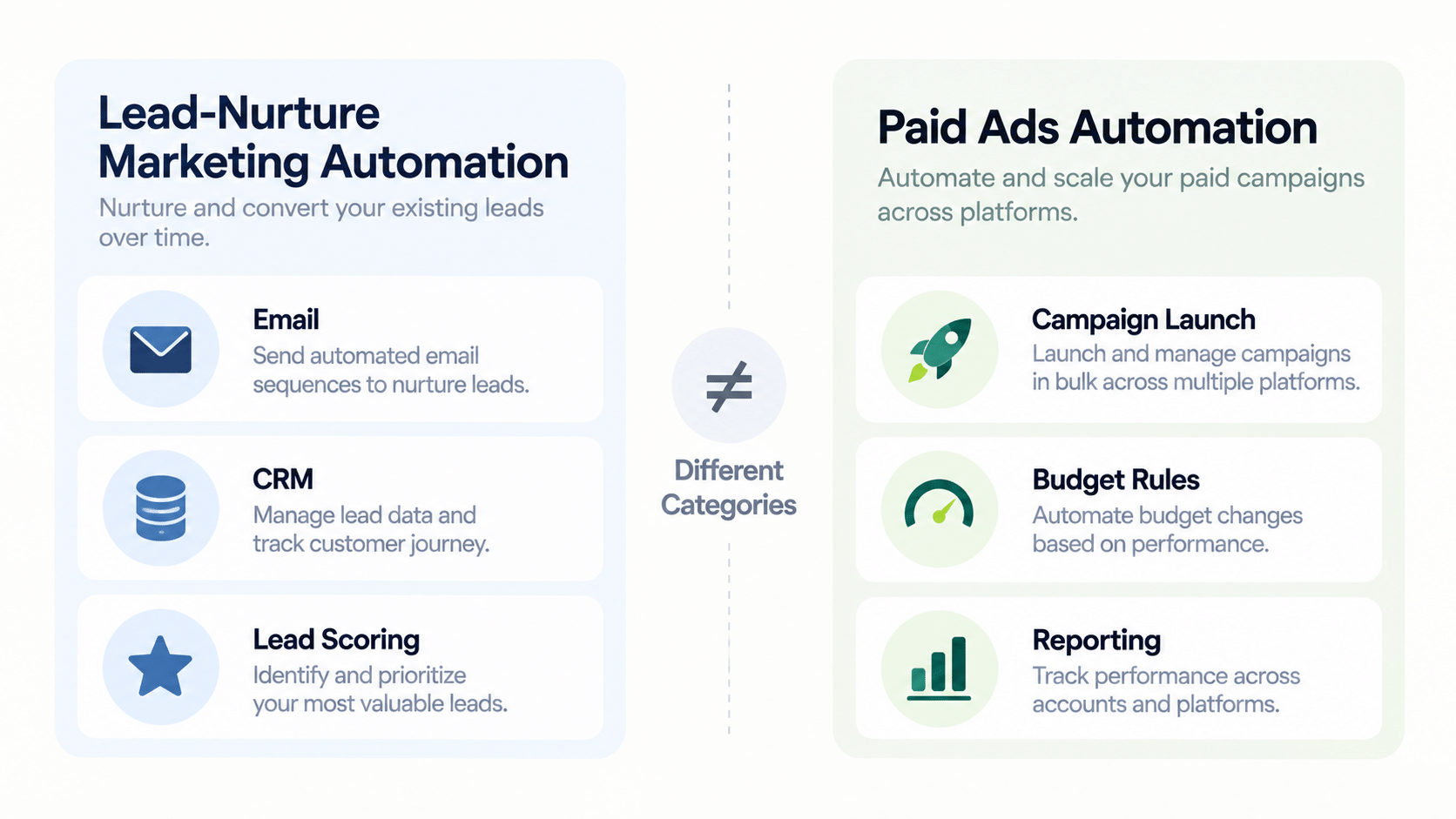
Why Does “Marketing Automation Platform” Usually Mean Email and CRM Tools?
Because that’s the dominant, older meaning of the category. Email drip sequences, lead scoring, CRM sync, and behavioral triggers are what most marketing automation platforms were originally built to handle, and most comparison content still frames the category this way. If your actual problem is launching and managing paid ad campaigns at volume, this is the wrong category to compare tools within — even though it shares the name.
What Should You Compare If You’re Evaluating Marketing Automation Platforms Specifically for Paid Ads?
Four capabilities matter for ad execution, and most lead-nurture platforms don’t cover any of them: bulk campaign creation (building campaign structures from a catalogue or template instead of clicking through native ad managers one at a time), rule-based budget automation (CPA floors, ROAS thresholds, frequency caps applied continuously), catalogue-connected creative generation (producing ad variants directly from product data), and consolidated cross-platform reporting.
FabFunnel covers this specific slice: Bulk Campaign Launcher pushes 200+ campaigns live in under two minutes, the Automation Rules Engine applies budget and performance thresholds automatically with every action logged, Genie generates creative from the Catalogue structure, and Multi Ad Account Reporting syncs performance data across Meta, TikTok, and NewsBreak roughly every 15 minutes.
Marketing Automation Platforms: Lead-Nurture vs. Paid Ads Execution
| Feature Area | Lead-Nurture Marketing Automation | Paid Ads Automation |
|---|---|---|
| Core job | Email sequences, lead scoring, CRM sync | Campaign launch, budget rules, creative generation |
| Bulk execution | N/A | Push 200+ campaigns live in under 2 minutes |
| Rule-based automation | Behavioral triggers on contact records | CPA/ROAS/frequency rules applied to ad accounts |
| Creative | Not typically covered | Catalogue-driven creative generation |
| Reporting | Email opens, CRM pipeline stages | Cross-platform ad spend, ROAS, CPR, CPC, CTR |
Is Sales and Marketing Automation Platform the Same Thing as Ad Execution Software?
Not usually. A sales and marketing automation platform typically covers the same lead-nurture and CRM territory, sometimes extended into sales pipeline automation. This is a distinct problem from launching and managing paid ad campaigns, even when both get described under the broad “marketing automation” umbrella.
Does a Brand Need Both Categories, or Just One?
Depends on the bottleneck. A brand struggling to nurture leads from form-fill to sales-ready needs the email/CRM category. A brand struggling to launch and manage paid campaigns at volume needs the ad-execution category. Many teams need both, run by different tools, because they solve genuinely different problems rather than being interchangeable options within one category.
How Do You Evaluate Marketing Automation Platforms for Paid Ads Step by Step?
Work from your bottleneck, not from a vendor’s feature page:
- Name the job. Is it launch speed, budget monitoring, creative production, or reporting? Rank them by hours lost per week.
- Check platform coverage. Confirm the tool supports the ad platforms you actually spend on. FabFunnel supports Meta, TikTok, and NewsBreak; Google Ads is not supported.
- Test with real volume. Ask for a trial that uses your catalogue and a realistic number of campaigns, not a demo with three products.
- Check the audit trail. Automated actions should be logged with the condition that triggered them.
- Check how it fits your stack. FabFunnel integrates with Slack, Voluum, RedTrack, and JVZoo. If your stack depends on other tools, confirm those connections before you commit.
FabFunnel offers a 7-day free trial, which gives you time to run step 3 properly.
Where Does the Lead-Nurture Category Still Matter?
Nothing here argues against email and CRM automation. If leads arrive and then go cold, you need nurture sequences and lead scoring, and a paid ads tool won’t solve that. The point is simply that these are separate jobs.
A common structure is to run both: an ad-execution platform to launch and manage campaigns, and a CRM or email platform to handle what happens after someone becomes a lead. The two meet at the handoff, where ad platforms pass conversion or audience data to the nurture side. Evaluate each category against its own job rather than looking for one platform to cover everything.
What Questions Should You Ask Before Buying Either Type of Platform?
Whichever category you are shopping in, a few questions expose weak spots quickly:
- What does it do on day one? Ask for the first-week setup plan, not the roadmap.
- What does it not do? A vendor who can’t name limits is hiding them.
- Where does my data live and who can see it? Permissions matter once more than one person is involved.
- How do I leave? Ask how rules, data, and creative can be exported or moved.
For paid ads specifically, add one more: does the tool support the ad platforms you spend on today? A strong feature set doesn’t help if your main channel isn’t covered.
How Do Teams Usually Combine Both Categories?
The common pattern is simple. The ad-execution platform handles creative, launch, budget rules, and reporting for the paid channels. The CRM or email platform handles lead capture, nurture, and sales handoff. Conversion data flows between them so the nurture side knows which leads came from ads, and the ad side learns which leads actually became customers.
The practical risk is the handoff. If lead data arrives late or incomplete, both systems make worse decisions. Check this early in any evaluation.
What Is the Fastest Way to Test a Marketing Automation Platform Before Committing?
Run a one-week proof on a real task. Pick the job that costs your team the most hours, then see whether the marketing automation platform you are testing actually removes it.
For a lead-nurture marketing automation platform, that might be building and sending a three-email sequence to a real segment. For a paid ads team, it is launching a batch of campaigns, applying a budget rule, and pulling a consolidated report. If the marketing automation platform cannot do the job end to end during the trial, assume it will not do it after you buy.
Record three numbers: time to complete the task, number of manual steps left, and number of errors you had to fix. Compare them with your current process. A marketing automation platform that saves ten minutes on a task you do twice a year is not worth the switching effort.
Finally, ask for the exit terms. Find out how you export your data and rules if you leave. A marketing automation platform that is easy to join and hard to leave deserves extra scrutiny.
FAQs
Is HubSpot a marketing automation platform for paid ads?
Not primarily — HubSpot and similar platforms are built for email, lead scoring, and CRM workflows. They can sync retargeting audiences to ad platforms, but that’s audience automation, not building or managing the campaigns themselves.
What’s the best marketing automation software for launching ads at volume, not nurturing leads?
Look specifically at bulk campaign creation, budget rule automation, and creative generation tied to a product catalogue — the features that matter for ad execution, which most “best marketing automation software” lists don’t evaluate since they’re comparing email/CRM platforms.
Does automated marketing software include ad campaign management by default?
Usually not. Most tools under that label handle email and lead workflows. Ad campaign management (launch, budget rules, reporting) is typically a separate, adjacent category.
How is a sales automation platform different from an ads automation tool?
A sales automation platform focuses on pipeline stages, follow-ups, and CRM workflows for a sales team. An ads automation tool focuses on campaign execution, budget rules, and creative for paid media — different function, different team, usually different software.
Can a sales and marketing automation platform sync data with ad execution tools?
Some can pass audience or conversion data to ad platforms, but that’s a narrower integration than the ad execution tool actually building, launching, and managing the campaigns itself.
What’s the biggest mistake teams make when comparing marketing automation platforms?
Assuming the category is one thing. A tool built for email and CRM automation and a tool built for ad campaign execution solve different problems, even when both get marketed under “marketing automation.”
Where to Start
Write down the three jobs that cost your team the most hours each week, then check whether the marketing automation platform you’re considering covers them. If your actual bottleneck is launching and managing paid campaigns at volume — not email or CRM workflows — compare tools on bulk campaign creation, budget automation, and catalogue-driven creative, not the features that dominate typical marketing automation platform reviews. FabFunnel is built specifically for that ad-execution slice — start at FabFunnel or explore Fab AI for the creative layer.